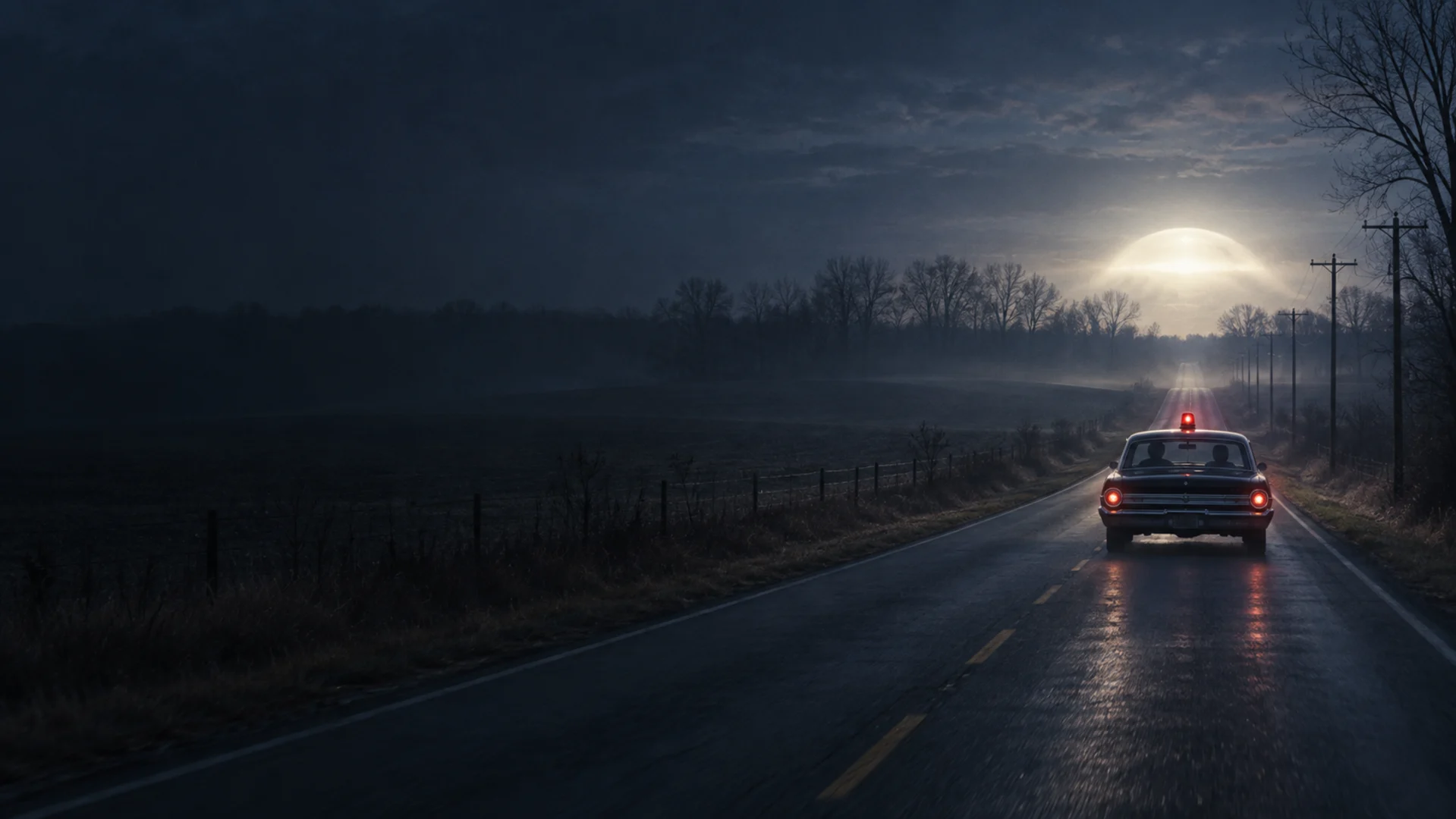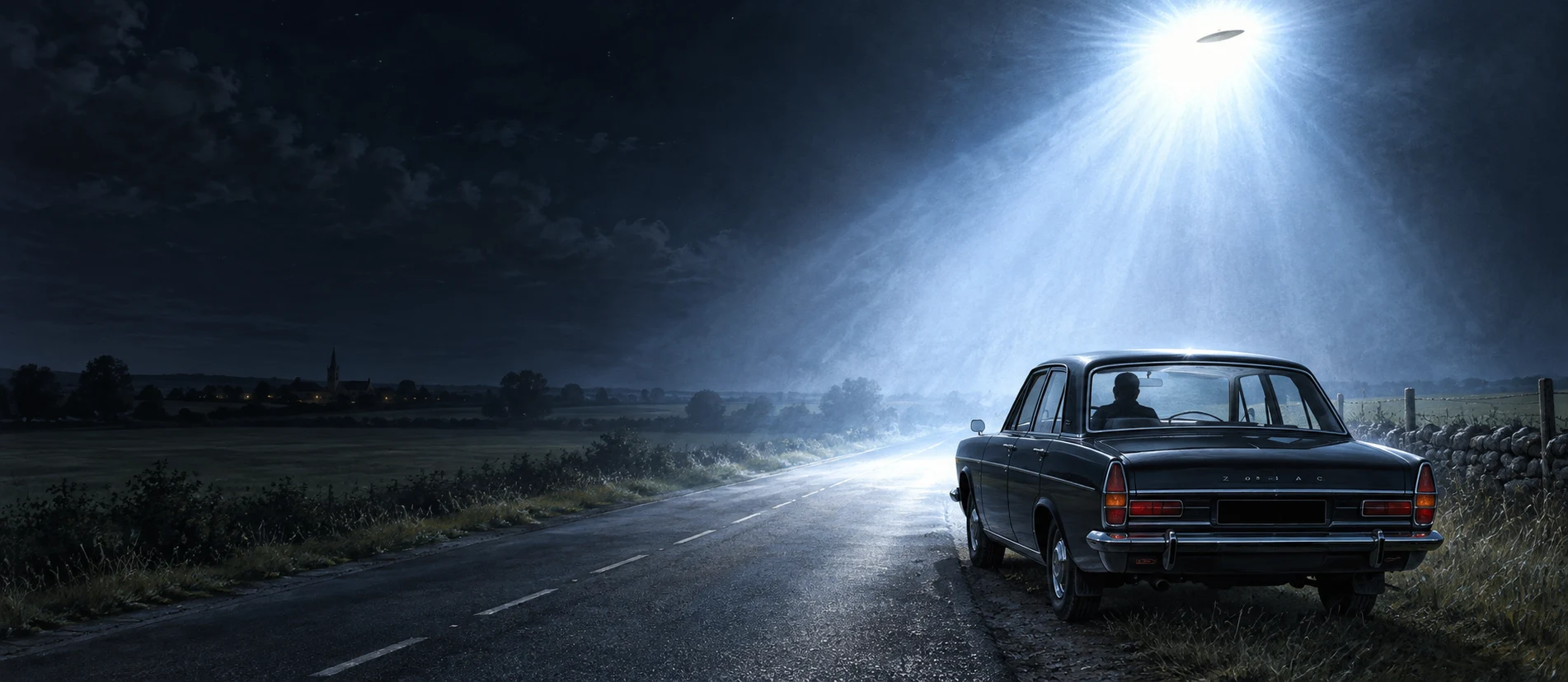
The two patrolmen thought an airliner was about to come down in front of them.
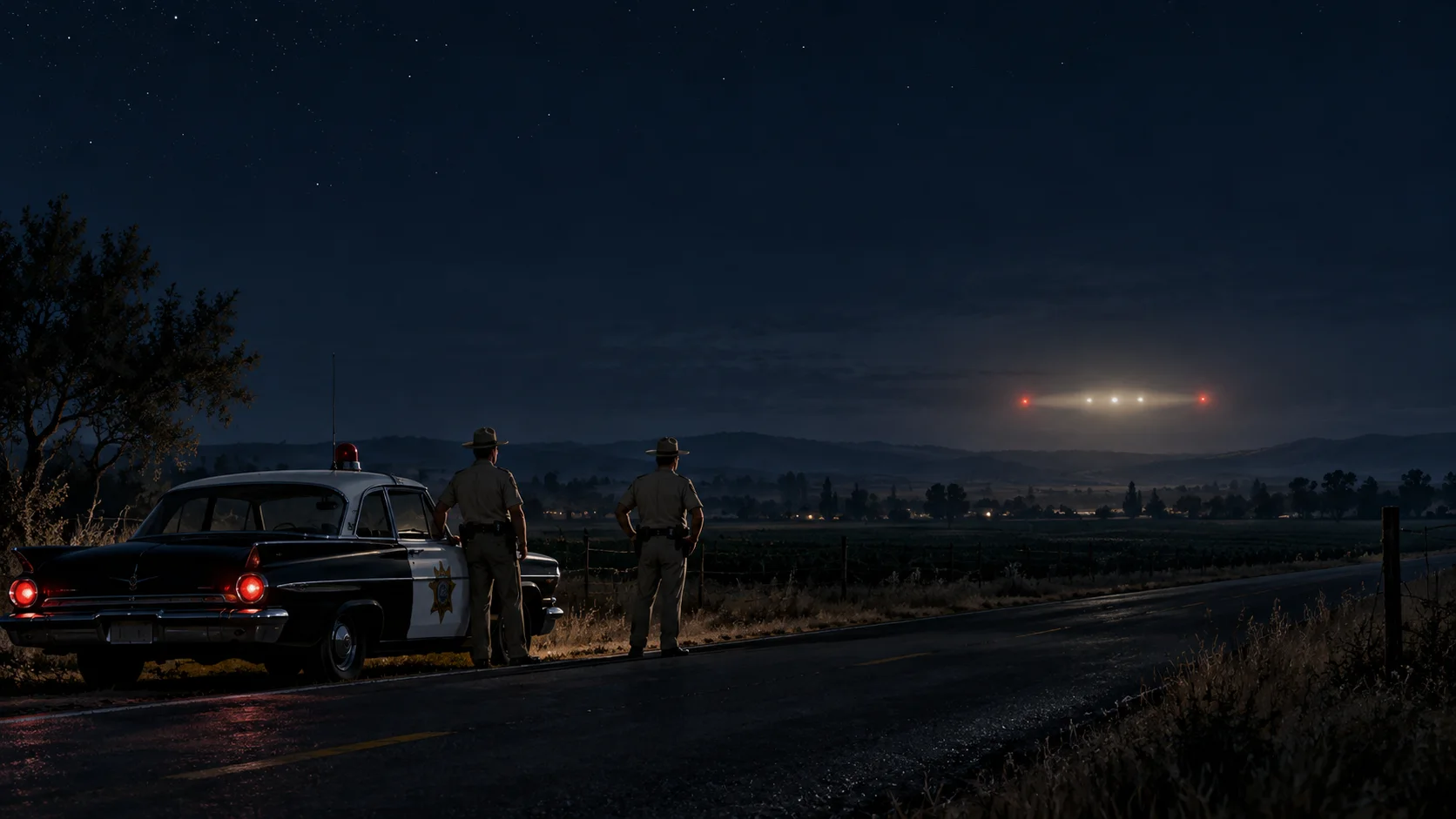
It was close to midnight on August 13, 1960. Charles Carson and Stanley Scott were driving east on Hoag Road, beyond the small California town of Corning, looking for a speeding motorcyclist. Something large appeared to descend ahead of their car. They stopped, got out and looked towards what they expected would be an aircraft crash.
The first thing Carson recorded noticing outside was silence.
In the report he and Scott submitted to their area commander, they said they continued watching, still allowing for an aircraft whose engines had lost power. They estimated that the object had fallen to within 100 or 200 feet of the ground. Then, as they perceived it, it reversed its course, climbed rapidly by roughly 500 feet and stopped.
Their patrol had turned into a watch that would last, by their account, more than two hours. The object never resolved into the airliner they had expected.
A shape inside the glow
What the officers described was not a bare point of light. Carson’s report called it round or oblong, its outline made visible by a glow. Red lights appeared at its ends or sides. At times, about five white lights seemed to show between them.
From the road, they could not determine its dimensions or even whether the form was circular or elongated. In a local KBLF radio interview soon after the event, one officer estimated its distance at anywhere from half a mile to two miles. Without knowing its size, he could only guess.
Scott described a football-like appearance and a white glow. Carson thought the apparent row of lights might have been windows, visible only when the object turned.
The officers said it seemed to stop in midair, move again and change direction abruptly. Their written report called some manoeuvres “unbelievable.” Nobody had established the light’s distance.
Something that had seemed about to crash was still there, apparently suspended ahead.
The red sweep
The patrol radio connected their observation to the Tehama County Sheriff’s Office. Carson and Scott asked the dispatcher to contact the local radar base. Other officers would begin looking too.
Carson’s report says that on two occasions the object came towards the patrol vehicle. Each time, it seemed to turn and sweep the area with a strong red light. Scott estimated six or seven sweeps of sky and ground over the course of the encounter.
Scott aimed the patrol car’s red light towards the object. The officers believed it moved away in response. That was their interpretation in both the report and radio interview.
In that interview, Scott recalled fear when the object first seemed to approach them, followed by a desire to find out what it was. Carson described losing sight of it after they drove on, stopping again and climbing onto the car to see over a rise. The light appeared ahead once more. They had not driven straight through a single uninterrupted view; they were trying to relocate it as roads and low ground interrupted the line of sight.
They also reported radio interference when it seemed near. No technical measurements in the examined record identify the cause.
Following east
The object gradually moved eastward, according to the patrol report, and Carson and Scott followed in their vehicle. They reached the Vina Plains fire station, where they found it again. A second, similar object then seemed to approach the first from the south.
For a time, the officers wrote, both appeared to stop. The red beam appeared intermittently. Finally both lights passed out of sight beyond the eastern horizon. Carson and Scott placed their first observation at 11:50 p.m. and the total span at about two hours and fifteen minutes, carrying their watch into the early hours of August 14.
Each stop offered another view, but no fixed distance to the lights. In the radio interview, an officer acknowledged that any size estimate would be a guess.
Their written report did not end on the road. After returning to the sheriff’s office, they met deputies who had also gone out to look. Carson said the deputies and a night jailer described something like what he and Scott had seen. The report presents this as corroboration, though it does not put all the observers at the same position or give each of them the patrolmen’s full two-hour view.
Other eyes on the valley
The deputies’ involvement broadens the story, but their recorded observations are not a neat second camera angle. A separate sheriff’s supplemental report, reproduced with the case material, places two officers near Los Molinos looking at lights in the western sky after midnight. It also describes later observations from the jail and on other nights. Some of its dates and times are difficult to reconcile with the patrol report.
Contemporary United Press reporting said more people had seen a light, including men brought outside the jail. Its distances and timing differed. The accounts do not establish that everyone saw the same thing at the same moment.
On local radio, Carson and Scott faced repeated questions about what they thought the object was. The interviewer suggested balloons and optical illusion, and pressed them for a shape. They resisted naming a cause. One officer said he would like to know what it was. Their captain publicly stood by the fact that they had reported seeing something, while the question of identification remained open.
Their report to their command contained the case’s sharpest dispute: Carson said the radar base had confirmed a completely unidentified object.
The call to the radar station
Red Bluff had an Air Force radar station, part of a wider air-defence network. The patrolmen’s request reached it through the sheriff’s office, and their report interpreted the reply as confirmation. In James A. Harder’s later account to a 1968 congressional symposium, based partly on his interviews and correspondence with Carson, the officers said they later spoke by telephone to an operator who described movements on a screen. That is a later account of what the men believed they heard, not a surviving radar trace.
The Air Force’s November 1960 case memorandum gives a different version. Major M. J. LeRoy of the station said there had been nothing on its scopes between August 12 and 16 requiring an aircraft scramble. He denied telling the patrolmen that an unidentified object appeared on radar that night. The memorandum explains that the station monitored equipment connected to the Portland Air Defense Sector, which held responsibility for identification and interception.
The file contains that disagreement, but no screen data or call recording to settle it. Radar confirmation remains the patrolmen’s claim, disputed by the station commander.
The answer from Blue Book
The sighting reached Project Blue Book, the Air Force’s UFO investigation programme. The file groups the patrol encounter with several reports from the Red Bluff area during August 12–20. Investigators contacted the radar station and sought weather information. The resulting memorandum went to officials after a request connected to the House Armed Services Committee.
Its proposed explanation was atmospheric refraction. Air Force analysts thought a temperature inversion could bend the light of an object near or just below the horizon into view, distort its appearance and make it seem to keep pace with people in a moving car. They suggested Mars as the most probable source for the patrolmen’s observation, while saying they could not determine an exact light source for every report. Smoke from forest fires, they added, might have affected the viewing conditions.
The weather argument rested on upper-air charts from Oakland and Medford. Red Bluff, Chico and Redding lacked complete measurements, so analysts treated the distant stations as representative. They had no direct upper-air measurement above the patrol car.
For Carson and Scott, the answer did not resemble the moving, lighted shape they remembered. For the Air Force, an optical effect in an unusual atmosphere could make a distant light appear extraordinary. Their accounts met in the case file but never became a shared description of what crossed the officers’ view.
What Is Known
Carson and Scott reported an encounter that began near Hoag Road at 11:50 p.m. on August 13, 1960, and continued for approximately two hours and fifteen minutes. Their report to the California Highway Patrol area commander survives in reproduction in the 1968 congressional symposium. A near-contemporary KBLF interview transcript records their own attempts to describe the light, its apparent motion and their uncertainty about its size.
The Air Force investigated and filed an analysis. It accepted that the patrolmen made a report, rejected their understanding of radar confirmation and attributed the Red Bluff area sightings to atmospheric refraction, with Mars its preferred candidate for this encounter. The memorandum used regional weather data in place of complete local upper-air measurements.
Other officers and civilians also reported lights that week. The surviving descriptions and times vary, so they are evidence of additional reports rather than a single, fully synchronized observation. There is no radar image in the sources examined here that independently establishes the patrolmen’s claimed confirmation, and no surviving measurement of the object’s range or dimensions. What remains most direct is the officers’ account of what they saw and the official record of how it was assessed.
The Bigger Picture
Red Bluff sits at the meeting point of two kinds of 1960 record. One is the working report of patrol officers who interrupted a search for a motorcyclist because they expected a crash. The other is the Air Force’s attempt to classify a cluster of strange-light reports through radar inquiries and atmospheric data. The National Archives’ guide to Project Blue Book places those files within the government’s long-running system for collecting and evaluating such sightings.
The case also shows why a confident identification can be harder to preserve than a vivid memory. Carson and Scott could describe red lights, a white glow and a route through the valley. They could not fix the object’s distance. The Air Force could propose a physical mechanism and a likely celestial source, but its crucial weather picture was inferred from stations far away. Neither kind of record turns the night into a simple diagram.
Years later, the patrolmen’s report was still being read aloud in a congressional hearing. Its opening remains unusually concrete: two officers step out of a stopped car, expecting an airliner to fall, and hear nothing. Beyond that moment lie two hours of reported pursuit, several other observers and an explanation the witnesses did not accept. The road near Corning leads, finally, into a disagreement still visible on the page.
Sources
- Charles A. Carson and Stanley E. Scott, report to their California Highway Patrol area commander, reproduced in the 1968 congressional UFO symposium. The officers’ own near-contemporary account; the same volume includes James A. Harder’s later testimony and interview-based additions.
- U.S. Air Force, Project Blue Book Red Bluff area file. Official case material, including the November 23, 1960 memorandum on radar inquiries, weather data and atmospheric refraction.
- KBLF interview transcript and contemporary press extracts, reproduced by Saturday Night Uforia. An archival reconstruction; quoted primary material is distinguished above from the site’s later commentary.
- U.S. National Archives, Project Blue Book research guide. Independent context for the Air Force programme and its records.