Frank McClure’s instrument was meant to find radar signals. On the return leg of a training flight, it found one he could not immediately place.
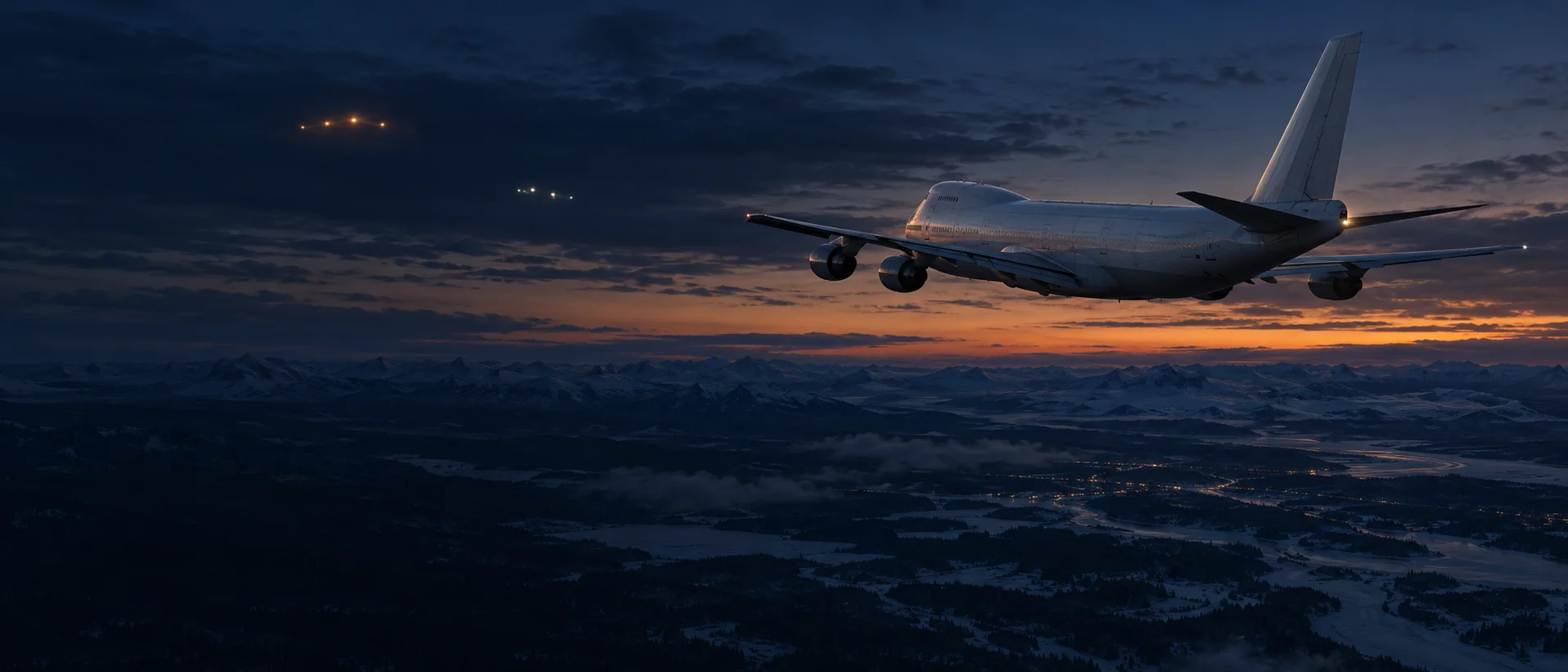
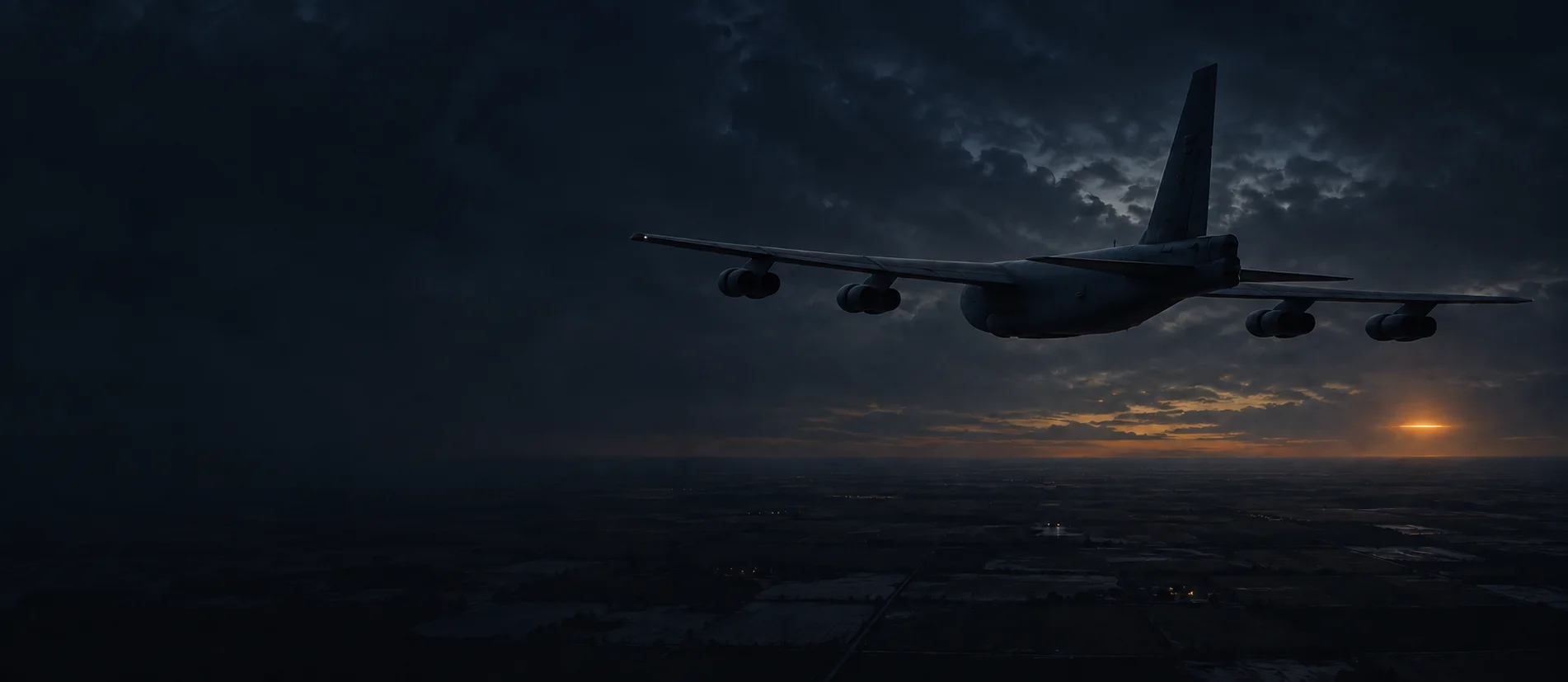
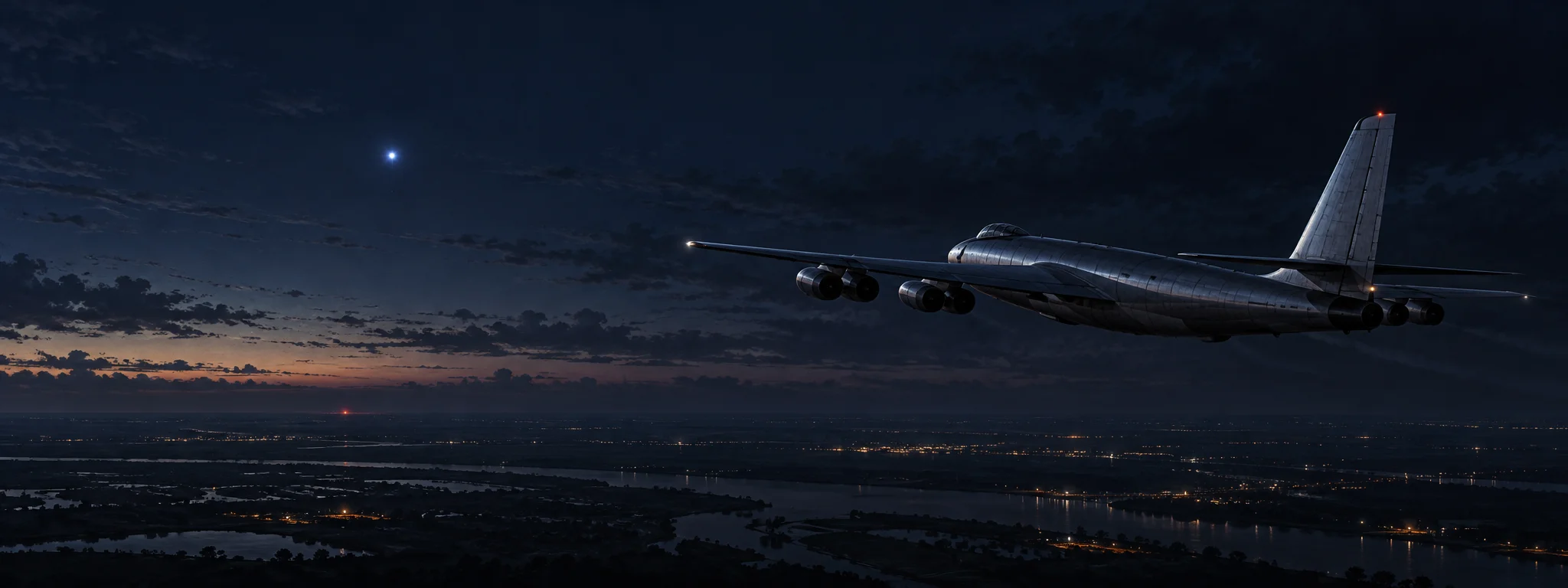
The aircraft was an RB-47H, a six-engine reconnaissance jet with equipment and operators dedicated to listening for electronic emissions. Its crew had flown over the Gulf of Mexico and was heading back towards Forbes Air Force Base in Kansas on July 17, 1957. Near the Mississippi coast, McClure, the second of three electronic countermeasures operators, noticed a radar-like signal behaving strangely on his direction-finding display.
He checked the equipment. The signal remained an oddity in the back of the aircraft until the pilots saw a light cross their path over Louisiana. Then the crew began trying to understand whether the two observations belonged to the same event.
For the next stretch of the flight, the story would move between cockpit windows, an electronic receiver and an air-defense station near Dallas. Each offered a different kind of information. None, by itself, could say what had passed the airplane.
A signal near the coast
The 1957 Air Force intelligence summary identifies the aircraft by its call sign, Lacy 17, and records McClure’s initial intercept near Meridian, Mississippi. His equipment detected a signal around 3,000 megacycles, in the range used by certain radars. He noted its pulse and sweep characteristics and, most strikingly, its apparent movement on the display.
The RB-47H was built to gather just this sort of electronic information. A signal’s bearing, frequency and pattern could tell its operators something about a distant radar. Yet a bearing on a passive receiver was not a picture of an object. It pointed towards a transmission; it did not supply a range or an image of the transmitter.
McClure at first suspected a problem with the receiver. In James E. McDonald’s later reconstruction, based on surviving documents and crew interviews, McClure did not immediately tell the cockpit about the anomaly. The aircraft continued west. No one there had yet seen anything that would turn a puzzling instrument reading into a sighting.
The light crosses ahead
At approximately 10:10 UTC, aircraft commander Lewis Chase and copilot James McCoid reported an intense white light with a bluish tint. They saw it move across the front of the airplane, from roughly their 11 o’clock to their 2:30 position, then disappear. The contemporary summary records the crossing; it does not describe a discernible craft.
That visual report brought McClure’s earlier signal into the conversation. He returned his receiver to the same frequency and again found a strong indication. Its bearing seemed to fall in the direction where the light had last been seen.
The crew checked against known radar sources. According to McDonald’s account, another operator, John Provenzano, tuned a separate monitor and received a signal from the same general bearing. The men now had two reasons to watch the right-hand side of the aircraft: the pilots’ light and the operators’ electronic indication.
Behind the cockpit, each operator had a particular job. McClure was watching his direction-finding scope; Provenzano could check the frequency on another set. Walter Tuchscherer, the third operator, was in a position to preserve part of the unfolding radio traffic. The crew were not simply exchanging impressions across a cabin. They were trying to compare what each station aboard the aircraft could tell them while the jet kept moving.
They had no way, from that coincidence alone, to prove both came from one source. But in the aircraft, moving quickly across Louisiana towards Texas, it was the relationship that demanded attention. If the signal came from a fixed ground radar, its relative bearing should change as the jet passed it. The crew understood the indication as staying with them.
Another light below
The intelligence summary places the renewed electronic indication at about 10:30 UTC, at a relative bearing of 70 degrees. Subsequent entries record bearings of 68 and 40 degrees. At 10:39, Chase reported a large light about 5,000 feet below the RB-47, then flying at 34,500 feet. He could not determine its size or shape.
Around 10:40, the receiver briefly showed two signals at different bearings. The pilot and copilot also reported two red lights. This is one of the case’s particularly vivid details, preserved in the early written account even though the men McDonald interviewed twelve years later did not remember seeing a second light.
Chase asked to leave the planned route and pursue the nearer observation. The crew contacted an air-defense radar station at Duncanville, Texas, whose radio code name was Utah, and requested help. An anomalous light in the cockpit had become a matter for people on the ground as well.
At 10:42, McClure noted a signal around 20 degrees off the aircraft’s nose. Chase increased speed, and the jet turned towards the reported light. The 1957 summary says the light pulled ahead. Two signals appeared again shortly afterwards, then one. The sequence reads like a pursuit, but its measures were uneven: a crew member’s visual estimates, bearings from a listening device, and a ground station trying to locate an airborne report.
The turn over Texas
Near Fort Worth, Utah asked the RB-47 to use an identification setting that would help distinguish it on the station’s radar. The crew reported a light about ten nautical miles northwest of Fort Worth. According to the wing intelligence summary, Utah then reported returns on its scopes in the indicated area.
The summary notes that Tuchscherer began recording the interphone and command-position conversations at 10:48 UTC. It also records Utah asking the crew to identify their aircraft and report where the light appeared. On a fast-moving flight, those exchanges mattered: a position called out from the jet could be compared with whatever a controller was seeing on a radar display. The report gives a sequence of calls, rather than a continuous trace of the target.
At roughly 10:50 UTC, the light seemed to stop. The RB-47 passed over the area where Chase believed it to be. The intelligence summary says the pilots lost sight of it, McClure lost his signal, and Utah reported losing its radar target. The crew turned back. As the aircraft changed direction, the visual report and electronic indication returned; the summary also says Utah reacquired a return.
The relationship between these events made the encounter memorable to the crew. A light ahead, a bearing on a receiver and a radar report appeared to converge, disappear, then return during a turn. In McDonald’s later interviews, Chase remembered the disappearance as almost simultaneous. His memory supplied a sense of a single moving source that the written observations alone could not establish.
The jet continued manoeuvring. At 10:52, McClure recorded a signal at a relative bearing of 200 degrees. The pilots closed on a light they estimated at five nautical miles. The contemporary summary says it then seemed to descend towards 15,000 feet and vanished from view; Utah again reported losing its target.
For a moment, the chase seemed to offer the possibility of a closer look. It produced no description of a structure. The reported object remained light, position and motion, seen from an aircraft that was itself turning and changing altitude.
Fuel and the way home
The crew could not continue indefinitely. At about 10:55 UTC they advised Utah that fuel would require them to return to Forbes. Chase later recalled making another descent towards the light, but the contemporary account and the men’s later memories do not align on every manoeuvre or minute.
The early record places a further visual sighting at 10:58, while Utah reported no target on its scope around that stage. Heading north, McClure continued to receive a signal from behind the aircraft. The intelligence summary says it faded abruptly when the RB-47 was roughly abeam of Oklahoma City at 11:40 UTC.
By then, nearly an hour and a half had passed since the white light crossed the cockpit’s view. The crew had followed an unfolding set of observations through several states and had involved an air-defense station, but had not arrived at a confirmed identity. The signal, the red lights and the reported radar returns entered the paperwork together. Whether they all belonged together was the question left for later investigators.
What Is Known
The Project Blue Book case file preserves a 1957 wing intelligence summary, Chase’s observer questionnaire and station correspondence. The summary times the visual reports and electronic bearings and recounts Utah’s radio responses. Its intelligence officer concluded that the light emitted the intercepted signal. That was an interpretation, not a direct measurement.
McClure’s passive receiver gave bearings to emissions; Utah’s active radar sought returns. The record describes reported concurrence, but no surviving radar film or receiver recording lets a later reader place every indication on one verified track.
As Philip J. Klass noted in his 1971 re-examination, Duncanville’s own brief message said it had no contact with the object. That conflicts with the wing summary’s account of radar returns relayed to the crew. The records do not resolve precisely what the station tracked.
McDonald’s 1969 interviews added detail after the Colorado UFO study struggled to find the original file. The memories came twelve years after the flight; the two red lights recorded in 1957 were not recalled in those interviews.
The Bigger Picture
The National Museum of the U.S. Air Force describes the RB-47H as a Cold War electronic reconnaissance aircraft. Its crews mapped radar locations, frequencies and coverage. Lacy 17’s operators were trained to notice signals most travellers would never know existed.
That expertise helped create the case and its later disagreement. McDonald read the changing bearings, visual sightings and reported radar responses as a compelling coincidence of observations. Klass argued instead that ground-based radars could account for the electronic indications, with the lights and possible air traffic requiring separate explanations. In comments included with Klass’s paper, Chase called that analysis plausible; McClure said he believed the later signals came from ground radars. Klass’s specific airline suggestion was a possibility he could not verify from flight records.
A Blue Book reference to an American Airlines flight near El Paso concerned a separate event, McDonald showed, rather than a straightforward identification of the Fort Worth sighting. The observations remain to be judged from an incomplete record.
The enduring feature of Lacy 17’s flight is the gap between three ways of looking. A pilot could report a light’s direction and apparent motion. A receiver could indicate where a signal seemed to originate. A radar station could report a return, or deny contact in its own message. The crew brought those views together in real time. Decades later, the surviving pages still show why they did—and why the join remains uncertain.
Sources
- USAF Project Blue Book RB-47 case file, 1957 documents. Scanned primary records, including the 55th Strategic Reconnaissance Wing intelligence summary, Chase’s observer questionnaire and radar-station correspondence.
- James E. McDonald, “Air Force Observations of an Unidentified Object in the South-Central U.S., July 17, 1957,” Astronautics & Aeronautics, July 1971. Later investigation using original documents and 1969 crew interviews.
- Philip J. Klass, “The RB-47 UFO Case—A New Explanation,” December 1971. Competing technical analysis, reproduced with the crew’s written responses in an archival collection.
- Colorado UFO study, case 5. Earlier investigation and crew interviews, completed before the original 1957 records were located.
- National Museum of the U.S. Air Force, “Boeing RB-47H Stratojet.” Independent historical context for the aircraft and its reconnaissance mission.