The boy was still in the car when he noticed the lights.
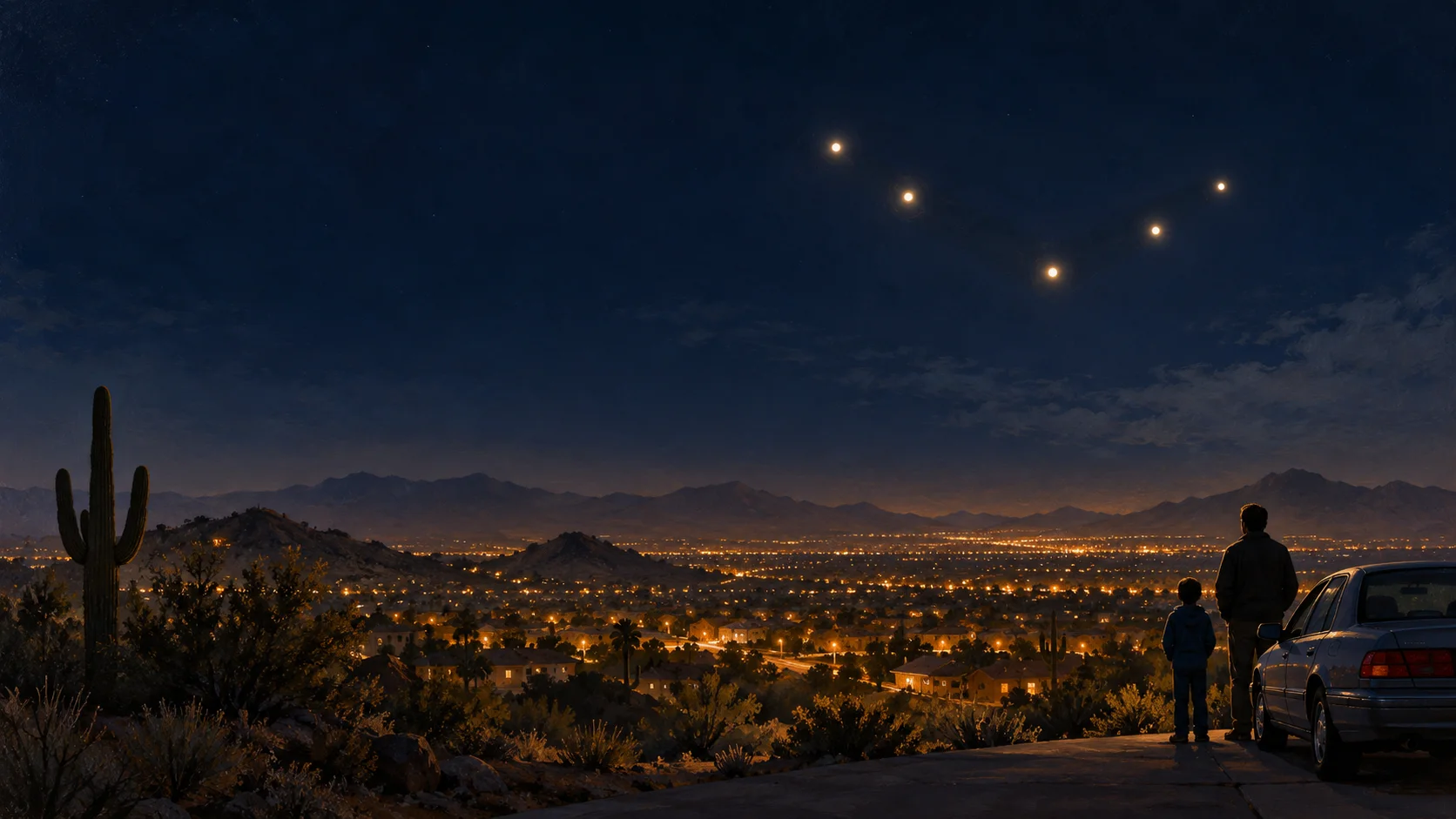
He and his father had arrived home in northeast Phoenix at about eight on the evening of March 13, 1997. While waiting for the door to be opened, the ten-year-old looked northwest, hoping to see Comet Hale-Bopp. Instead, a pattern of five lights was coming towards them.
His father first thought of a lighted blimp. The boy went inside and brought out the rest of the family. As they watched, the pattern changed from a shallow curve into a V, with a light at its leading point and two along each side.
In the report submitted to NUFORC six days later, the father described something passing directly above their hillside home without a detectable sound. He could see through the open middle of the V, but thought its arms looked broad and flat.
The children were frightened. The family watched the lights continue southeast until they could no longer see them.
Elsewhere in Arizona, other people were already trying to describe what had crossed their own part of the sky.
Looking for the comet
Near Kingman, a husband and wife had been watching the evening sky from much farther north.
Their next-day NUFORC submission begins with a single steady light seen at about 7:30. Half an hour later, the husband was looking northwest, towards the comet’s part of the sky, when he noticed a fuzzy light above the horizon.
They fetched binoculars. Through them, they saw five bright orange lights arranged in a V. At first the formation seemed stationary; then they thought it was moving slowly.
They went to get a clearer view. By the time they had changed position, the lights were gone.
The pair were interested in astronomy and accustomed to looking up. Their report was an effort to put a short observation into words: something indistinct, an instrument brought to bear, a formation coming into view, then an empty patch of sky.
Through binoculars
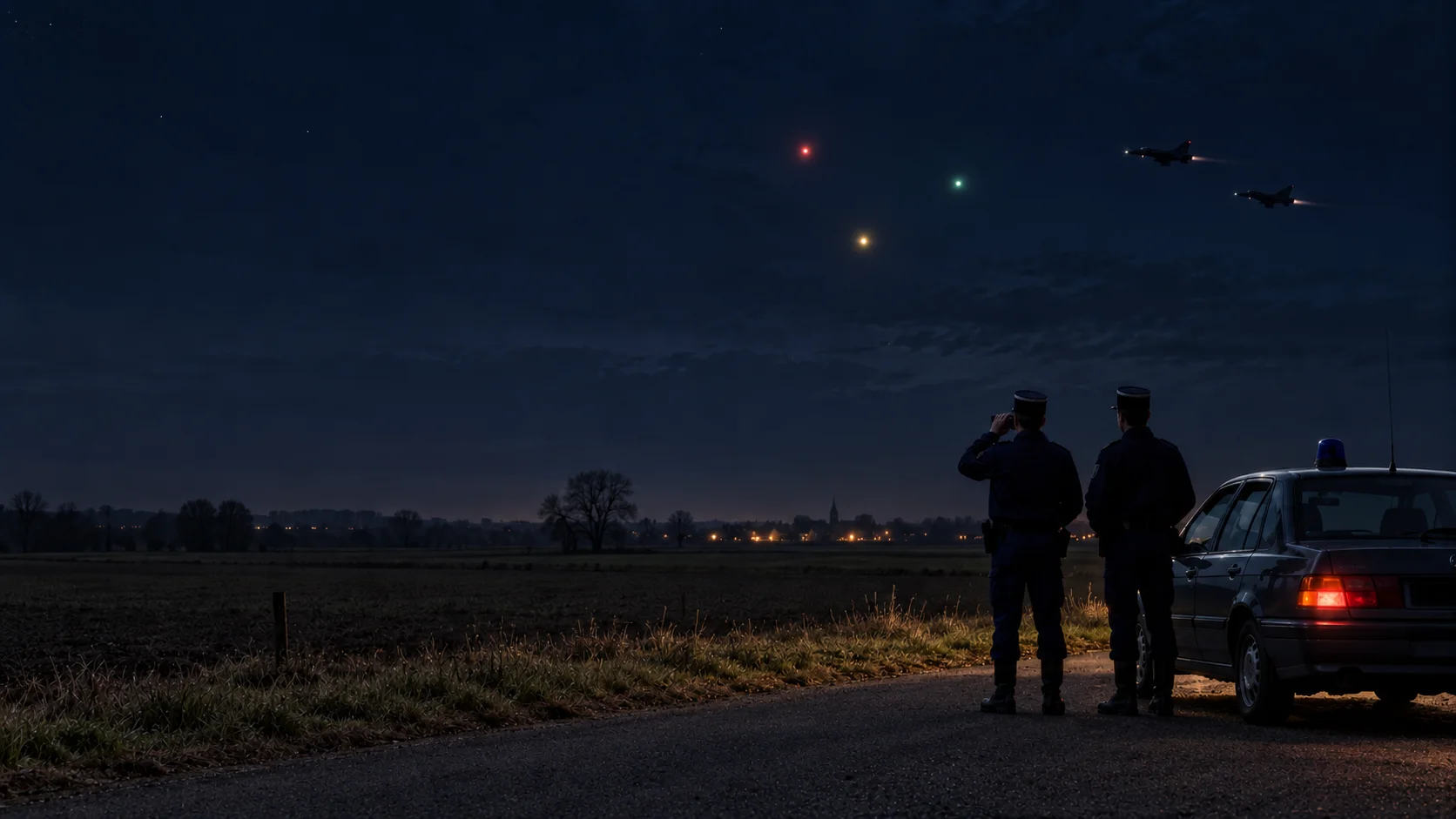
In Prescott, four people watched another V-shaped arrangement approach at about 8:15.
Their March 18 report describes bright lights that initially looked white. As the formation came nearer, they used binoculars. What had looked like individual lights now appeared to split into pairs, one red and one green.
The group included a school principal, a telephone worker, a dental assistant and a fourteen-year-old. They could make out the lights, but did not describe a visible surface connecting them. The silence was the feature that seemed hardest to account for.
A different Prescott observer, doing astrophotography, watched five yellow-white lights travel across the sky and turn south. Three formed a close V, while two lay farther back along its arms.
During the passage, one trailing light moved forward to join the leading group, then fell back again.
From the ground, the formation could offer both an overall pattern and smaller changes within it. These observers were attending to the same questions in different ways: the arrangement, the movement, and what became visible when they looked more closely.
The calls move south
At the National UFO Reporting Center, the night was arriving by telephone.
Its preliminary account, posted in August 1997, describes the first hotline caller as a former police officer near Paulden. He said that at about 8:16 he and his family had watched red-orange lights, several at the front and another standing back from them.
Calls followed from Prescott and Prescott Valley. The descriptions changed: white lights, red lights, a triangular pattern, a bank towards the southeast. People reported listening for a sound and hearing none.
Near Dewey, a group travelling north on Highway 69 pulled into a grocery-store parking lot and got out of their vehicle. The caller described a large V-shaped grouping above them. He held up his fist at arm’s length and found that it would not cover the formation.
The center was receiving pieces of the evening from separate places: a family outside, a stretch of road, the decision to stop and look. Together, the calls were making the lights into a story beyond any single viewpoint.
Above the house
In Ahwatukee, on Phoenix’s southern side, two observers first saw a reddish horizontal line on the northwestern horizon.
They arrived home and obtained binoculars. In their account submitted on March 18, the approaching lights had become brilliant white and the line had become a triangle. One light led; two pairs extended behind it.
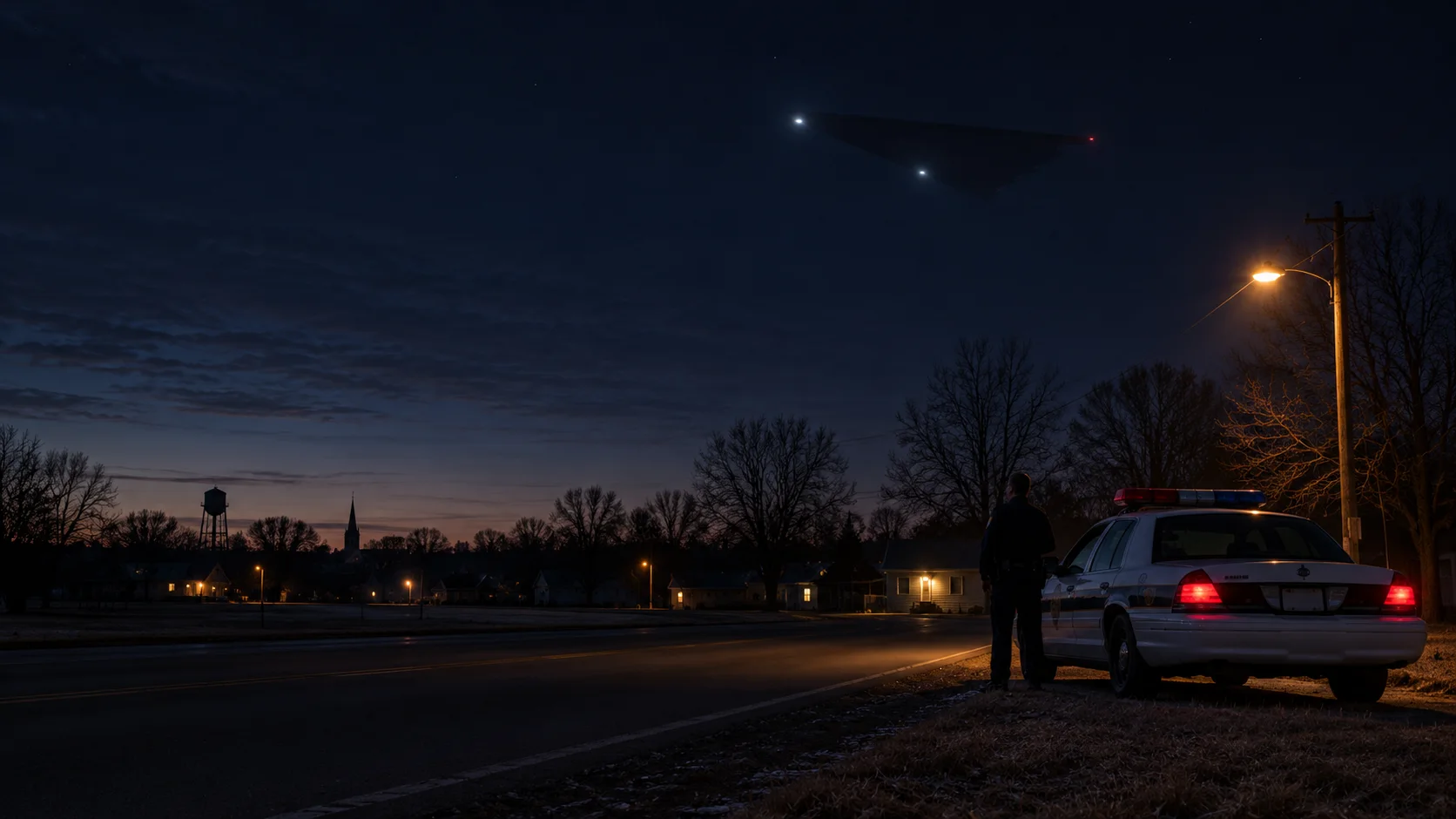
The formation crossed almost directly over their house, moving towards the southeast. The witness thought stars remained visible between the lights. They tried to hear something, considering whether helicopters might be passing together, but reported no sound.
They watched the spacing. To them, it remained fixed as the formation approached, passed and receded. They could not judge its altitude.
The next day, they discussed the change from red to white and tried to place the earlier, distant view. Their report preserves both the sighting and the conversation afterwards, when the route of the lights was being fitted to a map in memory.
A moving constellation
At Mesa Community College, a student was walking west and looking towards Orion.
Opposite that familiar constellation, in the northwest, appeared another pattern: five dim amber lights arranged in a triangle. Then the student realised they were moving.
The March 20 submission records lights at the corners, with two more nearer the front. The student interpreted them as part of a large triangular object and watched it move towards the south-southwest without hearing a sound.
Another person was reading the college newspaper nearby. Asked to look, he said he could see the lights moving too.
Other aircraft were visible in the sky, although the student did not place them close to the formation. After two or three minutes, the amber lights disappeared, either dimming or becoming obscured. The witness was unsure which.
The time was an estimate, checked only afterwards. But the sequence remained clear in the report: a glance at Orion, an unfamiliar pattern opposite it, movement recognised, and someone nearby asked to share the view.
Other eyes in the valley
Two Phoenix New Times writers also watched the earlier formation from separate parts of the valley.
In Tony Ortega’s reporting that June, David Holthouse and Michael Kiefer described five yellow-white lights travelling slowly from north to south, apparently high above them. Neither heard a sound.
Holthouse perceived a boomerang-like shape joining the lights. Kiefer did not think they were connected.
The same broad arrangement was leaving different impressions. For one observer, the space between the lights suggested a structure; for another, the lights remained separate. That difference would persist as the night became a public story.
The cameras turn southwest
Later, at about ten, a different display drew attention southwest of Phoenix.
Ortega’s 1998 reconstruction describes bright lights appearing, remaining visible for several minutes and disappearing in the direction of the Sierra Estrella. The number visible varied with the viewpoint.
Mike Krzyston recorded a sequence from his Moon Valley yard. Other cameras captured their own views from elsewhere in the valley. These were lights that could be replayed: the onset of a glow, its position relative to the others, and the moment it left the screen.
Lynne Kitei also recorded lights around ten. In her later firsthand account, she described capturing three lights and understood them as part of the same extraordinary evening. She would strongly dispute the explanations offered for the footage.
The cameras gave the night enduring images. Those images would soon be watched by people whose own encounter had been with a moving formation much earlier.
The tapes arrive
MUFON field investigator Richard Motzer had already arranged to meet a woman who had recorded lights on previous evenings. The meeting had been moved to March 14, the morning after the sightings.
His July 1997 report describes journalists arriving at his home before the visitor. Television stations carried the story that afternoon, and calls and visits continued.
He collected recordings and interviewed witnesses. It took several days to obtain a video of the earlier formation, shot near 56th Street and Carefree Highway. The bright later lights were already circulating on television.
Motzer went back to the places where cameras had been used and photographed the views by daylight. Mountains that could be difficult to distinguish in a dark recording acquired an outline against the sky.
People who had seen lights crossing overhead were watching televised lights that seemed to hang in the distance. Separate episodes were becoming a single familiar image.
What Is Known
The NUFORC entries preserve accounts submitted in March 1997, with separate fields for when an encounter occurred and when it was reported. Later posting dates describe publication in the database. The entries document testimony; their times, distances and inferred shapes are estimates by observers.
Motzer’s July report distinguished the moving formations from the later filmed display. His examination of the latter supported flares beyond the Estrella Mountains, with terrain affecting which lights each camera could see.
Ortega’s 1998 investigation reported that Maryland Air National Guard A-10s had dropped flares during training around ten. Comparisons between daytime terrain and nighttime footage supported lights disappearing behind the ridgeline. Kitei disputed that interpretation; her published objection is a witness’s later argument, rather than an independent demonstration that the flare evidence was overturned.
For the earlier formation, Ortega interviewed amateur astronomer Mitch Stanley in June 1997. Stanley said that, through his ten-inch telescope, individual lights resolved into pairs on the undersides of squarish aircraft wings. This is a substantive contemporary observation supporting an aircraft explanation. Other witnesses reported a connected structure. The extraordinary interpretations of those reports were not established by the sightings alone.
The Bigger Picture
Folklorist Thomas E. Bullard’s 2014 discussion examines the competing stories built from the Phoenix Lights. Sincere witness accounts, filmed lights and explanations of those lights can become joined in ways that obscure which evidence belongs to which episode.
The case also illustrates how an account can acquire new public significance years afterwards. In a 2007 CNN interview, former governor Fife Symington said he had seen a large, silent, wedge-shaped craft that March evening. He explained the alien-costume spoof staged during his governorship as an attempt at levity when the story returned to national attention in June. His claim to have witnessed a craft was a recollection disclosed a decade later.
Neither a famous witness nor a widely replayed recording can substitute for keeping the evening’s observations in order. The earlier accounts have their own details: paired lights through binoculars, one point shifting within a formation, stars visible between lights, and a family perceiving broad arms passing overhead.
The name endured because the night became something people could share. Returning to the early reports makes that sharing more precise. Before the familiar footage, there was a boy waiting in a car, a couple reaching for binoculars, and a student looking away from Orion towards a constellation that had begun to move.
Sources
- NUFORC 2079, Phoenix. Firsthand family account; submitted March 19, 1997.
- NUFORC 2058, Kingman. Firsthand account; submitted March 14, 1997.
- NUFORC 2073, Prescott. Binocular observations; submitted March 18, 1997.
- NUFORC 2076, Prescott. Astrophotographer’s account; submitted March 19, 1997.
- NUFORC 2070, Ahwatukee. Firsthand account; submitted March 18, 1997.
- NUFORC 2082, Mesa Community College. Student’s account; submitted March 20, 1997.
- NUFORC, preliminary summary, August 13, 1997. Early telephone-report compilation, explicitly provisional.
- Richard F. Motzer, “The Phoenix Lights, the Real Investigation,” July 1997. Contemporary investigator’s report, MUFON UFO Journal, pages 3–6.
- Tony Ortega, “The Great UFO Cover-up,” June 26, 1997. Contemporary reporting and Stanley interview.
- Tony Ortega, “The Hack and the Quack,” March 5, 1998. Follow-up investigation, republished on the author’s website.
- Lynne D. Kitei, later firsthand account. Witness recollection and disputed interpretation of the later lights.
- CNN, Larry King Live transcript, August 4, 2007. Symington’s later testimony and explanation of the spoof.
- Thomas E. Bullard, “Is the Anomalist on a Fool’s Errand?”, January 2014. Independent contextual discussion in Paranthropology, reproduced by RR0.