The call began with a truck driver who said he had seen something the size of a house in the sky. When dispatch passed the report to a police officer in Lebanon, Illinois, he wondered over the radio whether the man had been drinking.
Then Officer Ed Barton went looking.
It was the early morning of January 5, 2000. Across the small towns east of St. Louis, patrol officers could hear the same radio traffic. In the dispatch excerpts preserved by investigator David Marler, a report from Highland became a request to Lebanon, then an alert toward Shiloh. Later, an officer waiting in Millstadt would call in a sighting of his own.
Through the early morning, the story moved by radio and by road. What one witness called a floating house, others described as a long triangle or a broad arrowhead. Each watched from a different town, with a different view of the lights and the shape behind them.
The driver at the golf course
Melvern Noll owned a miniature golf course in Highland. During the off-season he drove trucks, and that Wednesday he was returning from a delivery. Before going home, he stopped to check the property. Marler’s March 2000 investigation places him there around 4 a.m.
As Noll got out of his truck, he noticed a bright point to the northeast. He first took it for a star. After checking inside the building, he saw it again and watched long enough to notice that it was moving towards him. The point of light gave way, in his account, to a much larger form passing at a low apparent altitude.
Noll reached for the comparison that would travel through the police channel: a two-storey house. He described a tall, dark, roughly rectangular body with bright rectangular openings like windows, some arranged in two levels. He also reported dim red lights underneath and little or no sound. From where he stood, he thought the object slowed as it passed, then moved southwest.
He did not have to decide what it was before deciding what to do. Noll drove to the Highland police station. According to Marler, he hoped a neighbouring officer might be able to verify that something unusual was in the sky. The Highland dispatcher listened and sent the report on to Lebanon.
The first link in the chain was now established. A man had seen something near his business. The next person to look would be on duty, driving towards the part of the sky Noll had indicated.
East of Lebanon
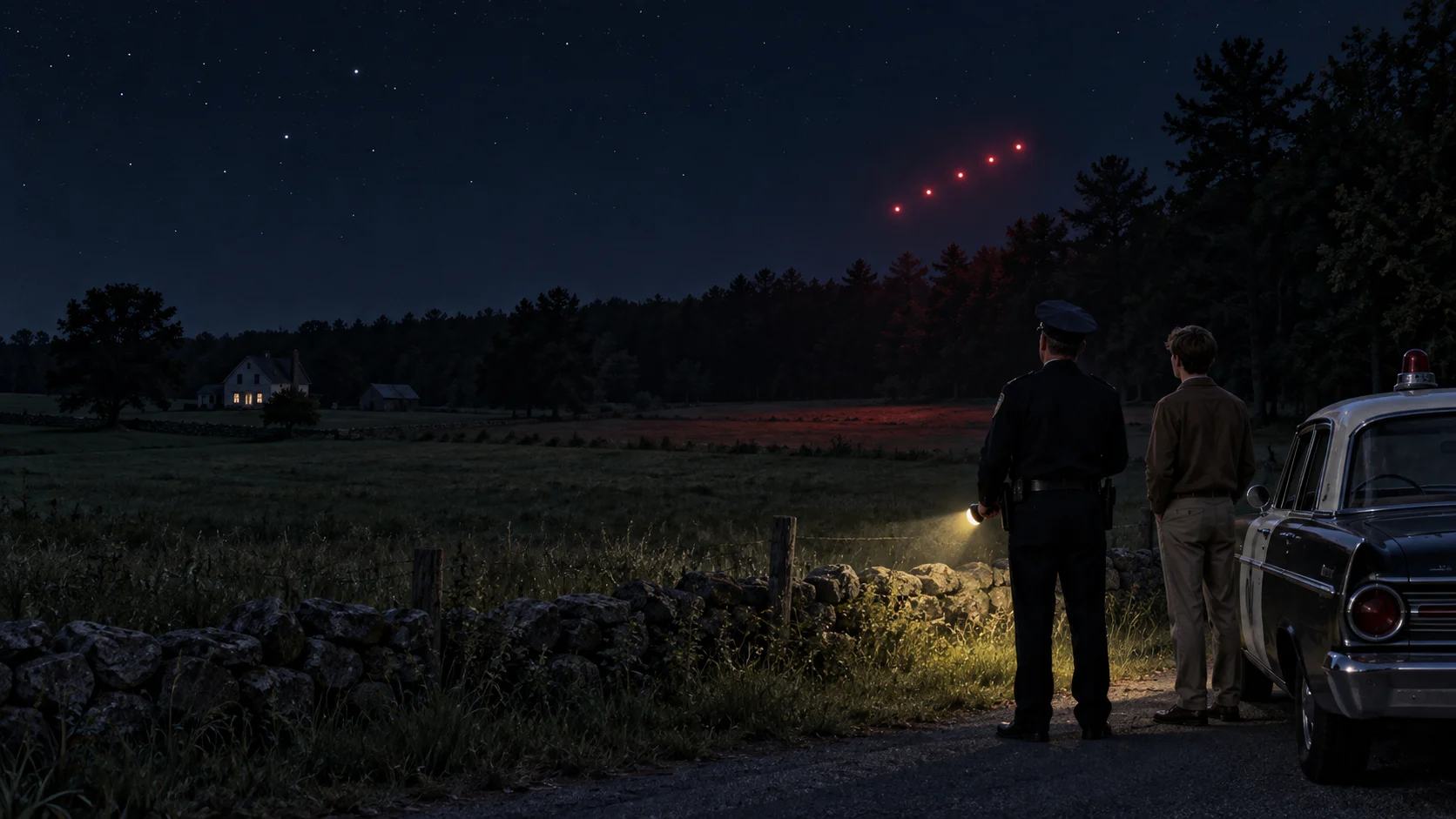
Barton was on patrol when the request came through. The radio excerpt preserves his initial levity, followed by a change in tone once he saw a bright light east of town. He went along Widicus Road towards Illinois Route 4, watching a pair of brilliant white lights as he drove. At one point they seemed to merge into one. From a distance, he said, the shape changed in his view from a light to something elongated.
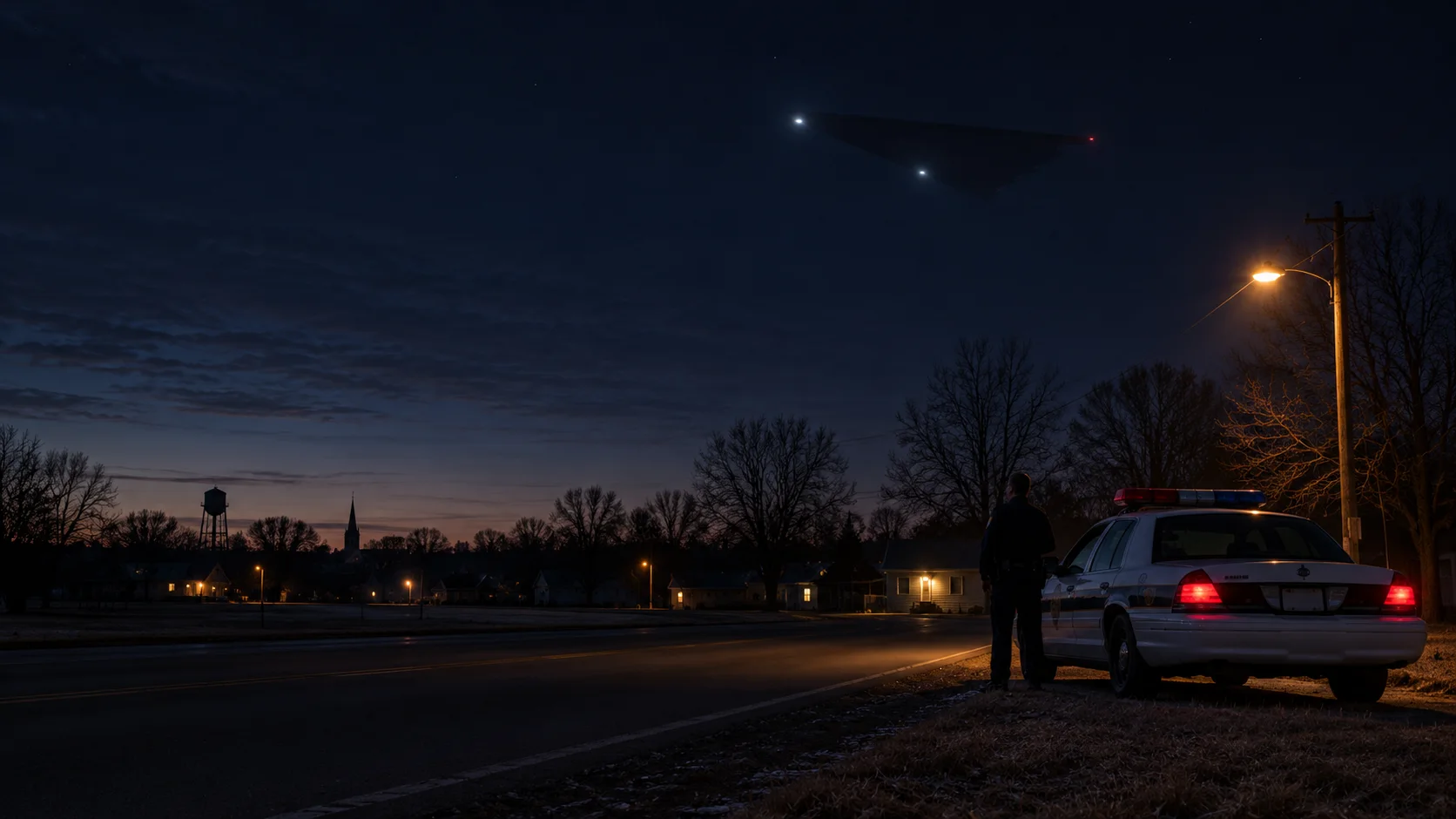
Near East Route 50, he pulled over. In Marler’s interviews, Barton described turning off his vehicle lights and radio to listen. He heard no sound that he could attribute to what he was watching. As it approached, he made out what he took to be a long, narrow triangle, with a strong white light near each corner and a smaller flashing red light nearer its rear.
He estimated the shape at about seventy-five feet long, though its distance and size were judgments made from the ground at night. He said its dark body interrupted his view of the stars. Then it appeared to pivot without banking, changing course toward the southwest.
Barton returned to the microphone to report the direction. In the recorded exchange, he suggested that the officer in Shiloh look up. As he reached into his patrol car and resumed watching, the thing he had seen was much farther away. The distance between two towns had become the measure of how quickly he believed it had moved.
The next officer looks up
Officer David Martin was driving in Shiloh when the radio call reached him. He saw something he could not identify and reported it to dispatch. The shape he later gave Marler was an extra-wide triangle or arrowhead, broader than Barton’s long, narrow form. He described three intense white lights shining downward, with smaller red and green lights towards the back.
Martin put the object roughly a quarter of a mile from his car and estimated it at about a thousand feet up. He rolled down his window and listened; he heard no engine noise. He was preparing to stop and get out for a better look when, in his account, it moved away to the west. He estimated that its pace had changed sharply.
The two officers were separated by town and by moment. Barton had watched a narrow shape near Lebanon. Martin saw a broad one near Shiloh. The radio traffic joined those reports into a moving account, but it did not give either man the other’s exact vantage point. Their sketches in Marler’s article preserve the difference: two arrow-like outlines, related but not identical.
The message went farther along the route. An officer in Millstadt had been listening.
Waiting at Liederkranz Park
Craig Stevens first drove to the east side of Millstadt. He saw nothing unusual there and moved to Liederkranz Park at the north end of town. In his own written report, he described seeing a very large object moving slowly above the town. He estimated its altitude at between five hundred and a thousand feet.
His view emphasized the rear. In Marler’s interview, Stevens described a broad arrowhead with a recessed or concave back. He saw white lights across that back edge and a red light below. Unlike Barton and Martin, who reported no sound, Stevens thought he could hear a faint low buzz. He watched the form begin to bank and head away.
He told dispatch he had it in sight. Then he left the patrol car for a Polaroid camera in its trunk. It was cold, around eighteen to twenty degrees Fahrenheit by his estimate, and the film did not emerge as he expected. He did make an exposure. The resulting photograph, reproduced in the contemporary investigation, shows lights but does not resolve the outline he described.
Stevens returned to the station and drew what he remembered. The sketch and report fixed his view on paper, while the image fixed only a small part of the light pattern. By then the apparent object had moved on in the direction of Dupo.
A more distant view
A Dupo officer also responded to the radio traffic. His report was unlike the closer views from the earlier towns. Looking through binoculars, he saw a distant grouping of lights at a much higher apparent altitude. He could not make out a body or estimate its size with confidence. On the radio, Stevens said the object he had watched was huge and very low. The Dupo officer answered that his own sighting appeared to be where aircraft usually fly.
Marler did not have permission to name that officer in his 2000 article. He included the account but also recorded its limits. It might be the last point in a path across southwestern Illinois; it might be a different set of lights. The dispatch record carries the disagreement without resolving it.
The radios had done their work. A civilian report had reached officers in successive towns. The officers reported what they thought they saw, drew the shapes afterwards, and tried to locate possible aircraft. The chain ended without a name for the object that Noll, Barton, Martin and Stevens had described.
After the shift
The account did not stay within police departments. The St. Louis Post-Dispatch reported on January 9 that Stevens had received a flood of calls and jokes from colleagues. His sketch and Polaroid were part of the public story almost immediately. The article named officers from several towns and described a route across the area. Three days later, the newspaper reported that Millstadt’s police chief had posted the report and images on the department’s website, then stopped interviews as calls began to interrupt police work.
Investigators arrived as well. The National Institute for Discovery Science summarized interviews on January 18, after sending people to the region. Marler, then MUFON’s Illinois state director, interviewed witnesses, examined drawings and reproduced excerpts of the dispatch exchange in the March issue of the MUFON UFO Journal. Those investigations drew a possible track near Scott Air Force Base, but a track assembled from witness accounts remains a reconstruction.
In his own report, Stevens ended with the practical actions of a patrol officer: he made a sketch and typed up what he saw. Noll had wanted somebody else to look. Several people did. The morning left a sequence of descriptions rather than one agreed picture: a house, a narrow triangle, a wide arrowhead, a concave rear, and finally distant lights.
What Is Known
The case has an unusually close record of its first hours. Stevens’s written police report gives his route through Millstadt, his sighting, his attempt to take a photograph and his later sketch. Marler’s March 2000 investigation reproduces the officers’ drawings, Stevens’s Polaroid and selected dispatch transmissions. The January 18 NIDS summary is another near-contemporary investigation based on interviews. Independent newspaper accounts from January 9 and January 12 show how quickly the reports became public.
Those records establish that multiple people made reports and police departments exchanged information. They do not give an instrument-measured size, speed or exact flight path for a single object. The Polaroid preserves lights, not a resolved triangular body. The Dupo officer’s high, distant grouping is especially difficult to join confidently to the low shape Stevens reported.
Marler also sought information from Scott Air Force Base. He wrote that the base told him it had no matching aircraft in operation and that radar service was provided through the FAA at Lambert–St. Louis rather than by a base radar. His account records the answer he received; it is not a radar trace of the reported object. The origin and identity of the earlier low, shaped sighting remain unestablished in the available records.
The Bigger Picture
Triangular craft have become a familiar category in UFO reporting. The J. Allen Hynek Center for UFO Studies distinguishes distant arrangements of three lights, whose connecting body may be inferred, from closer reports of an apparently structured object. Illinois contains both kinds of description. Barton, Martin and Stevens said they discerned a body or outline. The Dupo officer saw lights at a distance and could not identify a shape. Noll’s first comparison was not a triangle at all.
That variation makes the case more interesting than the neat image often used to represent it. The record does not arrive as a single drawing of a black triangle. It arrives as observations made from roads, patrol cars and a golf course, each passed through the local dispatch system. A later review in The Debrief returned to the original radio material and noted the differences between the familiar legend and what each officer said.
The contemporary Post-Dispatch coverage shows the other consequence of that radio chain: once the officers spoke openly, the story became a public one. Their sketches, the blurred photograph and the jokes at the station all followed from a truck driver’s decision to ask police to look up. The name “Illinois triangle” stayed. The source record still lets us follow how the shape came into view, one town at a time.
Sources
- Contemporary firsthand report: Officer Craig A. Stevens, Millstadt Police Department sighting report, January 5, 2000, reproduced from a contemporary publication.
- Near-contemporary investigation and dispatch excerpts: David B. Marler, “Illinois police officers track UFO near Scott AFB,” MUFON UFO Journal no. 383, March 2000, pp. 3–8. Includes interviews, officer sketches, a reproduced photograph and selected radio traffic.
- Near-contemporary investigation: Colm Kelleher, National Institute for Discovery Science summary, January 18, 2000, based on investigators’ witness interviews; reproduced by Rense.
- Independent contemporary reporting: Valerie Schremp, St. Louis Post-Dispatch, January 9, 2000, reproduced by Patrick Gross; and Heather Ratcliffe, St. Louis Post-Dispatch, January 12, 2000, preserved in UFO Newsclipping Service no. 367.
- Independent context: J. Allen Hynek Center for UFO Studies, “Triangular UFOs”, an overview of reports described as triangular or delta-shaped.
- Later source review: Jazz Shaw, “The St. Clair Triangle UFO Incident of 2000: A Fresh Look,” The Debrief, January 19, 2022, comparing common retellings with dispatch and witness material.