The sky above the opposite roof began to brighten.
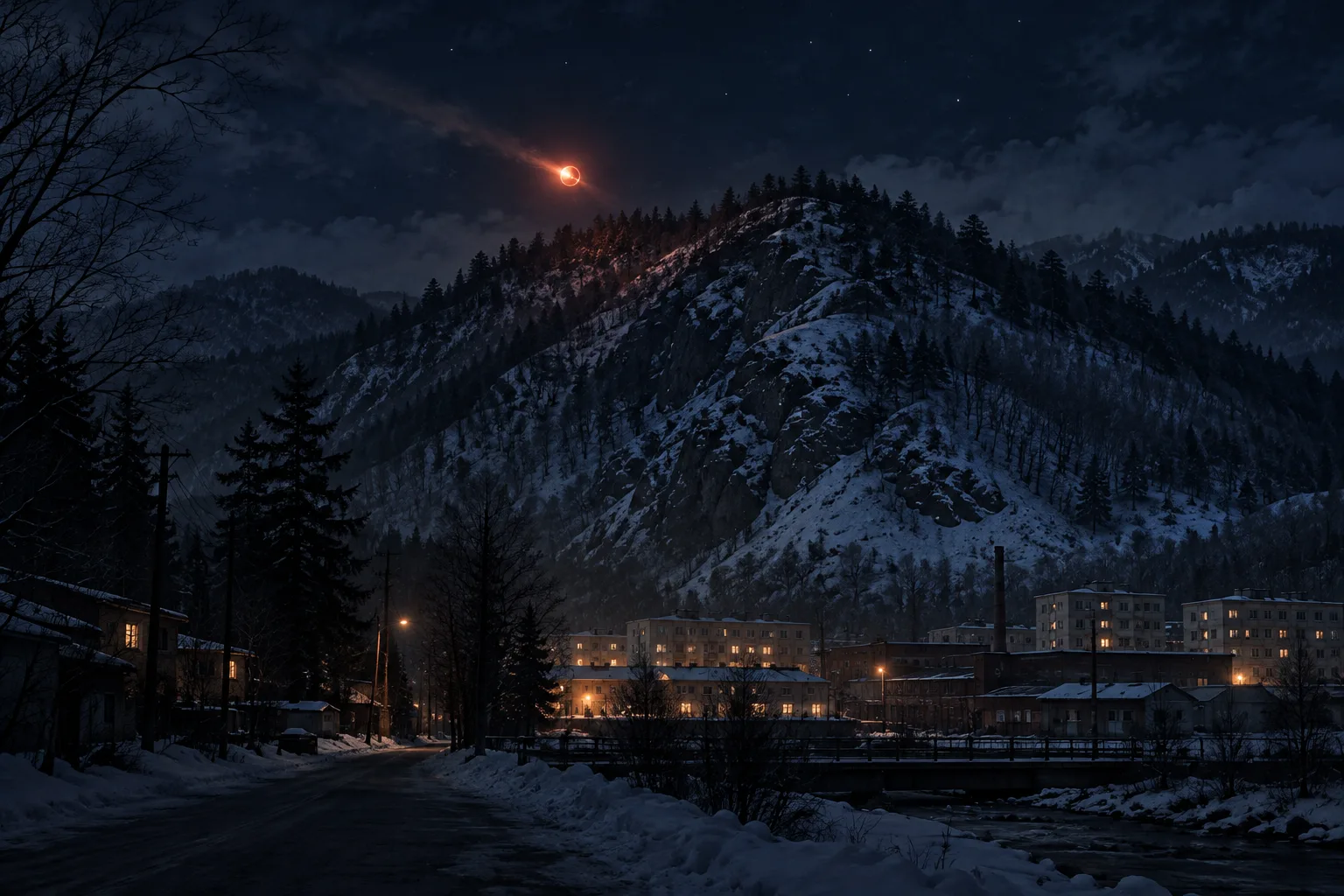
Vladimir Belyayev was working the night shift with an ambulance crew in Petrozavodsk. Around four in the morning on September 20, 1977, they had reached a call on Anokhin Street. His vehicle faced approximately north.
In his statement recorded that September, Belyayev described a halo forming above the building, followed by a luminous point. It moved upwards towards the Great Bear. Streams seemed to spread from it until they occupied much of the sky.
He watched the brightness change, the streams cease and the surrounding sky darken. The light then appeared to descend behind a house.
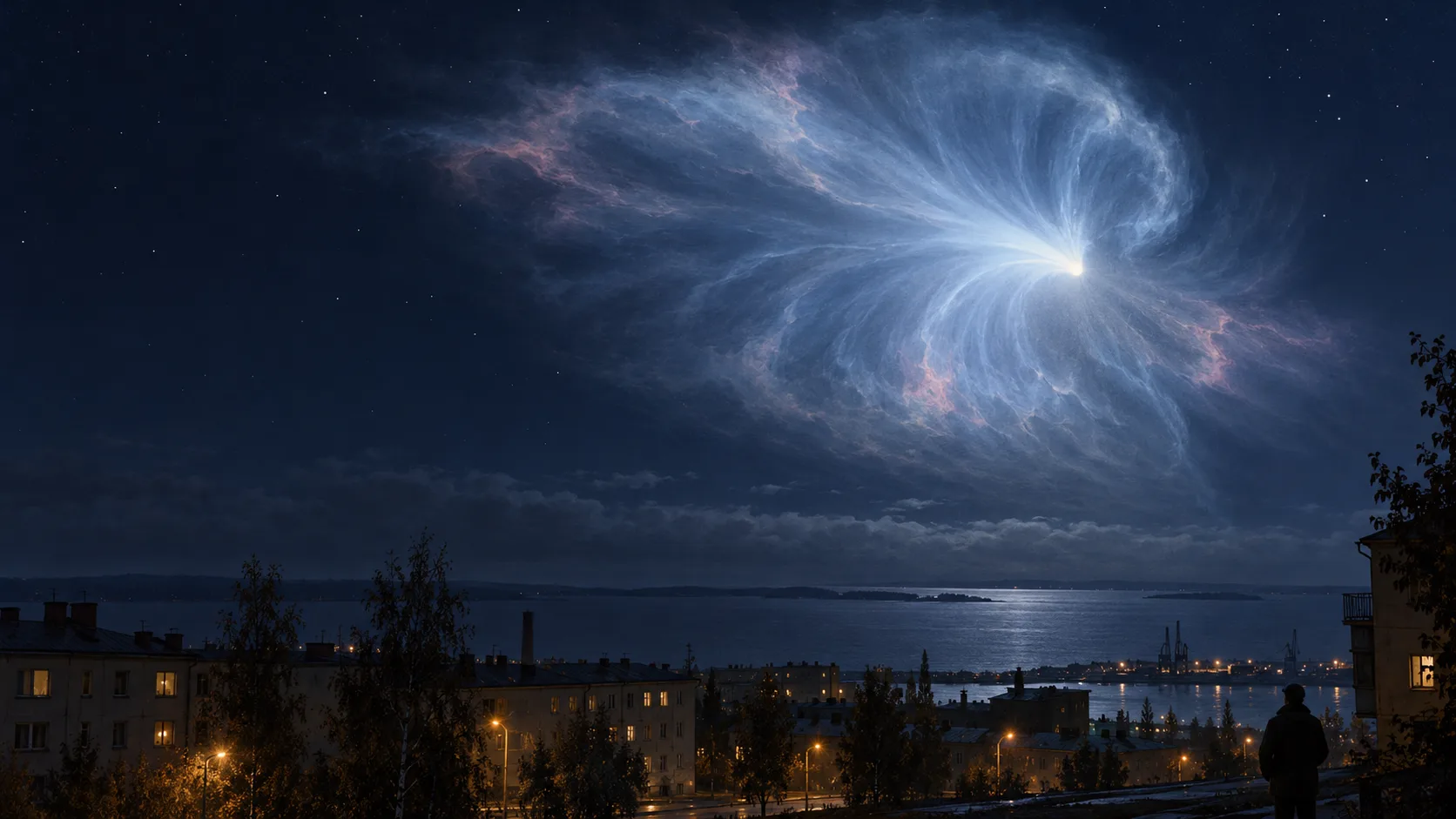
By the time the ambulance left the courtyard, there was something else to see over Lake Onega: an irregular luminous oval, pink along its upper edge and bright underneath.
Across the city, other people were looking up. The morning would leave a collection of accounts from streets, windows and the waterfront, all trying to give familiar names to a changing light.
The patient in the ambulance
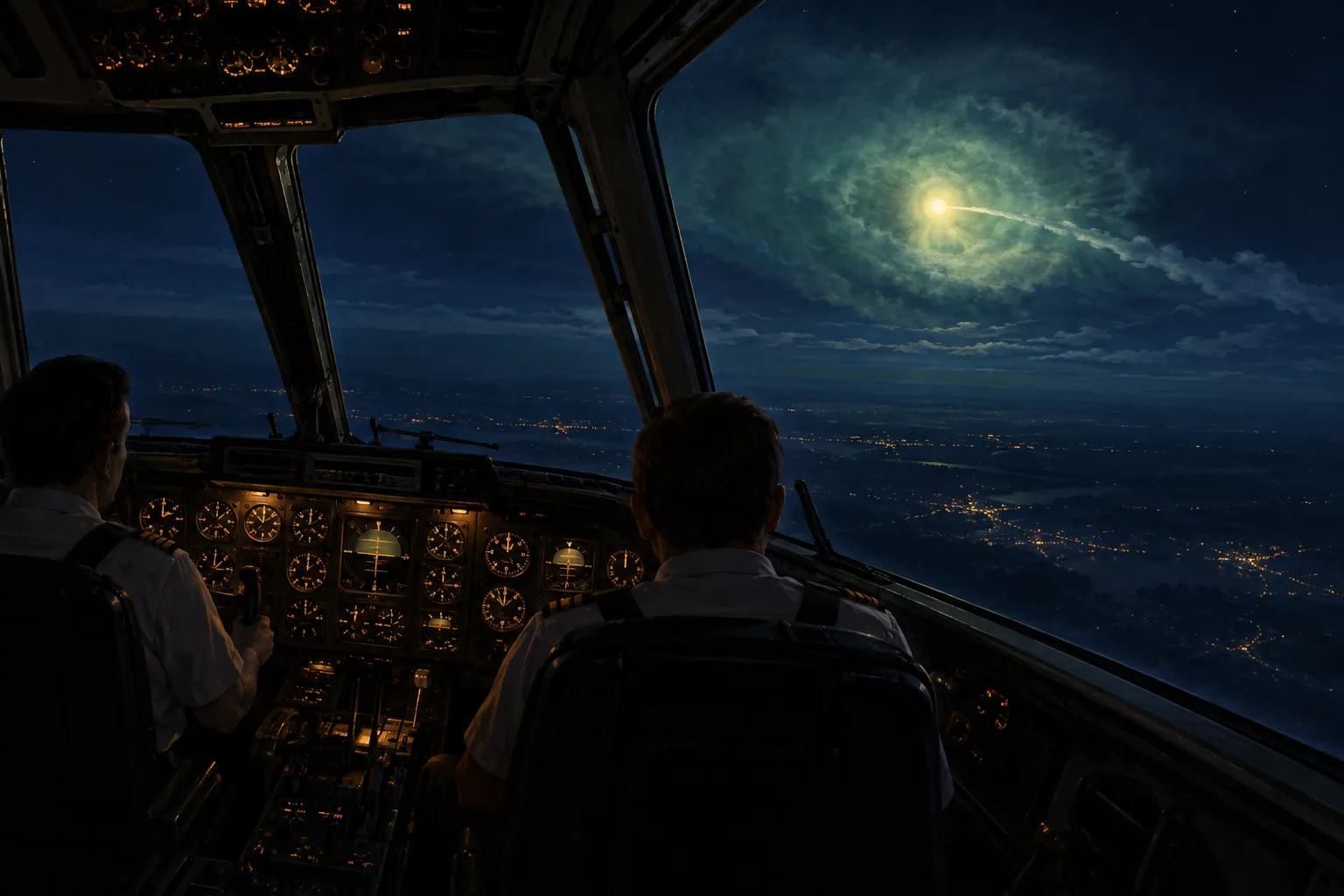
Doctor Violetta Menkova was also on duty. Her contemporary statement, transmitted to the Academy of Sciences, described travelling to the city hospital with a patient when she noticed an unusually bright star inside a thin cloud.
White, curved threads extended from it. She drew the attention of driver Vyacheslav Savin and paramedic Valentina Svistunova to the sky.
As the ambulance turned onto Lenin Street towards the lake, the light seemed high in the atmosphere yet strangely close. The cloud spread around it. Menkova compared the appearance to a transparent jellyfish or a parachute canopy with brightness at its centre.
She described something separating like a ray, with a luminous oval at its end. She thought of a satellite, a meteor, an aurora and a vessel from another planet.
At the hospital, the threads became less distinct, leaving a hazy trail. The crew handed over the patient. Later, back at the station, they went outside to look again. A glow remained above the lake.
The call still had to be completed. Through the ambulance windows, the sky had changed around that ordinary journey.
Lunch at four in the morning
At the port, crane operator Andrei Akimov and his colleagues were preparing for their meal break.
For the night workers, four in the morning was lunchtime. Someone called their attention to a light in the sky.
In Akimov’s account recorded on September 21, his first thought was the northern lights. Then the shape caught his attention: an oval resembling a parachute viewed from underneath, with something like a network inside it. A luminous point stood a little above and to the left of centre.
The oval expanded. The point moved towards its left edge. Dark pieces of ordinary night sky appeared within the glow, breaking up what had first looked like a continuous luminous canopy.
Akimov watched for roughly five to ten minutes. When he returned home, he drew the sequence.
TASS correspondent Nikolai Milov described receiving those drawings in a service message dated September 21. Akimov had been unloading a vessel when the display began. His pictures gave the light successive forms, including a view placing its broad canopy above the city from the direction of the lake.
The drawings preserved change: the bright point, the expanding outline, the darkness opening inside it, and the gradual fading.
At the fifth-floor window
Galina Safronova’s view began inside her apartment.
In a telegram dated October 4, she said she had awakened because the room was hot and got up to open a small window. From the fifth floor, she noticed a rounded white patch in the sky above the courtyard.
It seemed to churn or pulse, shaped like a parachute canopy with a bright spot in the middle. She used the Great Bear to describe its growing size.
One ray appeared, then another. Many rays met at the centre, while additional points flickered in the lower right portion. Safronova climbed onto the sill to see better.
Then darkness seemed to spread around the central light, interrupting the luminous pattern. The remaining arcs moved apart. One took on a reddish-violet upper edge and a less distinct greenish lower edge as it extended towards the lake.
She thought of the aurora. The bright centre dwindled, while the broad glow dispersed around it.
Her account placed the changing sky outside an opened apartment window.
Morning interviews
By daylight, the observations were becoming news.
Leninskaya Pravda’s September 24 report stated that its correspondent had spoken with Belyayev and Menkova at 8:40 a.m. on the morning of the event, as their shifts ended. The story also mentioned a woman at a public telephone, another hurrying to a pharmacy, and the port workers.
At nine, the newspaper contacted Yuri Gromov, director of the hydrometeorological observatory. Scientists began comparing the observations with reports from elsewhere.
The newspaper’s account moved between witnesses rather than presenting the city as a single observer. Each person had encountered the light from a particular place, while doing something else. Interviews brought those separate moments together after the display had faded.
A message for Moscow
Milov’s September 20 service message to TASS supplied the image that would define the case: a huge star spreading into a jellyfish, shedding fine rays that resembled heavy rain.
His account described the rays ending, the shape becoming a bright half-disc, and movement towards Lake Onega. Grey clouds covered the horizon. Within that veil appeared a bright opening, reddish in the middle and white at the sides.
The reported display lasted about ten to twelve minutes.
Milov consulted Gromov and telephoned Pulkovo Observatory near Leningrad, where he was told that information was being collected. The dispatch carried the uncertainty as well as the spectacle. People had seen something striking; the people asked to explain it were still gathering accounts.
The light now travelled through another network: telephone calls, service messages and newspaper offices. Its familiar name came from an animal of the sea, while the reports carried it away from the lakeside city and into Moscow.
The teletype reports
Astronomer Lev Gindilis later recalled how the first accounts reached him. On the evening of September 22, UFO researcher Felix Ziegel telephoned about Petrozavodsk. Another call came from Anatoly Makarov at the Academy of Sciences.
The next day, Gindilis went to see the material. Reports transmitted by Gromov had arrived by teletype. Further inquiries followed: calls to Petrozavodsk, requests for information from Pulkovo, and accounts from other locations.
By the end of September, Gindilis was preparing a summary for officials. The problem had become larger than the view from one city. Observations had arrived from Leningrad, Karelia and Finland.
One possible connection already required consideration: Kosmos 955, launched from the military space centre near Plesetsk around four that morning. Gindilis recalled that the site’s secrecy complicated even mentioning it in an unclassified document. His own summary omitted the location.
The bright canopy had been visible in the open sky. Discussing the machinery that might have produced it was another matter.
What Is Known
The archive preserves contemporary witness statements, dispatches, drawings and a preliminary report dated October 20, 1977. That report explicitly described an initial compilation whose accounts still required checking. Gindilis’s account of the inquiry is a later participant recollection.
Kosmos 955 was a real satellite launch. The Space 40 catalogue lists its departure from Plesetsk around 01:00 UTC on September 20, corresponding to about 4 a.m. Moscow time, and identifies it as a military electronic-reconnaissance satellite.
The 2012 study by Sergey Chernouss and colleagues explicitly attributes the Petrozavodsk display to the launch. Its Figure 2 reproduces all-sky camera sequences from Arkhangelsk, Loparskaya and Sodankylä, showing the glow’s development around 4:04–4:08 a.m. Moscow time. The authors distinguish the expanding exhaust cloud from background auroral activity. This provides substantial photographic and physical support for a rocket explanation of the main display; it does not require every sighting later grouped under the event’s name to describe one object.
The Bigger Picture
The geometry of dawn explains how a launch can produce something so unfamiliar. Observers remain beneath a dark sky while exhaust high above them catches sunlight. NASA’s account of a photographed “space jellyfish” describes that same contrast. The illuminated cloud can become the conspicuous object, while the distant rocket itself escapes recognition.
Petrozavodsk also had an institutional consequence. In their 2000 history of Soviet UFO research, programme participants Yulii Platov and Boris Sokolov describe how the event helped prompt coordinated research beginning in 1978, with military and Academy of Sciences branches. The work was classified, partly because it belonged to defence research and investigators anticipated military sources for some reports.
Secrecy could therefore help create uncertainty around a human-made spectacle. The witnesses had an extraordinary view of light spreading across the sky, while access to the activities behind it was restricted. The rocket explanation preserves that spectacle: for a few minutes, sunlight reached the exhaust above Karelia before it reached the people watching below.
Sources
The first six entries are distinct contemporary records transcribed in the Astronet collection. Several concern the same witnesses and are overlapping accounts, rather than independent confirmations.
- Vladimir Belyayev, statement 787/366. September 1977 ambulance-driver account.
- Violetta Menkova, statement 786/365. September 1977 doctor’s account.
- Andrei Akimov, records 793/372 and 794/373. September 21 account and report about his drawings.
- Galina Safronova, statement 789/368. October 4 telegram.
- Leninskaya Pravda, September 24, 1977, record 784/363. Contemporary local reporting.
- Nikolai Milov, TASS, September 20, 1977, record 785/364. Contemporary service dispatch.
- Gindilis, Menkov and Petrovskaya, October 20, 1977 report. Preliminary contemporary compilation.
- Lev Gindilis, “First Reports from Petrozavodsk.” Later participant recollection.
- Chernouss et al., Geophysica 48 (2012), 65–79. Scientific analysis and observatory photographs.
- Antonín Vítek, Space 40: Kosmos 955. Specialist mission catalogue.
- Platov and Sokolov, history of Soviet UFO research, 2000. Retrospective by programme participants; English translation.
- NASA, “Launch Plume: SpaceX Jellyfish,” March 19, 2026. Independent context for twilight illumination.