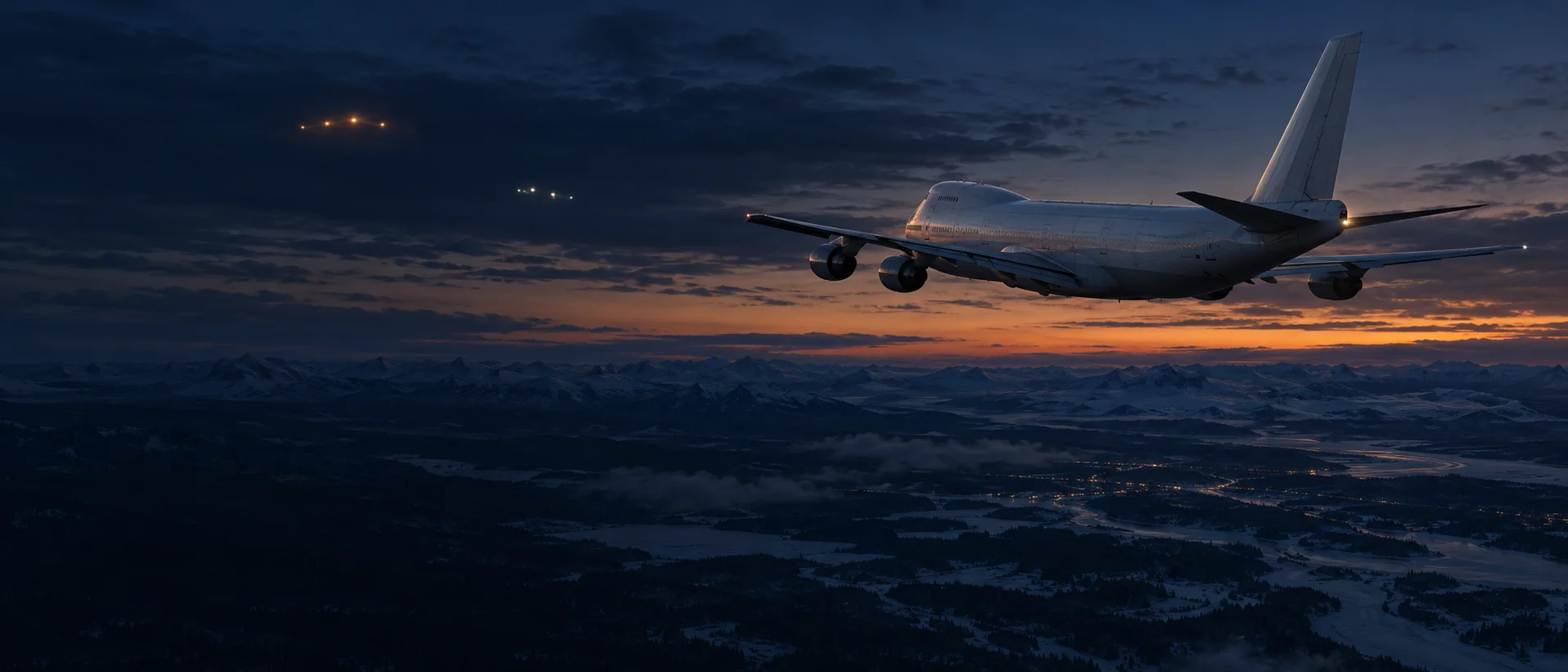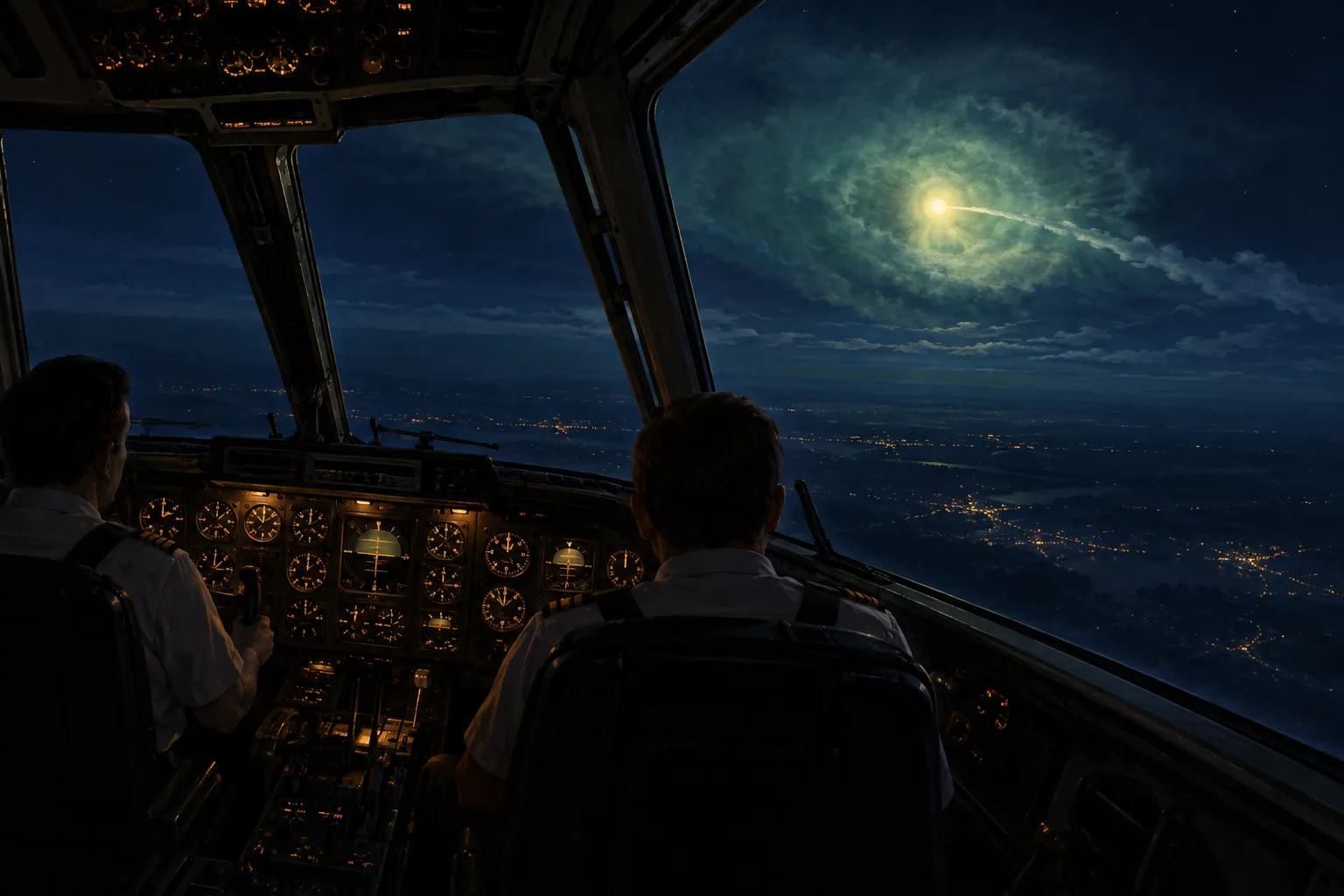
The light above and to the right of the airliner looked, at first, like a star.
Copilot Gennady Lazurin noticed its steady yellow brightness as Aeroflot Flight 8352 approached the Minsk area before dawn on September 7, 1984. Then a narrow line appeared beneath it, stretching towards the ground.
The star had become something else.
The account published in Trud the following January placed the aircraft about 120 kilometres from Minsk around 4:10 a.m. Its destination was Tallinn, on a service from Tbilisi through Rostov. Captain Igor Cherkashin, Lazurin, navigator Yegor Ognev and flight engineer Gennady Kozlov were aboard the Tupolev Tu-134.
Lazurin drew Kozlov’s attention to the light. The engineer looked, too.
What had begun as a point now had a vertical extension, and that extension was widening. The crew were watching a transformation in progress: a familiar-looking brightness acquiring an unfamiliar shape while their own aircraft continued along its route.
The widening beam
Timothy Good’s later account, drawing on the newspaper report, follows the sequence as the thin ray opened into a cone. Another cone appeared around it, and then a third, broader and paler.
The effect seemed to reach down to the landscape. Lazurin described being able to distinguish features beneath the light, including roads and houses. Above those features, the source remained high in the sky.
Then the apparent direction of the illumination changed.
The crew described the beam lifting away from the ground towards their aircraft. Where they had seen a narrow line and spreading cones, they now saw a brilliant white point within coloured, concentric rings.
The spectacle kept replacing itself. A description that fitted the view a moment earlier no longer fitted the next. Lazurin began sketching, giving the changing forms a succession they could take away from the flight.
The passenger cabin also became part of the account. Flight attendants brought a question into the cockpit: people looking out wanted to know what was travelling beside them. Cherkashin suggested describing it as a cloud, with the unusual colours attributed to illumination from below or the aurora.
That exchange brought the spectacle into the ordinary responsibilities of a passenger flight. The captain had to offer an answer while the sight itself continued to change. Outside the cockpit, other people had windows of their own and a view of the same unfamiliar brightness.
The crew’s immediate task was still to fly the aircraft. The drawings were another way to follow what was happening outside, alongside the observations being passed between the men in the cockpit.
Green beside the aircraft
The Associated Press dispatch preserved in the March 1985 MUFON UFO Journal carried the next part of the crew’s account abroad: the white brightness seemed to rush towards the airliner, leaving a green cloud, before taking a position alongside it.
From the cockpit, the cloud appeared to accompany their flight.
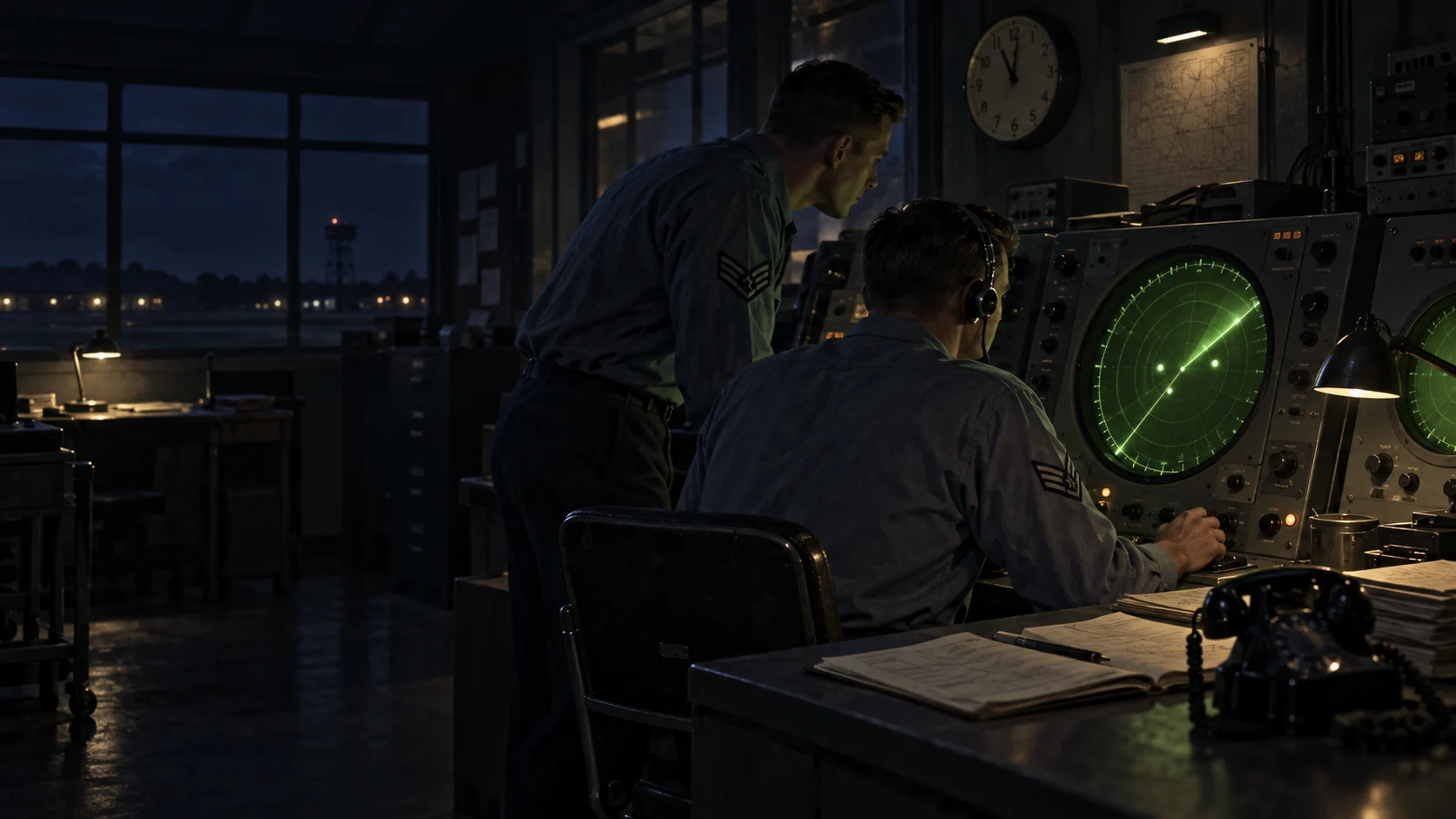
Minsk air traffic control was brought into the encounter. At first, the response from the ground was that nothing unusual could be seen on radar. Up in the aircraft, however, the men still had a luminous phenomenon outside their windows.
The situation now involved two different views of the same stretch of sky. The crew were describing an apparent companion to their aircraft; the controller was trying to find something corresponding to that description.
The AP report would later present the experience as an escort continuing towards the destination. That was how the encounter entered international news: an ordinary domestic service with an extraordinary accompaniment.
Inside the aircraft, there was no completed story yet. There was a light that had changed into rings, then a cloud, and was still visible as the flight continued northwards.
Shapes in a notebook
In his 1994 discussion in Omni, James Oberg returned to Lazurin’s efforts to record the changing light in his logbook. Colour, size and outline all altered during the observation.
For a later reader, those drawings give the encounter a different rhythm from a single spectacular image. There is a beginning and a succession of intermediate states. The strange form beside the aircraft becomes something the observer has watched develop.
The notebook also fixes attention on Lazurin’s position in the event. He was looking out while travelling, drawing what he understood himself to be seeing from an airliner in motion. His sequence would outlast the changing light and become one of the most discussed parts of the case.
A photograph would have preserved one appearance. A spoken report could follow the changes, but each description would give way to the next. On the page, the pilot could set those appearances beside one another. The point, the widening illumination and the cloud belonged to a developing sequence, rather than separate encounters with unrelated objects.
That continuity is part of the story’s lasting appeal. Its extraordinary feature was the change itself: something apparently distant and star-like becoming a much broader presence that the crew understood as sharing their flight.
The other cockpit
Another Tu-134 was crossing the region on Flight 7084, travelling from Leningrad towards Tbilisi by way of Boryspil and Batumi.
Copilot Yuri Kabachnikov’s statement, excerpted in Yuri Krasilnikov’s 2009 retrospective, describes hearing the controller direct his attention leftwards and up. Initially he reported nothing. After another minute or two, he found a bright green, elongated light.
Kabachnikov described beams extending from it. He also recalled an instruction to turn twenty degrees towards the phenomenon, followed by a brilliant illumination of their aircraft and a return to their intended course.
His statement places a second cockpit within the unfolding encounter. The radio had carried an observation from one aircraft to the ground, then brought another crew’s attention towards the sky.
The first sighting was no longer confined to Cherkashin’s aircraft. Another passenger service had found something luminous in the indicated direction, although the details of Kabachnikov’s version would later become contested.
The last view
Investigator Konstantin Khazanovich’s retrospective, based partly on lengthy interviews with Cherkashin and Lazurin in August 1986, follows the first crew towards Tallinn.
In their recollections, the cloud developed an elongated form with a tail, resembling an aircraft without wings. Its position in the cockpit windows changed as the Tu-134 followed its route and descended.
After landing at about 5:20, the pilots recalled a final view while taxiing: a boomerang-like shape towards the northeast, above the Gulf of Finland. Airport lighting then interfered with further observation.
The flight had reached its destination. The extraordinary light had persisted through a substantial part of the journey, taking on successive forms that the men would try to describe afterwards.
Beyond their route, others had also been looking upwards that morning. Oberg’s 2009 investigation assembled reports from Sweden and Finland, including observations by motorists, railway staff and police. Far from the two cockpits, witnesses described an unusual brightness in the northern sky.
The experience near Minsk would eventually be read alongside those scattered ground observations. For the pilots, it had begun with one steady yellow point outside the window.
What Is Known
The early public record includes Vladimir Vostrukhin’s Trud article of January 30, 1985, and the AP coverage reproduced that March. The surviving translation in a released US government collection preserves foreign newspaper reporting; its archival location does not turn it into a CIA investigation of the encounter.
The later record is more complicated. Khazanovich reproduced Kabachnikov’s statement, dated February 18, 1985, and compared it with interviews involving other members of the second crew. They supported an observation of a luminous, aircraft-like form, but did not confirm his account of directed beams and an investigative turn.
Khazanovich also challenged the celebrated Tallinn radar story and cited a later Lazurin interview denying the extra radar return described in the newspaper. The case therefore supports multiple visual witnesses more securely than a verified radar-tracked escort. Reported later illnesses likewise do not establish that the light caused an injury.
The Bigger Picture
Oberg’s 2009 analysis treated the wider geographical pattern as crucial. He argued that reported viewing directions pointed towards the Barents Sea, while Lazurin’s sequence resembled the changing appearance of distant rocket exhaust. He proposed a naval missile test in the Murmansk region, expressly acknowledging that a matching released launch record was needed to prove that identification.
That qualification matters. His earlier Omni article had named Plesetsk; the later analysis advanced a different location. A plausible explanation and a documented identification remain distinct conclusions.
Mikhail Gershteyn, interviewed in Krasilnikov’s retrospective, also favoured a rocket-generated cloud. An expanding, illuminated plume could appear to approach, then change outline as it dispersed.
The broader lesson concerns the distance between a view and an interpretation. Two people can agree that a light is present while understanding its movement differently. Adding witnesses can strengthen the observation without settling its scale, distance or cause.
Lazurin’s sketches preserve that distinction unusually well. They record successive appearances, allowing later investigators to ask what process might produce them. They also preserve the human encounter: a pilot watching something unfamiliar develop, drawing it before the next shape replaced the last.
Sources
- Vostrukhin, Trud, January 30, 1985 — early newspaper account, archived English translation.
- Associated Press, in MUFON UFO Journal 203, page 14 — contemporary international coverage; March 1985 issue.
- Konstantin Khazanovich, investigator’s retrospective — later interviews, statements and critical comparison.
- Timothy Good, Above Top Secret, Aeroflot section — later retelling, consulted in Hungarian translation.
- James Oberg, Omni, December 1994 — earlier interpretation, superseded in part.
- Yuri Krasilnikov, KP.UA, September 15, 2009 — retrospective, statement excerpt and Gershteyn interview.
- James Oberg, Skeptical Inquirer, January–February 2009 — independent analysis, Scandinavian reports and reproduced sketches.