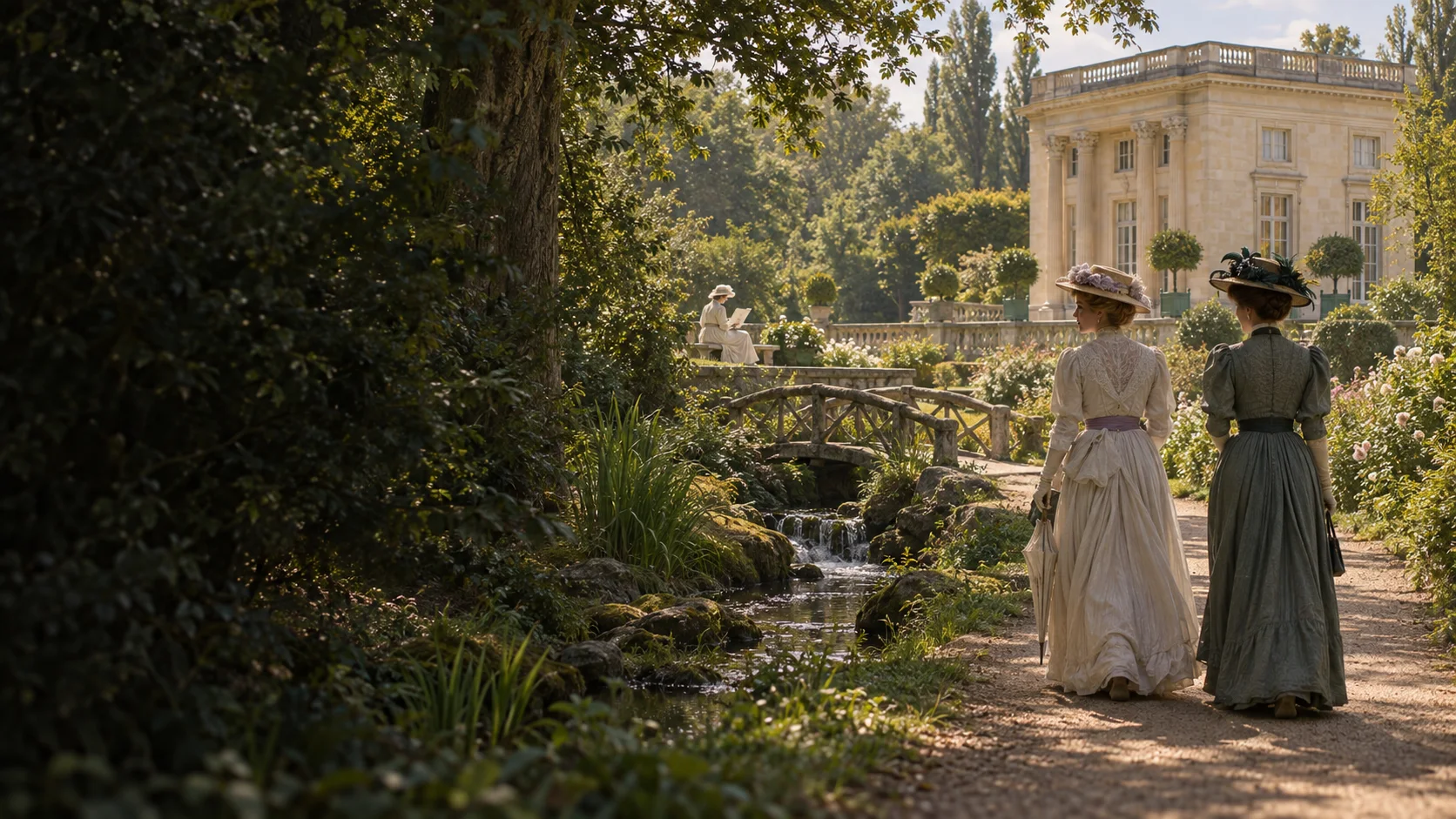
The woman was sitting near the terrace, holding a sheet of paper out in front of her.
Charlotte Anne Moberly thought she was sketching. The woman wore a pale dress and a white hat; when the two visitors passed, she turned towards them. Moberly looked directly at her, then climbed the steps to the Petit Trianon and saw the pale green of her shoulder covering from behind. Her companion, Eleanor Jourdain, was walking beside her.
Three months later, Moberly mentioned the woman. Jourdain said no one had been there.
The disagreement would become the most arresting part of a story about a supposed passage into the past. But on the afternoon itself, the woman was only one detail in a walk that had grown stranger, step by step, before either visitor reached the house.
The turn off the drive
On August 10, 1901, the two Englishwomen spent part of a holiday at Versailles. They toured the main palace, then decided they had time to see the Petit Trianon. Neither knew the estate well. They consulted a Baedeker guide and set out on foot, passing the Grand Trianon on their way.
Moberly later wrote that a broad green drive would have taken them straight to their destination. They crossed it instead and entered a lane. She noticed a woman shaking a white cloth from a window; Jourdain’s account does not mention her. Jourdain remembered an open gate and a sunken path, with apparently empty farm buildings, tools and a plough to one side. The small differences began before anything either woman thought extraordinary had happened.
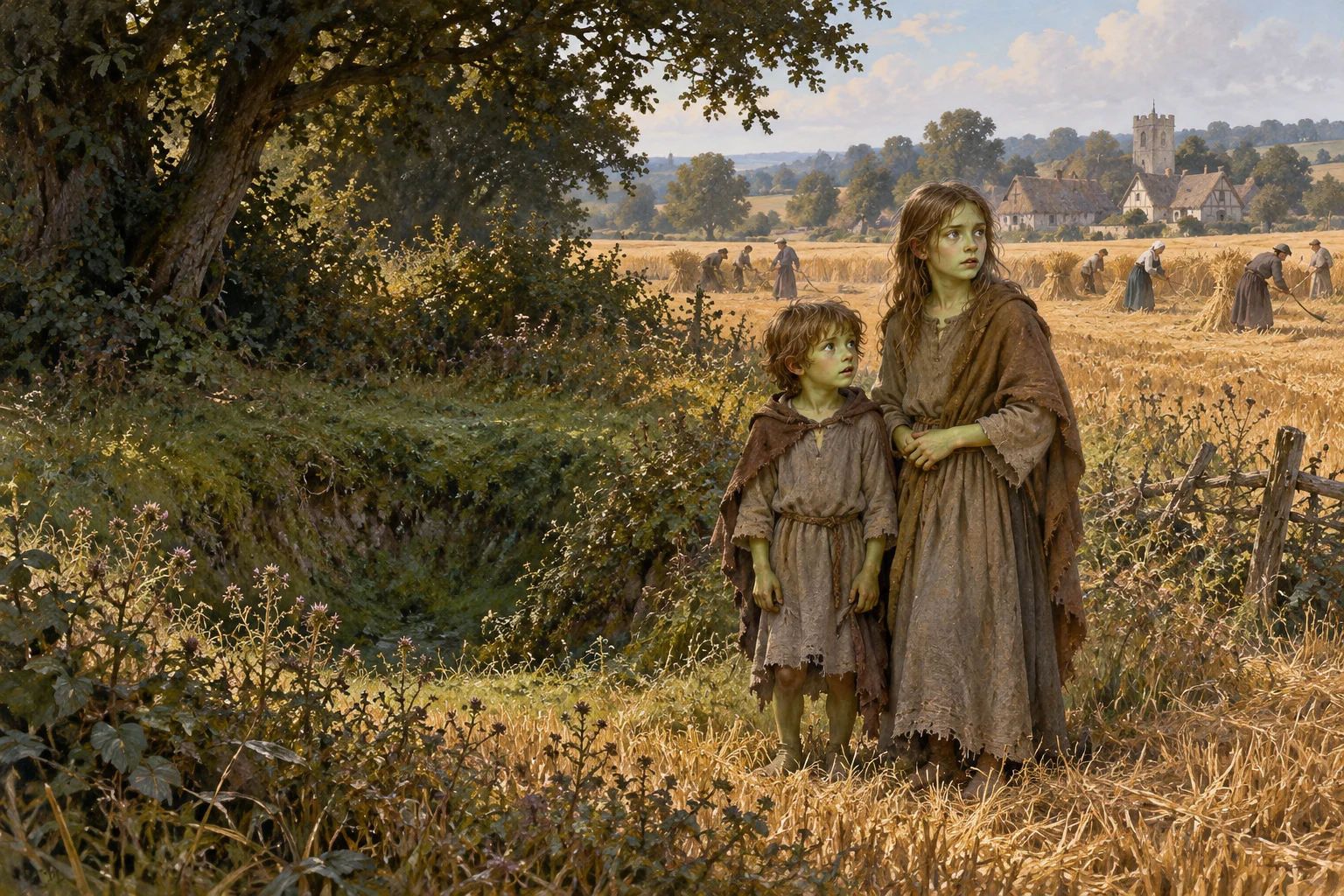
Ahead stood two men in greenish coats and small three-cornered hats. The visitors asked the way. Both accounts say the men directed them forward. Moberly noticed something like a wheelbarrow and spade nearby and initially thought of them as gardeners; Jourdain remembered their manner as strangely mechanical. Jourdain also recalled a cottage where a woman passed a jug to a girl. Moberly did not report seeing the pair.
The route had not become a vision of a vanished century in their minds. They were still trying to find an entrance to a building. Yet both later placed a change in feeling near the two men. Moberly described an inexplicable depression that deepened as they walked. Jourdain felt lonely, uncertain of the direction, and dreamlike. Neither told the other at the time.
The man in the shade
The path met another beneath the trees. In front of them stood a small roofed structure with columns. A man sat nearby, wearing a dark cloak and a broad hat. Moberly remembered his dark, rough complexion and the alarm she felt when he looked at them. Jourdain described a face marked by smallpox and a powerful reluctance to pass him.
The man did not approach. Another man did.
They heard running, then found a younger man close to them. He called to them in French, warned them away from one direction, and gestured towards the right. Moberly recalled dark curling hair, a flushed face and a cloak caught in his haste. Jourdain remembered buckled shoes and an unusual accent. Both understood that they should take the route he indicated.
They crossed a little bridge beside a narrow fall of water. Their separate accounts in An Adventure describe the small cascade in slightly different terms, but agree on the bridge and the approach to the English garden front of the Petit Trianon. The encounter with the running man had moved them out of the shadowed crossroads and towards the house.
The sense of unease did not immediately lift. Moberly said the trees seemed flat and still, as if worked into a tapestry. Jourdain remembered drawing her skirt aside on the terrace, as though making room for someone she could not see. For both women, the ordinary act of reaching a tourist destination felt unusually difficult.
Beside the terrace
Moberly then saw the seated woman. She described fair hair beneath a white hat, a long-waisted dress with a full skirt, and a shoulder covering edged in a colour she could not decide was green or gold. She thought the woman a visitor in somewhat old-fashioned clothes. She did not ask her for directions.
Jourdain’s account moves from the garden path to the terrace without any seated woman. The distinction matters. Their story is often retold as if both visitors saw Marie Antoinette. In Moberly’s own version, the woman was at first simply a woman sketching; in Jourdain’s, she was absent altogether.
A young man came out of a nearby door and told them that the public entrance lay around the other side. He led them through the French garden. At the proper entrance they joined a cheerful wedding party making its way through the rooms. Moberly said she felt lively again. The strange walk had ended in the familiar movement of visitors and a guided tour.
They returned to Versailles and then Paris without discussing the afternoon. That silence did not last forever, but it lasted long enough for each woman to carry her own version of the walk away from the garden.
A question after a week
About a week later, Moberly was writing a letter about their excursions when the feeling from the garden returned to her. She asked Jourdain whether she thought the Petit Trianon was haunted. Jourdain said she did. They compared the depression they had felt near the same stretch of path and spoke about the seated man and the hurried guide. The two had shared a route and an unease, even where their eyes had collected different details.
They did not then compare every figure in the garden. On November 10, while Jourdain was visiting Moberly in England, Moberly casually referred to the woman with the sketch paper. Jourdain said she had seen no one there. Moberly could scarcely believe it: she remembered walking close to the woman and looking down on her from the terrace. Jourdain, in turn, believed she had been looking around carefully.
Now they decided to write separate accounts. The texts are dated November 1901 in the book they published a decade later. They were not written on the day of the visit, and the women had already compared some of their impressions. But the decision to preserve what each remembered separately also fixed their differences on the page. Moberly saw the woman with the cloth and the woman by the terrace. Jourdain saw the plough, the cottage, the woman and girl. Only their more central route and encounters overlapped.
The next day Jourdain was teaching the French Revolution. She thought of the date on which she and Moberly had visited Versailles: August 10, the anniversary of the fall of the Tuileries in 1792. When Moberly checked her diary, the visit indeed proved to have been on August 10. The historical date had entered their story after the walk, through a lesson and a diary, rather than through something they noticed among the trees.
Going back
Jourdain returned to the gardens on January 2, 1902. This was a second experience, in winter, made by one visitor who now knew the first walk’s possible historical significance. She wrote that an oppressive feeling returned near a bridge. She saw two labourers and a cart, looked away, and found them gone when she looked back. Later she heard what seemed to be women’s voices and distant band music while she could see no one nearby.
Her account does not make the January visit another shared event. It shows what the gardens had become for her: a place to retrace, map and question. She asked a gardener for directions and made enquiries about whether a band had played that day. The second visit enlarged the mystery, but it did not give Moberly another sighting of the woman by the terrace.
The women kept returning to maps, paths and old descriptions. In 1904 they went back together. Moberly wrote that the scale and layout seemed different from her memory: the kiosk, little bridge and cascade of 1901 could not be found where she expected them. They questioned people at Versailles, compared pictures and searched documents. Some details seemed to them to resemble features of the eighteenth-century gardens; other leads went nowhere.
Years passed before they offered the story to the public. In 1911, An Adventure appeared under the names Elizabeth Morison and Frances Lamont. The publishers’ note explained that these were pseudonyms. The book contained their accounts of the first walk, Jourdain’s winter return, and their long attempt to identify what they believed they had encountered. Its final theory went beyond a simple sighting of ghosts: they wondered whether they had entered a scene held in the memory of Marie Antoinette.
The most famous proposed identification was the sketching woman herself. Moberly came to connect her with a portrait of the queen. That connection belonged to the years of research after the visit. At the terrace in 1901, she said, she had taken the woman for a tourist.
What Is Known
The principal record is Moberly and Jourdain’s An Adventure, published in 1911 under pseudonyms. It presents accounts dated November 1901, approximately three months after the visit. The authors say they wrote separately after discovering that Jourdain had not seen the woman Moberly remembered. They also say they had discussed their shared feeling and some of the men they encountered about a week after the walk. Their written versions therefore preserve two perspectives, but not two completely unshared first impressions.
The date August 10 comes from Moberly’s diary as checked after Jourdain raised the anniversary. The two women agreed that they encountered men who directed them, crossed a small bridge and reached the Petit Trianon. Their accounts diverge over several other people and objects, most prominently the woman near the terrace. The 1911 volume also records later visits and historical comparisons. Those comparisons tell us how the authors came to understand their experience; they do not independently establish who the people in the garden were or what year, if any, the visitors perceived.
The Château de Versailles recounts the episode as part of the site’s history and identifies the visitors as Moberly and Jourdain. Its overview gives a different date for when they first put the experience into writing. For that chronology, the November 1901 dates printed beside the first-person accounts in An Adventure are the more direct evidence. The reported walk survives through the visitors’ own later publication, not through a photograph of the terrace or an independently identified seated woman.
The Bigger Picture
The Petit Trianon was already a place built around memory before the two women arrived. Versailles’ history of the estate says Louis XVI gave it to Marie Antoinette in 1774 and she remade its grounds as an Anglo-Oriental garden. In 1867, Empress Eugénie converted the house into a museum dedicated to the former queen. By 1901 a visitor could walk through a garden designed for one era and a house curated to remember another.
That setting does not decide what happened on the path. It does explain why the women’s later investigation led them so insistently towards the eighteenth century. They were searching not just for a missing bridge or a man in a cloak, but for a way to connect scattered impressions with the visible history of the place. Their own book shows the connection being made over years: a date checked in a diary, a portrait found in a book, old plans compared with a walk they could not repeat.
The phrase time slip makes the episode sound like one clean instant of crossing. The published story is more intricate. Two people walked together and came away with a shared unease, a partly shared route and some unshared sights. The woman who now stands at the centre of the legend was the person only one of them remembered seeing.
Sources
- Later published eyewitness accounts and research: C. A. E. Moberly and Eleanor F. Jourdain, An Adventure (1911), published as Elizabeth Morison and Frances Lamont; includes accounts dated November 1901 and January 1902, later visits, and the authors’ historical interpretation.
- Independent institutional context: Château de Versailles, “The Petit Trianon”, history of the house, gardens and 1867 Marie Antoinette museum.
- Institutional retelling: Château de Versailles, “Les fantômes de Trianon”, overview identifying the visitors and describing the episode; its writing chronology differs from the dates in the original book.