The children broke open the stalks and found nothing.
They had refused the bread and other food set before them. Now someone had brought in fresh bean plants, and the boy and girl reached for them with a hunger the people around them could understand even if they could not understand a word the children said. They pulled at the stems, searching the hollow inside. The beans were elsewhere, sealed in pods along the plant. When no food appeared in the stalks, the children began to cry.
Someone opened a pod and offered them the beans. At last, they ate.
That small misunderstanding sits at the centre of one of medieval England’s strangest stories. It gives the two children something more immediate than the colour that made them famous: a need, a gesture, and a room full of people trying to help them. The two chroniclers who preserved the account agreed on the beans. They also agreed that the children were a brother and sister found near the village of Woolpit, with green-tinged skin and speech no one there knew. What happened before they arrived—and what became of them afterward—looks different depending on which chronicler one follows.
Beside the pits
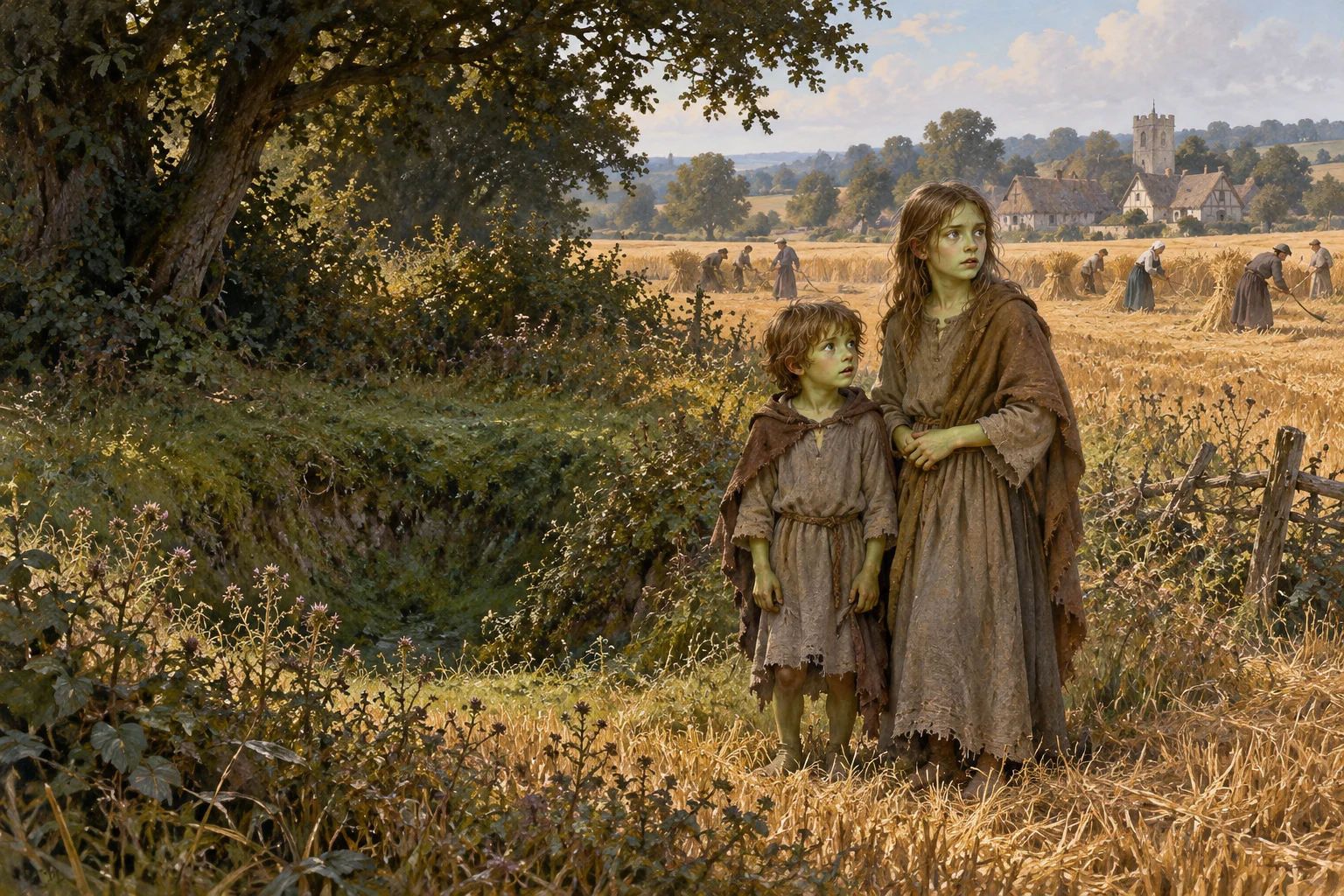
William of Newburgh placed the arrival during the reign of King Stephen, sometime between 1135 and 1154. Harvesters were at work near Woolpit in Suffolk. The name, as William explained it, came from old pits used for wolves. From those cavities, his account says, emerged a boy and a girl. Their skin was green; their clothing was of a colour and material unfamiliar to the people who found them. The reapers brought them into the village, where others gathered to look. William’s chapter does not give the children names.
Ralph of Coggeshall set the scene at the edge of a pit too. He did not describe their clothes. His Latin account, preserved in an 1875 edition, says the children’s bodies were shaped like other people’s but their skin was marked by green. Nobody understood their language. Ralph then followed them out of Woolpit to the house of a knight, Richard de Calne, at Wykes. There, he said, the children wept inconsolably.
William’s reapers and Ralph’s named household bring the same arrival into focus from different directions. One text begins with a harvest field and the astonishment of villagers; the other takes the reader to the place where the children were sheltered. Both leave the most basic questions unanswered. The children could not tell the people receiving them who they were. The people receiving them did not know where to send them back.
The first food
Food ought to have crossed that divide. Instead, bread and other familiar offerings remained untouched. William says days passed while the children ate none of it. Ralph says they were extremely hungry and later attributed their refusal to the belief that the unfamiliar food was not edible. Both writers then arrive at the bean plants.
The detail is almost stubbornly practical. They recognized something they could eat, but looked inside the stalk rather than opening the pod. The people watching learned what the children wanted by watching where their attention went. The children learned where the beans were because someone showed them. Neither side needed a shared language for that exchange.
For a time, the beans were enough. William says the children lived on them for many months before accepting bread. Ralph says they touched no other food for a long period. Both describe the boy as failing while his sister survived. In Ralph’s version he remained weak and died soon afterward. In William’s, baptism came first for both children; the younger boy died not long after it. The difference in sequence is modest, but it matters when trying to turn two separate tellings into a single exact chronology.
The girl slowly took other food. Her green colour faded. She learned the language spoken around her. The child whom the villagers first could only watch became someone they could question. Those changes lead to the part of the story that makes Woolpit more than a tale about an unusual appearance: at last, she was able to say where she thought she had come from.
A country without sunrise
William says the children named their home as the land of Saint Martin. It was Christian, with churches of its own. It was also, in their account, a place where the sun did not rise over the inhabitants. They lived by a light like the dimness before sunrise or after sunset in England. Beyond a great river lay another country that looked bright to them.
As for the way to Woolpit, William’s version gives no clear route. The children had been tending their father’s animals when they heard a sound like bells. They listened; then, somehow, they found themselves in the fields where the harvesters were working. They did not know where their homeland lay in relation to the village. William recorded the account as something said after they had learned English, when the people around them could finally put their questions directly.
Ralph also recorded bells and grazing animals, but supplied a passage between the two countries. The children had followed the animals into a cave. Drawn onward by the sound, they wandered through it until they reached an opening. Outside, the sunlight and warmth overwhelmed them. When people approached, they tried to retreat but could not find the entrance again. In Ralph’s telling, the girl also said that the inhabitants and things of her country were green. He gave no name for that country and no bright land across a river.
The cave and the river are now among the story’s most familiar images, but they do not belong to the same account. A reader who gives the children both is joining William and Ralph together. Their shared elements are stranger in a quieter way: animals, bells, a world of dim light, and a girl trying to describe it in a language she acquired only after leaving it.
The girl who remained
Ralph says she was baptized after the boy died and spent years in Richard de Calne’s service. He also passed on an unkind judgment of her conduct. That judgment tells us something about the household’s view of a young woman under its care; it does not give her own voice. Ralph said he had heard about her from the knight and his family. The girl herself left no account that we possess.
William gave a different last glimpse. The surviving girl, he wrote, grew to be like other women in appearance and was said to have married at Lynn. He added that she had been living only a few years before he wrote. He did not name her or her husband. The statement extends her life beyond the marvel of her arrival, but it also fades into hearsay. William’s cautious wording cannot be turned into a marriage record.
In both versions, she is the reason the story has an ending at all. Her brother died young; she survived long enough to change her diet, lose the distinctive colour, and answer questions about the place she remembered. The account of that place, however, reached the page only after passing from a child to adults, then through the tellings of medieval writers.
From one village to two books
William wrote from Newburgh in Yorkshire, far from Suffolk. He introduced the episode by admitting he had resisted believing it. Only the weight of people he regarded as competent witnesses, he said, persuaded him to include it. He did not name them. His willingness to write down the tale was itself part of his story: he could neither understand it nor leave it out of a history of his time.
Ralph wrote from a Cistercian abbey in Essex, much nearer to Woolpit. He named Richard de Calne and the knight’s family as people from whom he had repeatedly heard about the girl. His account was composed later than William’s. Neither man says he saw the children emerge, watched them eat the first beans, or heard their first words. They are chroniclers preserving what was told, not eyewitnesses at the pit.
That distance gives the two texts their curious power. A Suffolk harvest scene travelled far enough to be recorded in Yorkshire. A second writer near the region preserved a version with a household and a cave. Even after the girl in the story had learned English, her original name never made the journey into either manuscript. What survived instead was the moment she and her brother found the beans—and the image of a home where daylight never quite arrived.
What Is Known
The earliest surviving accounts are passages in William of Newburgh’s Historia rerum Anglicarum, written in the late twelfth century, and Ralph of Coggeshall’s Chronicon Anglicanum, written in the early thirteenth. The links lead to a later English translation of William and an edited Latin text of Ralph; an 1850 English translation of Ralph helps compare the passages. These are medieval reports about an earlier event, not contemporary depositions or documents made at Woolpit when the children appeared.
They agree on a boy and a girl, green skin, unfamiliar speech, an initial refusal of food, acceptance of beans, the boy’s death, and the girl’s survival. They differ in details that later retellings often merge. William alone supplies the reign of Stephen, unusual clothing, the name Saint Martin’s land, the bright country across a river, and the reported marriage at Lynn. Ralph names Richard de Calne, describes the cave, and says he heard of the girl from the knight’s household. His account places her baptism after the boy’s death; William places the boy’s baptism before it.
Historian Michał Madej’s comparison notes that the two texts are unlikely to be simple copies, but that their information may have circulated through a shared source or network. Two chronicles therefore mean two textual witnesses, not two independent observations of the children. No surviving record identifies either child by name, verifies the cave or homeland, or fixes an exact year for the reported arrival.
The Bigger Picture
The writers placed the children inside histories full of other matters. William’s account follows political narrative and sits beside further wonders; Ralph included the story among reports of unusual beings. Madej argues that these settings shaped what each chronicler wanted readers to notice: questions of belonging in one text, bodily difference and social order in the other. That is a reading of the writing, not evidence that the girl or boy was invented.
More recent scholarship, including Carolyne Larrington’s work on the story and child refugees, draws attention to what the marvel can obscure. In both accounts, vulnerable children arrive somewhere they cannot speak the language, fail to recognize the food, and depend on strangers. One dies; one adapts. Those human details survive regardless of how literally the green skin or the land of Saint Martin should be read.
The story’s lasting mystery is partly the loss between experience and record. We have the words of men who wrote about the girl, and in those words traces of things she was said to have told them. We do not have her name, her own writing, or her account before someone else gave it a shape. At Woolpit, the beans were opened for the children. The way back was never opened on the page.
Sources
- William of Newburgh, Historia rerum Anglicarum, book I, chapter 27. Late twelfth-century chronicle; English translation reproduced by Fordham University’s Internet Medieval Sourcebook.
- Ralph of Coggeshall, Chronicon Anglicanum, “De quodam puero et puella de terra emergentibus,” pp. 118–120. Early thirteenth-century chronicle; Latin text in Joseph Stevenson’s 1875 edition.
- Thomas Keightley’s English translation of Ralph’s passage, The Fairy Mythology (1850), pp. 281–282. Later translation reproduced alongside the Latin; used to read Ralph, not as a separate witness.
- Michał Madej, “The Story About the Green Children of Woolpit,” Res Historica 49 (2020), 117–132. Scholarly comparison of the chronicles and their historical and literary settings.
- Carolyne Larrington, “Green Growing Pains,” in International Medievalisms (2023). Publisher’s chapter summary and independent context on the children as outsiders and refugees.