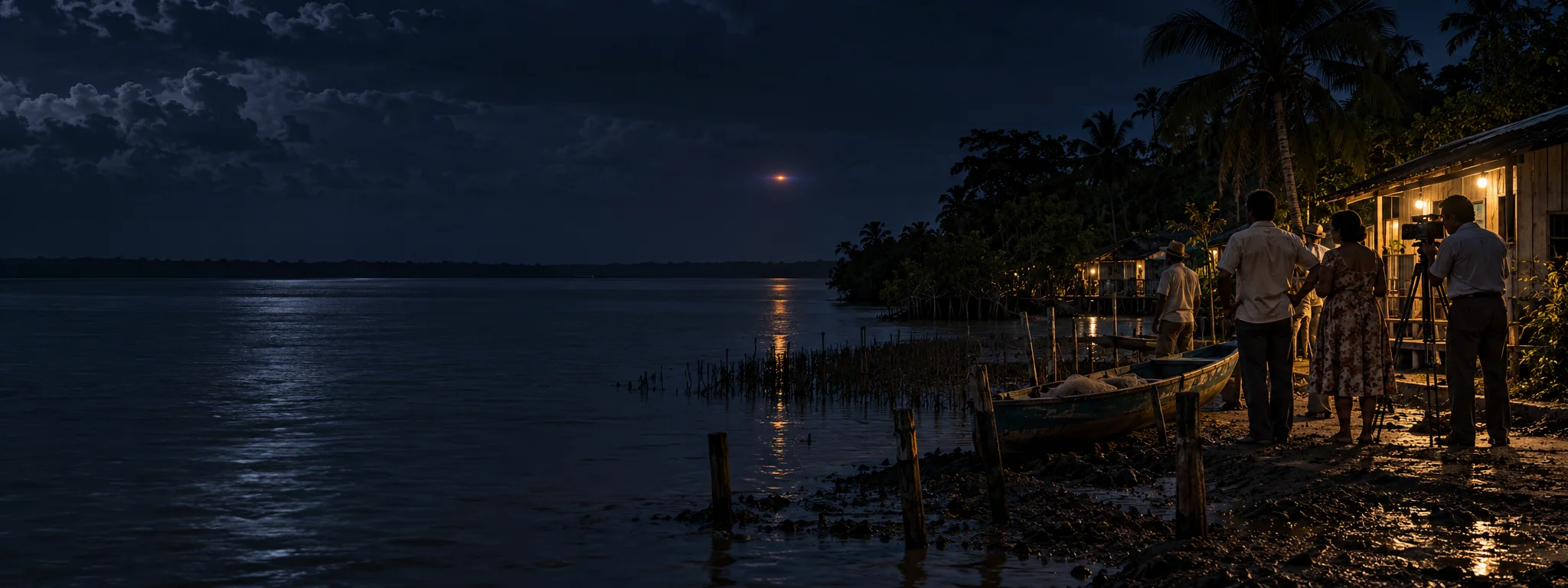
Claudomira Rodrigues da Paixão was awake in a hammock when a light entered her account of the night.
It was October 18, 1977, in Colares, an island community on Brazil’s northern coast. In the report later written by a Brazilian Air Force investigator, she said the room grew bright, then greenish. She felt heat and a sharp pain in her hand, and believed something had touched her breast. She called for help but said her voice would not come.
Claudomira was one of several residents who would describe a light as an encounter, not merely something seen at a distance. The Air Force report preserved her account alongside those of fishermen, neighbours, a priest and a local doctor. By the time the investigators arrived, people in Colares were already changing where they slept and keeping watch at night.
The name that travelled through the villages was chupa-chupa: roughly, the thing that sucks. It was an alarming answer to an unanswered question. The light itself would be seen, or said to be seen, from houses, roads and boats. Soon, people sent by the First Regional Air Command would begin watching too.
The lights reach the coast
The reports did not begin with one night on Colares. Through 1977, stories of unusual lights spread across Maranhão and Pará. In July, newspapers described fear around Viseu; by October, Pará newspapers were reporting incidents in Vigia and nearby settlements. Later historical research traced how three papers—A Província do Pará, O Estado do Pará and O Liberal—carried the accounts into a much wider public conversation.
The descriptions were not all alike. Some people reported a distant point moving above the water. Others described blue or reddish light near a roof or tree line. Some said they experienced numbness, weakness or pain. These accounts reached the Air Force investigators as individual stories, with dates and locations, rather than a single encounter repeated by a crowd.
On September 2, Amélia Martins da Silva and her daughter Odete were walking from Santo Antônio do Tauá towards home. According to their interviews in the mission report, Amélia noticed a yellow-red light crossing the road ahead. They moved beneath a tree as it seemed to turn towards them. Closer to the ground, she thought it looked rounded and bluish, with a small red light above. Odete agreed with her mother’s account without adding details of her own.
Amélia told the team she had felt no physical ill effect. She had found the object beautiful and said she would like to see it again. That response sits beside the fear in the other interviews: the same wave of reports did not leave every witness with the same experience.
In another settlement, Maria Francisca Furtado and her companion had begun going to Miguel Arcângelo Soares’s house at night. Several families slept there together, the report said. Maria Francisca later described a light and a sensation like an electric shock. The decision to sleep among other families is a small measure of how the reports altered ordinary life before any military explanation arrived.
At the health post
In Colares, Dr Wellaide Cecim Carvalho encountered the story through her patients. She also told investigators that on October 16 and 22 she had personally seen a bright object over the front of town, towards Cajueiro beach. She estimated its distance and described an irregular, silent motion. Those measurements were her visual estimates; the report gives no instrument reading for them.
Her clinical account was more specific. Wellaide said she had treated four people who believed they had been affected by a focused light. She described weakness, headache, dizziness, tremors, first-degree burns and small marks that looked like punctures. The Air Force’s account of her interview records her professional concern and her hesitation to send a fuller report to the state health secretary for fear of ridicule.
It also records a limit to the name chupa-chupa. Wellaide said she had found no signs of anemia and did not think her patients had been drained of blood. She considered a connection between the lights and their complaints possible, based on what she had seen and heard, but the report did not establish a mechanism. In the village, the name spoke to fear; in the health post, she was describing people who had come for care.
Claudomira’s experience entered that same record. The mission report says she was examined after the October 18 incident and notes marks in the areas where she said she had felt pain. It cannot, from those marks alone, identify what caused them. Yet her account had a person, a place and a sequence: the hammock, the light, the attempt to call out, and the visit for examination afterward.
The Air Force comes ashore
The Air Force sent a team into the area during October. Its task, as stated in the mission report, was to gather information, conduct its own observations and make photographic or film records where possible. The team moved through Santo Antônio do Tauá, Vigia and Colares, interviewing people across the settlements.
The report did not treat the newspaper label as neutral. Its writer objected to chupa-chupa, calling it a creation of the local press. By then, however, that word had become part of how residents described what frightened them. The investigators inherited both the reports and the language already attached to them.
The team also inherited a difficult landscape of testimony. Some interviewees described a shape; others could identify only light. One man described a glow over his home but no pain. A fisherman reported changing his boat’s lamps after seeing a brilliant light near the water. Residents watched from the shore; people on boats watched from the bay. Every account brought the investigators to a different position and a different distance.
At times the team was near a reported event without seeing it. On October 27, residents reported a low light over town; the military personnel arrived too late to confirm it. A second report came from witnesses while observers posted on a water tower saw nothing. The mission report kept those failures in the chronology. It also recorded a bright descending object on October 26 as a probable meteor.
Those entries give the fieldwork its texture. The investigators were not simply receiving stories from frightened households. They waited outside, compared what people said from different places, and wrote down occasions when their own view differed. The record was becoming a set of nights, not a single verdict.
Forty-five seconds above Colares
On November 1, the team recorded an observation of its own. At about seven in the evening, members of the Air Force’s intelligence section saw a bright yellowish light. The mission report’s operational account describes blue-violet flashes, a curving path and a glow that diminished to a reddish point. It estimates that the passage lasted about forty-five seconds.
People standing near the town cemetery were also reported to have seen it. Members of a helicopter crew, preparing a football field for an emergency takeoff or landing, were listed among the observers. The sighting had moved beyond an interview in a house: the team itself placed a light in the sky and described how it appeared to move.
Its figures for altitude, range and speed were estimates made from observation. The crucial difference was that the report named the observers and recorded their position within an active field mission. It did not identify the source of the light. In a place where residents had spent weeks scanning the dark, the investigators now had their own brief view to write down.
The Air Force continued to log observations in the region. Its surviving observation register, catalogued by Brazil’s National Archives, covers reports from September 1977 through November 1978. It ranges across Colares, Vigia, Belém and other Pará locations. The dates show that the documentation outlasted the most intense weeks on the island; they do not mean the same field team watched Colares continuously for that entire period.
By 1978, newspapers were still returning to the story. One March headline told readers that the sky over Colares inspired fear. The light had become a public subject as well as a private recollection. The military pages and the newspaper pages would later be read together, although they were produced for different purposes and did not always agree.
The file comes into view
The mission report did not reach most readers in 1977. A copy appeared in a UFO magazine in 1991. A 1991 Air Force intelligence note preserved with that publication identified it as a report written in November 1977 by João Flávio de Freitas Costa and discussed how the copy may have circulated. That note gives the published document a provenance distinct from the magazine’s own claims about what the lights were.
The records later passed into the Brazilian National Archives’ UFO collection. An archival page can preserve a witness’s words, a doctor’s interview, a photograph or an investigator’s uncertain estimate. It cannot put all those things on the same footing. At Colares, what survives most vividly is the progression from people sleeping together for reassurance to soldiers watching from the shore, both trying to locate a light that would not stay long enough to be understood.
What Is Known
Operation Prato was a real Brazilian Air Force investigation. The November 1977 mission report records interviews in several Pará communities and observations made by the team, including the November 1 Colares light. A later Air Force note identifies the report’s author and date. The National Archives identifies a separate observation register covering September 1977 to November 1978.
The interviews document what residents said they saw and felt. They also show differences: some described close light and bodily effects; some saw a distant glow; Amélia reported no illness after her sighting. Dr Wellaide described four patients and visible skin changes, but no evidence of blood loss. The surviving material does not establish that one phenomenon caused every light, symptom or mark.
The contemporary press is another record of the event’s public life. Digitized newspaper issues show the reports spreading through 1977 and returning in 1978. Their headlines record how the region heard about the case, while the Air Force documents show how investigators tried to organize it. Both are evidence of a sustained wave of reports. Neither identifies an extraordinary craft.
The archive’s own explanation of its UFO collection makes the distinction explicit: “unidentified” means the source was not immediately known. The 743 records mentioned on that page belong to the entire multi-decade national collection, not to Operation Prato alone.
The Bigger Picture
Operation Prato unfolded in the meeting place of a coastal community, the press and the military. Fernandes and Barbosa’s study follows three Pará newspapers and shows how accounts from separate settlements became a shared story. More recent historical research traces the earlier Maranhão reports and the ways contemporary news shaped what later readers remembered about Colares.
That history does not make the residents’ fear imaginary. The mission report describes families spending nights together, people calling for help, and a doctor treating those who came to her. It also shows military observers sometimes identifying a likely meteor, sometimes missing a light others reported, and sometimes recording a light they saw themselves. The range of entries resists being compressed into one event with one agreed cause.
The record acquired another life when the 1977 report surfaced in 1991 and the Air Force material became accessible through the National Archives. Each stage changed the audience: a neighbour hearing a warning, a doctor listening to a patient, a soldier writing an observation, a reader opening a scanned file decades later.
The island’s nights ended, but the watch was preserved on paper. Colares remains remarkable because the people who feared the lights and the people sent to investigate them left records of the same sky, while neither record tells us what every light was.
Sources
- Brazilian Air Force, Operation Prato mission report, November 1977, and 1991 intelligence note, Arquivo Nacional file ARX.0.0.322. Contemporary interviews and field observations; the archived scan includes the report as reproduced in a 1991 magazine and a later Air Force provenance note.
- Brazilian Air Force, observation register, September 1977–November 1978, Arquivo Nacional file ARX.0.0.184. Original observation forms and attachments; large archival PDF.
- Contemporary Pará newspaper issues, 1977–78. Digitized issue index for A Província do Pará, O Estado do Pará and O Liberal.
- Brazilian National Archives, “Os OVNIs no Arquivo Nacional.” Archival overview identifying Operation Prato and file ARX.0.0.184.
- Brazilian National Archives, “Conheça o fundo sobre OVNIs do Arquivo Nacional,” 2018. Institutional description of the wider UFO collection and its scope.
- Phillippe Sendas de Paula Fernandes and Marialva Carlos Barbosa, “Luzes misteriosas nos céus da Amazônia,” 2021. Independent study of contemporary Pará press coverage and the formation of the case’s public memory.
- Renan Klepa, University of São Paulo doctoral thesis, 2025. Later historical analysis of the 1977 reports, military response and press context.