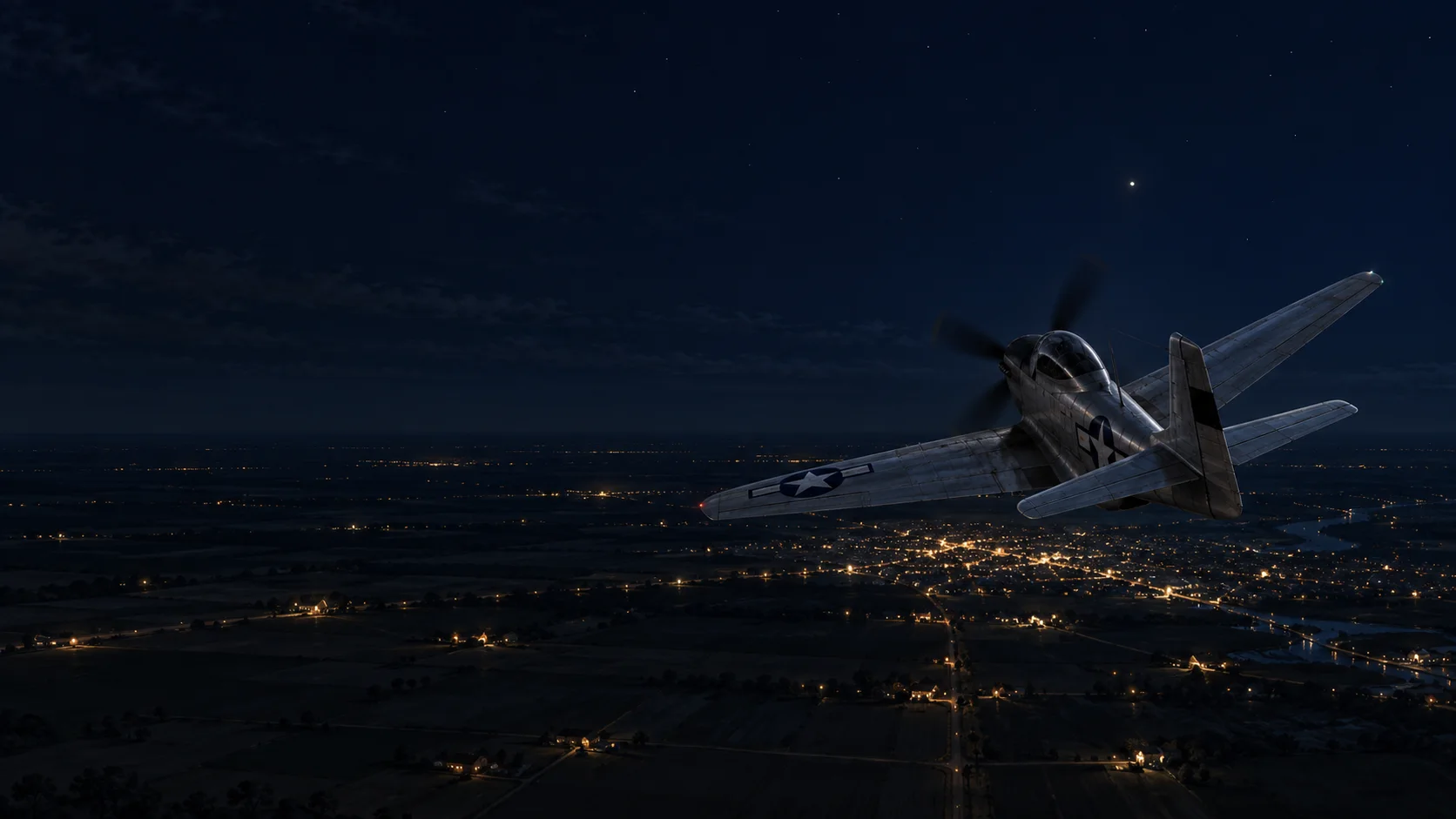
George Gorman could see the Piper Cub below him. He could make out its outline against the lights of Fargo.
The other light had no outline he could identify.
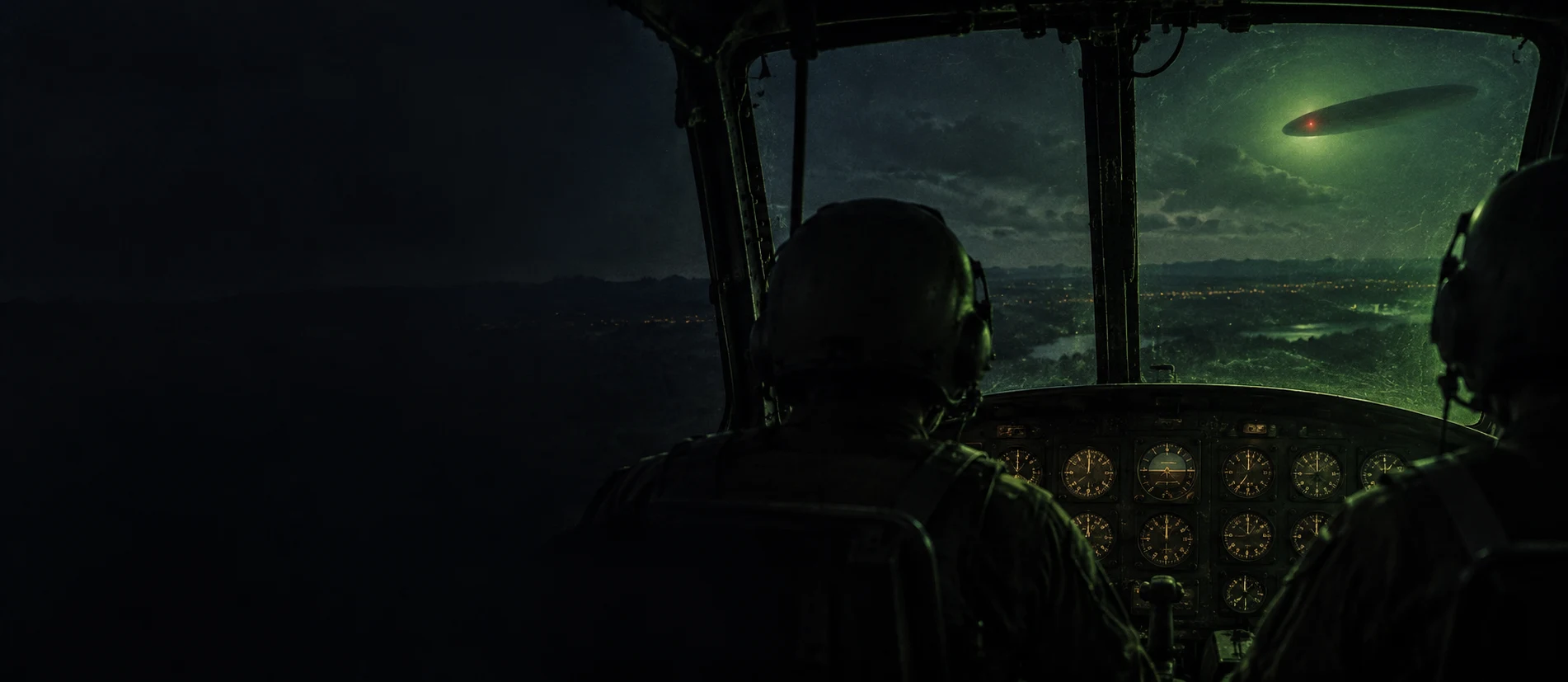
It was October 1, 1948. Gorman was circling the city in an F-51 Mustang when he noticed the light moving between Hector Airport’s tower and the football field. At first he took it for an aircraft’s rear navigation light: white, blinking, without much glare.
In his contemporary statement, he placed that first observation at about nine in the evening. He watched, looking for wings and a fuselage. The Cub remained recognisable. Around the unfamiliar light, he could distinguish neither.
At 9:07, he called the tower to ask whether another aircraft was in the air besides the Cub and himself.
They knew of no other local aircraft.
Gorman gave the tower his position, reported the light’s position, and told them he was peeling off to give chase.
Over the football field
The evening had begun as a flight that could have ended normally at Hector Airport. Gorman had returned from a cross-country trip and remained airborne for more night flying. He was twenty-five, a second lieutenant in the North Dakota Air National Guard, with wartime flying and instructing experience recorded in the investigation.
Below him, another pilot was also taking advantage of the evening.
Dr. Cannon and his passenger had left the nearby Skye Ranch flying field at about 8:40. Cannon flew the Piper Cub while his companion handled the radio. They circled the football field at about 1,600 feet, in contact with the Fargo tower.
The controllers advised them that a Mustang was in the air. A few moments later, they asked who the third aircraft might be.
Cannon had already noticed Gorman’s fighter. As the Cub passed north of Hector Field, heading west, a light went above them and to the north, moving rapidly westwards. At first, Cannon thought it belonged to the Mustang.
Then he saw the fighter’s lights higher up, more nearly over the field.
Two aircraft were expected. There was another light to account for.
Cutting inside the turn
Gorman’s first attempt to overtake it became a pursuit in which the light seemed to keep the advantage.
The October 4 interrogation report describes him approaching what he believed was another aircraft. The white light had been blinking; as he closed, it became steady and appeared to bank sharply left.
He dived after it and increased power. He could not catch it.
In his longer statement, Gorman explained the next decision plainly. A straight chase was failing, so he would try to intercept through the turns. His reported speed varied between 300 and 400 miles an hour, with the fighter under full power.
As the light circled left, he cut back to the right.
That brought him onto what appeared to be a head-on course. He put the first such approach at roughly 5,000 feet. The light came towards him until, in his description, a collision seemed inevitable.
He turned away. The light passed above him, at a separation he estimated as 500 feet or less.
Gorman brought the Mustang round again. For a moment he did not have the light in sight. Then, he said, it made a half-turn and came back towards him.
Following it upwards
On the next approach, Gorman held his course longer.
His statement says he matched the light’s approach until it began to pull up. He then pulled up abruptly himself, trying to ram it.
The reported encounter had changed from an effort to identify traffic into an attempt to make contact with a small light. In the climb, Gorman followed it towards 14,000 feet.
The Mustang stalled.
Gorman’s account places the light about 2,000 feet above him, circling to the left. He described making two left circles before another head-on approach. The light then broke away, apparently travelling over Hector Airport towards the northwest at about 11,000 feet.
He continued trying to cut it off. By his estimate, the chase carried him as far as twenty-five miles southwest of Fargo.
He was still at about 14,000 feet. He placed the light lower, near 11,000, and again applied full power in a descending turn. Another apparent head-on approach followed.
This time, he pulled up with it and watched it continue straight upwards until he lost sight of it.
Then he returned to the field.
From the tower windows
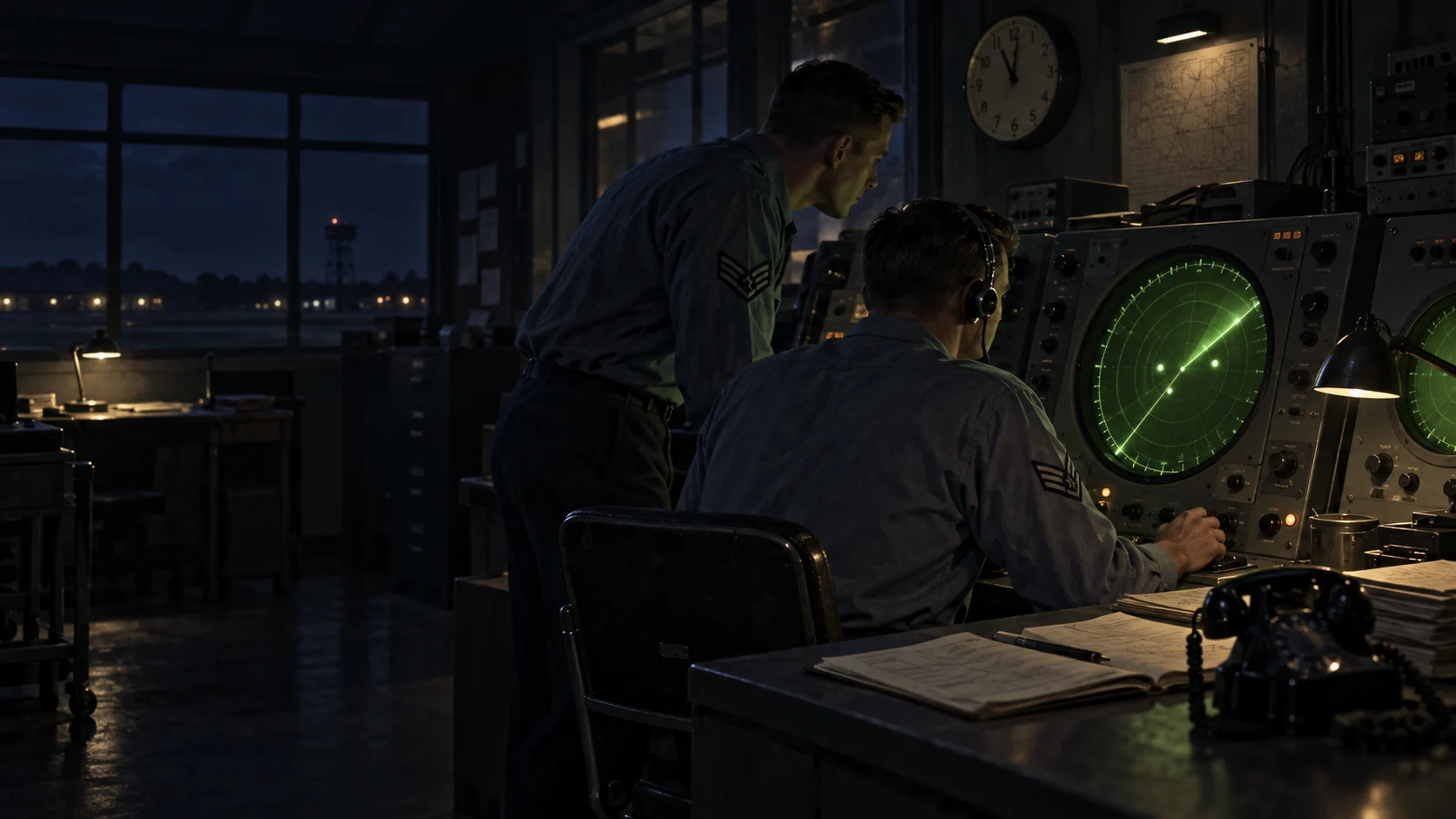
The men in the tower had a different view of the same evening. They were watching from the airport while Gorman changed position, altitude and direction above the surrounding country.
Manuel E. Johnson, the assistant controller, wrote a statement dated that night. He first noticed the light east of the airport. It appeared to be heading north, then northwest, and seemed faster than the Piper Cub, which he could see at the same time.
Johnson could identify no definite outline.
Lloyd D. Jensen also put his observation in writing. Using binoculars, he saw a round, clearly edged light apparently travelling southwest between his position and the city. The F-51 was some distance behind it. Jensen thought the separation was increasing.
His account put the observation at approximately 9:10. He described a light without rays or a fuzzy border, and no other visible shape.
The later interrogation was more specific about the extent of his observation: Jensen had seen it pass over the field, rather than watching the full series of manoeuvres Gorman described.
The controllers’ accounts gave the investigation another vantage point. They had seen something they could describe as a light, with familiar aircraft nearby for comparison. The turns and climbs farther from the field belonged chiefly to the pilot following it.
The Cub comes down
Cannon and his passenger landed on runway three and taxied to the administration building. They went up to the tower.
In Cannon’s statement recorded at 11:20 that night, he described listening to calls from the Mustang, which seemed to be trying to overtake the light. He watched it move southwest over the city and thought it was travelling faster than the fighter.
They tried binoculars, but could not follow it well enough for a better view.
Cannon also reported seeing the light and the Mustang simultaneously, with the light apparently outside the circle made by the fighter. He had observed from his own aircraft, then from the tower, while Gorman continued flying.
After the Mustang landed, Cannon and his companion took off again and returned to Skye Ranch. Their flying-sheet entry recorded their return at 10:20.
Gorman’s landing had required more attention than an ordinary conclusion to the flight. The October 4 report says he was sufficiently excited to make two passes at the field before landing properly. It also records his statement that he had noticed no deviation on his instruments during the encounter.
He estimated that he had kept the light in view for twenty-seven minutes.
Putting the flight on paper
After landing, the encounter became a set of questions. Where had he first noticed the light? How close had it come? What shape had it appeared to have? Had its brightness or colour changed?
Gorman described a white light with a clear edge, apparently flat rather than a sphere with visible depth. He estimated its diameter at six to eight inches during a close pass.
He associated blinking and changes in intensity with slower movement. When it appeared to accelerate, he said, the light brightened and became steady. Asked whether he thought it was controlled, he answered that he did.
In a further October discussion, he explained why he had considered ramming it. It had appeared so small that he thought contact might cause limited damage to his own aircraft.
He also described momentarily blacking out during tight turns. His report compared the strain he experienced with the manoeuvres he attributed to the light. It had followed curves, he said, rather than changing direction through right angles.
Investigators collected statements, drew flight paths and examined the Mustang with a Geiger counter. A follow-up comparison included other F-51s, and the file preserves tables and discussion of the readings.
The radio conversations themselves could not be supplied. An October 16 transmittal explained that Hector’s control tower had no recording device. What could be sent onwards was the written testimony of the people who had flown and watched that night.
What Is Known
The surviving Air Force file records Gorman’s pursuit as a contemporary report, supported by separate observations of a light from Cannon and the tower controllers. Those accounts support the presence of a visible stimulus; they do not independently establish every apparent head-on approach, altitude or turn in Gorman’s narrative.
His estimates of the light’s size, range and performance are witness estimates. His fighter’s reported speed and altitude describe his own flight, rather than measurements of the other object. His belief in intelligent control is expressly recorded as his interpretation.
The investigation’s assessment developed over time. The Air Intelligence Report dated April 28, 1949 retains a summary saying that aircraft and meteorological balloons had been eliminated. The University of Colorado’s later historical review dates the Air Weather Service analysis favouring a lighted balloon to January 24, 1949. The surviving documents therefore should not be presented as a single, uniform conclusion.
Edward J. Ruppelt, who later led Project Blue Book, also endorsed the balloon explanation in his 1956 book. His account is a retrospective review, published years after the flight, rather than another eyewitness description.
The Geiger-counter material likewise requires its own reading. The comparative report associated higher readings with luminous instruments and other radiation sources aboard the aircraft, and recorded very low readings from wings and tail surfaces. It did not establish extraordinary contamination from the light.
Gorman landed safely. The documentary record preserves a demanding flight and the investigation that followed; it does not establish an extraterrestrial opponent.
The Bigger Picture
The “dogfight” label captures how Gorman experienced the encounter: an attempted interception in which another light seemed to respond to his manoeuvres. The people at the tower had a narrower experience, watching a light cross part of their view while listening to the pilot.
That distinction matters in night flying. The FAA’s aviation guidance describes autokinesis, in which a stationary light can appear to move when watched against darkness, alongside other visual illusions. This is relevant context for evaluating an encounter with a light; it is not a reconstruction proving which illusion, if any, occurred over Fargo.
The case also belongs to the opening years of the Air Force’s UFO inquiry. Gorman’s flight was investigated under Sign, before Blue Book acquired that name. The National Archives describes the resulting collection of case files, arranged by sighting date and preserved on microfilm for public research.
Its enduring scene is a pilot searching for the outline of an aircraft, finding only a light, and turning towards it. The flight that followed is preserved through his answers and the observations of others, each watching from a different place.
Sources
- U.S. Air Force, Fargo incident 172, October 1948. Contemporary statements, interrogations and field investigation reports, preserved in a microfilm scan; Fargo material occupies the opening section. Original records.
- U.S. Air Force, Air Intelligence Report 100-203-79, April 28, 1949. Official analysis containing a Gorman summary; consulted through an archival transcription. Transcription.
- Edward J. Ruppelt, The Report on Unidentified Flying Objects (1956), chapter 3. Former Project Blue Book chief’s retrospective account and balloon assessment. Transcription.
- University of Colorado, Scientific Study of Unidentified Flying Objects (1968), Section V, chapter 2. Later historical review, including the January 1949 Air Weather Service assessment. Report text.
- National Archives, Project Blue Book research guide. Independent institutional context for the surviving Air Force case files. Guide.
- Federal Aviation Administration, Aeronautical Information Manual, chapter 8, section 1. Independent aviation context on visual illusions in flight. Medical Facts for Pilots.