The light was between the trees.
Lieutenant Bruce Englund pointed ahead, trying to show Lieutenant Colonel Charles Halt where to look. The party had been examining marks in the forest floor. Now something beyond their torchlight had drawn their attention away from the ground.
Halt saw it too.
He described a small red light, somewhere out in the darkness. It disappeared, then returned. He asked the men to extinguish their torches and move towards the edge of the clearing for a better view.
A recorder was running in his hand. On the tape, directions and instrument readings gave way to short exchanges about the light ahead.
The deputy base commander had gone into Rendlesham Forest after his men reported something unusual beyond an airfield gate. Now he was following a light himself.
Beyond the perimeter
It began during the final days of December 1980, outside RAF Woodbridge in Suffolk.
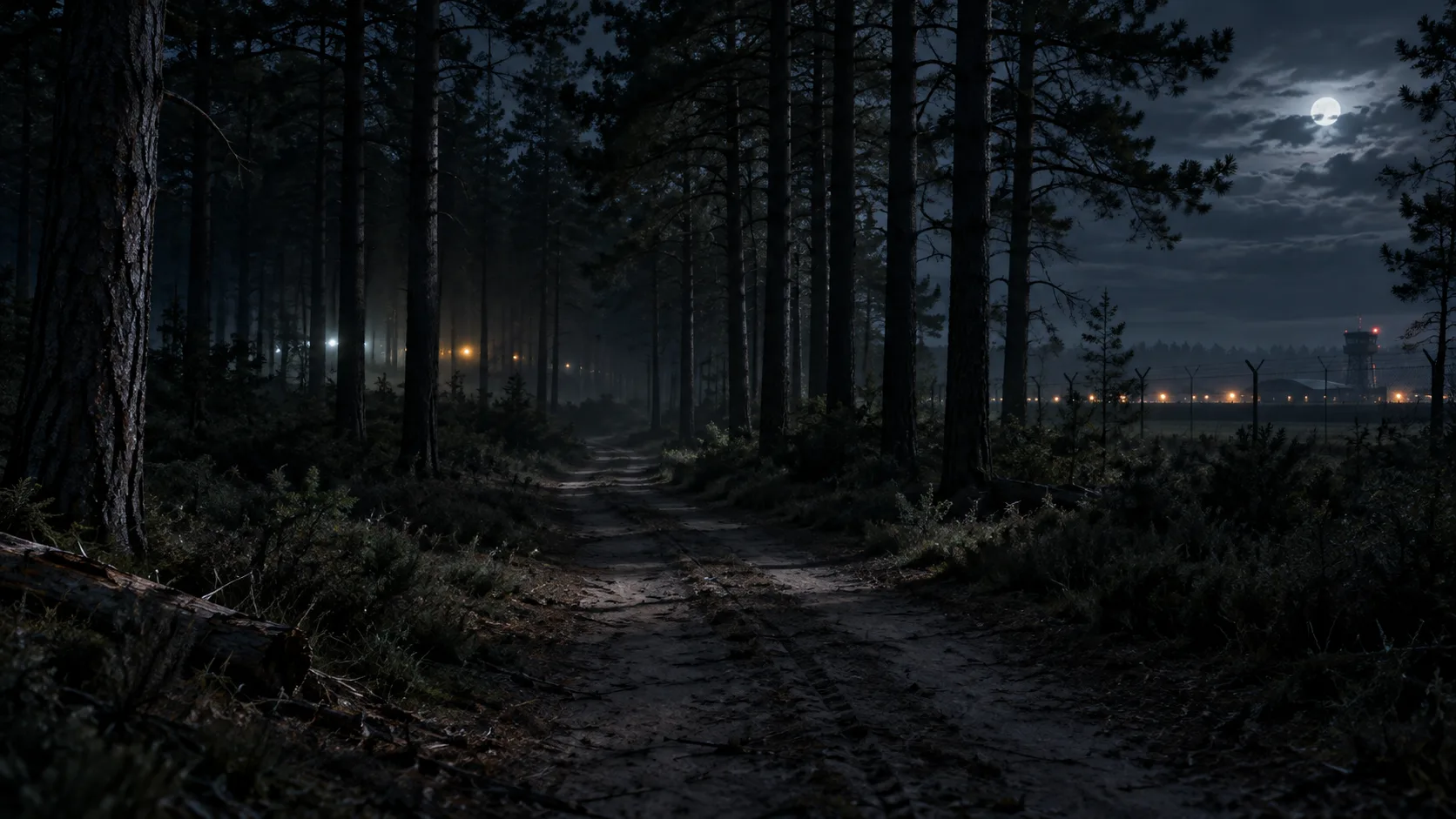
The airfield was used by the United States Air Force. Its eastern gate opened towards the forest, a landscape of tracks, pines and open ground separating the base from the countryside beyond.
Security patrolmen noticed unfamiliar lights in that direction. Their first concern was that an aircraft might have crashed or made a forced landing. They contacted their superiors and asked permission to investigate outside the perimeter.
In his handwritten statement recorded in January 1981, Airman John Burroughs described red and blue lights flashing beyond the gate. He and his patrol partner went down the road for a closer look, then returned to call the sighting in.
A white light appeared to come down into the woods. The red and blue lights remained visible.
Three men were allowed to proceed into the forest on foot.
Into the woods
Burroughs described taking a vehicle down the road that led into the trees, stopping and continuing on foot across an open field.
Ahead, the illumination seemed to light the woods. There were sounds as well. He remembered noises among the trees and animals making a disturbance nearby.
The patrol had left the familiar boundary of the airfield. The route now took them towards the lights they had seen from outside the gate, across ground where trees interrupted their view.
Burroughs recalled the lights appearing to draw back towards the field. As the men moved into the trees, the illumination shifted out into the open. They continued after it.
In the account later summarised by Halt, the patrolmen described something more than separate points of light. They reported a glowing form among the trees.
White light, red above, blue below
Halt’s January 13 memorandum preserved their description: an object that appeared metallic and triangular, roughly two to three metres across the base and about two metres high.
White light illuminated its surroundings. Above it was a pulsing red light; beneath it, blue lights. The men described it as hovering or standing on legs.
As they approached, they reported that it moved through the trees and disappeared.
The search continued beyond that first view. Burroughs’s statement follows the men across the field and towards a farmhouse. He remembered a beacon farther away, which they followed before turning back. On the return, a blue light appeared briefly to their left among the trees.
Then they made their way back to the vehicle.
The gate had been their starting point. The night had taken them into the woods, across open ground and back again, with changing lights giving the search its direction.
A place to return
The following daylight visit brought attention to the ground.
Halt recorded that three shallow depressions had been found where the apparent object was reported. Each was about seven inches across and an inch and a half deep. Together, they formed a triangle.
The forest now contained a particular place to examine. The first patrol’s observations had given the search an area; the marks gave subsequent visitors points they could identify and revisit.
When Halt went out on a later night, his party brought a radiation survey meter, lighting equipment and a night-vision scope. He also carried the small recorder with which he would make notes aloud.
Its surviving recording begins with practical difficulties. A portable lighting unit would not work. Another was requested while the men started checking the area.
The clicks in the clearing
The live tape, transcribed by Ian Ridpath with assistance from Halt, places the listener beside the men as they moved between the impressions.
Sergeant Monroe Nevels operated the survey meter. Halt asked about the readings, then directed the party towards the centre of the triangle. The exchanges move between audible clicks, the needle’s deflection and the position being checked.
They numbered the marks so the site could be sketched. The one nearest the Woodbridge base became point one; the others followed clockwise.
Nearby trees received attention too. Englund pointed out abrasions facing towards the area they were examining. Halt discussed collecting a sample from a pine and asked for a photograph of the mark.
They were building a description of the place while standing in it: ground impressions, tree surfaces, positions and readings, each added to the tape in turn.
Through the scope
The men looked at a marked tree through the night-vision scope.
Torches went on to help locate the trunk, then off so it could be viewed through the instrument. Halt described a white streak on the tree. They moved their attention to the impressions and the patch near the middle of the triangle, talking about slight increases in brightness.
The recording follows their movements in small directions: step back, find a corner, focus on the spot, switch off the light. Halt warned the men to avoid walking over the marks they were examining.
Above them was an opening in the trees. He noted broken pine branches on the ground beneath it.
At 1:48 a.m., he recorded strange animal sounds. The discussion had been centred on the clearing and its marks when Englund drew his attention to a light straight ahead.
Halt asked where it was.
The search changed direction.
The red light returns
Englund pointed between the trees. Halt saw the light and began describing it into the recorder.
He initially estimated it might be a quarter to half a mile away, perhaps farther. When it disappeared, he recorded its direction. Englund then announced that it was back.
They moved towards the clearing’s edge, keeping their torches off. The scope was brought to bear on the light.
As they watched, the men described changes in colour and apparent movement. Halt called it red; Englund saw yellow, and Halt acknowledged a yellow tinge. The light seemed brighter. He said it was coming towards them.
Another voice called attention to what looked like pieces coming away from it. Halt repeated that observation.
The exchanges became shorter. Their attention was concentrated on the changing brightness ahead, with the forest still between them and the source.
An eye in the darkness
They approached the edge of the woods carefully.
Halt compared the light to an eye winking at them. Through the scope, he described a dark centre, and another voice compared it to a pupil. The surrounding flash appeared especially bright through the instrument.
The image gives this part of the recording its peculiar intimacy. The party was looking outward across dark country, yet the description made the light seem to look back.
They continued past a farmhouse and into another field. Halt recorded several lights of a similar appearance, now seeming steadier. They crossed a creek and continued checking the meter as they moved.
At 2:44 a.m., he placed the party on the far side of the second field. A light was visible towards the coast, close to the horizon, moving about in his view and flashing intermittently.
The expedition had carried them away from the marked clearing. They were now watching across the open countryside.
Above the field
Shortly after three, Halt recorded sporadic flashes and turned his attention north.
He described two lights low above the horizon, appearing half-moon-shaped, with changing colours. Their shapes then seemed to become full circles. In his later memorandum, he described northern lights showing red, green and blue and making sharp movements.
At 3:15 a.m., his recording placed another object to the south, also low above the horizon. Voices discussed apparent movement in both directions.
Then Halt reported what looked like a beam descending towards the ground.
The words arrived amid the observations, followed by an exclamation and a laugh. The party had begun by checking impressions underfoot. Now its commander was describing light coming down from above.
At 3:30, he said the objects were still visible. The men turned back towards the base.
At four, his final timed entry described a light in the direction of Woodbridge, still moving in his view and apparently sending illumination downwards.
The walk ended with the lights still part of the night. The recorder had carried the party’s attention from the forest floor, to a flashing presence beyond the trees, and finally to the sky.
What Is Known
Rendlesham has several contemporary records with distinct perspectives. Burroughs’s January 1981 statement preserves his account of the first patrol. Halt’s live recording documents the later expedition’s spoken observations, movements and instrument checks. His signed memorandum combines the first patrol’s reported object with ground observations and lights he witnessed himself.
Their calendar dates differ. Burroughs’s statement begins with the night of December 25–26; the tape reconstruction places Halt’s expedition in the early hours of December 28. His memorandum dates the initial event December 27 and the later survey December 29. The narrative follows the sequence without treating those dates as interchangeable.
The memo gives a beta/gamma figure of 0.1 milliroentgens at the impressions and centre, with lower readings beside a tree. These are recorded survey readings. The tape’s descriptions through the night-vision scope are the men’s interpretations of visible brightness, rather than a thermal measurement.
The National Archives’ research guide identifies the memorandum in the Ministry of Defence files. In a 1997 parliamentary answer, the government said air-defence staff had assessed it and judged there was nothing of defence significance requiring further action.
These records establish the reported encounters and the expedition undertaken in response. The patrol’s apparent structured object, the later flashing light and the sky observations remain different reported experiences; the documents do not establish a shared identity or an extraterrestrial origin.
The Bigger Picture
The setting makes Rendlesham distinctive. A military perimeter stood beside a working forest. Security personnel looking out from the gate could move into a landscape of trunks, tracks, clearings and fields, then look farther towards the Suffolk coast.
The case unfolds across that changing landscape. The first patrol left a post to investigate a possible aircraft emergency. Halt’s party returned with equipment and procedures for examining a location. Their task took on a different character when a light appeared beyond the trees, and they followed it out into open ground.
The recording preserves that transition especially well. Directions, survey readings and radio exchanges share the tape with attempts to describe something unfamiliar. The voices belong to men carrying out a search while trying to decide where to look next.
Today, Forestry England’s three-mile UFO trail takes visitors through forest, heathland and wetlands associated with the December sightings. A place once approached from a guarded gate has become a landscape people enter deliberately to imagine the encounter.
The archive offers another way to follow it. A handwritten account takes readers into the first search. A memorandum gathers the reported events. The tape brings back the changing focus of one expedition, from a mark on a pine to a red light ahead.
The men returned towards Woodbridge. Their voices still carry listeners out beyond the gate.
Sources
- John Burroughs, January 1981 handwritten statement, reproduced in the archived document collection. Early firsthand account, including the approach from the gate and the forest search; scans reproduced from Georgina Bruni’s book.
- Charles Halt, live tape transcript, compiled by Ian Ridpath with Halt’s assistance. Contemporary spoken observations; the narrative uses the recording, separately from the transcriber’s explanatory notes.
- Charles I. Halt, “Unexplained Lights,” January 13, 1981. Signed contemporary memorandum, FOIA copy and transcription.
- UK National Archives, UFO files research guide. Archival provenance and the Rendlesham records.
- UK Parliament, October 14, 1997, answer on the memorandum’s assessment. Official account of the Ministry of Defence’s response.
- Forestry England, Rendlesham Forest UFO trail. Independent geographical and public-history context.