The ship returned. The people did not.
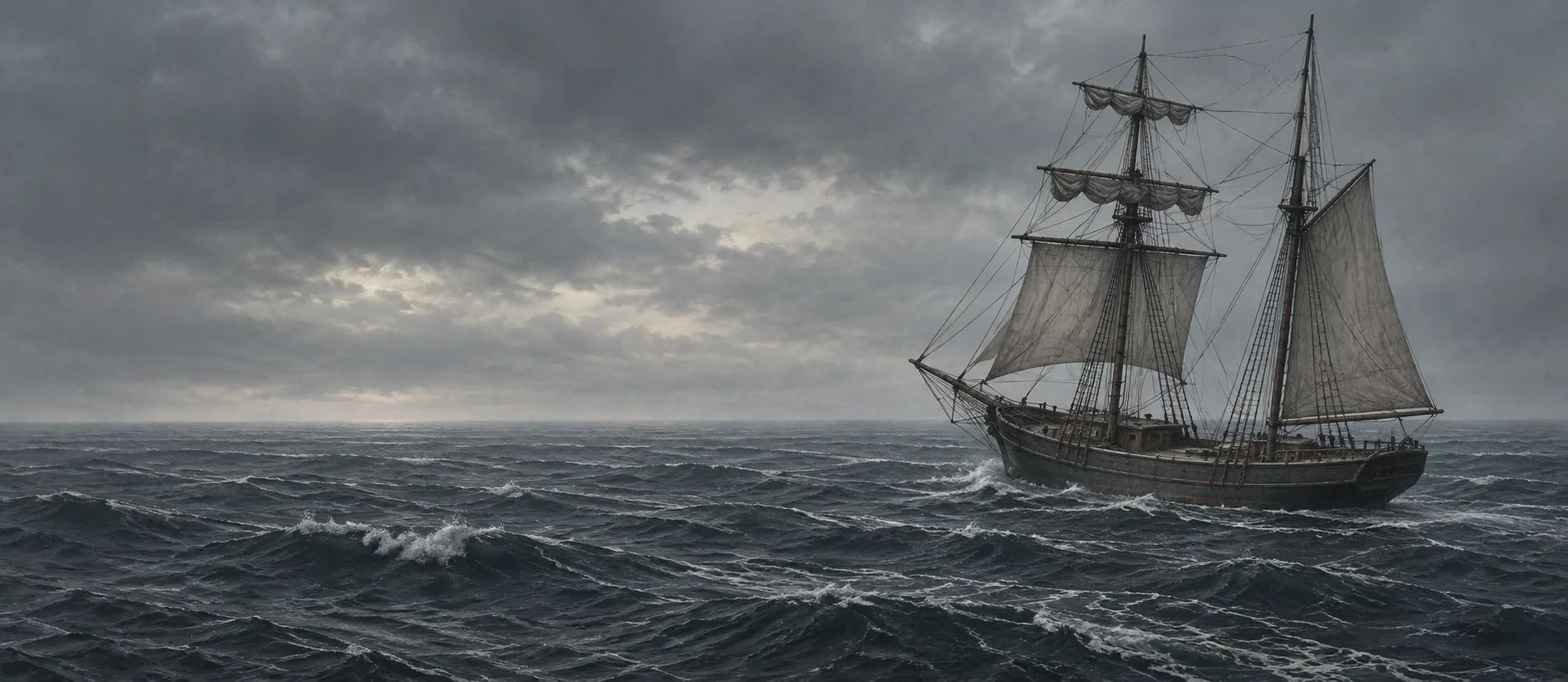
On December 13, 1872, the Mary Celeste reached Gibraltar. The local newspaper’s first report described an abandoned vessel brought in by men from the Dei Gratia.
There was no explanation for where her people had gone.
The discovery would become a legend of a perfectly preserved vessel from which everyone had vanished in an instant. The surviving records tell a rougher, more complicated story. They contain water, damaged equipment, an absent boat, an inquiry searching for a crime, and investigators unable to explain a departure.
The enduring question is a decision: what made ten people leave the larger vessel that could still carry someone safely across the sea?
A family crossing
The Mary Celeste left New York on November 7 for Genoa, carrying alcohol. Captain Benjamin Spooner Briggs travelled with his wife Sarah, their two-year-old daughter Sophia and seven crew. Royal Museums Greenwich’s curator account identifies that company.
In early December, Captain David Morehouse’s Dei Gratia encountered the brigantine east of the Azores. Her erratic course and lack of response prompted a boarding party. Oliver Deveau and John Wright went aboard and found nobody.
The final notation on the log slate was from the morning of November 25. The people who could explain what followed were gone.
These details begin a timeline without completing it. The last entry marks the end of the surviving shipboard account. It does not record everyone stepping into a boat. Between that notation and the boarding party’s arrival lay the interval the inquiry would try to recover.
The wet ship
Deveau’s boarding evidence, as summarised from the inquiry by Jim Watt, describes a vessel that needed attention. One pump was out of order; he used the other on the journey to Gibraltar. The forward and after hatches were off, and water had entered between decks.
The galley was disordered. The stove had shifted, cooking utensils were scattered, and the captain’s bed needed drying. The chronometer, sextant and ship’s papers were missing. A sailor reported that no boats remained aboard.
This was the condition found by people who would have to make the vessel work again. It gives the abandoned ship a different texture from the untouched rooms of the familiar ghost story.
The inventory also points toward an evacuation. A missing boat and absent navigation equipment fit people preparing to leave. They do not establish whether the departure was organised, panicked, temporary or forced.
There is a crucial difference between finding evidence compatible with escape and finding a record of an escape. The boarding party reached the scene after the act that mattered. Their task was to bring the ship in, with the answer already somewhere beyond her rails.
The voyage after the disappearance
Deveau and two sailors sailed the Mary Celeste to Gibraltar. She was not simply towed behind the Dei Gratia. Charles Edey Fay’s documentary corrections, first published in 1942 and reproduced online, distinguish those accounts.
Three men could work the deserted vessel well enough to reach port. That practical achievement made the abandonment harder to understand. It also left the salvors exposed to questions about a ship they had rescued and a company they had never seen.
Even the discovery date needs care. Greenwich gives December 4; Smithsonian’s later account gives December 5. Fay explains the difference through nautical dating, in which the day changed at noon. This article uses early December to avoid presenting the differing dates as two separate encounters.
Fay also checked the story of warm food waiting on the table. His cited testimony records no meal there and no cooked food in the galley. The famous interrupted breakfast supplies a dramatic moment of disappearance that the evidence does not supply.
What reached Gibraltar was a vessel with a missing company, not a clock stopped at the instant they left.
Below the waterline
The inquiry could examine the ship even if it could not question her original crew.
On December 23, diver Ricardo Portunato inspected the underwater hull at the direction of the court’s marshal and shipping surveyor John Austin. His sworn affidavit describes a careful search for damage from collision, grounding or another accident.
He reported none. Hull, keel, sternpost and rudder appeared in good condition, as did the copper sheathing. He believed such an accident would have left marks that he could discover.
It was a bounded finding. Portunato could speak about the surfaces he examined in Gibraltar. He could not reconstruct the sea conditions at the moment of abandonment or rule out every temporary source of alarm.
His examination nevertheless removed one direct route to an explanation. There was no underwater wound showing why everyone had needed to escape. The vessel’s bottom had failed to preserve the sort of catastrophe that might have made the missing boat self-explanatory.
The surveyor’s inventory
Austin’s sworn report, reproduced through Fay’s transcription, is unusually detailed. He spent hours examining spars, planking, fittings and rooms. He found narrow injuries on both bows and judged them to have been made with a cutting instrument. That interpretation would become part of the suspicion surrounding the vessel.
Intact fittings and dry belongings led him to argue against exceptionally violent weather.
The pump also appears in his inventory. One worked; the other’s valve had been removed to allow a sounding apparatus into the well. He found that apparatus nearby.
Austin reported no traces of fire or explosion. He considered the ship sound and could discover no reason for abandonment.
His observations took place after the passage to Gibraltar. They differ in emphasis from the boarding account’s wet, disordered scene. Those descriptions should retain their dates and purposes. Treating them as one simultaneous inspection would erase the voyage, work and time between them.
The sword and the stains
A sword and reddish marks offered the inquiry another direction. Gibraltar’s attorney general, Frederick Solly-Flood, suspected foul play. The stains could appear to supply the physical evidence such a suspicion required.
Dr. J. Patron’s January 1873 report follows that possibility through actual tests. He inspected the ship, collected suspicious material, and examined the sword and its sheath. His first impression of some marks on the blade was that they could be blood.
He then tested them. Material was soaked in distilled water and heated; samples were examined microscopically, and some blade stains were treated with acid. The apparent incrimination did not survive those procedures. He described iron-related material and vegetable fibres, and reported finding no blood globules.
His conclusion was that, by the scientific knowledge and tests available to him, the examined stains were not blood.
This is one of the case’s clearest changes in evidential status. A suspicious appearance had prompted a hypothesis. Examination weakened it. The sword remained an object aboard the vessel, but its presence could no longer bear the same accusation.
A newspaper changes direction
The Gibraltar Chronicle reports show the story developing while the inquiry proceeded. Its January coverage treated possible violence seriously. By March, it described Captain Shufeldt of the U.S. ship Plymouth rejecting mutiny after visiting the brigantine.
He interpreted the bow damage differently from the surveyor, suggesting splintering and the action of the sea. He proposed an abandonment during alarm about leakage, perhaps with another ship nearby. Those were contemporary conjectures, not sightings of Briggs leaving.
On March 15, the paper reported a salvage award of £1,700. The dispute had produced a legal outcome without recovering the missing people.
The change in reporting matters. The earliest version of a mystery may preserve important observations and also an explanation that later evidence undermines. Here, the record contains the correction as well as the accusation. Reading only the suspicious sword or damaged bows would stop the inquiry before it had finished examining them.
What the record establishes
The Mary Celeste was found without her original company, with her boat missing, and was sailed to Gibraltar by salvors. The inspections found no underwater collision damage and no confirmed blood in the tested marks. Those facts support a real disappearance at sea. They provide no evidence of a supernatural removal.
An evacuation followed by loss of the boat is the most economical general account of the missing people and equipment. The cause of that evacuation remains unresolved. Fear of sinking and fear arising from the alcohol cargo are plausible possibilities; neither comes with testimony from someone who witnessed the decision.
Fay’s retrospective hypothesis suggested fumes escaping from a poorly ventilated hold could have alarmed the company. It explains how a ship might be abandoned without subsequently burning. It requires circumstances not established by the ship’s later condition: a dangerous or frightening concentration, an encounter with it, and a decision to take to the boat.
Later research pursued another route. In Smithsonian’s 2007 interviews, documentarian Anne MacGregor and oceanographer Phil Richardson described reconstructing drift from historical marine weather data. They found an uncrewed passage from the last recorded position to the discovery area feasible.
MacGregor proposed that pump problems, possible debris and uncertainty about incoming water could have prompted abandonment near Santa Maria. The reconstruction makes a scenario possible. It does not establish the pump’s exact failure or Briggs’s reasoning. Austin’s later inspection of the sounding apparatus is another detail that any such explanation must address.
The primary documents used here are online transcriptions, rather than fresh examinations of the original Gibraltar papers. Their provenance is stated in the source list. That gives readers a way to follow the evidence while preserving the difference between a historical document and the modern page carrying it.
The Bigger Picture
The case also shows how an unresolved event can accumulate a second history made of confident stories. Greenwich’s curator identifies Arthur Conan Doyle’s fictional 1884 “J. Habakuk Jephson’s Statement” as a major source of confusion, including the enduring name “Marie Celeste.” A memorable narrative can outlive the distinction between fiction and testimony.
There are more productive ways to revisit an old mystery. NOAA’s ICOADS documentation describes an archive of marine observations extending back centuries, including ships’ reports and later measurements. Those observations allow environmental questions to be tested using records beyond the vessel’s own surviving account.
A drift reconstruction can ask whether an unattended ship could travel between two positions. A chemical test can ask whether a stain is blood. A hull inspection can ask whether a collision left damage. Each answers a question small enough for evidence to constrain.
The remaining question concerns the transition between the ship and the missing boat. A contemporaneous sighting of that boat, or a new record placing the people aboard it, would advance the case far more than another complete explanation built around the same gaps.
The ship survived long enough to be examined. The decision that emptied it did not leave an equally durable record.
Sources
- John Austin, sworn survey report. Contemporary inspection; reproduced through Fay’s transcription from a photostat.
- Ricardo Portunato, diver’s affidavit. Contemporary underwater inspection, transcribed online.
- Dr. J. Patron, suspected bloodstain report. Contemporary tests, transcribed online.
- Gibraltar Chronicle, December 1872–March 1873. Contemporary reporting, transcribed by Jim Watt.
- Royal Museums Greenwich, “The mystery of the Mary Celeste.” Curator’s retrospective account and literary context.
- Jim Watt, court-based boarding account. Modern summary of discovery testimony.
- Charles Edey Fay, documentary corrections, 1942. Retrospective source review with original-record references, reproduced online.
- Fay’s alcohol-vapour hypothesis. Later conjecture, reproduced as an excerpt.
- Jess Blumberg, “Abandoned Ship,” Smithsonian, 2007. Direct interviews about the modern reconstruction.
- NOAA NCEI, ICOADS documentation. Independent context for historical marine observations.