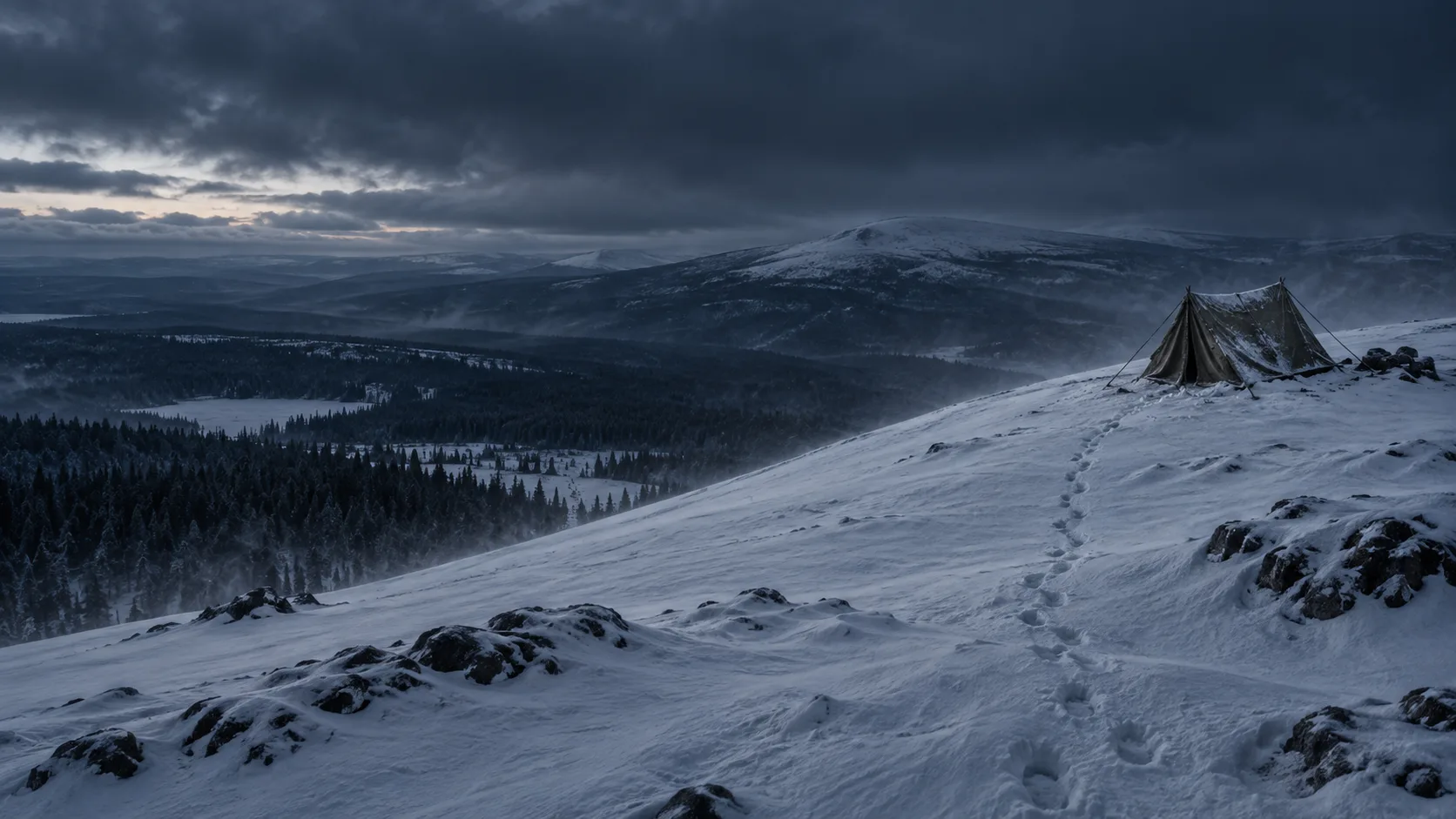
When searchers found the tent on the eastern slope of Kholat Syakhl in February 1959, the nine people who had slept there were gone. The shelter still held backpacks, blankets, food, and most of the group’s footwear. A prosecutor’s inspection of the campsite listed boots, felt boots, jackets, a stove, axes, notebooks, a route plan, and a camera. There were no bodies inside.
The trail led away from these things. According to the investigation’s May closing resolution, eight or nine sets of footprints survived for part of the descent toward the forest. Some prints appeared to have been made by feet in socks or minimal footwear. At the forest edge the tracks disappeared under snow. Roughly 1.5 kilometres from the tent, searchers found a small fire beneath a cedar and two dead hikers nearby. Three more lay between the tree and the shelter. Four would not be found until spring.
The trail shows a group leaving a stocked tent, reaching the trees, and failing to return. It does not show what drove them out.
The last recorded day
Igor Dyatlov led an experienced ski party from Sverdlovsk, now Yekaterinburg, into the northern Urals in January 1959. Ten people set out. Yuri Yudin turned back near the beginning of the wilderness leg because he was ill, leaving nine to continue. The group’s route and Yudin’s departure are recorded in the 1959 prosecutor’s summary. The nine were Dyatlov, Lyudmila Dubinina, Zinaida Kolmogorova, Aleksander Kolevatov, Yuri Doroshenko, Yuri Krivonischenko, Rustem Slobodin, Nikolay Thibeaux-Brignolle, and Semyon Zolotaryov.
In the group diary’s entry for 31 January, the hikers described a clear sky, wind, difficult trail breaking, and an exhausting climb toward the edge of the forest. They turned back down into the Auspiya valley to camp among trees. The pace was slow, firewood was scarce, and pitching the tent took effort.
On 1 February, the party left a cache of supplies in the upper Auspiya valley and climbed again. The 1959 resolution says developed photographs showed them cutting a level platform in the snow for their final camp on the slope of Kholat Syakhl. The investigator estimated that they began putting up the tent around late afternoon. No later diary entry or photograph in the case file records what happened there that night.
The camp was a stage of their planned journey toward Mount Otorten. They were due to report their return by telegram on 12 February. When no message came, other hikers pressed for a search. The case summary says the first search party was sent on 20 February; more searchers and aircraft followed.
The shelter they left
The tent was found on 26 February. A formal campsite protocol drawn up on 28 February placed it on a snow platform on the northeast slope of the mountain, above the sources of the Auspiya. Skis lay beneath it. Nine backpacks and an array of clothing and equipment remained inside. These were the materials the group would have needed if it intended to keep travelling.
The fabric carried different kinds of damage. Searchers had handled the tent before the laboratory examined it, so a general statement that it was “slashed” can obscure what the specialist actually established. In April, forensic examiner Genrietta Churkina distinguished tears from three cuts in the surviving material. Her microscopic examination found marks on the inner face of the cloth consistent with a blade moving from inside the tent. That supports an emergency opening from within. It does not identify the person who cut it or the reason.
The closing resolution described eight or nine sets of footprints going downhill, close together in places and separating in others. Some hikers wore little or no outdoor footwear. Drifting snow erased the tracks near the trees, but their direction was clear: away from the tent and toward the forest.
The 1959 inquiry found no sign of a fight or tracks attributed to outsiders near the tent. Weeks of snow and wind had passed. The evidence describes departure and direction more securely than cause.
A fire under the cedar
At the forest boundary stood a cedar with broken lower branches. The scene inspection protocol recorded partly burned wood and other charred material beneath it. Yuri Doroshenko and Yuri Krivonischenko were found beside the remains of a fire, inadequately dressed for the conditions. Whatever had brought the party downhill, someone had tried to make heat at the trees.
Igor Dyatlov, Rustem Slobodin, and Zinaida Kolmogorova lay uphill from the fire, toward the tent. The May resolution interpreted their positions as attempts to climb back. Position alone cannot establish the order of their movements or whether they travelled together.
The original medical findings attributed the deaths of Doroshenko, Krivonischenko, Dyatlov, and Kolmogorova to cold. Slobodin had a skull fracture, but the investigation recorded freezing as his cause of death. Minor abrasions and the fracture did not supply an account of an attack at the campsite. Nor did the fire and footprints explain why the group had gone into the open with so much clothing still in the tent.
The search continued into May. Beneath deep snow near a stream, searchers found Dubinina, Zolotaryov, Thibeaux-Brignolle, and Kolevatov. The case resolution described clothing from Doroshenko and Krivonischenko near or on the four. Cut garments indicate that clothing had been redistributed; the record cannot tell us exactly when or by whom. The four were close to the cedar, but a different part of the site held them through the winter.
Their injuries made the case harder to settle. The 1959 forensic findings summarized by the prosecutor attributed Kolevatov’s death to cold. Dubinina and Zolotaryov had extensive rib fractures; Thibeaux-Brignolle had a severe skull fracture. Those are real traumatic findings, and they should not be collapsed into a single story about everyone freezing. At the same time, the injured bodies were found under metres of snow by a stream months after the last camp. The records establish the injuries, not the precise moment or mechanism that caused each one.
The inquiry’s unfinished answer
On 28 May 1959, prosecutor Lev Ivanov closed the criminal case. His resolution weighed the tent, the tracks, the valuables left behind, and the absence of evidence of a struggle. It concluded that the hikers had encountered a force they could not overcome. The document did not identify a specific physical event. It also treated the group’s route decisions harshly, calling some of Dyatlov’s choices mistakes; that judgment came from the investigator after the loss, not from an eyewitness to the final night.
One other detail has often been made to carry more than it can. A May 1959 radiological report found elevated beta contamination on selected pieces of clothing from the later-recovered hikers. The tested tissue samples were within the report’s natural range, and the specialist said some of the contamination could be washed from the garments. The report did not identify the source of the material or connect it to the party’s departure from the tent. Its unexplained presence on clothing is a question about provenance, not evidence that radiation killed the group.
Proposals multiplied: attack, military testing, strange lights, unusual winds, and avalanches. Each has to be tested against what searchers and doctors recorded.
Snow above the tent
In 2020, a renewed Russian prosecutor’s inquiry identified an avalanche as the cause of the disaster, according to TASS’s report of investigator Andrei Kuryakov’s announcement. That is a later official interpretation. It can be tested against the record, but the announcement does not turn an unseen slide into an observed fact.
The following year, snow scientists Johan Gaume and Alexander Puzrin published a physical model of a small slab avalanche. Their proposal does not require a vast wall of snow racing far down the mountain. It begins with a cut made to level the tent site. Wind then deposits more snow above a buried weak layer until a compact slab can fail after a delay. Their simulations show conditions in which a small block could strike the tent with enough force to cause serious injuries and prompt an abrupt exit.
This addressed two objections to an avalanche: the apparently modest slope angle and the lack of obvious avalanche debris when the tent was found nearly four weeks later. The researchers argued that the buried terrain was locally steeper than the smoothed snow surface, and that a small slide could leave little visible evidence after weeks of drifting snow. In follow-up fieldwork reported in 2022, they documented avalanche-prone terrain near the site and observed small slabs in the area. Those later observations strengthen the model’s plausibility; they are not a preserved trace of a slide in February 1959.
The scientists also stated the model’s limits. Their 2021 paper did not reconstruct the group’s actions after leaving the tent or settle exactly where all of the severe injuries occurred. It noted that a later impact in the steep ravine might account for some chest injuries. A snow-slab trigger therefore offers the strongest developed natural explanation, but the physical and human sequence between tent and ravine remains partly inferred.
What the record establishes
The contemporary record establishes a last camp on 1 February, a tent found on 26 February with much of the group’s gear inside, cuts that a 1959 examiner judged to have been made from within, footprints descending toward the forest, a fire at the cedar, and nine deaths in the surrounding terrain. The campsite protocol, scene inspection, tent examination, and closing resolution are records of different observations made at different times. Together they make a coherent trail; no single document witnesses the first emergency.
The best-supported broad account is that a sudden hazard at the tent forced an exit, and exposure became fatal as the group tried to survive below. A small snow slab is a scientifically supported candidate for that hazard. The later prosecutor’s avalanche finding and peer-reviewed model point in that direction by different methods. Neither establishes that this particular slope failed that night, how every hiker was injured, or the order in which the group divided its efforts among fire, shelter, and a return uphill.
The gaps matter most where the story is most dramatic. There is no surviving diary entry after the party pitched the last tent. The search began weeks later. The tracks were incomplete. The four bodies near the stream remained buried until spring. These limits invite reconstruction, but they also put a boundary around certainty. The group members’ final choices cannot be narrated as if someone had watched them make them.
The Bigger Picture
Dyatlov Pass is an example of a mystery built from unusually tangible evidence. There is a real tent, an examined piece of fabric, a line of footprints, body locations, and medical records. Yet each item answers a narrower question than the one most readers ask. The cuts show a direction of cutting. The tracks show a direction of travel. The fire shows an effort to endure the cold. None records the first sound, movement, or decision at the camp.
Snow science has changed what can be asked of that evidence. The American Avalanche Association’s account of wind slabs explains how wind can build a cohesive layer over weaker snow in specific terrain. Gaume and Puzrin used that general mechanism, local topography, and numerical modelling to test a proposed trigger. Their work makes an avalanche more credible than a simple glance at today’s slope might suggest, while their stated uncertainties keep the model from becoming an invented eyewitness.
The case also shows how an unexplained detail can be promoted into an explanation. Beta contamination on clothing, severe injuries, and a tent cut from inside are each documented in some form. Placed side by side, they look like clues to one hidden event. They may instead belong to different parts of the group’s history and its final night. Good reporting keeps their dates, locations, and evidentiary roles separate.
A contemporary photograph of the slope immediately after the escape, a reliable record of the snowpack that night, or a direct account from a survivor could decisively change the reconstruction. None is available. The most responsible ending is therefore specific: nine people left shelter, reached the forest, and died in the cold and snow; a small avalanche is a credible trigger, but the moment that drove them out remains unseen.
Sources
- Dyatlov group diary and chronology, English translations of contemporary entries
- 1959 protocol of the final campsite, English translation with Russian scan
- 1959 scene inspection protocol, English translation with Russian scans
- Genrietta Churkina’s 1959 forensic examination of the tent, English translation with Russian scans
- Lev Ivanov’s 1959 resolution closing the case, English translation with Russian scans
- Vladimir Levashov’s 1959 radiological report, English translation with Russian scans
- TASS: prosecutor’s 2020 avalanche conclusion
- Gaume and Puzrin, 2021 snow-slab model, Communications Earth & Environment
- Puzrin and Gaume, 2022 follow-up field observations, Communications Earth & Environment
- American Avalanche Association: wind-slab formation