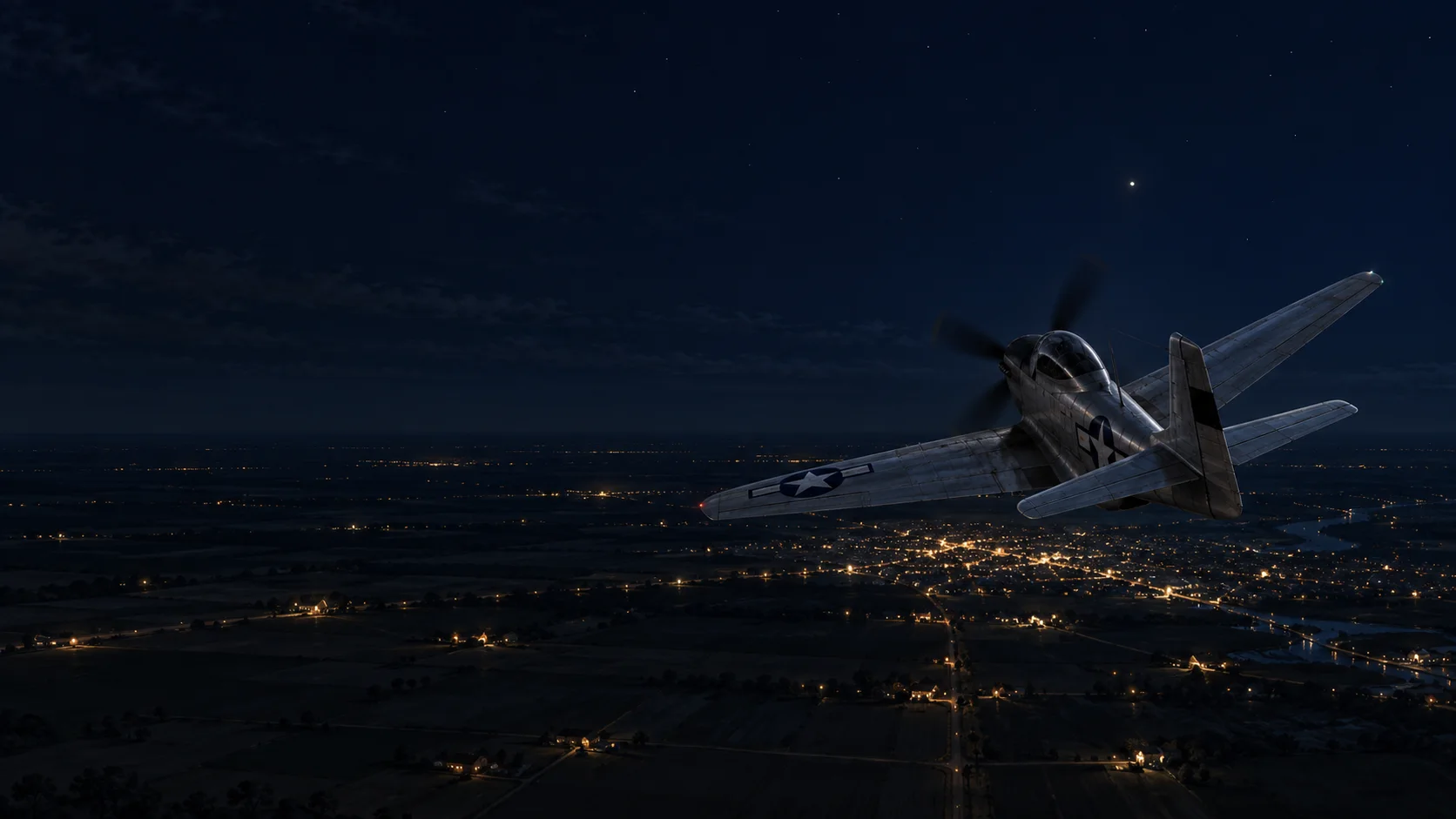
Two Mustangs turned away from the climb. Thomas Mantell kept going.
His wingmen had warned that they were too high. In the Kentucky Air National Guard accident account, Lieutenant A. W. Clements remembered Mantell’s aircraft still climbing steadily when he and Lieutenant B. A. Hammond broke off. Hammond had no oxygen and was becoming dizzy. Clements had a mask; Mantell did not.
The flight had begun as an ordinary ferry trip. According to the accident investigator, the Mustangs had been left at Marietta after weather interrupted an earlier journey. A transport took four Guard pilots and mechanics down to collect them; the group expected to bring the fighters back to Kentucky. Now three of those pilots were above southern Kentucky, trying to identify something the men at Godman Field could see from their control tower. Mantell was farther ahead and higher than his companions. He said he would climb on for a short while before coming down. His final reply to Clements was garbled.
Below, the tower still watched an object it could not name. Ahead, Mantell continued upwards. Neither the wingmen nor the men on the ground would speak to him again.
An object over Kentucky
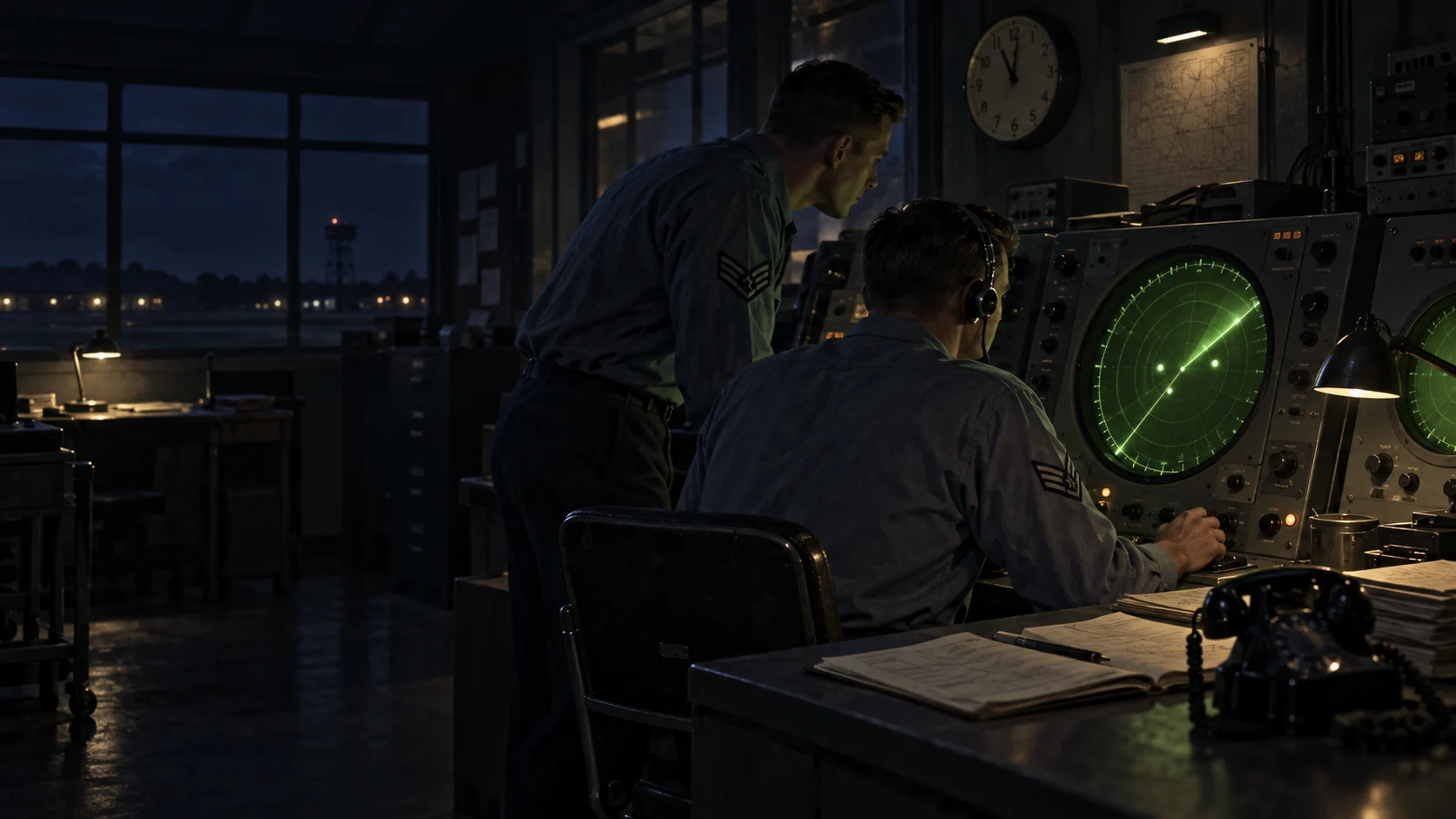
On January 7, 1948, reports of an unusual object had reached Godman Field near Fort Knox. The descriptions and locations were not perfectly consistent: callers placed it near several Kentucky towns. At the field, tower chief Technical Sergeant Quinton Blackwell looked to the south and saw something himself. He called Lieutenant Paul Orner, then operations officer Captain Cary Carter, to see it too.
Carter’s statement, written two days later, describes a round white form visible to the naked eye. Through field glasses, it looked brighter than nearby clouds. Colonel Guy Hix, the base commander, also came to the tower. His own statement called the object white, apparently about a quarter of the full moon’s size, with what looked at times like a red border. From his position it seemed nearly stationary.
The field did not have a ready identification. The tower checked for known aircraft. Meanwhile, four P-51 Mustangs approached from the south on a return trip from Marietta, Georgia, to Standiford Field near Louisville. They were Kentucky Air National Guard pilots bringing aircraft home, not a patrol sent up to search the sky.
Blackwell contacted the flight leader, Captain Thomas F. Mantell Jr., and asked whether he had enough fuel to take a look. Mantell agreed. One pilot, Lieutenant Hendricks, continued towards Standiford. Mantell turned with Clements and Hammond towards the direction given from the tower.
Ahead and above
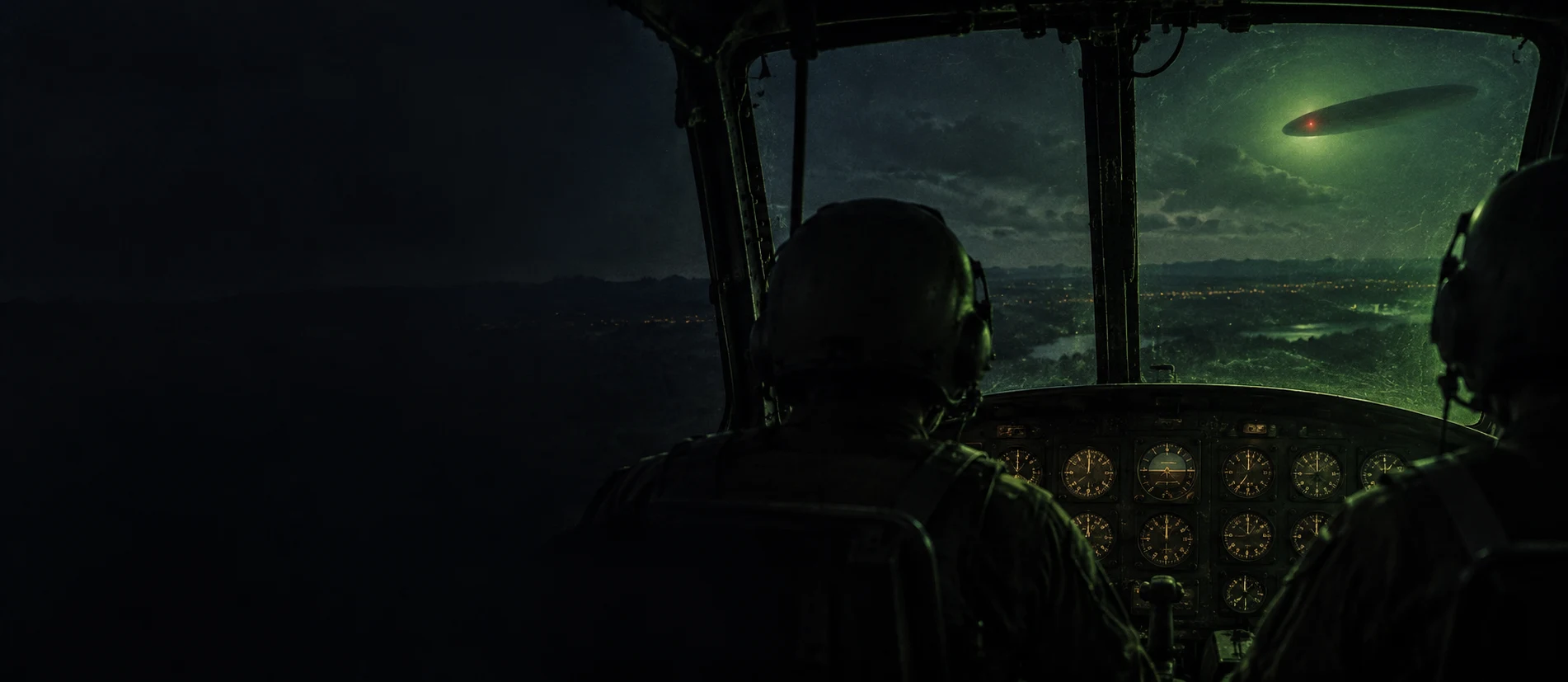
At first, the men in the aircraft could not see what the tower was tracking. The ground operators gave them a heading. Mantell began climbing, with the other two Mustangs following. The space between them grew. Blackwell later recorded Mantell saying he could see the object ahead and above him and was still climbing.
The surviving accounts of his radio calls do not form a single clean transcript. Blackwell’s January 9 statement attributes to Mantell a description of something metallic and tremendously large. Carter’s statement remembers a pilot saying that the object seemed to move upwards and forwards as fast as he did. Carter also recalled the pilot saying he would go to 20,000 feet and abandon the chase if he came no closer—but Carter could not identify with certainty which aircraft made every transmission he heard.
For the men in the tower, the sighting remained a visible white shape, sometimes given a reddish edge. For Mantell, it was an apparent target that remained out of reach. The descriptions were made from radically different positions: stationary observers on the ground and a pilot climbing into a pale afternoon sky.
Clements and Hammond reached the altitude where the climb had become dangerous. The accident material places the wingmen’s turn near 22,500 feet; Edward Ruppelt’s later retelling says 15,000. The records agree on the crucial separation: the two pilots turned back, and Mantell continued without an oxygen mask. Clements’ report to his flight leader drew a garbled answer, then silence.
The return without him
The wingmen landed at Standiford. Clements refuelled, obtained oxygen and went back up to search, reaching a far greater altitude than on the first climb. He found no object. At Godman, observers continued to watch the distant shape for a time before it disappeared from their view.
Near Franklin, farther south, people on the ground saw a Mustang descending. One witness, William Mayes, later described an aircraft circling high overhead before entering a dive and breaking apart. The wreckage was scattered over the countryside. Mantell was dead when rescuers reached the crash site. An investigator recorded that his watch had stopped at 3:18 p.m.
The accident investigation addressed a different question from the one that had started the flight. It sought to determine how an aircraft under control during the climb had been lost. Captain Richard Tyler, Mantell’s friend and a Kentucky Guard operations officer, gathered witness statements and described the wreckage. He believed Mantell had lost consciousness at high altitude from lack of oxygen. The Mustang, still trimmed for a climb, could then have levelled, entered a widening turn and accelerated into a dive. The left wing separated in the air before impact.
That conclusion did not identify the thing above Kentucky. It explained the likely chain that carried a pilot from an unanswered radio call to a fatal descent. Mantell had not been attacked in the account Tyler assembled. The aircraft’s damage could be explained by its own speed and the forces of the dive.
An answer that changed
The public explanation did not stay fixed. Ruppelt, who later led Project Blue Book, recalled the Air Force quickly raising Venus as the answer. A bright planet in roughly the right part of the sky offered a familiar object to put against the alarming reports. Yet the tower witnesses described an apparent shape, not just a pinpoint of light.
Years later, Ruppelt reopened the case file and consulted astronomer J. Allen Hynek, who had studied the original sighting. Hynek agreed that Venus lay in a similar direction, but thought it too faint against the afternoon sky to account for what the men at Godman reported. Ruppelt also looked at other ideas: a reflection in a canopy, a sundog, a balloon.
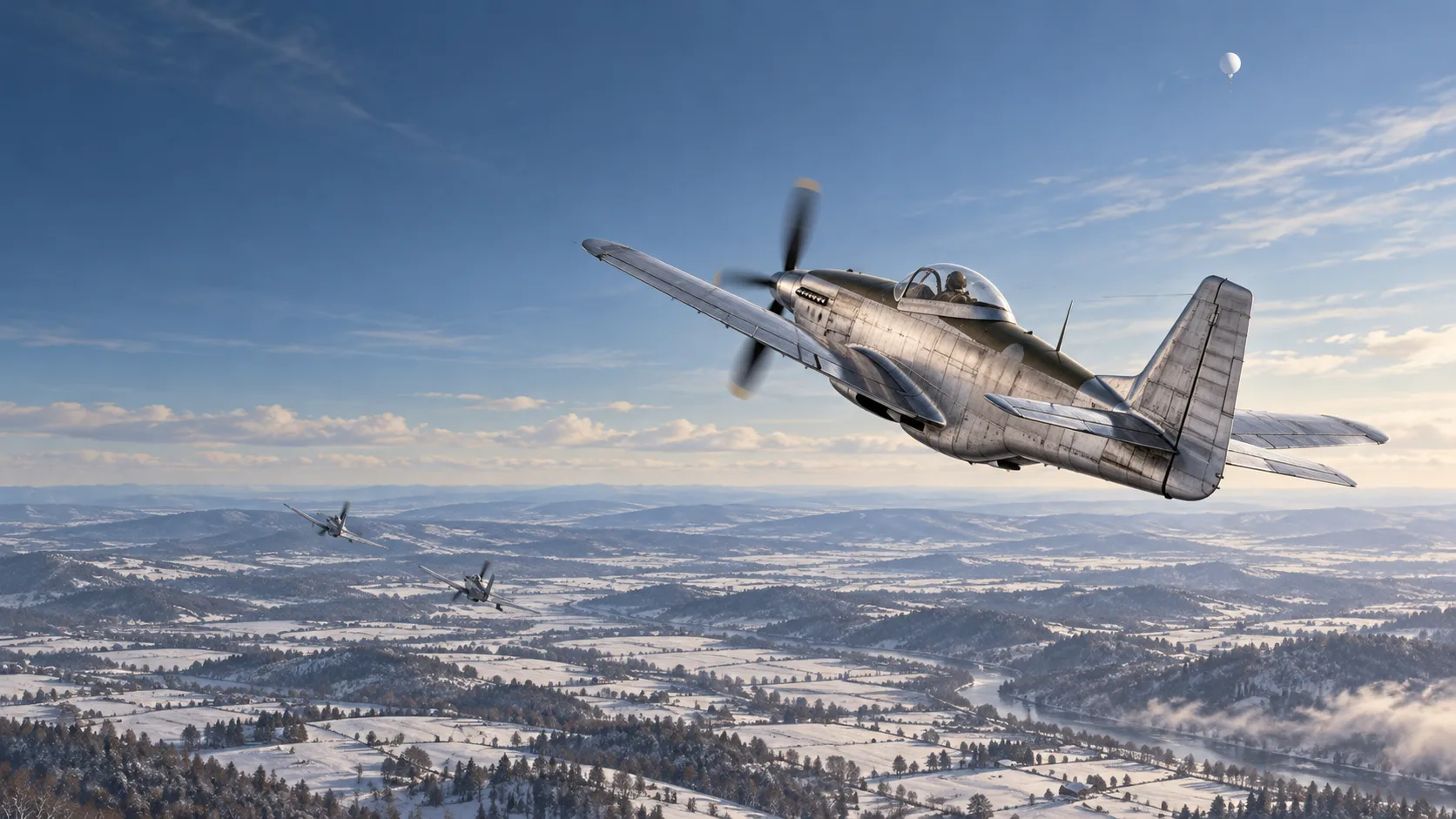
One detail in the older record kept the balloon possibility alive. Later that afternoon, observers in Kentucky and Tennessee had reported looking through telescopes at objects they identified as balloons. A large research balloon, far higher than a Mustang could safely reach without oxygen, could look white, rounded or strangely tapered as its envelope and suspended equipment changed angle to an observer.
But the precise flight remained elusive to Ruppelt. His proposed route began with a possible launch from Clinton County Air Force Base in Ohio. Winds might have carried a balloon across the reported sighting positions. He could not locate a launch record for January 7. His book ended with a conditional answer: the object could have been a Skyhook balloon.
What Is Known
The January 1948 tower statements establish that multiple personnel at Godman reported seeing an object and that the tower diverted Mantell’s ferry flight to investigate it. They preserve differing descriptions and recollections of the radio exchange. There is no surviving recording that resolves every word. The “metallic” description appears in Blackwell’s written statement, while Ruppelt later noted that tower personnel did not all remember that wording.
The accident material provides the flight’s tragic endpoint: a crash near Franklin, an aircraft that broke apart in a high-speed descent, and an oxygen-related loss of consciousness judged the likely cause. Tyler’s report includes a wingman account placing the turn-back above 22,000 feet, in contrast to Ruppelt’s 15,000-foot figure. The difference should not be hidden behind a single confident altitude. Mantell’s lack of supplemental oxygen and his continued climb are consistent across the principal accounts.
Ruppelt’s 1956 book is valuable because he had reviewed the Air Force file and questioned the early Venus explanation. It is also a retrospective narrative, written years after the flight; his statements about the crash and the radio calls can be checked against the 1948 documents. His Skyhook proposal was a reasoned identification, not a verified launch match at the time he wrote it.
The Bigger Picture
The balloon trail developed after Ruppelt’s book. In Just Cause in 1994, researcher Barry Greenwood described photographs dated January 6, 1948, and an interview with balloon pioneer Charles B. Moore. Moore identified a large Skyhook launch from Camp Ripley, Minnesota, at about 8 a.m. the day before Mantell’s pursuit. He also said Clinton County did not begin launching that type of balloon until 1951. The StratoCat flight catalogue records the Camp Ripley flight as a cosmic-ray experiment whose payload failed to detach and whose balloon was lost at sea.
A balloon released in Minnesota had time to drift towards Kentucky. Greenwood connected the launch to the sightings using the reported route and later balloon observations, while acknowledging that full tracking data for the entire flight were unavailable. That makes Camp Ripley a much more concrete candidate than Ruppelt’s hypothetical Ohio launch, though the surviving trail does not plot the balloon’s position minute by minute above Mantell’s aircraft.
The loss of Thomas Mantell is not uncertain in the way the object’s exact identity remains. The danger of climbing without oxygen was real, and the accident investigators set out a plausible sequence for the crash. The object drew the aircraft upwards; the answer offered to the public moved from Venus to an unnamed balloon, and finally towards a documented launch from the previous morning. His wingmen’s decision to turn back remains the stark dividing line in the story.
Sources
- Godman Field incident statements, January 9, 1948. Archival transcriptions and links to original pages, including Blackwell, Carter and Hix.
- Richard L. Tyler, report on the Mantell accident, January 12, 1948. Transcription of an early Kentucky Air National Guard accident investigation, including the wingmen’s turn-back and probable oxygen-related loss of control.
- Edward J. Ruppelt, The Report on Unidentified Flying Objects (1956), chapter 3. Former Project Blue Book chief’s later review of the Venus and Skyhook explanations.
- Barry Greenwood, “The Mantell UFO—A Smoking Gun? Maybe! Part Two,” Just Cause, June 1994. Research account of dated launch photographs and an interview with Charles B. Moore; argues for the Camp Ripley balloon while noting incomplete tracking data.
- StratoCat, “Cosmic Ray Studies,” January 6, 1948. Historical balloon-flight catalogue entry for the Camp Ripley launch.