Patrolman Eugene Bertrand had gone into the field with a flashlight.
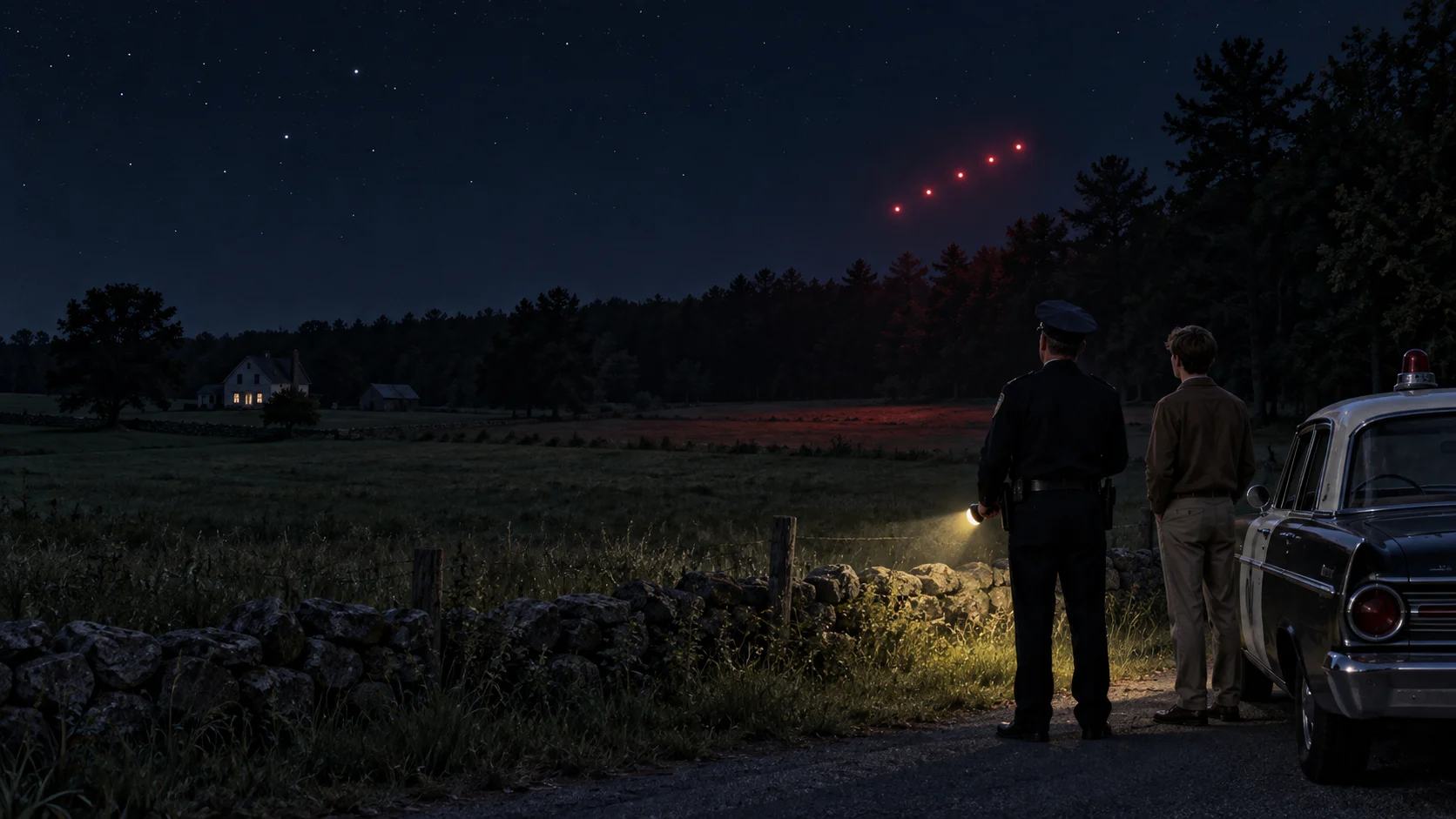
The teenager beside him had already seen the lights once. Now they were returning from behind the trees: five bright red lights, flashing one after another, moving out over the field.
In Bertrand’s statement preserved with the Air Force report, they came so close that he fell to the ground and began drawing his gun. Their glare prevented him from making out a shape. He heard no sound from them, but the farm animals were making a commotion nearby.
Then the lights approached again.
Bertrand and Norman Muscarello ran for the cruiser. The officer radioed another patrolman for help.
Only a short time earlier, Muscarello had been alone on a country road. He had found someone to take him seriously enough to return. Now that person was calling for another witness.
Walking towards home
It was the early morning of September 3, 1965.
Muscarello was eighteen. He was hitchhiking along Route 150 in Kensington, a few miles outside Exeter, New Hampshire. The Pease Air Force Base report identifies him as a young man due to join the Navy later that month.
In his statement recorded that September, a group of five bright lights appeared over a house approximately a hundred feet from where he stood. They formed a slanting line, at an angle he estimated as sixty degrees.
The light spread across the surrounding area.
As he watched, the row moved out over a large field. Its motion reminded him of a floating leaf. It would disappear behind trees or a house, then come into view again. The arrangement appeared to hold as it moved.
He described the flashing as a sequence travelling along the row and back. One light would be on at a time, the illumination passing from one position to the next. The brilliance kept him from distinguishing the form of whatever carried them.
At one point, they seemed to come towards him. He jumped into a roadside ditch because he thought he might be struck.
He estimated that he watched for about fifteen minutes before the lights disappeared behind trees and seemed to move into the field. Afterwards, he caught a ride to the Exeter police station.
The road had given him an encounter he could not identify. At the station, he would have to describe it to someone who had not been there.
The parked car
Bertrand’s night had already included an unusual call of its own.
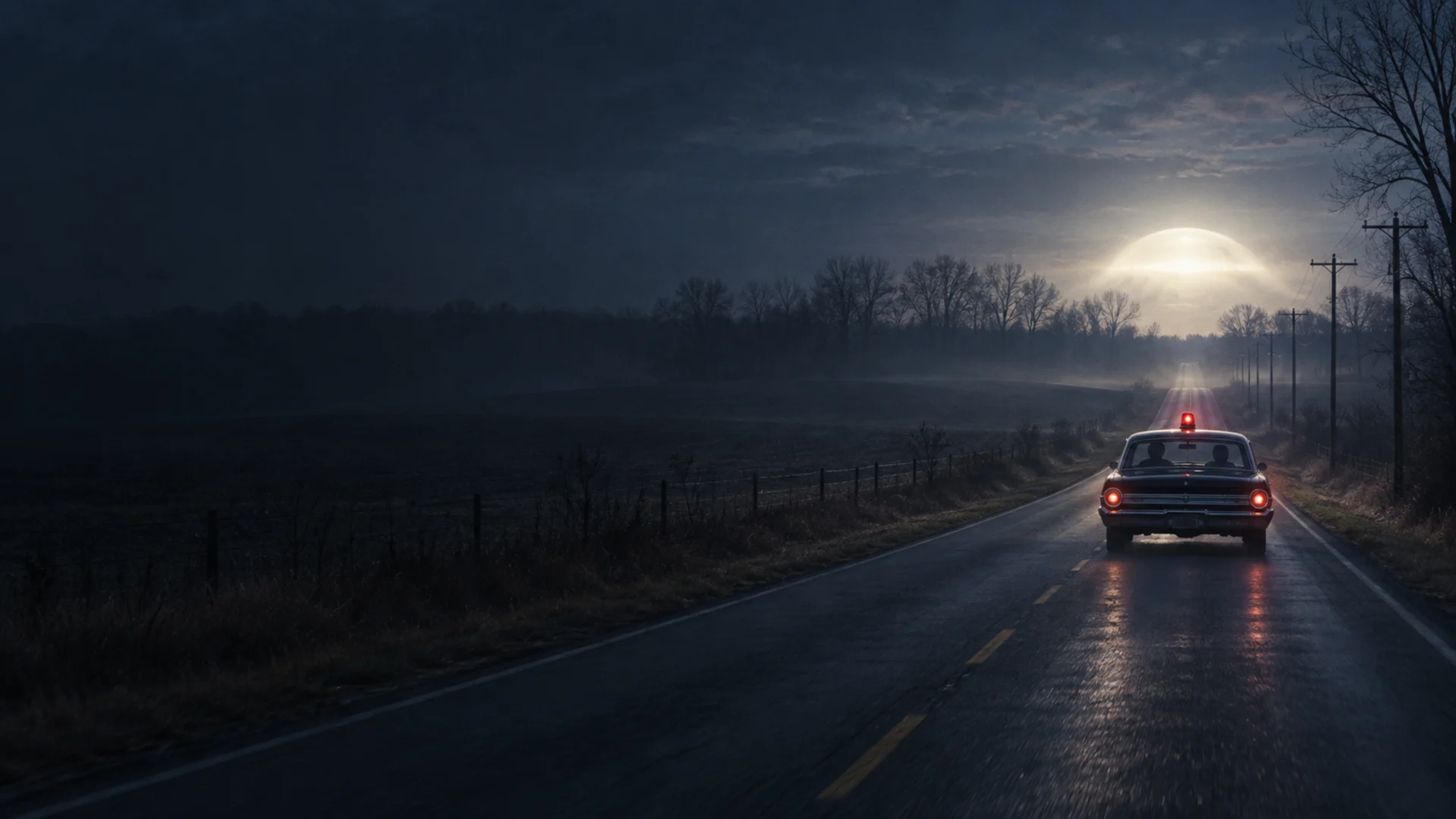
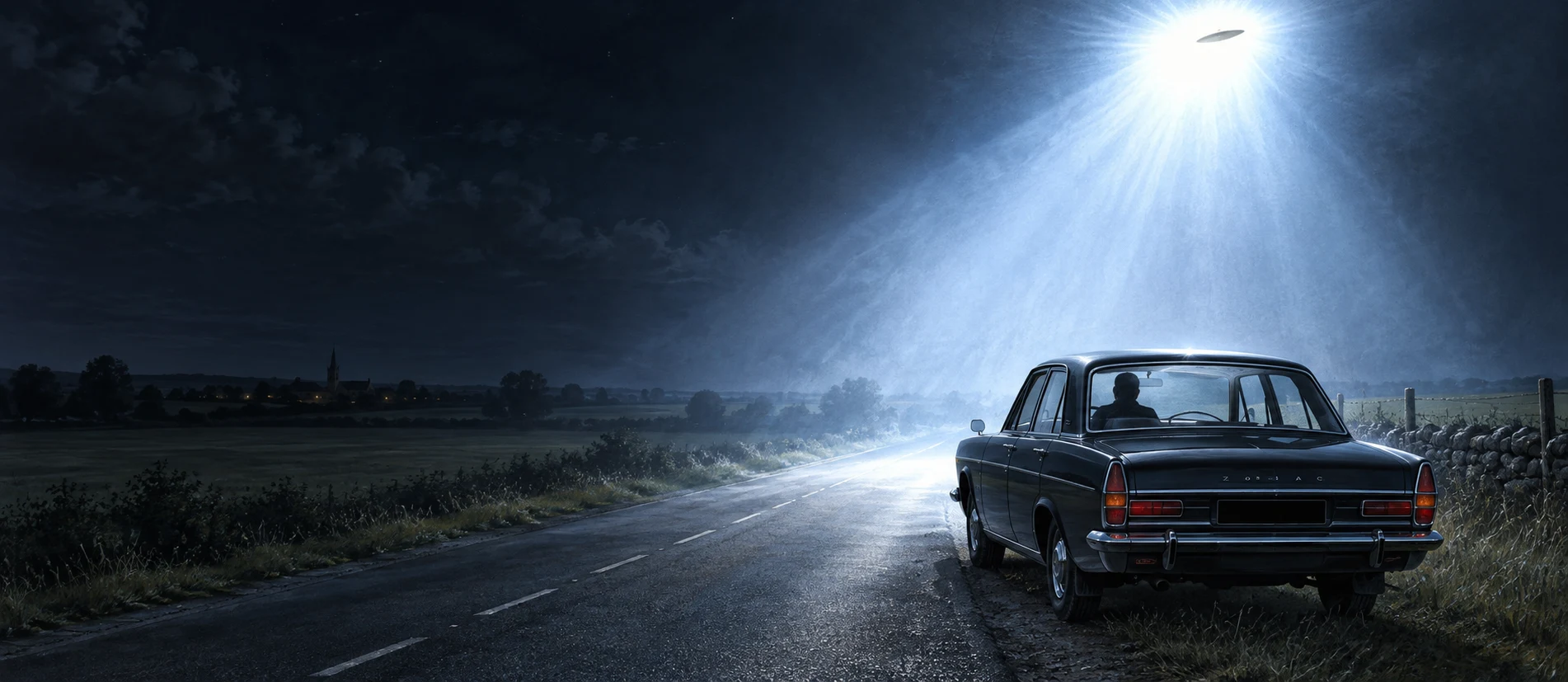
His September statement describes finding a car parked beside the bypass near Exeter at around one in the morning. A woman inside said she was too upset to drive. She told him that a light had followed her and stopped over her car.
Bertrand stayed with her for approximately fifteen minutes. He did not see the thing she described.
He then returned to the police station, where he found Muscarello reporting bright red lights in a field. After talking with him, Bertrand decided to drive him back to the place.
The earlier motorist’s report remained a separate account. The officer’s own observation was still ahead of him, beyond the road and the trees.
Back to the field
Bertrand parked his cruiser and switched off its lights.
Nothing unusual was visible.
He and Muscarello got out and began walking into the field with the flashlight. In the officer’s statement, they had gone approximately fifty feet when the red lights appeared from behind a nearby group of trees.
The return to the site had changed the encounter. Muscarello was looking again at the place where he had been frightened. Bertrand was now watching it himself.
The lights flashed individually and moved around over the field. Their approach sent the officer to the ground. Then the two men retreated to the cruiser and Bertrand called Patrolman David Hunt.
The flashlight, the parked car and the radio all belong to the officer’s own account. They locate the observation within a patrolman’s response to a report: drive to the scene, look around, move closer, and call another officer when the situation changes.
Bertrand also described the animals in the barn becoming noisy. The strange lights themselves remained silent to him. He reported neither a vibration nor a sound that he could connect with their movement.
The row appeared tilted, with its lower lights leading as it travelled. Even while they moved, he said, the lights maintained their relationship to one another.
Beyond the cruiser, the field had become something to watch from a distance.
Hunt arrives
Hunt’s September statement begins with the radio call. He placed it at approximately 2:55 a.m.
On arriving, he saw bright red lights flashing in sequence. They appeared to him to be roughly a quarter of a mile away over a field to the southeast.
Bertrand’s statement likewise places them farther off by the time Hunt reached the scene. The third observer joined a later stage of the encounter, after the closest reported approach.
Hunt watched for a short period. Then the lights moved southeast and disappeared in the distance. He estimated their height at around a hundred feet and thought they maintained it as they departed.
The view ended without an identification. The men had watched the lights from different positions and at different moments, but each would put his name to an account of what he had seen.
The night becomes a report
The story reached nearby Pease Air Force Base.
Major David Griffin, the base’s disaster control officer and a command pilot, examined the sighting area. His assessment became part of the initial report dated September 15.
The report described a close grouping of red lights moving together, disappearing behind houses and trees, and returning to view. It preserved the comparison with a floating leaf. It also recorded clear weather and attached statements from Muscarello, Bertrand and Hunt.
Griffin said he had not arrived at a probable cause. He regarded the three observers as reliable, particularly the patrolmen. He noted B-47 aircraft flying in the area during the period, but did not believe they were connected with the sighting.
These were the initial investigator’s judgements. The report carried them from the local airbase to the Air Force’s investigation system, alongside the witnesses’ descriptions.
The field was now represented by pages: positions, estimated heights, movements, weather information and three statements. A night that had sent a teenager into a ditch and a patrolman back towards his car had acquired an official file.
Returning in daylight
Civilian investigator Raymond Fowler also went to Exeter.
His contemporary report, later printed in the April 1966 hearing record, describes arriving at the police station on September 11. Hunt completed a questionnaire. Fowler then drove Bertrand back to the sighting area, where the patrolman filled out another form and described the encounter.
Muscarello was out of state during that first visit. Fowler explicitly identified his initial account of the teenager’s experience as information received through the officers, pending a personal interview.
Later, Fowler and his brother returned to photograph the area. They walked along nearby power lines, looking for signs of a landing. They found none.
The daylight visits brought the investigators back to the same countryside. The witnesses could point out where they had stood and where the lights had appeared. Their descriptions travelled farther than the lights themselves had been followed.
Two signatures
By December, Bertrand and Hunt were writing to Major Hector Quintanilla, the head of Project Blue Book.
Their letter dated December 2, 1965 explained that publicity about the Air Force’s evaluation had brought them ridicule. They were concerned that people might consider them dishonest or incapable observers.
They said they had compared their observations with each other. They also distinguished the strange lights from an aircraft they believed was a B-47, seen high above the area immediately afterwards. Bertrand cited his four years of Air Force experience in refuelling operations.
Their letter pressed for a correction to the timing used in discussing the encounter. Muscarello’s first observation and the officers’ later visit, they argued, should be kept distinct.
Both patrolmen signed it. They were still asking the investigation to account for the night they had reported.
The reply
On January 25, 1966, Lieutenant Colonel John Spaulding wrote to Fowler about the Air Force’s evaluation.
The letter associated the earlier reports with aircraft participating in Operation Big Blast. It treated the subsequent observation by Bertrand and Hunt, after two in the morning, as unidentified.
A February 9 letter to the two patrolmen stated that the Air Force had been unable to identify the object they observed. Spaulding thanked them for reporting it and acknowledged the inconvenience they had experienced.
The correspondence had given their account a different official ending. The lights had left the field months before. The two officers had continued following their report through letters until that reply reached them.
What Is Known
The surviving record includes three contemporary witness statements, Pease AFB’s September 15 report, and correspondence between the officers, Fowler and the Air Force. The field observation took place in Kensington; Exeter was the town whose police received the report and returned with Muscarello.
The documents preserve differing times, distances and descriptions. Hunt’s statement places the call at 2:55 a.m.; Fowler’s preliminary reconstruction assigned the joint observation an earlier interval and explicitly acknowledged timing uncertainty. Reported heights and distances remain estimates. The individual statements describe five lights; Fowler’s account sometimes says at least four.
The January and February 1966 letters document the Air Force’s inability to identify the officers’ later observation. They establish an investigative outcome, without establishing an extraordinary origin.
Exeter was discussed at the April 5, 1966 House Armed Services hearing. Quintanilla confirmed that it was unexplained. He also stated that the case had no radar information and that aircraft had not been scrambled to investigate it. Fowler’s report and correspondence were inserted into the hearing record; their inclusion preserved the material rather than endorsing every claim within it.
The Bigger Picture
Exeter unfolded inside a national reporting system with a local point of entry.
The National Archives’ account of Blue Book’s procedures describes the process set out in a 1966 Air Force publication. The nearest airbase investigated a sighting and forwarded the information to Wright-Patterson. Further analysis followed when the initial investigation did not produce an identification. Public information formed a separate stage of the process.
At Exeter, those stages became visible through the documents. The local investigator visited the field. The case reached Blue Book. Information passed back to witnesses and into public discussion. The officers then wrote about the difference between what they had reported and how they felt their observation had been represented.
That gives the case a human continuity beyond the encounter itself. Muscarello asked someone to return with him. Bertrand called Hunt to join them. Afterwards, their statements carried the experience to people who would never stand in that field on that night.
The most memorable turn remains the first one. A patrolman went out to examine another person’s story, switched off his car lights, and found himself reporting an encounter of his own.
Sources
- Eugene F. Bertrand Jr., September 1965. Contemporary witness statement, attached to the Air Force report; reproduced scan hosted by NICAP.
- David R. Hunt, September 1965. Contemporary witness statement, attached to the same report; reproduced scan.
- Norman J. Muscarello, September 1965. Contemporary witness statement, attached to the same report; reproduced scan.
- USAF, Pease AFB, September 15, 1965. Initial Report of Unidentified Flying Object, pages 33–36 of NICAP’s archival compilation.
- Bertrand and Hunt, December 2, 1965. Contemporary letter to Quintanilla, pages 20–21 of that compilation.
- John P. Spaulding, January 25, 1966. Air Force evaluation letter to Fowler, reproduced scan.
- John P. Spaulding, February 9, 1966. Air Force reply to the patrolmen, page 12 of the compilation.
- U.S. House Committee on Armed Services, April 5, 1966. Contemporary hearing transcript, including Fowler’s earlier investigation report, correspondence and the discussion of Exeter.
- National Archives, 2018. UFOs: Natural Explanations, independent historical context reproducing Blue Book’s 1966 description of its procedures.