The man on the terrace thought he was watching an airplane. Something had caught the light beyond his garden, coming from the southeast across a clear sky. He expected it to pass over the house. As it grew larger, the line it was following brought it toward the patch of grass in front of him.
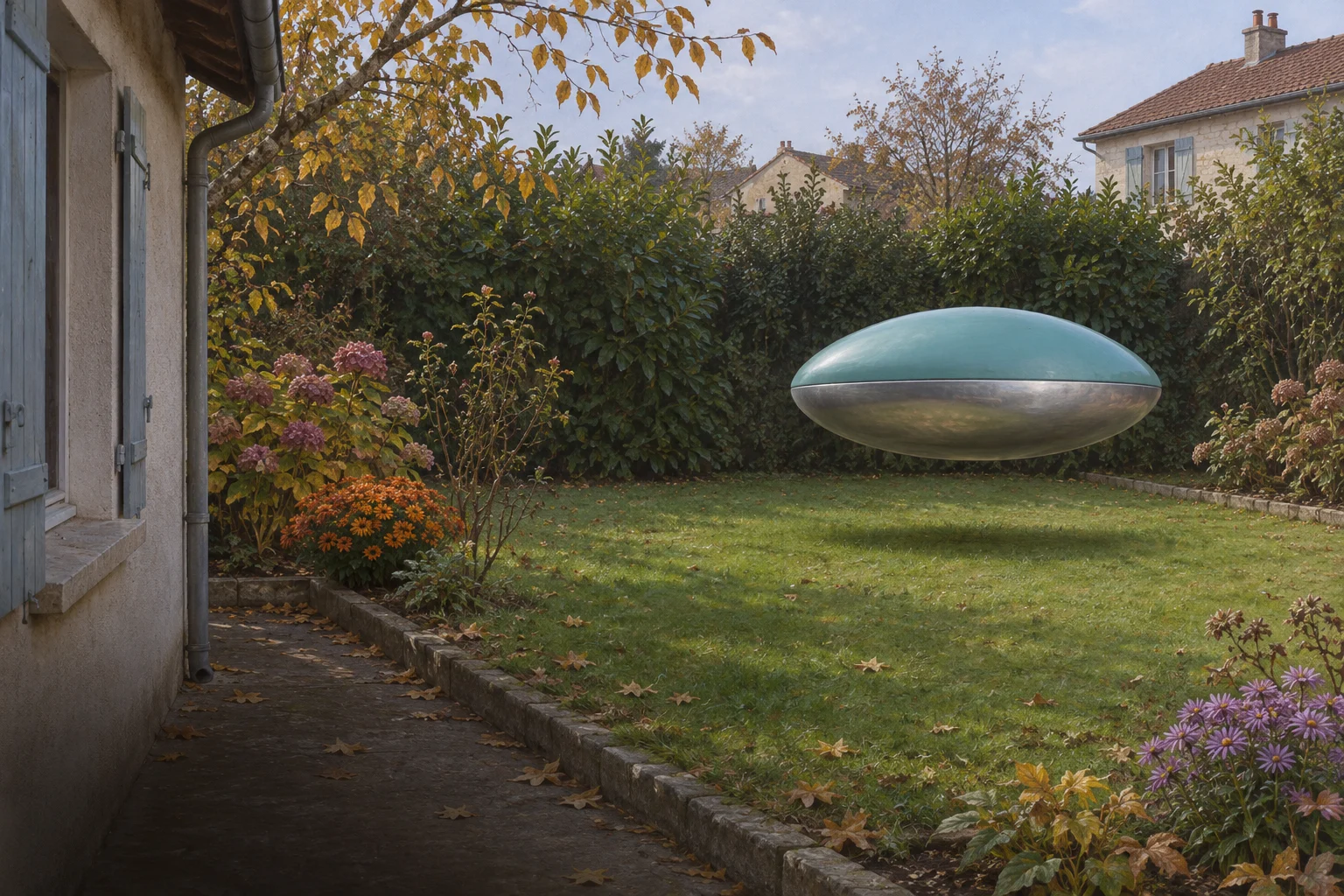
He backed away. By the time he reached the kitchen wall, the thing had stopped descending. He could make out an oval shape with a pale metallic underside and a blue-green top. Beneath it, he could still see the lawn.
That was how a biologist identified in the French space agency’s file as Monsieur Henri described the beginning of his lunch break on October 21, 1982. By six that evening he was at the gendarmerie, drawing what he said he had seen.
Below the road
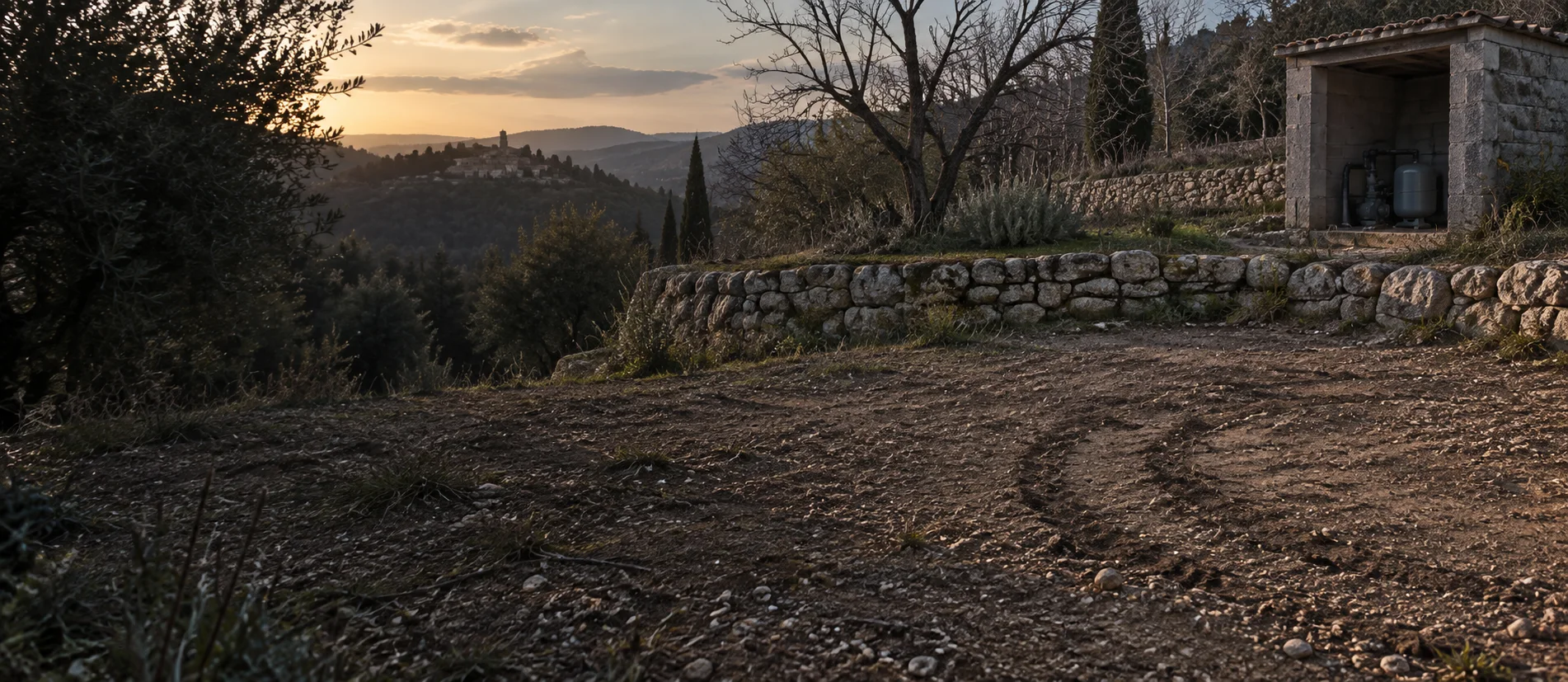
The house lay below street level, at the end of a narrow approach. The garden had a rectangle of grass edged by low masonry and planted beds. Tall shrubs screened the wall at the far end. Henri tended the beds himself and changed what grew in them with the seasons. That October there were irises, hydrangea and wallflowers along the edges, and hollyhocks about as tall as he was. The amaranths stood in a bed along one side.
Henri gave the gendarmes an approximate time in the middle of the lunch hour. When investigators came back to the garden eight days later, he remembered looking at his watch at 12:33 as he stood near the kitchen wall. In the laboratory where he worked, he told them, he regularly timed experiments by checking his wrist. He used the same habit on the terrace. By his reckoning the object was there for about twenty minutes.
At first he stayed back. Then he went down the terrace steps to the workshop door, closer to the grass. He put the object about a metre above it, slightly towards the privet. He estimated that it was roughly a metre and a half across. It made no sound that he could hear, even with so little garden between them.
The camera upstairs
Henri went into the house and up to the floor above. His camera was loaded. He brought it down to the terrace, where he said the object was hanging in the same place. He tried to take a picture. The camera jammed. It had given him trouble before.
He went closer. In the route he later retraced for investigators, the failed photograph came before some of his closest looks. He moved from one position to another and bent down to look at the underside. At the gendarmerie he put his nearest approach at half a metre. When he drew the shape again during the reconstruction, he marked a flat area beneath the rounded lower portion and a rim around the upper cap. From the angles he remembered seeing it, he took the object to be circular when viewed from above or below.
The finish on the bottom reminded him of a polished piece of beryllium he had seen at an exhibition of laboratory equipment. It was a comparison for the blue-grey sheen. The upper part was harder for him to put into words. He likened the colour to lagoon water and tried to describe a sense that there was something within the volume. He could never quite say whether the effect came from inside it or from the surface. Looking along the shell, he could pick out none of the small marks or fasteners he would have expected on a manufactured object.
Back into the sky
There had been time to go upstairs and time to walk around the garden. The departure gave him very little. Henri said the object rose abruptly from the spot where it had been hanging. The approach had been oblique. This time, as he followed it with his eyes, it went straight up. He watched the glint shrink to a point and disappear.
His attention returned to the lawn. He told the gendarmes the blades had stood up as the object left and then settled again. He reported no scorch or flattened patch. He was alone at the house and had seen no neighbour who might have watched it with him. Someone on the road above, he said, would have had no view of the object while it was down in the garden.
At five he told his wife. They went to the brigade together. The officer took his statement at six and kept the sketch. In the morning the brigade sent a telex with the dimensions Henri had supplied, the approximate time of departure and the failure of the camera. The same morning, the gendarmes were in the garden looking at flowers.
The flowerbed
The tops of several amaranth stems had dried. Some leaves had curled in on themselves. The drooping flower clusters, which normally ranged from russet to burgundy, had turned brown. One bent over its central stem. The gendarmes photographed the garden and cut away the affected tops, sealing stems, leaves and flowers in plastic. They later returned for plants that looked undamaged, so there would be something to compare with the wilted specimens.
Henri had looked at some of the material himself under a binocular magnifier at work. He could see how thoroughly the flowers and leaves had dried. He left further examination to the laboratories receiving the brigade’s samples and kept the matter to himself among his colleagues.
The telex reached GEPAN on October 23. By the 29th a team from Toulouse was at the brigade inspecting the statement, sketch and plans. They reached the house around half past twelve, roughly the time of day when Henri had first looked up. They let him tell the story in his own order. Then they went outside with him and worked through it on the ground.
The route they plotted had nine stopping points. Henri could show them where he had first stood, where he had backed away and where he had gone down the steps. With a compass they took a bearing in the direction he remembered first seeing the object. They marked the spot on the grass beneath its reported position. He drew it again, and they set the new drawing beside the one he had made for the gendarmes.
The garden had changed in the intervening days. Henri said he had cut the grass. Plants had been pulled from the flowerbed, leaving turned earth where some of the amaranths had stood. The team used the position Henri indicated to lay out four sampling lines across the lawn, working outward from the centre. By two that afternoon they were collecting grass. They also took material from shrubs and gathered shorter amaranths growing along the path.
The gendarmes’ first samples had spent the intervening days in the vegetable compartment of a refrigerator. The team sealed its own samples and put them into liquid nitrogen for the journey to Toulouse. The following morning both sets were in a freezer. The researchers now had the witness’s two drawings, the measurements he had helped them make, and bags of vegetation from a garden that had already begun to change.
What Is Known
Technical Note 17, dated March 21, 1983, preserves the same-day statement, the next morning’s telex and the later reconstruction. The reported times vary by a few minutes. The police photographs document withered flowers the following morning. Those photographs and the samples could establish the condition of the plants when officers arrived. The laboratory found that deterioration and the storage conditions of the early samples prevented a biochemical explanation of the difference between the wilted and comparison plants. It also raised local frost as a possible explanation for the drying, drawing on readings from a nearby weather station.
Henri was the sole witness to the object. In a later reanalysis, Éric Maillot used site photographs and the report to explore whether a reflective balloon could have rested against tall plants. The proposal depends on reconstructing the garden as it stood before the plants were removed. It remains a hypothesis.
The Bigger Picture
France’s space agency founded GEPAN in 1977. Its successor, GEIPAN, began publishing archived investigations in 2007. The garden file shows what that early effort could preserve. A report made at a brigade desk became a sequence a reader can still follow, from a first look across the terrace to a set of sealed bags going back to Toulouse. The file takes its name from the flowers the gendarmes could carry away.
Sources
- CNES/GEPAN, Technical Note 17, L’Amarante. The March 1983 investigation reproduces the October 21 gendarmerie statement and October 22 telex, along with the scene reconstruction, sampling chronology and laboratory findings.
- Éric Maillot, Le PAN D du 21 octobre 1982, dit « l’Amarante ». Retrospective analysis of the garden photographs, witness description and balloon hypothesis.
- GEIPAN, institutional history. Background on the founding of GEPAN and the later public release of archived files.