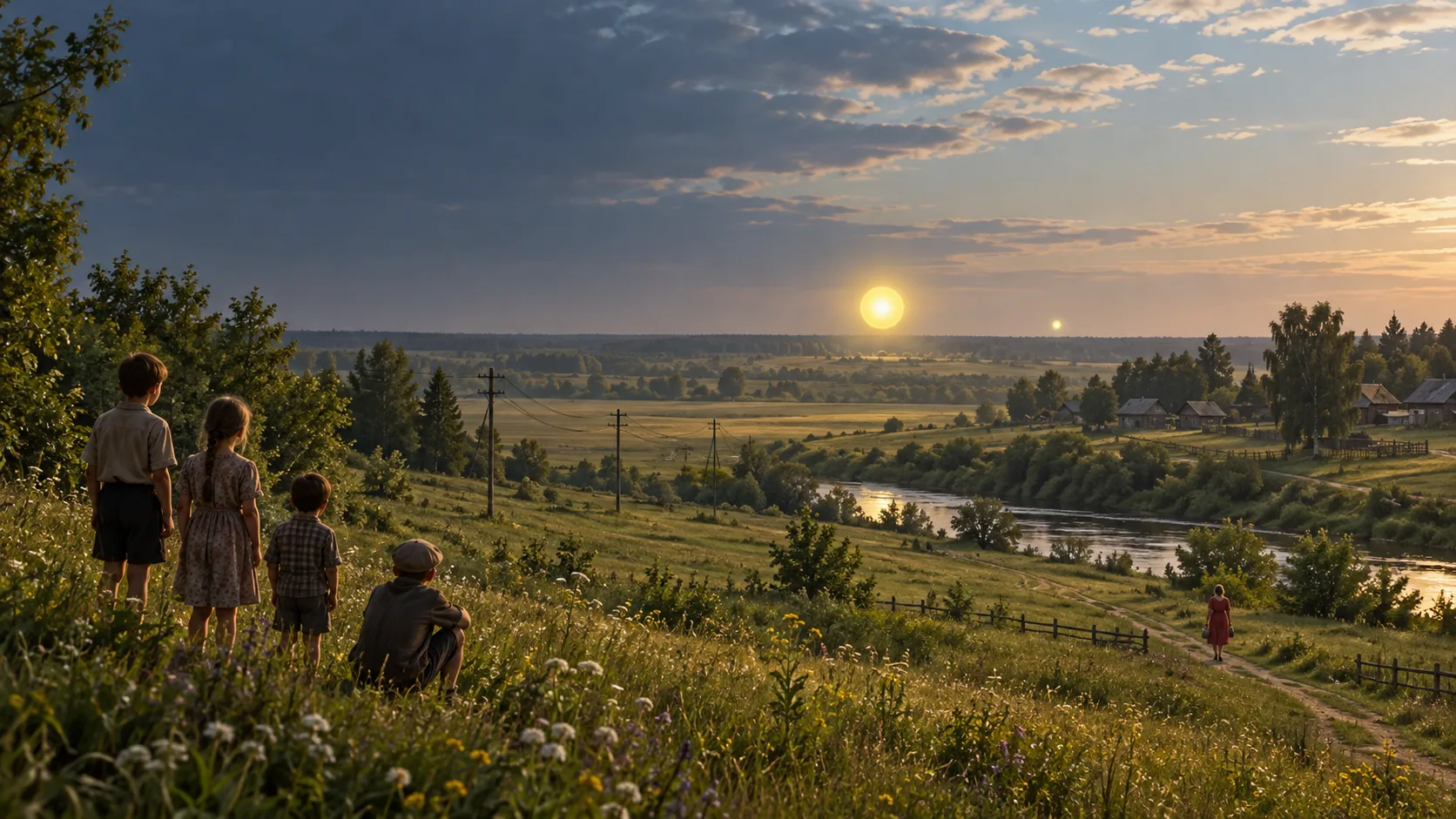
The children were walking home from the river when they looked up at a kite above the edge of the village. Then they noticed a second, smaller point in the sky. It was yellowish, and it seemed to be growing.
The children said the point brightened into a sphere, descended over the meadow and appeared to touch the ground. From where they stood, they thought it rolled towards the river.
The account would eventually reach English-language readers abroad. Its first setting was a meadow near a village in the Vologda region, on June 6, 1989. The sphere was only the beginning.
The first sphere
According to the TASS report published that month, the children estimated that the object was no more than half a kilometre away. Two younger girls ran home crying. The others stayed and watched the bright shape on the meadow.
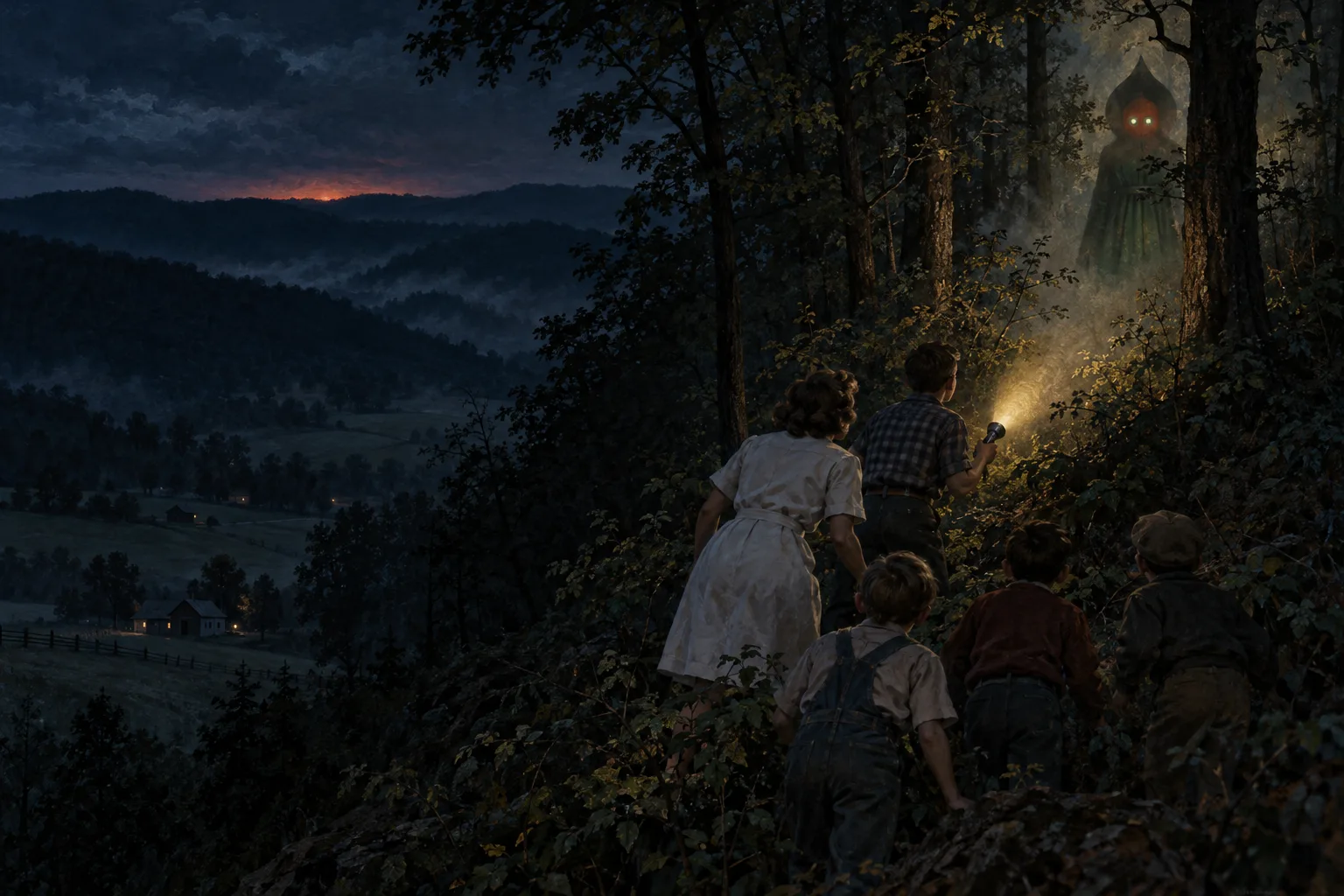
They described it as dividing. Where the sphere had been, they said, there now appeared a dark figure with a human outline but no visible head. Its arms seemed to hang below its knees. The sphere itself became impossible to see, while the figure moved in the direction of Konantsevo.
Their reported view was less definite than the label alien suggests. They were looking across open ground at a moving shape whose head they could not make out. The impression of a headless body, with arms unusually long for it, survived the retelling. A later visitor would call the figures’ movements robot-like.
The dark shape did not disappear with the light. In the children’s account, it crossed familiar ground towards their village. A distant bright point had become something apparently walking below it.
The woman in red
One of the most arresting details in the original report concerns a woman in a red dress. The children said she was walking nearby. As the dark figure drew level with her, both seemed to vanish from their view. Minutes later, the children said, they saw the woman again, running away from the meadow.
The report gives us the children’s account of that moment, not the woman’s own testimony. From their position, two shapes were lost to sight, and one later reappeared. The account does not tell us what she saw.
Nor did her reappearance end the children’s watch. The meadow, in their telling, had become a place to which other lights would come.
Three more arrivals
One after another, three more luminous spheres reportedly descended on the same ground. The children said figures appeared beside two of them. The last sphere also seemed to divide, but nobody emerged from it. As with the first, the lights and figures became invisible after a short time.
The third figure left an unusually precise landmark in the story. The children placed it between poles of a power line, at an estimated distance of no more than 150 metres from them. Something on its chest looked like a glowing disc. In an account full of difficult shapes, the poles gave the witnesses a fixed point with which to describe a route.
Their story had a sequence: a point becoming a sphere, the first figure and the woman, further spheres descending, and a figure near the power line. The last sphere produced no visible figure at all.
The sequence gave a local editor something to test: would the children tell it the same way when separated?
Separate rooms at Prizyv
The children went to the district newspaper, Prizyv. Its editor, N. Shaverin, later told the TASS correspondent that staff had spoken to them separately, in different rooms. He named Sergei Belyaevsky, Sveta Karetina, Olga Krylova, Marina Shiryaeva and Luda Rybakova, and said their accounts matched. On that basis, the paper published the report.
The local paper did more than copy one child’s story. Yet the surviving TASS article gives Shaverin’s assessment, not verbatim transcripts of five accounts. His conclusion was that the children had seen something unusual. It did not identify what.
By June 23, UPI had carried the story in English. Its report relayed TASS’s account of the children and the luminous spheres. A reader far from Konantsevo could now encounter the meadow as a short international news item: a Soviet village, children returning from a river, a headless figure, and lights that seemed to vanish. The wider circulation gave the case reach, but it did not add a separate witness to the meadow.
Another publication would bring reporters to the ground itself.
A road back to the meadow
On June 29, a team connected with the magazine Vokrug Sveta arrived in Kharovsk. It included the UFO enthusiast Alexander Kuzovkin. The visitors found a town already receiving journalists. The editor of the local newspaper made a vehicle available, and the visitors began moving between reported sighting locations and witnesses.
The magazine’s account is valuable precisely because its writers did not just repeat the wire story. They travelled to the area, heard people describe events, and recorded Sergei Belyaevsky telling the children’s story on tape. They summarized what he and his friends said: bright spheres near the slope of the Konantsevo ravine, and three dark, apparently headless figures emerging beside them. Sergei placed the figures near bushes and described them walking a short way on stiff legs before disappearing.
The writer dated the children’s experience only to early June and put it at roughly early afternoon. The June 6 date comes from the TASS account. Those are two descriptions of the same reported encounter, rather than two sightings that happened on different days.
The team also followed the path from which the children said they had watched. There, the visitors noticed that two power lines crossed near the place Sergei indicated. They wrote that the figures’ reported route ended near a transformer substation. Their observations confirm that those features were present in the landscape they inspected. They do not confirm that luminous spheres or figures moved through it.
This gives the case a second, quieter scene: adults standing where the children said they stood, trying to map a remarkable account onto poles, paths and a slope. The power line that marked the children’s closest figure was no longer just a detail in a news story. It was a structure a visiting reporter could actually find.
A boy on tape
The visitors’ conversation with Sergei included an awkward question. Evgeny Nekrasov, a reporter travelling with the group, asked whether films might have influenced the story. The magazine account says Sergei acknowledged watching American science-fiction films at a video bar, then said he had not seen beings like the ones he described. The writer also remembered Sergei saying his friends would not believe him until the story appeared in a newspaper.
Neither exchange settles the event. They do show the world into which the child’s report entered. Stories of visitors from the sky were available in popular entertainment; a newspaper could make a claim feel more real to school friends; and the arrival of outside reporters would give the meadow a public identity. The people asking questions had their own expectations, just as the children may have had theirs.
There was a further field visit that summer. In a much later recollection, V. Novgorodov-Taymyrsky described travelling with a Tomsk group after hearing of the case in late June. He remembered spending days in the area and speaking with the children. His reconstructed order of events broadly follows the early press account, but the recollection was published decades afterwards and differs on some names and particulars. It cannot be treated as a transcript made on June 6.
The scene at Konantsevo had become two things at once: a meadow that the children had passed on their way home, and a destination to which reporters and investigators now travelled. The accounts they gathered preserved more than the headline’s strange figure. They preserved where the witnesses stood, what landmarks they used, and how a local report became a national and then international story.
What Is Known
The strongest contemporary record is the TASS dispatch by O. Dzyuba, printed in Trud on June 24, 1989, and reprinted in Avangard five days later. It dates the reported encounter to June 6, locates it near Konantsevo, and records the local editor’s account of separate interviews with named children. UPI’s June 23 item shows how rapidly the story travelled abroad, but it relies on TASS. Those two publications are not independent confirmation of the claimed objects.
The Vokrug Sveta report records a visit to Kharovsk on June 29, a taped account from Sergei, and a walk to the children’s viewing point. It establishes that the visitors found power lines and a substation where the story placed them. It does not establish that the visitors saw the alleged phenomenon, and its writer noted how little physical evidence was available. The later Tomsk recollection adds another report of interviews and fieldwork, with the limitations of a retrospective account.
No source examined for this article supplies an independently verified image of the June 6 spheres or figures. The red-dressed woman’s experience comes to us through the children’s description, not her own documented statement in the contemporary articles used here. The cause of what the children reported remains unresolved in this record.
The Bigger Picture
Konantsevo is often grouped with other Soviet UFO reports from 1989, yet its paper trail is unusually revealing. A district editor described speaking to children separately; a TASS correspondent carried the account into the national press; UPI compressed it for readers overseas; and a magazine team returned to the path and listened to one of the children. Each step made the story more accessible while changing what a reader could actually know about it.
The TASS dispatch also mentioned other reports elsewhere in the Vologda region. They are part of the period’s interest in unusual lights, but they do not corroborate the events in this meadow. The magazine’s account captures a different feature of the same moment: reporters, enthusiasts and local residents trying to meet one another at places that had already become known through print.
The image that stays with Konantsevo is the shift from sky to ground. A yellow point grows above a kite, then the children describe something walking between familiar power-line poles. Thirty years of retellings cannot turn those reported movements into a verified landing. They can, however, show why a single route home from the river became a case that people kept returning to.
Sources
- O. Dzyuba, TASS, Trud, June 24, 1989, reprinted in Avangard, June 29, 1989, p. 4. Contemporary news report, including the district editor’s account of separate interviews with the children.
- Vokrug Sveta, “The Kharovsk Landing,” no. 10, 1989, parts one and two. Contemporary on-site reporting and a taped retelling from Sergei Belyaevsky; online transcription.
- UPI, “UFO sightings in Soviet Union,” June 23, 1989. Contemporary English-language relay of TASS, not a separate investigation.
- V. Novgorodov-Taymyrsky, recollection of the Tomsk group’s visit, published April 10, 2018. Later first-person account of fieldwork; used for the investigation’s history, not as contemporary proof of the encounter.