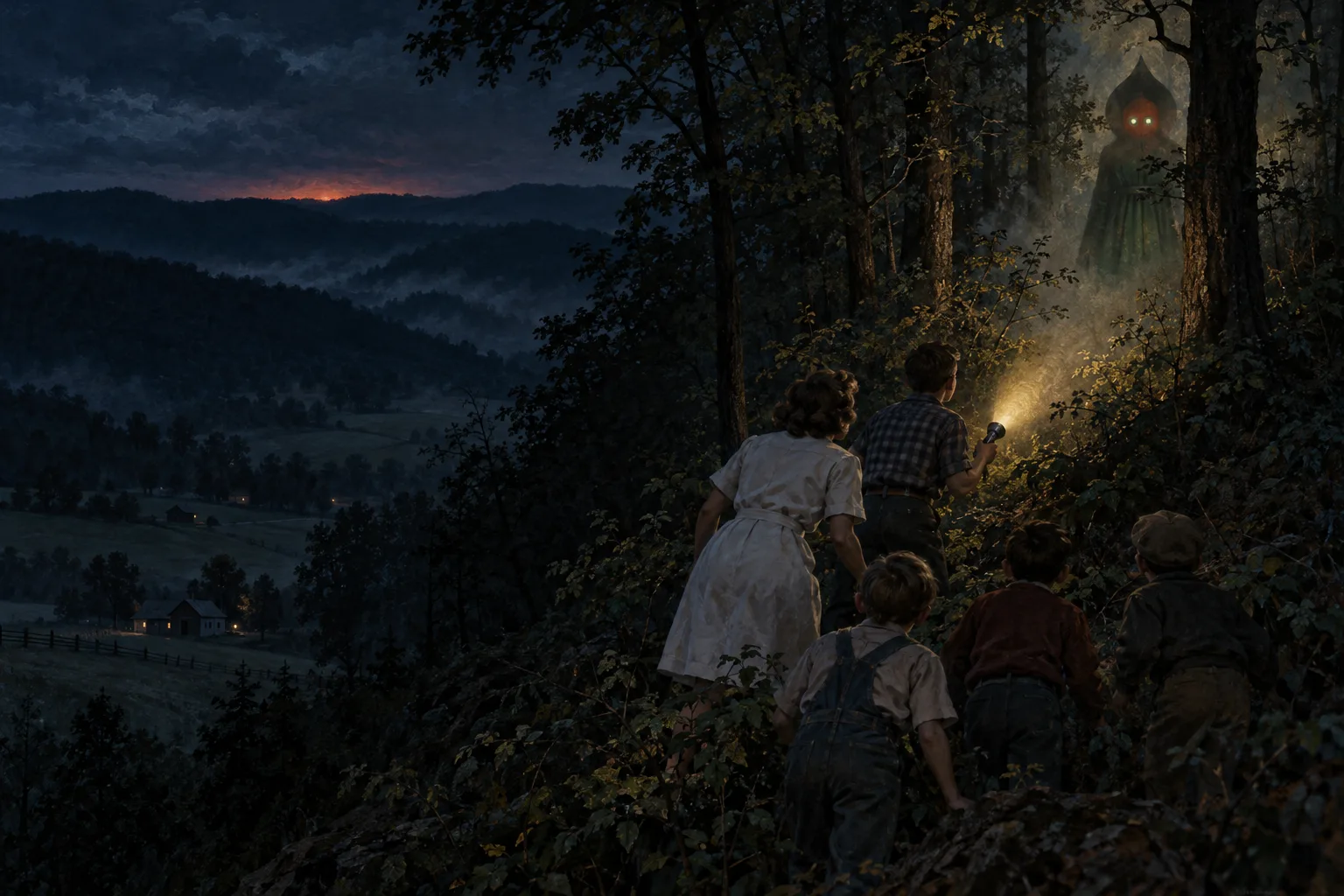
Eugene Lemon lifted the flashlight towards a pair of eyes in the darkness.
He was seventeen, a National Guardsman, and the oldest of the boys who had followed Kathleen May up the hillside. They had come looking for something bright that appeared to have fallen from the sky.
The beam revealed a shape they would struggle to describe: a red face, a pointed hood, and a body that seemed far too tall.
Lemon cried out and fell backwards. The others turned and ran.
It was September 12, 1952, above Flatwoods, West Virginia. Their journey up the hill had lasted longer than their encounter with whatever stood among the trees. The story they brought down would travel much farther.
A light beyond the playground
Earlier that evening, children had been playing near the school when a bright object crossed the sky.
In Gray Barker’s account, published in Fate in January 1953, the May brothers, Eddie and Fred, described a silvery object trailing red, fiery-looking material. It appeared to pause over the hill and descend beyond it.
The boys went to tell their mother.
Kathleen May, a local beautician, agreed to accompany the youngsters. Lemon found a flashlight and took the lead.
The party numbered seven: May, her two sons, Lemon, Neil Nunley, Ronnie Shaver and Tommy Hyer. A dog accompanied them in accounts of the walk.
The object had disappeared from the children’s view. To investigate, they had to climb towards the place where they believed it had come down, on G. Bailey Fisher’s farm.
Through the gate
Lemon and Nunley went ahead.
Barker described a pulsating red light, irritating mist, and Nunley’s observation of a rounded object beyond a gateway, down the hill to their right.
Their search had begun with a distant light. Now their descriptions included something apparently on the hillside, air that irritated them, and another presence off to the side.
An early follow-up in the winter 1953 Civilian Saucer Investigation Bulletin, based on enquiries by William and Donna Smith, recalled May negotiating a fence as the party approached the site.
Lemon thought the shining eyes belonged to a raccoon on an overhanging branch. He directed the flashlight towards them.
That ordinary possibility gave way, in the group’s account, to a figure of extraordinary size.
The pointed hood
The shape that became the Flatwoods Monster had an unusual outline.
The West Virginia Encyclopedia’s reconstruction describes a red face surrounded by a form resembling the ace of spades. Below it, green material seemed to hang in folds. Witnesses placed the figure at roughly ten feet or more, with a broad body.
It was recognisable enough to describe in parts, yet those parts did not fit an animal or person the witnesses could name.
May’s account included small claw-like hands. Other descriptions concentrated on the head and eyes, leaving the lower body indistinct. The remembered figure would acquire a dress-like silhouette in the artwork that followed.
The local tourism history preserves the reported movement: a hiss, then a rapid glide towards the group. Their response was immediate retreat.
They had climbed the hill to get closer to a light. With the flashlight turned towards the trees, getting closer was the last thing they wanted.
Back down the hill
The early civilian bulletin carried the story beyond the moment of flight.
It described May scrambling back over the fence and the boys arriving home distressed. According to that account, their grandmother wiped an oily substance from the May boys’ faces while May telephoned for the sheriff and the local newspaper publisher.
The witnesses reported nausea, vomiting and painful throats. Lemon was described as particularly badly affected during the night. The bulletin carried these as reports gathered after the event; its dramatic medical comparisons were part of the emerging account.
The hillside was close to their homes. Running away ended their immediate view of the figure, but left them nearby, telling adults and neighbours what they thought they had encountered.
The calls drew other people towards the farm. A search that had begun with children watching the sky became a matter for local officials and a newspaperman.
A return with a camera
A. Lee Stewart Jr., who helped publish the Braxton Democrat, became one of the story’s principal early chroniclers.
In the September 15 Washington Daily News report, preserved in a newspaper transcription, Stewart described returning to the hill with the sheriff and others, carrying his camera. Lemon went with them, though Stewart said he needed coaxing and remained visibly frightened.
Stewart reported flattened vegetation and two parallel marks resembling skids. He also said a trace of the unpleasant smell remained.
These observations gave the story another setting. People were now examining grass and ground where the witnesses had looked into darkness. The striking figure had gone; the search focused on things that might remain after it.
Stewart knew the people involved and believed their fear was real. His account conveyed the difficulty of accompanying a terrified youngster back to the place that had frightened him.
The return to the farm was becoming a story in its own right.
From the hillside to television
Within a week, the encounter had reached a national audience.
An Air Force memorandum written on September 30 records that some of the witnesses appeared on We the People on September 19. A drawing shown during the programme was presented as a composite of the witnesses’ descriptions.
Someone following the broadcast made a rough sketch of that drawing. It was attached to the memorandum for the Air Technical Intelligence Center at Wright-Patterson.
The image was travelling separately from the people who had seen the shape. An encounter glimpsed in a flashlight beam was becoming a figure that television viewers and intelligence officers could study on paper.
Barker separately interviewed the witnesses, recording accounts he found broadly consistent despite differences and repeated telling. His article appeared four months after the encounter, bringing the case into flying-saucer literature.
Samples from the farm
The Air Force correspondence also followed the reported marks on the ground.
Captain Dale L. Leavitt of the National Guard prepared a report dated September 17. After information about a greasy, graphite-like deposit reached officials through the Washington Daily News, Leavitt was contacted and asked to collect soil and vegetation.
The samples arrived on September 29. The September 30 memorandum forwarded them, Leavitt’s report and drawings to the Air Technical Intelligence Center.
The paperwork shows how the enquiry developed: a newspaper relayed a local claim; an officer was contacted; material was requested; samples and descriptions were sent onwards together.
By then, the original walk had produced several kinds of record. There were the children’s account of the light, descriptions of the figure, statements about sickness, observations from return visits and a television drawing. Each had its own route away from Flatwoods.
The story stays
Two years later, the Charleston Gazette returned to the case.
James Haught’s October 31, 1954 retrospective pictured May and Lemon holding an artist’s conception. It also reported Ivan Sanderson’s interpretation that several aerial machines had crossed the county. The encounter was already generating elaborate attempts to connect the hillside scene with reports from elsewhere.
The photograph offered a quieter continuity: two of the witnesses standing beside an image of what they said they had seen.
Decades later, Roy Wenzl’s 2018 reporting for HISTORY found the May brothers still standing by their experience. Museum director Andrew Smith described their weariness with interviews. Freddie appeared in a documentary, expressing indifference to whether others believed him.
The frightened children had grown old. Their short journey up the hill was still being retold.
What Is Known
Contemporary newspapers establish that May, Lemon and the boys reported a frightening encounter immediately afterwards. Barker’s early interviews and the civilian bulletin preserve fuller versions, with differences in appearance, movement and aftermath. The famous drawing is an interpretation of descriptions, not a photograph of the hillside figure.
The Air Force record documents an actual request for samples. Its September 30 memorandum also states that the material received showed no graphite-like deposit. An earlier reply to members of the public, dated September 26, dismissed the monster report as excitement associated with a meteor. That dismissal preceded the forwarding of Leavitt’s report and samples.
In his 2000 investigation, Joe Nickell argued that a meteor explained the aerial light and a barn owl, seen among branches by flashlight, explained the figure. He linked the reported face, eyes, hiss and gliding motion to the bird. Max Lockard told him that his pickup truck had left the supposed landing tracks during a visit that night.
Those are explanatory findings and later testimony. The surviving accounts document reported observations and investigative actions; they do not establish an alien visitor or a common extraordinary cause for the light, figure and illnesses.
The Bigger Picture
Flatwoods has carried the encounter into its public identity. The county tourism bureau describes a museum in nearby Sutton and five large monster-shaped chairs around Braxton County. The state encyclopedia records a community festival for the fiftieth anniversary in 2002.
Wenzl’s reporting captured the distance between belief and belonging. Local resident John Gibson doubted the monster while making ceramic figures of it and wanting the attention to help his community.
That transformation gives the case a second history. The same silhouette that once sent people running became something visitors seek out, photograph and take home. Its pointed hood made it distinctive enough to survive changes of medium: testimony, newspaper description, television drawing, souvenir.
Behind that familiar image remains a much smaller scene: seven people on a farm hillside, a flashlight turned towards the trees, and a hurried return to the homes below.
Sources
- Gray Barker, “The Monster and the Saucer,” Fate, January 1953. Publisher’s partial republication of the early investigator’s account.
- September 1952 newspaper reports, transcribed by Saturday Night Uforia. Includes Stewart’s contemporary Washington Daily News account.
- “More on the ‘Green Monster,’” Civilian Saucer Investigation Bulletin, winter 1953. Early follow-up based on the Smiths’ enquiries; reported symptoms are witness claims.
- USAF Directorate of Intelligence file DOW-UAP-D105, pages 141 and 149. Contemporary correspondence, examined as scans; public mirror of the released government file.
- James Haught, Charleston Gazette, October 31, 1954, page 48. Newspaper retrospective and witness photograph.
- Joe Nickell, “The Flatwoods UFO Monster,” 2000. Later field investigation and natural explanations.
- Roy Wenzl, HISTORY, 2018. Later local interviews and reporting on the witnesses and community.
- Buddy Griffin, “Flatwoods Monster,” West Virginia Encyclopedia. Regional historical and folklore context.
- Braxton County Convention and Visitors Bureau, “The Flatwoods Monster”. Local legend and heritage context.