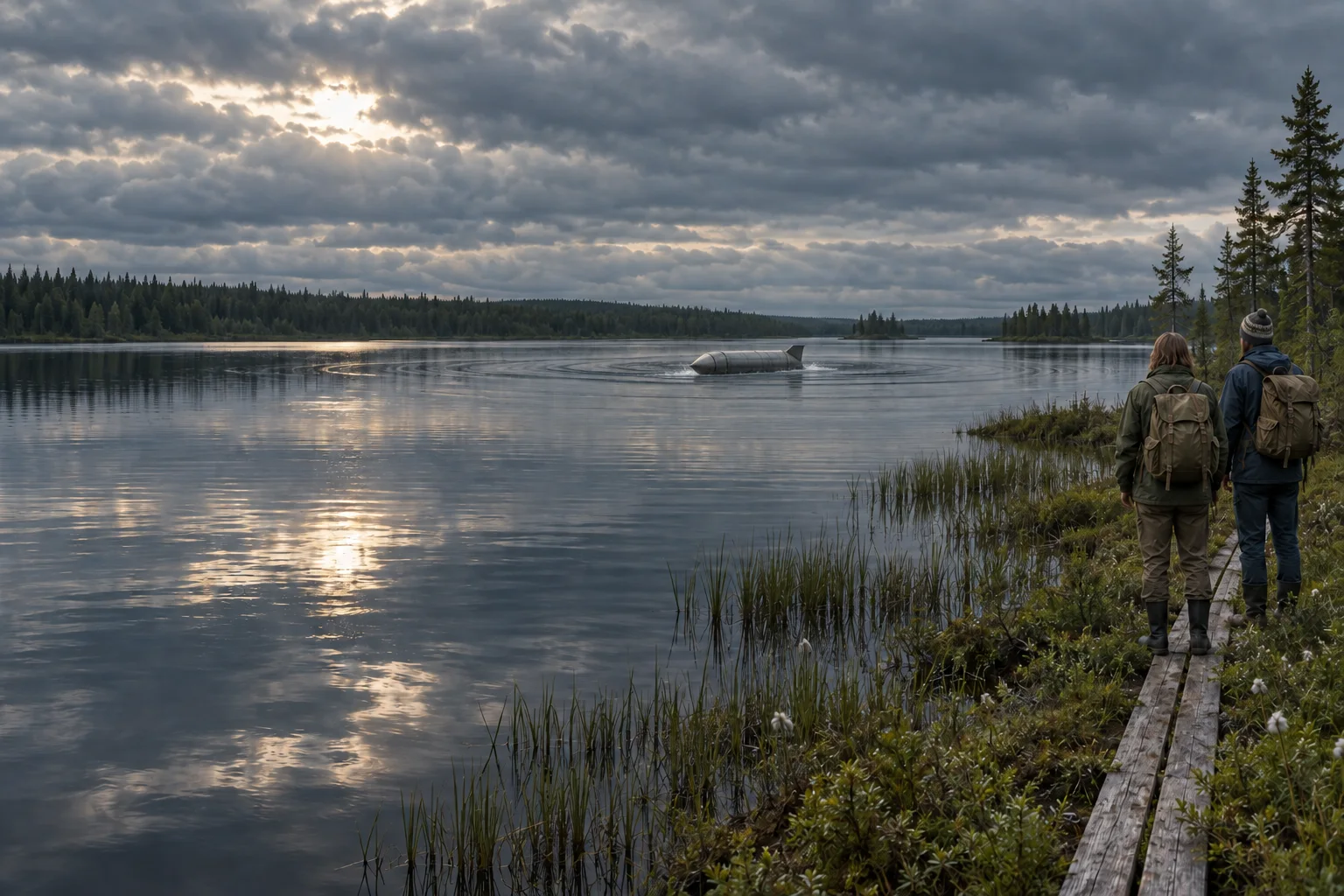
The man noticed the light before they reached the lake.
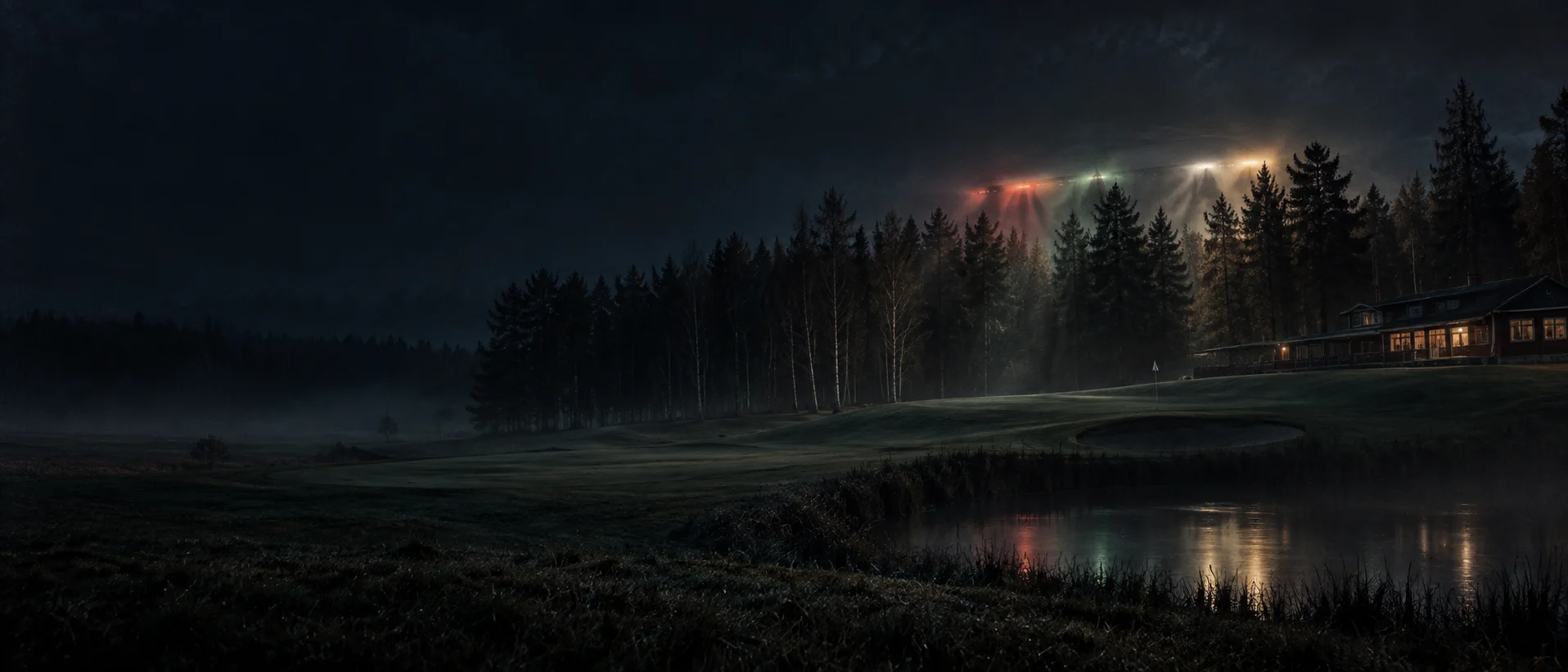
It showed between the trees near Ingetorpssjön, outside Kode in Bohuslän. There were houses around the water, but he did not think the glow came from one of them. For a moment he considered going towards it. Then an uneasy feeling changed his mind, and he continued with his girlfriend towards the lake.
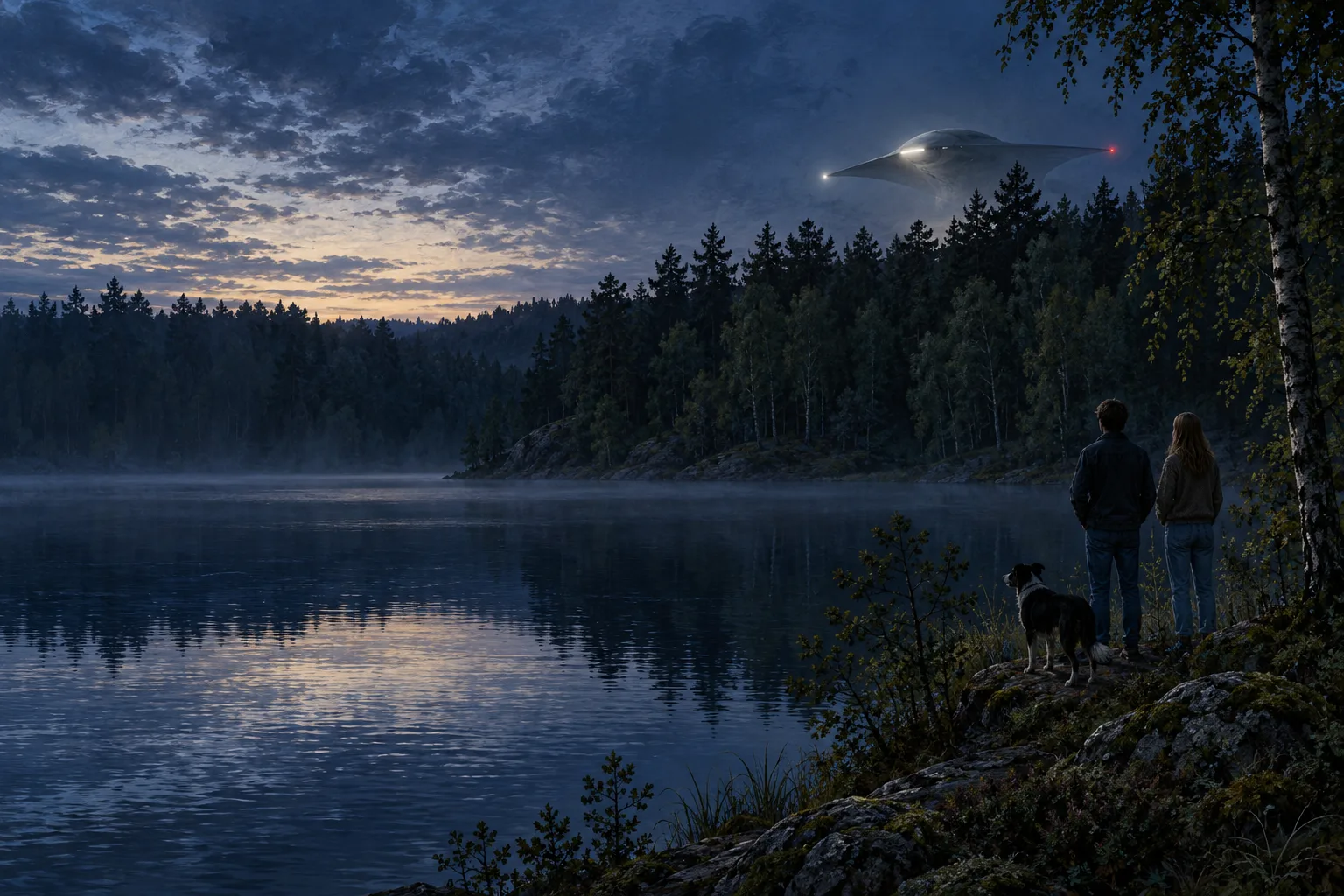
They had taken a dog for a walk in the early hours of August 4, 1990. In Anders Persson’s later investigation account, their first decision was simply to leave the light alone.
They reached the water and sat down. Soon the woman drew his attention back towards the woodland.
The light was moving.
Out of the trees
It appeared to come from the same place where he had noticed the earlier glow. This time both watched it rise slowly until it passed above the treetops.
As the trees ceased to conceal it, the glow became an object with an outline. The man compared its apparent size to something slightly larger than a Viggen aircraft. Its shape reminded them of a ray: a broad body extending out to either side.
These were the comparisons the encounter would leave behind. The object had emerged from a familiar landscape, yet describing it meant reaching for the outlines of an animal and an aircraft.
Light came from an area around its front, bright enough, according to their account, to cast distinct shadows on the ground. The shorter archive summary describes something resembling an illuminated cockpit, with light reaching the witnesses’ faces.
What began as a glow through trees was now above them, close enough in their estimation to invite attention to individual features.
Remember the details
The object started to move slowly over their position.
They estimated its height at thirty to forty metres, just above the trees. Its surface looked metallic or silver-coloured. At the ends of the apparent wings were lights, one red and one white; the man remembered them blinking.
He told the woman that they should concentrate on remembering as many details as possible.
That instruction gives the encounter a particular character. The two were describing more than an unexpected light seen during a walk. In the man’s account, he consciously tried to retain the appearance of something passing overhead. The details he later supplied belonged to that remembered effort: the surface, the lights, the shape and the view underneath.
Persson’s reconstruction follows their attention as the object moved. Its underside became part of the observation. So did a sound that seemed unexpectedly familiar.
Under the body
Near the middle of the underside, they described a round opening resembling a vent. From it came intermittent puffs, which they compared to small bursts of smoke.
The woman likened the puffing sound to an old fishing boat. The man compared it to a steam locomotive. Alongside that rhythm was a rushing or whining noise.
He offered another comparison: a large American V8 engine, suggesting considerable power even without overwhelming loudness.
None of those descriptions supplied a name for the object. Instead, they conveyed separate impressions through sounds the witnesses already knew. A boat and a locomotive were different machines, but each provided a way to describe repeated puffs. The engine comparison expressed the man’s impression of power.
In the remembered scene, the broad metallic shape and the mechanical sound belonged together. The object was moving slowly enough for them to attend to its underside, yet its departure would have a very different character.
The turn west
It entered a sharp right turn.
Then it accelerated strongly towards the west. The sound changed to a rumble as it moved away, and the treetops eventually hid it from view.
The encounter did not end with the loss of the outline. A strong light illuminated the horizon, accompanied by a loud rumbling sound compared to a sonic boom. Aftonbladet’s later retelling also preserves that sequence: the object over the lake, its disappearance from sight, then the horizon lighting up and a bang.
The witnesses had followed it through several stages. First it had been a light between trees; then a rising form, then something overhead. Now it was beyond the trees again, with its last reported effects arriving from a direction they could still watch.
There was one more detail, but it belonged to only one of them.
A light after the departure
The woman said she saw a greenish luminous ball descending slowly behind the forest in the direction where the object had gone.
The man did not report seeing it.
Persson retained that difference in his account. Alongside the shared sequence was a separate observation, rather than a final detail automatically assigned to both witnesses.
The man estimated the entire observation at twenty to twenty-five seconds. The long description that followed would unpack a very brief encounter: a change of height, a passing view, several remembered features and a sudden departure.
The dog walk had provided the setting. What would eventually reach investigators was the couple’s recollection of those seconds beside the water, including the part they did not both remember seeing.
A call years later
The story reached UFO-Sverige when the man telephoned one evening, several years after the encounter.
He thought the organisation should know about his experience. Persson found the account unusually detailed and wanted to investigate it further. The man said he had not been alone: his girlfriend at the time had also seen the object.
Reaching her required another step. The two had not been in contact for years, and he did not have her current telephone number. He located her parents’ number instead. Through them, investigators obtained a way to contact her.
They explained why they were calling and asked her to tell her version.
Persson reported that, apart from small details, it matched the man’s. He also described both witnesses as making a credible impression, first by telephone and later during visits. He expressly identified that judgement as subjective.
The inquiry had now moved from one caller’s account to a second person who had been beside him at the lake. Her recollection brought another perspective to the remembered outline, movement and departure.
Back to the neighbourhood
Investigators also visited the area and knocked on doors.
During those inquiries they happened to meet the woman’s mother. According to Persson, she confirmed that the story had been told to her at the time of the encounter. A family recollection connected the later investigation with the period when the couple said the sighting occurred.
Another lead concerned a newspaper. Investigators had heard that a brief local item might have appeared in the following days. They searched through newspapers published in the area, but did not obtain further confirmation.
The location associated with the apparent ascent was described in Persson’s account as an old burial ground dating from the fifth century. Investigators examined it and reported no visible traces in the vegetation.
Their inquiries followed different routes: another witness, a relative, neighbours, newspapers and the ground itself. Each route began with something in or around the original account. The investigation preserved the testimony and its setting, but did not produce an identification.
The phone rings again
The case remained available to later researchers.
On August 6, 2024, Clas Svahn recorded another contact in his daily blog. He was helping Göteborgs-Posten find a UFO case within its circulation area and called a witness to the Kode encounter.
He dated the event to August 4, 1990, credited Persson with the earlier investigation and wrote that they had never found an explanation. He also reproduced a drawing, identifying it as the work of the man’s fellow witness.
The entry does not reproduce their new conversation or announce a new finding. It documents something more modest but concrete: thirty-four years after the reported night at the lake, a researcher was again contacting a witness about it.
The memory had moved through a telephone report, interviews, a written reconstruction, summaries and renewed interest. At its centre remained the same brief sequence: a light coming above the trees, a shape overhead, and a departure towards the west.
What Is Known
The fullest source consulted is Persson’s investigation narrative. It describes interviews and field inquiries, but says the initial report arrived several years after the event without giving that reporting date. Its detailed descriptions are therefore retrospective testimony, not a record written during the encounter.
The published times differ. Persson opens with 02:30; UFO-Sverige’s archive list gives 02:15. Both place the sighting in the early hours of August 4. The thirty-to-forty-metre height, aircraft-sized comparison and twenty-to-twenty-five-second duration are witness estimates.
The separately obtained accounts and the mother’s recollection establish a reporting trail. They do not demonstrate what the object was. The possible newspaper item was not located, and the field inquiry reported no visible vegetation traces. The burial ground is a location detail in the reconstruction, not evidence of a connection with the site’s ancient use.
Svahn’s 2024 entry supplies a dated follow-up and identifies a witness drawing. It records continued contact, rather than an independent observation of the 1990 event. The archive list and newspaper retelling likewise preserve the case’s circulation; they are not additional sightings.
The Bigger Picture
In Aftonbladet’s reporting about the Swedish UFO archive, archive co-founder Håkan Blomqvist described an approach open to different explanations, while distinguishing investigation from a presumption of extraterrestrial visitors.
Kode shows why that distinction matters. Its most striking details come from people trying to describe an experience. The investigators’ contribution was to seek the second account, record a difference, follow a family recollection and return to the place. The case remains interesting because those actions allow the reader to follow how a private memory became an investigated report.
Its unusual noises also give it an individual character. The witnesses reached for ordinary machines to describe something they found extraordinary. Their comparisons preserve how the encounter sounded to them without resolving the source of the sound.
The object they reported was gone in seconds. The work of asking about it continued across years. Kode’s lasting story holds both timescales together: the brief view from beside the lake, and the much longer effort to understand what had passed above it.
Sources
- Anders Persson, “1990 Kode – Puffande drake över gravfält,” UFO-Sverige. Investigator’s retrospective reconstruction from witness interviews and field inquiries; says the initial report arrived several years later, without giving that reporting date.
- UFO-Sverige, “Elva fall ur UFO-Sveriges arkiv som ännu inte fått en förklaring.” Later archive summary; gives a different time from the detailed account.
- Clas Svahn, “Ny bokhämtning och ny hyrbil,” August 6, 2024. Researcher’s dated account of renewed witness contact; includes a drawing attributed to the fellow witness. No new interview transcript is reproduced.
- Niklas Eriksson, “Är det inte… ufo i Sverige?”, Aftonbladet. Later newspaper coverage providing independent context about the archive and a short Kode retelling, rather than confirmation of the encounter.