The dog began barking around eight o’clock.
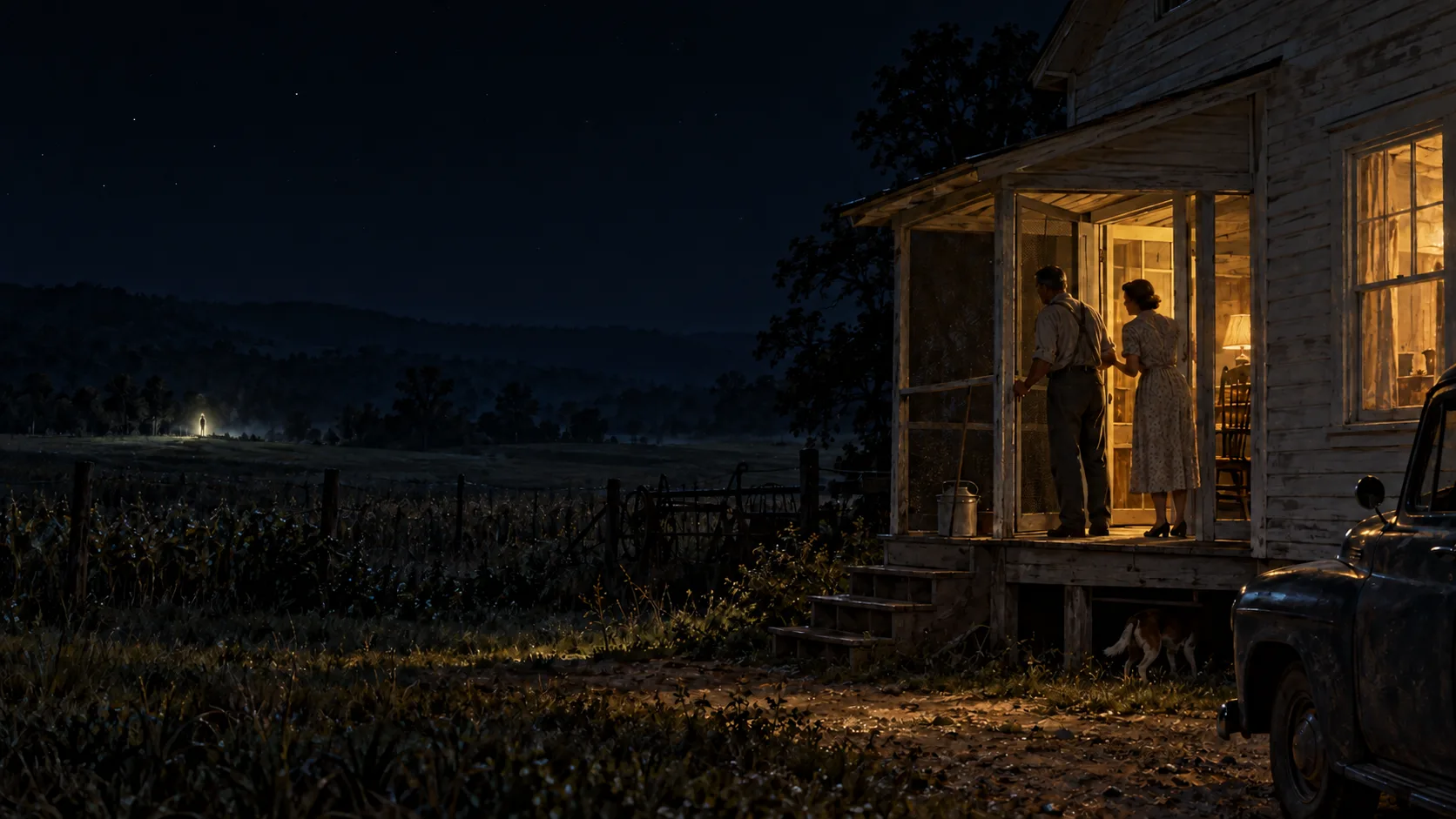
Elmer “Lucky” Sutton and his friend Billy Ray Taylor went to the back door of the farmhouse to see what had disturbed it. According to the family’s account, the dog tucked its tail between its legs and ran beneath the house. It did not appear again that night.
Beyond the yard, the men said, something was coming towards them.
That sequence—the alarm, the retreat, the two men looking into the field—comes from Isabel Davis and Ted Bloecher’s investigation, assembled from interviews after the event. The dog cannot tell us what was there. Its reported behaviour explains why the men looked outside and why their account began at a door that would soon become difficult to leave.
A light beyond the well
The farm stood near Kelly, a small community north of Hopkinsville, Kentucky. Eleven people were at the house that Sunday evening, among them Glennie Lankford, her adult sons and their visitors, and three children. The Taylors had come with Lucky and his wife Vera. Some of the group lived there; others were visiting.
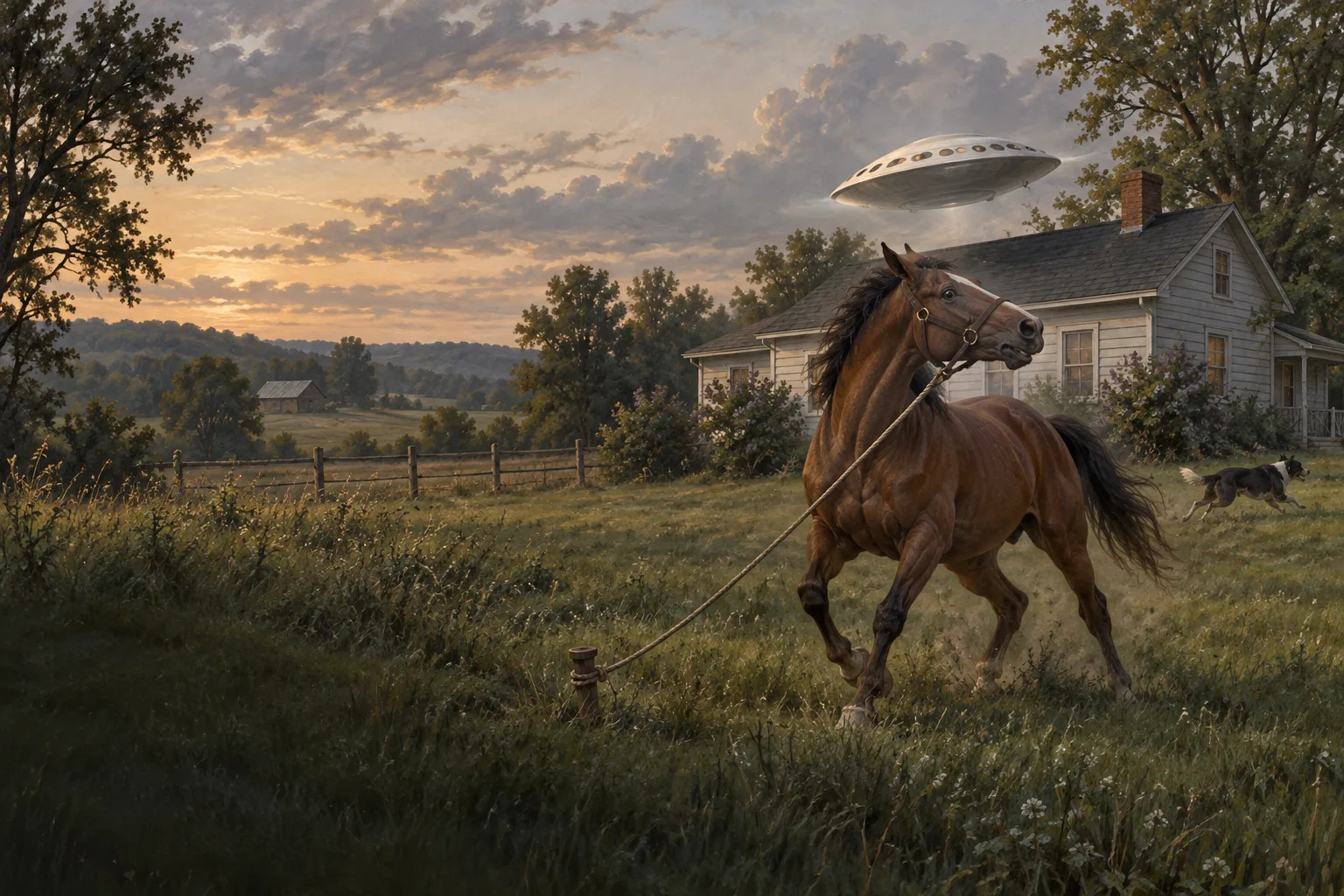
An hour before the dog barked, Taylor had gone to the well for water. He came back saying that a bright, silvery object had travelled over the house and descended beyond the fields. In Davis’s reconstruction, Taylor described colours trailing behind it and a drop into a gully where it vanished from his view. The others did not rush to search the gully. They treated his report lightly and went on with the evening.
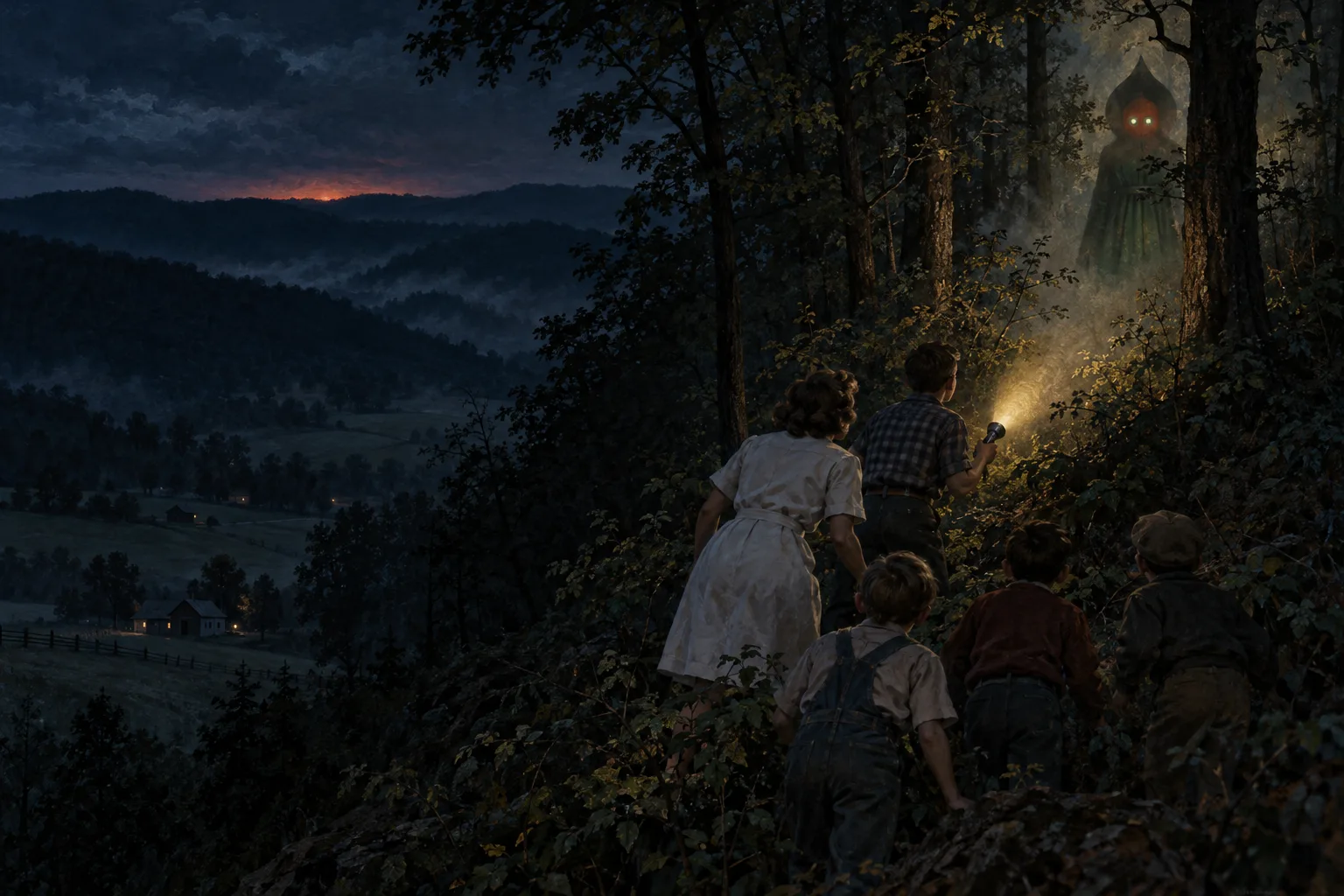
Then the barking started. Lucky and Taylor looked out. They described a glow approaching from the fields and, within it, a figure far shorter than an adult. Its head seemed large and round. Its arms hung long, ending in hands they compared to talons. They said its eyes shone yellow and its body looked silvery in the darkness.
The description reached the public quickly, but the familiar phrase “little green men” did not come from these witnesses. In the detailed interviews collected by Davis, the colour was silver or metallic. The difference matters: a label that survives for decades can replace the details people originally tried to describe.
At the back door
Lucky and Taylor went inside for guns. Davis’s later reconstruction identifies a shotgun and a .22 rifle. When the figure came closer to the back of the house, the men fired. They said it seemed to tumble, right itself and move off into the dark. They had not found a body, and their shots had not ended the encounter as they understood it.
Back in the living room, the men saw a similar shape at a screened window and fired again. A hole in a screen was among the damage officers would later see. The occupants were now trying to watch more than one side of a house, with children and other adults inside and an open yard beyond each doorway.
They went out to see whether the shots had struck anything. As Taylor passed beneath the small overhang at the front door, witnesses said a hand reached down and touched his hair. Alene Sutton pulled him back. Lucky fired upwards. Another figure was reported in a nearby tree. Shots followed it into the yard, where, according to the family, it did not fall in the expected way.
The exact number of figures was never settled. In the Kentucky New Era’s report the following day, officers repeated the family’s early account of twelve or fifteen. Davis later judged that repeated appearances could have made two or three seem like many more; Glennie Lankford told her she had never seen more than one at a time. The witnesses agreed on a succession of appearances around the house. They did not leave a reliable head count.
The view from inside
For Glennie Lankford, the night began differently from the men’s. She later said she had thought the younger people were joking or shooting for amusement. The women were occupied with ordinary evening work and the children. Her judgment changed when Alene came in frightened after seeing something herself.
Lankford moved into the hall to watch the screened front door. In a 1959 interview included in Davis’s book, she recalled crouching there with Taylor for roughly twenty minutes. A small, shining form came up to the screen. She likened its shape to a gasoline can with a head and thin legs. Startled as it reached the door, she lost her balance; Taylor fired through the screen. Her description was her own, and its plain, household comparison is more specific than the later nickname given to the case.
The family’s response was not uniform. The men repeatedly shot at what they believed they saw. Lankford recalled urging them to come in and close the doors. To her, the figures had approached and looked, but had not forced a way inside or harmed anyone. That distinction did not make the rest of the household feel safe. Davis recorded a child so frightened when the family finally left that the child had to be carried to a car.
By about eleven, they had had enough of the windows and the yard. The group left in two automobiles and drove to Hopkinsville for help. The dog, according to the later account, was still under the house.
The trip to town
At police headquarters, the family described small figures, gunfire and a craft beyond the farm. The next day’s local newspaper reported two cars arriving around eleven, with at least five adults and several children who appeared highly excited. City and state police, a sheriff’s deputy and military police went out to Kelly. The New Era’s staff photographer joined the search.
The officers arrived at a place the family had fled. They examined the house, yard and land behind it. They found a damaged screen and signs that shots had been fired, but no figure, tracks or clear landing mark. The newspaper reported that the search continued until after two in the morning. Officers did not settle on an explanation, and the paper said those who visited the site saw no evidence of drinking.
One small incident showed how tense the search had become. A military policeman stepped on a cat’s tail near the house. Its sudden cry made several people react at once. The episode was recorded in the contemporary newspaper, and Davis later heard it again from investigators. It was an ordinary sound in a yard full of armed, alert people.
Eventually the officers left. The family returned to the farmhouse. According to Lankford’s later account, the figures appeared again after the police departure. She recalled waking or lying awake near a window and seeing a small form put its hands against the screen. She looked away and back more than once. The family reported further shots, and the final sighting was placed shortly before daybreak.
By morning, police and private visitors were back. The night’s report had moved from a frightened household to the newspaper, the radio and the roads around Kelly.
What Is Known
The strongest contemporary account is Joe Dorris’s front-page report for the Kentucky New Era on August 22, 1955. Dorris recorded the trip to the police station, the officers’ night search, the damaged screen, and what the families told investigators. He did not witness the reported figures. His article also shows uncertainty already present on the first day: officers could not determine exactly how many occupants claimed to have seen them.
Davis and Bloecher’s Close Encounter at Kelly and Others of 1955 is much fuller, but it is not a transcript made during the night. Radio engineer Bud Ledwith interviewed witnesses and drew figures from their descriptions on August 22. Davis visited in June 1956, spoke with Lankford, Alene Sutton, police chief Russell Greenwell and others, and used additional interviews collected later. Her book was published in 1978. Some testimony was therefore recorded immediately; other material reflects memories months or years after the encounter.
The dog’s barking and retreat belong to that witness account. Neither the newspaper’s physical findings nor the dog’s reported fear can identify what the family saw. The police verified the family’s appeal for help and searched the place they described. Their search did not establish the presence of the figures or a landed craft.
Even details within the records differ. The newspaper described Taylor’s .22 as a pistol; Davis’s reconstruction calls it a rifle. The early figure count was much higher than Davis thought the observations supported. Those differences are part of the surviving record, not details to smooth into a single precise version.
The Bigger Picture
The name Kelly–Hopkinsville joins the farm to the town where the family sought help. What happened at the farm remains unresolved in the available evidence; what happened after the drive is easier to trace. Officers responded, reporters arrived, and the incident became news while the family was still dealing with the previous night. Davis documented how sightseers crowded the property and how ridicule made some witnesses unwilling to talk when she visited the following year.
The story kept travelling. In a 2023 Kentucky Life segment, Lucky Sutton’s daughter and a local historian described its place in family and regional memory. That later perspective shows how an episode reported in one farmhouse became a lasting Kentucky legend; it cannot independently confirm the figures described in 1955.
The familiar headline creature can obscure the people at the centre of the report: a mother watching a screen door, children being carried to a car, police searching a field, and a dog said to have chosen the space beneath the house. The animal’s retreat is one of the account’s sharpest images. It tells us how the family remembered the start of the alarm, while leaving the cause of that alarm open.
Sources
- Joe Dorris, Kentucky New Era, August 22, 1955. Contemporary local newspaper article, reproduced in a case archive; reports police response and early witness claims.
- Isabel Davis and Ted Bloecher, Close Encounter at Kelly and Others of 1955 (1978), CUFOS digitization. Davis’s 1956 field interviews, Ledwith’s August 22, 1955 notes and later testimony; principal source for the dog’s behaviour and detailed chronology.
- NICAP encounter catalogue, Kelly entry. Retrospective summary used to cross-check the date and basic account.
- Kentucky Educational Television, Kentucky Life: “Little Green Men” (2023). Later local-history and family perspective on the case’s legacy.