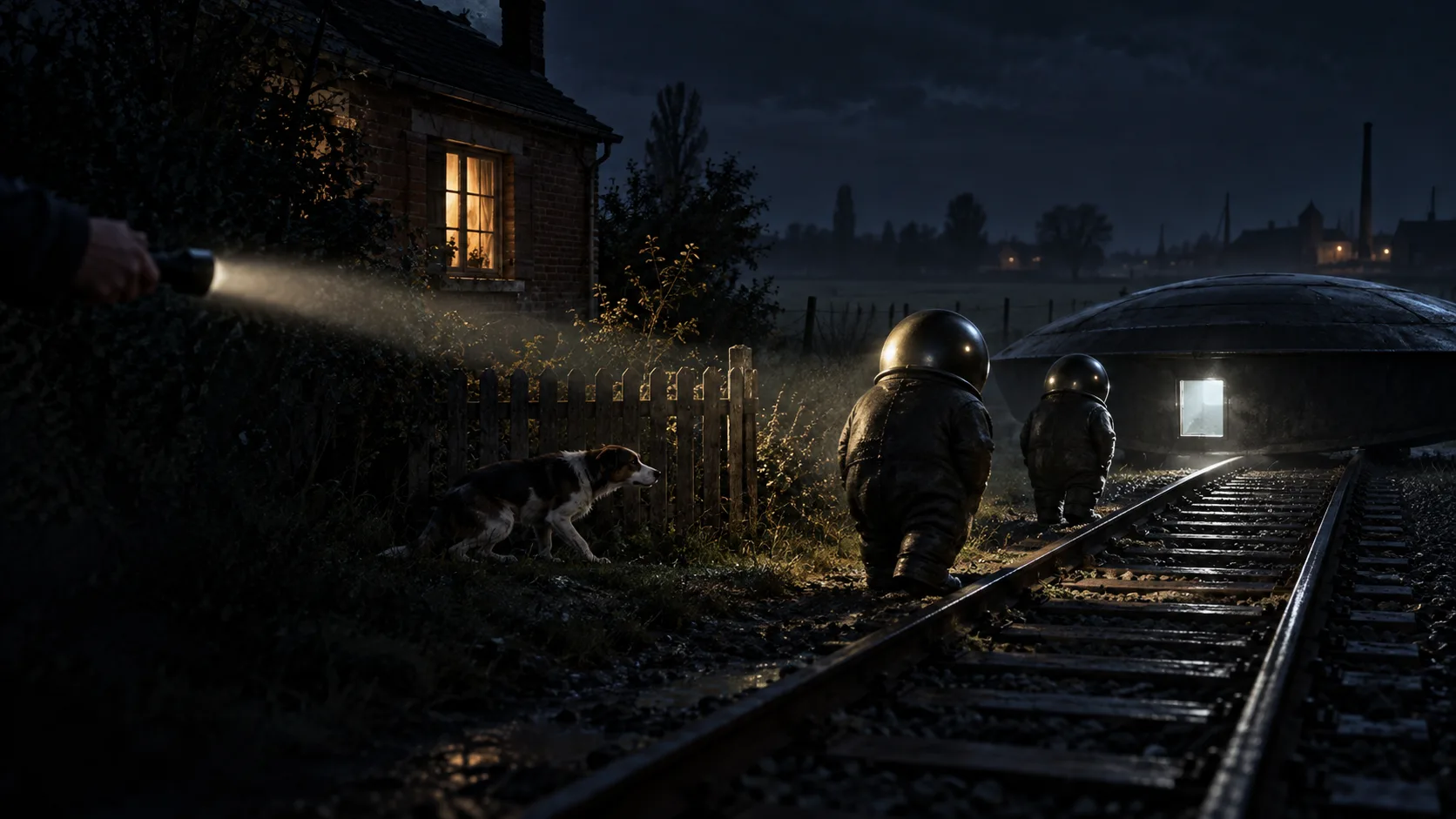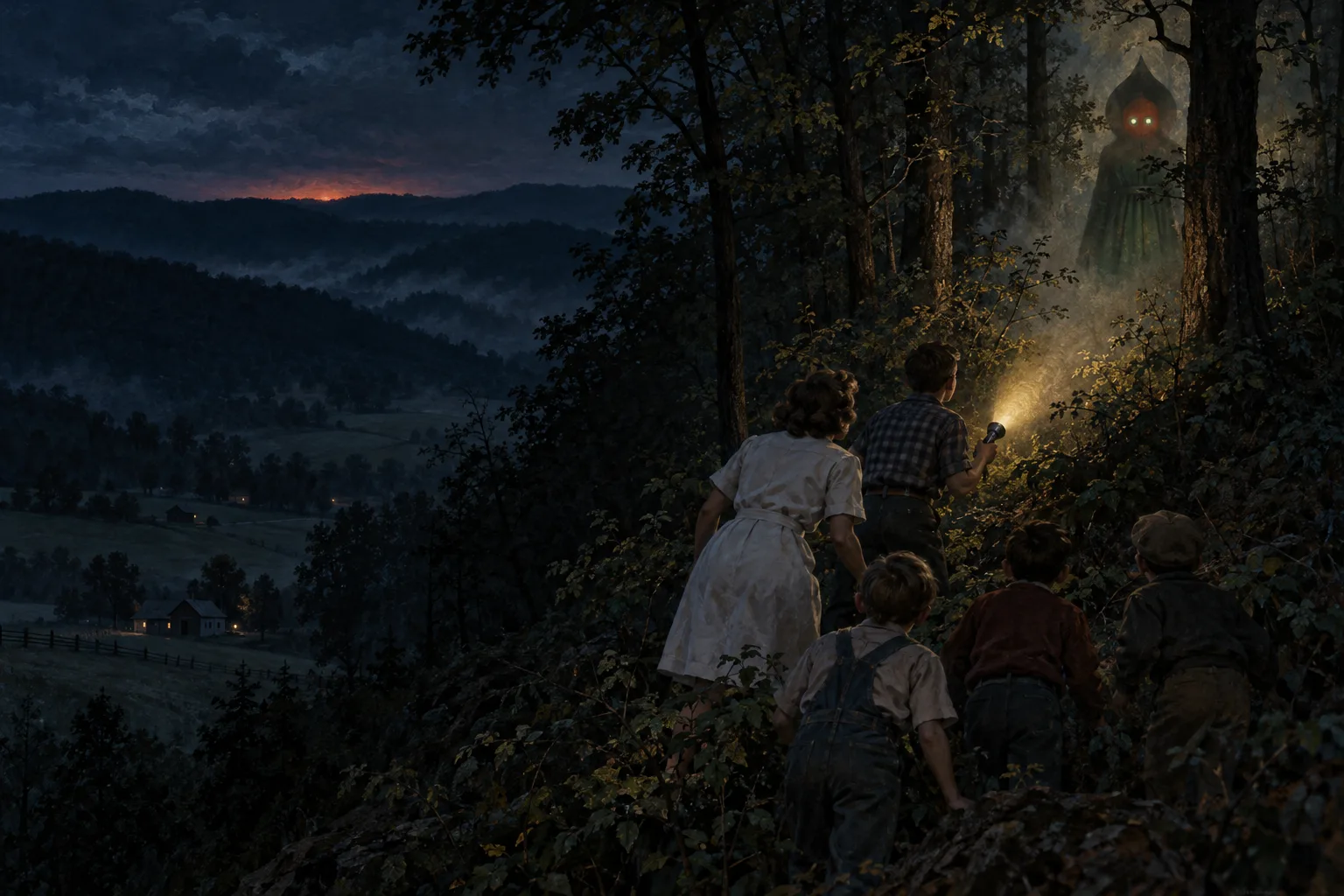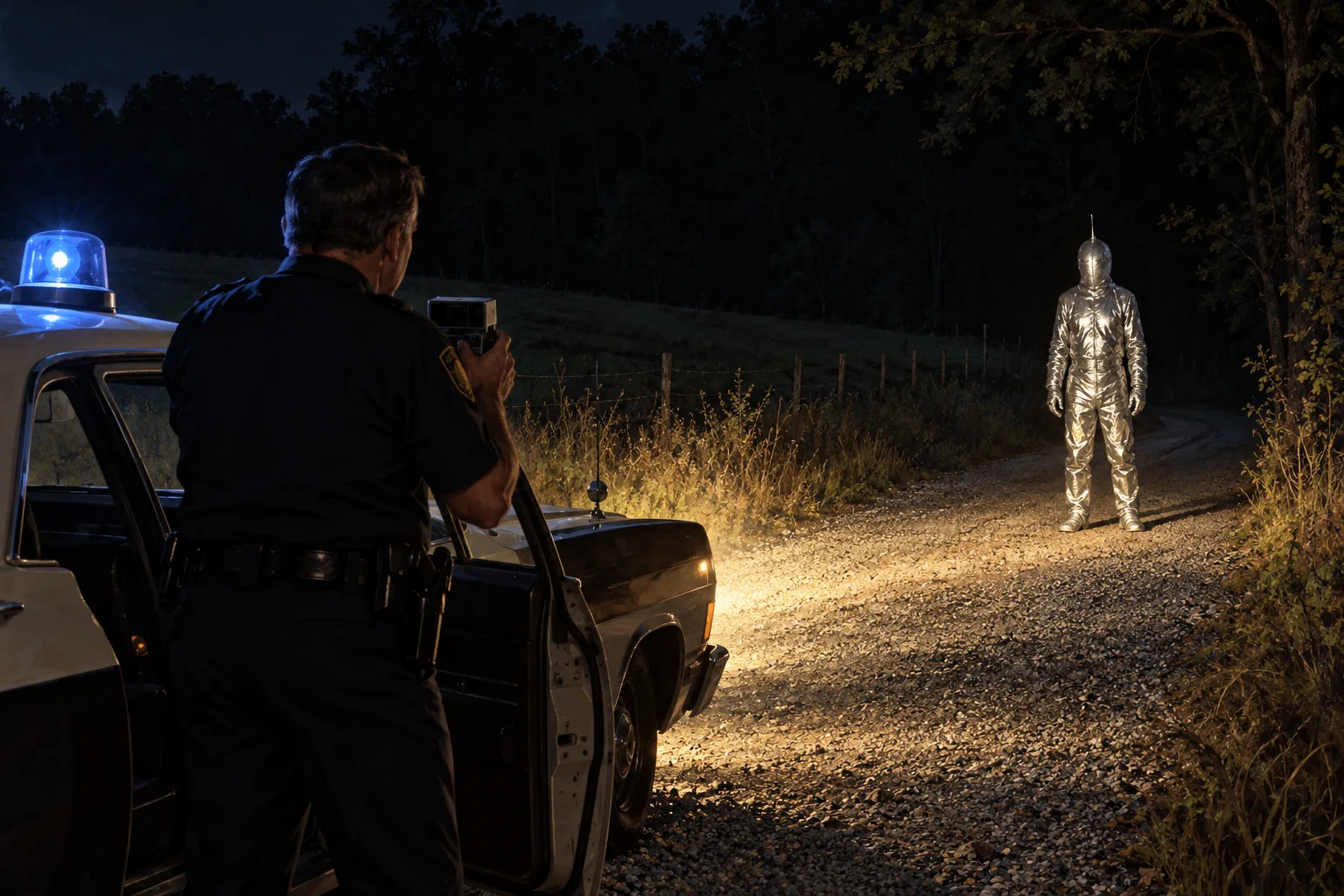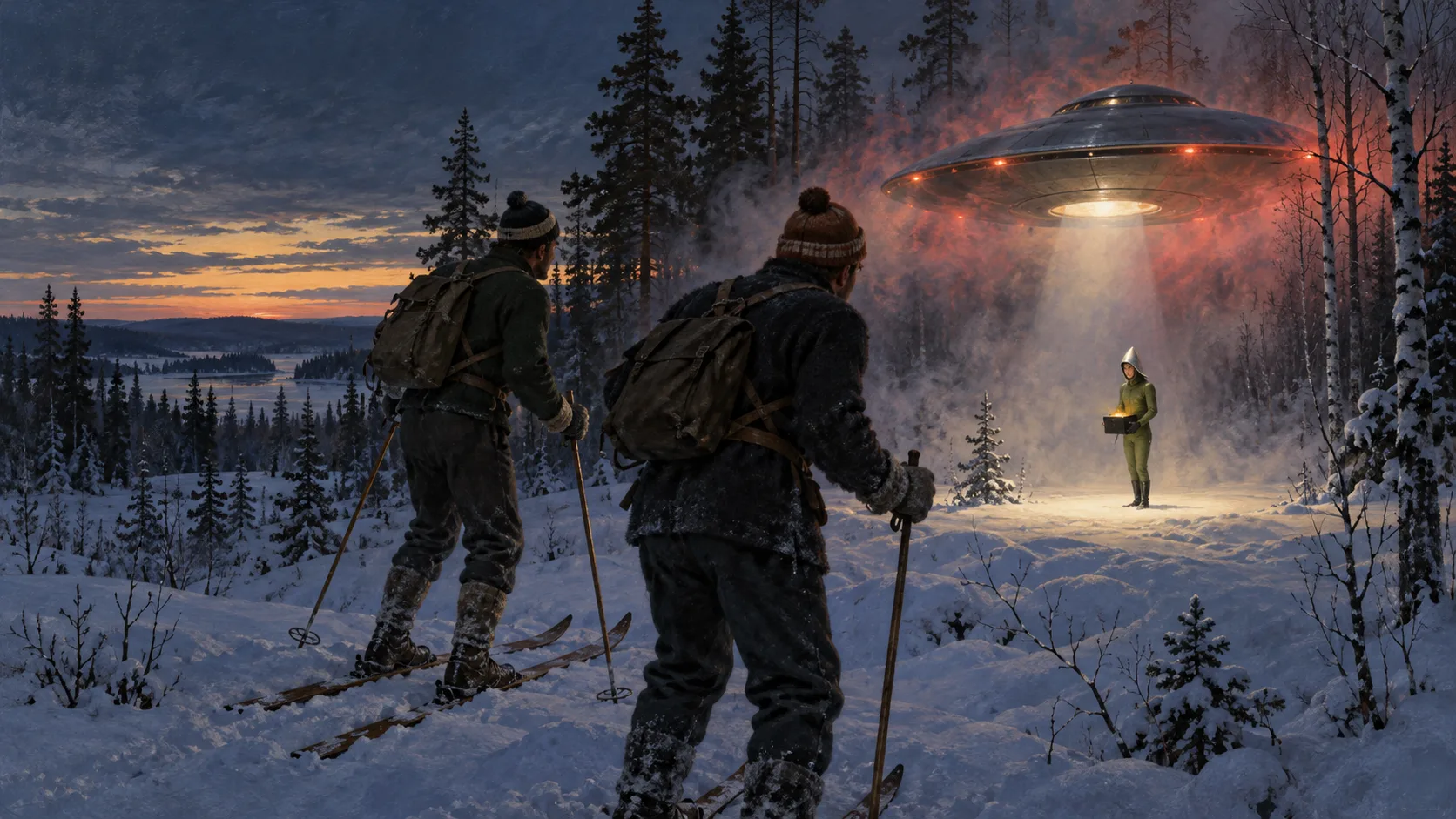
The light came down into the clearing while the two men still had their skis on.
Aarno Heinonen and Esko Viljo had stopped at a familiar place in the forest near Imjärvi. It was late afternoon on January 7, 1970. According to the account assembled that year by Swedish investigators, they heard a buzzing sound and looked up. A luminous cloud had crossed the sky, curved, and approached from the south. Within it, they said, was something round and metallic.
The sound grew louder. The cloud descended. Then a beam from beneath the object swept across the snow and settled into a bright circle. In the men’s later account, this was the place where a small figure appeared.
The pause on the trail
Imjärvi lay north-east of Heinola in southern Finland. Heinonen, a forest worker, and Viljo, a farmer, were experienced skiers who knew the route. The 1970 investigation placed their stop in a glade where they often rested after a small descent. Sunset was near; a few stars had appeared. The reported temperature was around −17°C, with no wind.
They first heard what the investigators described as a weak buzz. The light arrived from the north, made a broad turn, and came towards them from the south. It seemed surrounded by a red-grey mist that pulsed with its brightness. As it dropped lower, the men said they could make out a flattened, circular body within the cloud. They judged it roughly three metres across, though that figure came from their visual estimate, not a measurement.
On its underside they described three rounded projections and a central tube. The mist gradually thinned. The object stopped a few metres above the ground. Heinonen thought it close enough to reach with a ski pole, an impression that conveyed proximity more than a reliable distance.
The buzzing stopped. Light came from the tube and travelled over the snow. When it settled, the illuminated patch had a darker rim.
The circle beneath the disc
Heinonen’s version began with a physical sensation. He said it felt as though he had been pulled backwards at the waist. As he stepped back, he noticed a small figure in the circle of light, holding a dark box. A yellow glow emerged through a round opening in it and appeared to pulse.
He described the figure as about ninety centimetres tall, with thin limbs, a pale face and a light green overall. Darker boots rose above its knees; white gloves reached towards its elbows. He could not make out its eyes. What he remembered most sharply was the narrow face and the box gripped in its hands.
Viljo’s description gave the figure a pointed, reflective helmet. He saw a slight body, thin sloping shoulders and a pale face. In Sven-Olof Fredrickson’s 1970 report, Viljo also said the figure looked luminous. The impression of a helmet and fitted clothing would later make the apparition easy to portray as a robot. The witnesses’ description does not establish that it was mechanical. It is equally a description of a small, apparently suited person-like shape.
The figure turned the box towards Heinonen. He remembered the yellow light becoming almost blinding. Red-grey mist descended from overhead, and coloured sparks seemed to drift out from the circle. The mist thickened until the men could no longer see each other.
They estimated that the figure had been visible for perhaps fifteen or twenty seconds. When the mist opened, it and the object were gone.
Viljo recalled the bright circle shrinking and the beam lifting back into the central tube. For a few minutes, the two men stayed still. They had not spoken while it was happening, Heinonen said. Then getting home became urgent.
The journey back
About two minutes after the mist cleared, Heinonen said his right side went numb. He tried to move forward on his skis and fell. His leg would not support him. Viljo helped him from the clearing, leaving Heinonen’s skis behind.
The investigator’s chronology says the trip to the village took an hour for about two kilometres. Heinonen felt pain in his limbs and back, became nauseated and vomited. He also reported difficulty breathing and urine so dark that he later compared it to coffee. These are symptoms as the men and their investigator described them; they do not, by themselves, identify a cause.
At around eight that evening, Heinonen saw Dr Pauli Kajanoja in Heinola. The doctor later recalled low blood pressure and thought the men had suffered a considerable shock. Viljo, who had not felt ill immediately, developed a red, swollen face and trouble with his balance. The doctor saw him too. In subsequent days Viljo reported sore eyes and sensitivity to light.
Heinonen returned to the doctor and said he could not work. In a May letter to the investigators, he described persistent headache, pain and heaviness in his right hand. Viljo’s January appointments included treatment for his eyes and a later visit when, according to the investigator, the doctor found nothing wrong on examination.
The story travels west
News of the encounter reached GICOFF, a Swedish UFO-investigation group, through newspaper coverage. Its members began corresponding with the men. Questions were translated, replies came back from Finland, and the investigators compiled a case report. A Swedish magazine reporter later travelled to interview both witnesses, visited the clearing and spoke with the doctor. Fredrickson published the fuller account in the September–October 1970 issue of Flying Saucer Review.
Fredrickson acknowledged that his earliest accounts had not contained the whole story. He said Heinonen recovered parts of the event after a period of incomplete memory. The men had not discussed the figure in detail with each other before later interviews. Heinonen initially wondered whether, through the mist, he had seen a distorted image of Viljo; Viljo had held back for fear of ridicule. The figure became explicit when a visiting reporter questioned them.
The delayed detail gave the case its most memorable image and its hardest chronological question. The light and illness brought the matter to investigators; the helmeted figure entered their fuller reconstruction months later. Fredrickson offered the witnesses’ explanation, leaving the reader to judge what an evolving recollection can establish.
The investigators did obtain material from the site. Fredrickson wrote that soil, melted snow and branches were sent to Chalmers Institute of Technology in Gothenburg. He reported a negative result for radioactivity in the earth sample. There was no reading from the clearing on the night itself, and Kajanoja said he had no instrument with which to test for radiation when he examined the men.
The doctor was careful about the difference between a resemblance and a diagnosis. He thought the men looked shocked. Some symptoms reminded him of radiation exposure, but he could find no clinical cause for Heinonen’s complaints and could not account for the prolonged dark urine. His comments recorded the men’s condition and the limits of his examination. They did not confirm that an unusual beam had injured them.
A voice on Finnish radio
The encounter also stayed in Heinonen’s own telling. In a 1971 interview recorded by Finnish broadcaster Yle, he described a saucer-shaped object and a being with a relatively large head and small round body. He spoke of a suit that glowed strongly in the dim light. He also said he had been on sick leave for months and remembered Viljo’s face swelling and turning dark red.
In the Swedish account, the figure is slim, green-clad and helmeted; on Yle, Heinonen emphasised the large head, rounded body and luminous suit. Later summaries differ again on the object’s size and the appearance’s duration.
The shared outline remains: a stop on a ski trail, an approaching light, a strange shape beneath it and illness after the return home. The differences matter when the account becomes a precise drawing, a medical claim or a label such as “robot.”
What Is Known
The earliest substantial surviving source located for this article is Fredrickson’s 1970 report. It drew on GICOFF’s correspondence with Heinonen and Viljo, a visiting reporter’s interviews and conversations with Dr Kajanoja. The issue reproduced drawings and a photograph of the men revisiting the site. UFO-Sverige’s later review describes the preserved correspondence and the route by which the Swedish group obtained it. Yle preserves Heinonen’s own 1971 radio account.
These sources document a reported encounter and a medical visit. The doctor’s quoted observations support that the men appeared unwell and distressed, but no available clinical finding identifies the source of their symptoms. The reported sample test was negative for radioactivity; it cannot reconstruct conditions at the clearing hours earlier. Fredrickson explicitly described the small figure as a detail that emerged in the investigation after initial reports. That timing belongs to the record alongside the image itself.
FUFORA’s later Finnish summary differs from the Swedish reconstruction on dimensions and timing. Those accounts share witness origins rather than serving as separate confirmation. No photograph of the object or figure is known from the cited materials. What survives most clearly is the sequence of testimony, correspondence, medical recollection and broadcast interview.
The Bigger Picture
Imjärvi became one of Finland’s most familiar UFO stories during a period when unexplained lights drew sustained media attention. Yle’s archive places it among Finnish reports discussed in radio and television around the turn of the 1970s. The broadcaster’s surviving interview makes this case more than a story passed along in books: one of the men can still be heard giving his version soon after the event.
It also shows how an encounter becomes an image. The first object of attention was a light in the winter sky. Investigators’ letters and interviews added the disc’s underside, the illuminated snow and the small figure with its box. An artist drew the scene for Flying Saucer Review, and that drawing helped fix the figure in the case’s public memory. The visual certainty of a drawing can outlast the uncertainty in the words that produced it.
The clearing remains most compelling at the point before any label is attached: two skiers stopped on a familiar trail, a beam finding a place on the snow, and an unfamiliar shape appearing there for only seconds. The men carried that brief scene into months of questions. Their accounts leave us with a vivid report, and with the care needed to tell it faithfully.
Sources
- Sven-Olof Fredrickson, “A Humanoid Was Seen at Imjärvi,” Flying Saucer Review 16, no. 5 (September–October 1970), pp. 14–18. Near-contemporary investigative article, based on witness letters, reporter interviews and a doctor’s recollection.
- Yle Elävä arkisto, “Ufoilua ja valoilmiöitä Suomessa.” Finnish broadcaster’s archive page, preserving and describing Eero Porkka’s 1971 interview with Aarno Heinonen; also provides independent historical media context.
- Björn Högman and Clas Svahn, “Mysteriet i Imjärvi,” UFO-Sverige. Later reconstruction of GICOFF correspondence and investigation records.
- FUFORA, “Some significant Finnish UFO cases.” Later Finnish summary drawing on Tapani Kuningas; useful for identifying variations in the retelling, not independent corroboration.