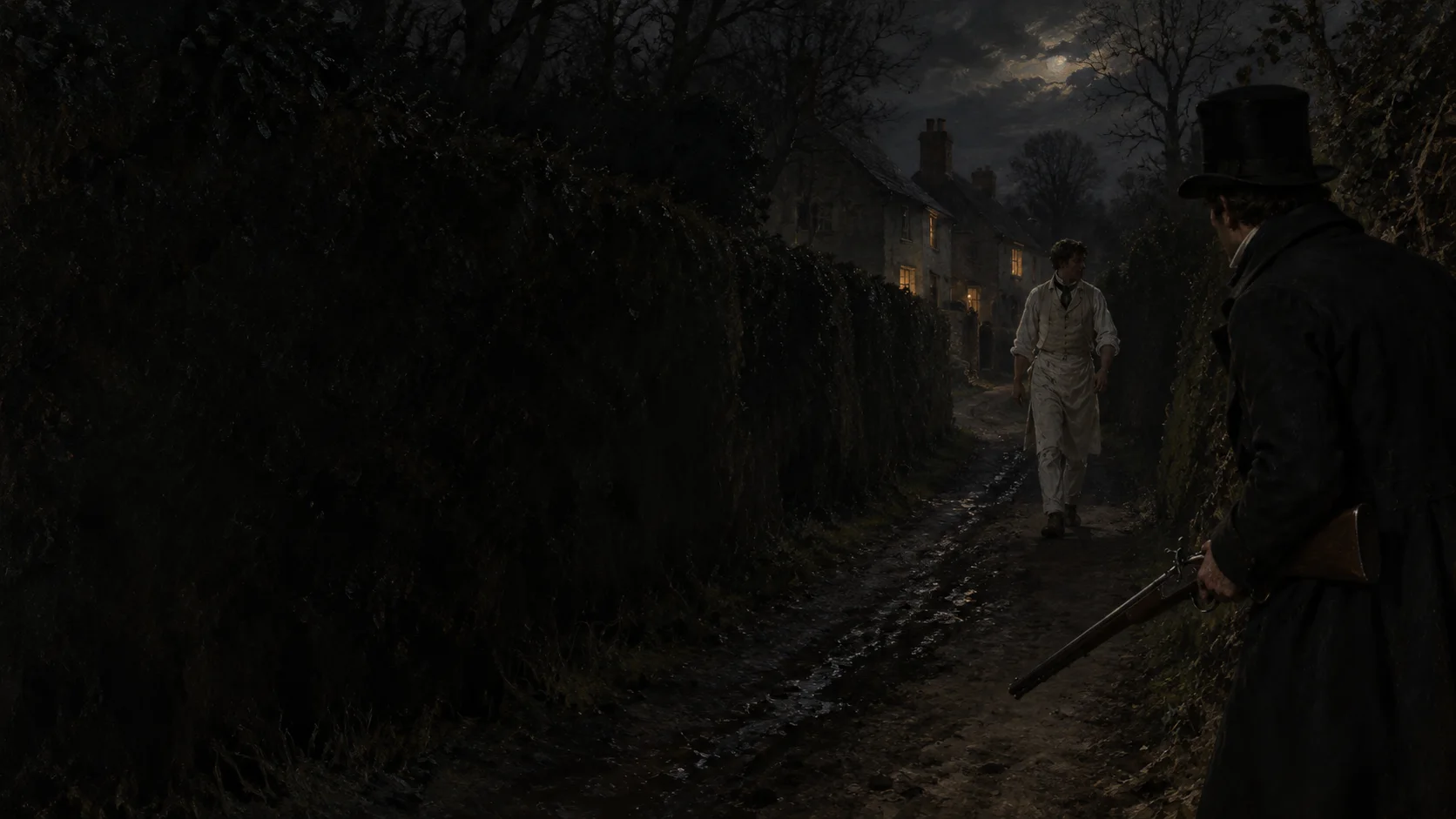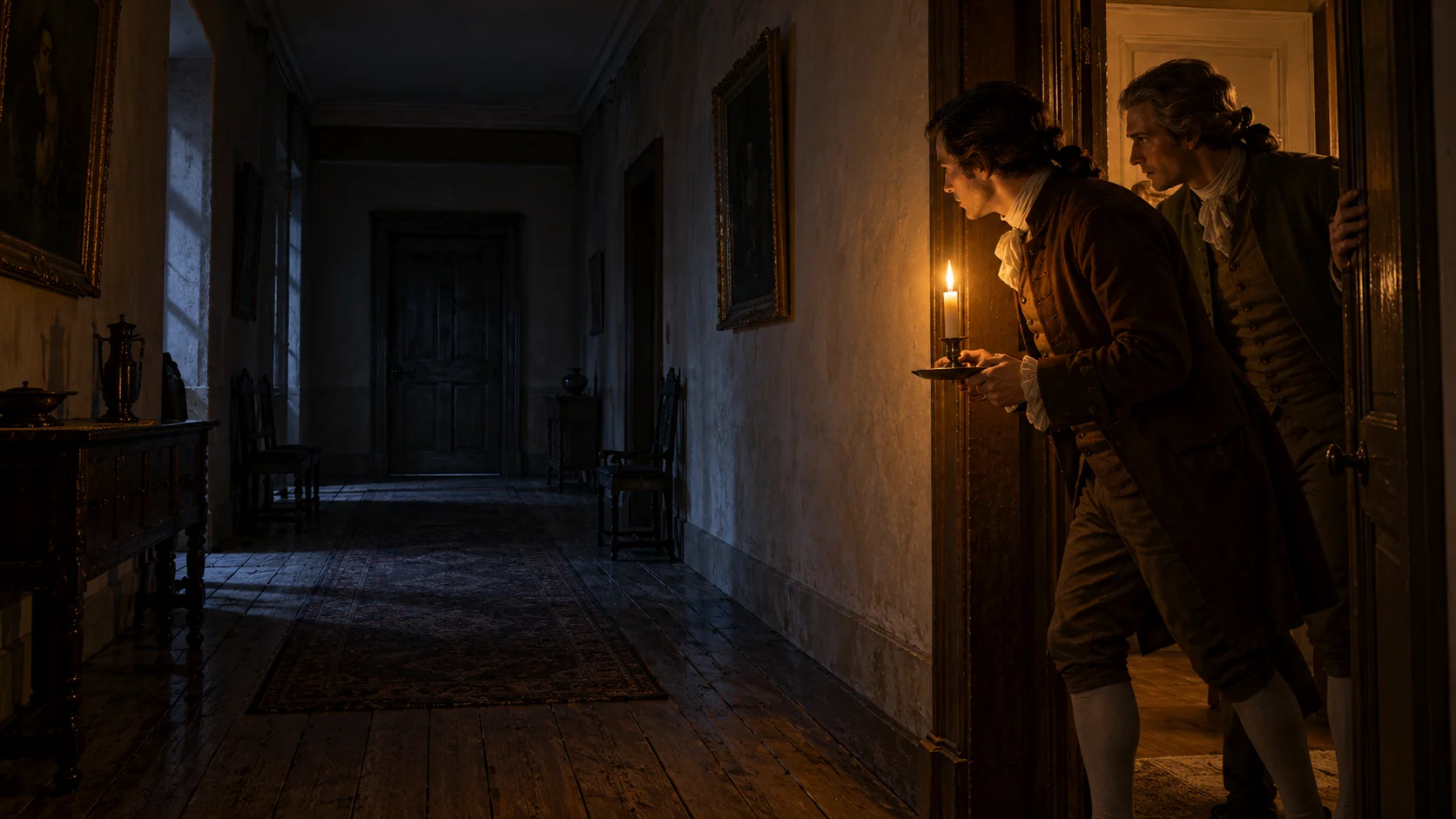
Captain Luttrell heard footsteps crossing the lobby and threw open his door.
In Mary Ricketts’s account, written the following year, he challenged whoever was there. Something seemed to flit past him. From the adjoining room, her brother called his attention towards his own door: the sound was continuing in that direction.
The men had searched the house before settling down to watch. Mary had locked and bolted the entrance from the back stairs. Upstairs, the servants were in their rooms.
Now Luttrell and John Jervis searched again.
For Mary, the summer night in 1771 brought other people into a disturbance she had endured for months. They had come to discover who was moving through the old Hampshire manor. By morning, they would be discussing whether she should live there any longer.
The gentleman in drab
The Ricketts family had moved into Hinton Ampner in January 1765. Before long, Mary heard doors apparently being slammed at night. Her husband went round the house looking for intruders or servants out of their beds. He found neither.
Mary suspected that someone had keys. The locks were changed. The noises continued.
That summer, according to the earlier part of her narrative, nurse Elizabeth Brelsford was sitting beside the sleeping baby when she saw a gentleman enter the yellow bedchamber opposite. He wore a drab-coloured suit. Nothing about his appearance initially suggested an alarm.
When the housemaid brought supper, Brelsford asked who the visitor was. There was no visitor, she was told. The women searched the room together and found no one.
Later that year, groom George Turner crossed the hall and saw a man in a similar coat. He assumed it was the butler. Upstairs, however, he found the butler already in bed with the other men servants.
Mary initially dismissed the nurse’s experience. Those early reports returned to her mind after the house began disturbing her own sleep.
A figure passes the kitchen
In July 1767, several people were sitting in the kitchen at about seven in the evening. They heard someone descending the stairs and approaching along the passage. The sound suggested a woman’s stiff silk clothing.
Through the open doorway, they reported seeing a tall figure in dark clothes rush past towards the exit. The cook, coming from the scullery, said the figure passed close beside her and disappeared.
A man entered through the yard immediately afterwards. Asked about the woman coming the other way, he said he had seen no one.
These episodes reached Mary through the people who described them. By late 1769, when William Henry Ricketts left for Jamaica, she remained in the house with their three children and eight servants. The experiences that followed would place her at the centre of the account.
In the summer of 1770, she heard a man’s heavy steps approaching the foot of her bed. She had been lying awake. Rather than ring for help, she sprang up and crossed to the nursery.
She returned with nursemaid Hannah Streeter and a light. They searched without finding anyone. Mary went back to sleeping in the room.
The door beside the nursery
By November, she had moved to the warmer chintz bedroom over the hall. There were knocks downstairs and, as the new year began, a hollow murmuring that she thought seemed to fill the house.
On April 2, 1771, she woke between one and two in the morning. A watch and rushlight stood beside her bed. She heard footsteps in the adjoining lobby and listened at the door for about twenty minutes.
The walking was joined by a sound like someone pushing hard against a door.
She rang. Elizabeth Godin came from the room where Mary’s sons slept. Together they checked the window, looked under the couch and removed the chimney board. There was no one concealed there.
While Mary stood considering what they had heard, another door began sounding as though someone were moving it backwards and forwards. It led towards the yellow apartment.
She went into the nursery and rang the bell connected to the men’s rooms. Robert Camis came to the landing door. Mary gave him a light and a piece of wood with which to defend himself.
He opened the suspect door. Nothing was behind it. Beyond, the yellow apartment remained locked and bolted.
Mary went to bed in her sons’ room. About half an hour after the search, she heard three more knocks from somewhere below.
Sounds without words
On May 7, she left her room again because the murmuring prevented her from sleeping. After staying in the nursery until daylight, she returned to bed. Shortly before four, she heard the great hall door slam so violently that her room seemed to shake.
She went to the window overlooking the porch. No one was visible. When the door was examined, it was still locked and bolted.
Godin began sleeping in a small bed in Mary’s room. After midsummer, the reported disturbances extended from the evening into daylight. Mary described a high female voice joined by two deeper voices, apparently conversing nearby. She could never distinguish their words.
Her brother Jervis visited, but she hesitated to tell him the whole story. On one occasion she asked whether the servants had disturbed him during the night. He said they had not.
After he left, Mary and Godin heard what she described as a tremendous falling weight in the lobby, followed by repeated shrieks that seemed to descend beneath the floor. Streeter, in the children’s room, also reported hearing the disturbance.
Mary decided to tell her brother when he returned. Waiting for him, she tried another bedroom. The noises, she wrote, followed her there.
Keeping watch
Jervis arrived, heard her account, and discussed it with Captain Luttrell, a neighbour from Kilmston. They arranged a watch without announcing their intentions to the household.
Jervis and his servant John Bolton examined the rooms and possible hiding places. Luttrell and Bolton then took their position in the chintz room. Jervis went to bed nearby, ready to be called. Mary secured the back-stair door.
It was during this watch that Luttrell heard the footsteps and opened his door.
Mary distinguished what she heard herself from the account he gave at breakfast. She heard rustling near her door, then Luttrell speaking. He subsequently described the movement across the lobby. Jervis joined him; the men checked the staircase door and searched upstairs.
They found the servants in their rooms and the doors as they had left them.
Towards dawn, Jervis returned to bed. Mary then heard doors slamming and assumed her brother was responsible. At breakfast, Luttrell said he had attributed the sounds to her rooms. Neither explanation survived the conversation.
Jervis continued keeping watch during his stay. One afternoon, resting after the night’s vigil, he rang his bell rapidly. Mary went to him. He said something immensely heavy seemed to have fallen through the ceiling beside a piece of furniture. His servant, sitting below, had heard nothing.
Her brother urged her to leave.
The letters out of Hinton
On August 9, Jervis wrote to William Henry Ricketts in Jamaica. He described the noises, his search and the effect of lost sleep on his sister. He considered the house unsuitable for the family.
Mary’s own letter of August 17 came from Winchester. She explained that she had finally left and was recovering with the Newbolts. Friends were arranging accommodation for her and the children.
The house’s owner, Lady Hillsborough, approached the affair differently. Her agent John Sainsbury wrote in September about another proposed watch and a reward for discovering those responsible.
A notice dated September 20 offered fifty guineas, payable on conviction. Robert Camis reported notices being put up at local churches. The disturbance had passed beyond bedroom searches into an effort to identify human offenders.
Mary had already made her decision. Whatever continued inside Hinton, she would sleep elsewhere.
What Is Known
The surviving record combines letters dated during the crisis with Mary’s retrospective narrative. Her August 1771 letter and Jervis’s correspondence describe the disturbances, the watch and the decision to leave. Sainsbury’s September letter and the reward notice preserve a contemporary attempt to investigate suspected interference.
Mary dated her longer account July 1772. It includes her own experiences and servants’ reports from earlier years, identifying people and distinguishing several incidents she had only heard about. The British Library catalogues this narrative as Add MS 30011, with related papers; it also points to correspondence in Add MS 30004. The catalogue establishes the manuscript’s survival. The account used here was examined through its later printed publication.
The family papers appeared in The Gentleman’s Magazine in November and December 1872. Those publication dates belong to the nineteenth-century presentation of eighteenth-century testimony. They should not be confused with reporting printed while the family occupied Hinton.
The documents establish a reported household disturbance and the practical responses it produced. Mary’s conviction that its cause was supernatural remains her interpretation.
The Bigger Picture
The National Trust’s history of Hinton Ampner places the Ricketts tenancy within a much longer estate history. The family’s wealth came from transatlantic trade and the ownership of enslaved people. William’s absence in Jamaica connected the household in Hampshire to that wider economy.
Within the house, the account moves between people whose duties took them into different rooms: nurses beside children, a groom crossing the hall, a cook at the scullery and a woman responsible for the household. Their reports reached Mary, and her letters carried the disturbance overseas.
The old manor was demolished in 1793. Today’s house belongs to a later architectural history; its rooms cannot serve as the rooms Mary searched.
Her written sequence survives the building. A sound outside a bedroom becomes a search, a search becomes an organised watch, and the watch ends in correspondence about leaving. The most consequential door in the story was the one through which the family finally went out.
Sources
- “A Hampshire Ghost Story,” The Gentleman’s Magazine, November 1872, pp. 547–559. Later publication of family papers, including 1771 letters, the reward notice and the beginning of Mary’s July 1772 narrative.
- “A Hampshire Ghost Story,” continuation, December 1872, pp. 666–678. Continuation of the narrative, including the searches and night watch, followed by additional family recollections.
- British Library, Add MS 30011. Archival catalogue description; manuscript pages were not examined for this article.
- National Trust, “History of Hinton Ampner.” Independent estate and architectural context.