Ann Millwood had barely seen her brother leave when she heard a voice in the lane.
The man outside demanded to know who he was. A gunshot followed.
It was the night of January 3, 1804. Thomas Millwood had just visited his family in Hammersmith, on London’s western outskirts. He was wearing his working clothes: long white trousers and a white waistcoat. Within moments of saying good night, he was lying dead near the house.
His sister called his name and went back to tell their mother. In the trial account published that year, neither parent would believe what she had told them. Ann went out again and found him.
The man who had fired was searching for a ghost.
The lanes after dark
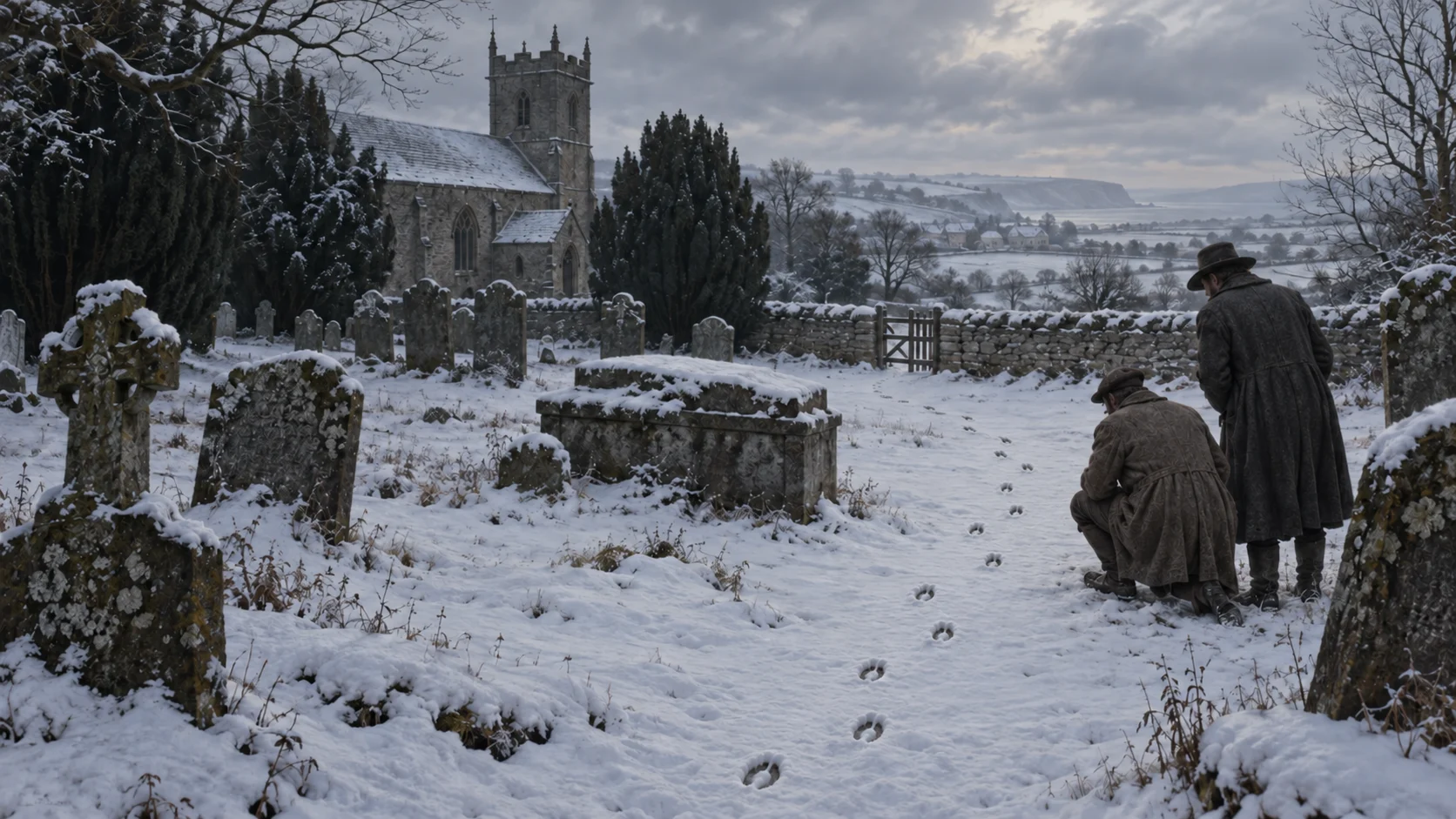
For weeks, Hammersmith had been talking about a figure that appeared after nightfall. People described something white in the churchyard and the paths around it. Others spoke of a stranger wrapped in an animal skin. The descriptions travelled through a neighbourhood where people were beginning to go out specifically to catch whatever was frightening them.
John Lock, a local wine merchant, would tell the court that he had heard about the ghost for more than five weeks. He had never seen it himself, but knew that parties of young men went searching in the evenings. They meant to apprehend the person behind the appearances.
One man brought a more immediate account.
Thomas Groom worked for a brewer. In Kirby’s contemporary account of the case, he described passing through the churchyard with another servant nearby. Something caught him by the throat. He called to his companion, who turned back, but they could see nothing there.
In another contemporary trial report, Groom described being seized by the chin and feeling something soft when he reached out. The experience had left him badly frightened. His account would eventually be repeated in a courtroom, alongside the evidence of a shooting.
The watchman William Girdler had also gone after a white figure. His encounter came on the Thursday before Millwood’s death.
The cloth by the road
Girdler saw it near Beaver Lane, on the opposite side of the road. He described a figure covered in a sheet or a large tablecloth.
He pursued it.
The covering came off, and the figure ran away. In Kirby’s fuller account, Girdler saw the person gather the cloth under a coat before disappearing into the darkness. He followed, then went to the White Hart to ask whether a stranger had just arrived there.
The chase produced no captive. Several days later, another man would ask the watchman to join a search.
Francis Smith was an excise officer who lodged near the White Hart. On the evening of January 3, he went out with a loaded gun. Girdler identified the weapon as a fowling piece, the long gun carried for shooting birds.
The two men arranged a watchword so they could recognise each other in the dark. One would challenge; the other would answer as a friend. Girdler then continued his duties, intending to meet Smith again.
Smith went towards Black Lion Lane.
The warning about a coat
Elsewhere, Millwood’s family had already heard how his clothes could be mistaken for the apparition.
Phoebe Foulbrook, his mother-in-law, told the court about a conversation on the Saturday before his death. Millwood said that two women and a man had been frightened when they saw him on the terrace. They had taken his white working dress for the ghost.
He had answered them, insisting that he was as human as they were.
Foulbrook advised him to put on a greatcoat. Covering the white clothes would spare other people a fright and protect him from an accident. Kirby’s account records that he dismissed the danger.
On Tuesday night, Millwood had a wife to fetch and a family to visit. His sister testified that he came to their father’s house between ten and eleven, sat for a while, and said good night before leaving.
The reports differ in their description of his movements that evening. In one, he had been looking for his wife; in another, the family asked him to go and bring her home. Both place him at the family house shortly before he walked out into the lane.
He left wearing the clothes in which people had already mistaken him for the ghost.
The shot between the hedges
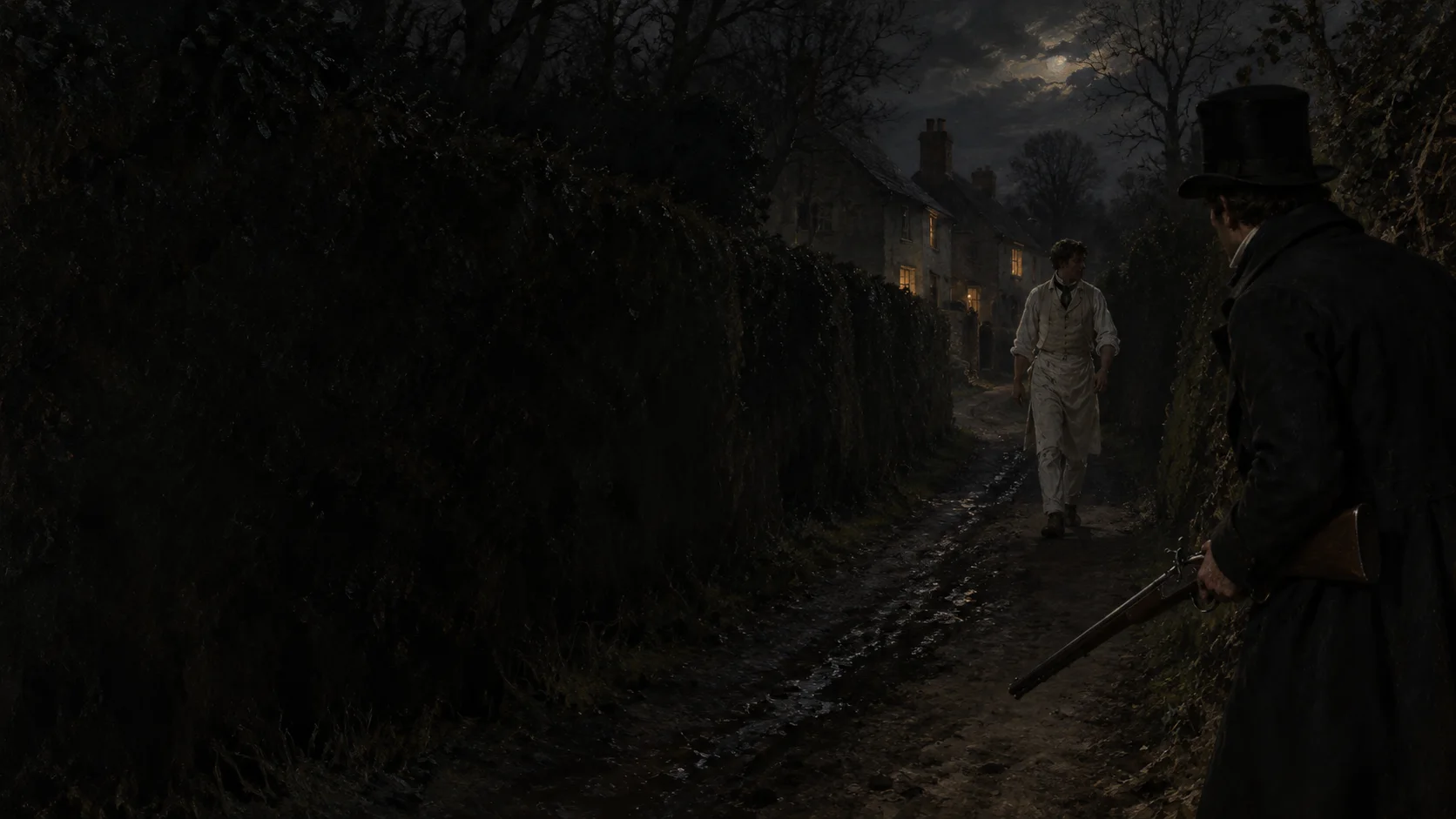
Lock described the night as extremely dark. High hedges enclosed the lane, making it difficult to distinguish someone even on the opposite side.
Smith saw a white figure approaching.
According to the account he gave afterwards, he called twice and received no answer. The figure continued towards him. Smith said that he became frightened and confused.
Ann heard the challenge from the house. Her testimony placed the gunshot almost immediately after it. Contemporary reports give different wording for the demand, but preserve the same sequence: identify yourself, or be shot.
The gun fired. Millwood fell.
Nearby, Girdler heard the discharge. He did not immediately investigate it; he told the court that hearing guns fired at night was familiar to him.
Lock was returning home with George Stow when Smith approached him. Smith said that he had shot a man and asked him to come and examine the body.
They went together. Millwood lay on his back, with a wound below the left side of his jaw. There were no apparent signs of life. Smith told Lock that he had not known whom he was firing at.
The white figure now had a name.
The ghost hunt ends
Girdler was summoned and joined the men. Smith said that he would give himself up.
The body was taken to the Black Lion public house. A constable later went to Smith’s lodgings, where Smith came downstairs and surrendered. The search through the lanes had become a death requiring an inquest.
The surgeon, Mr. Flower, examined Millwood’s body. He found shot below the jaw that had penetrated the neck and injured the spinal cord. Gunpowder had blackened the face. Flower attributed the death to the wound.
Witnesses described Smith as mild, generous and well liked. Even a cousin of the dead man spoke favourably of his character and said that he knew of no quarrel between them.
The coroner’s jury returned a verdict of wilful murder. Smith was committed to Newgate, and the case went to the Old Bailey.
Two verdicts
The 1804 collection of remarkable trials describes a crowded courthouse, with people gathering early and others waiting outside for news. Its account and Kirby’s place the hearing on January 13.
Smith appeared in black. The witnesses brought the separate parts of the night into the same room: the watchman’s search, the sister’s warning and gunshot, the wine merchant’s discovery, and the surgeon’s examination.
When invited to defend himself, Smith initially left the matter to his counsel. The judge explained that counsel could examine witnesses, but Smith must make his own statement.
He said that he had gone out with good intentions. He had wanted to discover the person frightening the neighbourhood. When the approaching figure failed to answer, he had become so alarmed that he did not know what he was doing. He denied intending to take anyone’s life.
The Lord Chief Baron addressed the jury. Lack of a personal grievance against Millwood did not, he explained, settle the charge. A man could commit murder without knowing his victim or having previously hated him.
Even if the person shot had been the one impersonating a ghost, Smith had no right to kill him. The proper course was apprehension. Frightening the neighbourhood did not give another resident authority to impose a death sentence.
The jurors retired for more than an hour. They returned with a verdict of manslaughter.
The court refused to accept it.
The judges said that, on the facts they had heard, the choice was murder or acquittal. They directed the jury to consider its decision again. This time the consultation was brief. Smith was found guilty of murder.
The sentence was death, with his body to be given to surgeons for dissection. The Chief Baron promised to report the case immediately to the King.
That evening, a reprieve arrived.
The man beneath the sheet
Meanwhile, a shoemaker named John Graham had admitted to an appearance in the neighbourhood.
Kirby’s account identifies it as the incident on December 29, the Thursday when Girdler pursued the white figure. Graham said that his apprentice had been frightening his children with ghost stories and disturbances at the house. He decided to frighten the boy in return.
He put on a sheet and waited for the apprentice to come back from escorting a young woman home. The performance had brought a frightened boy into the road and attracted the watchman’s attention.
Graham described this as his first offence. The period account therefore gives his confession a particular place in the sequence: a named man beneath the cloth at one December encounter. He was not the bricklayer shot five nights later.
Smith survived the sentence. A later New Newgate Calendar account records a conditional pardon on January 25, requiring a year’s imprisonment.
For Smith, the reprieve changed what would happen after the trial. For Millwood’s family, the night remained where Ann’s testimony had left it: a good night at the door, a voice outside, and her brother lying in the lane.
What Is Known
The case survives in Kirby’s Wonderful and Eccentric Museum, volume II, which preserves inquest and trial reporting and a retrospective discussion of the scare. Medland and Weobly’s 1804 trial collection and the January 1804 Scots Magazine provide further contemporary versions through modern transcriptions.
These accounts identify the shooting date, the white working clothes, Smith’s admission, the medical evidence, the rejected manslaughter verdict, the murder conviction and the reprieve. They also preserve differences in wording and detail. Millwood’s surname appears as Milwood or Milward in some versions; those variations refer to the same victim.
The ghost reports have their own layers. Groom described a frightening physical encounter; Girdler described a covered figure escaping; Graham admitted to a particular impersonation. Kirby’s account also disputes some sensational claims circulating in newspapers, including a horned apparition and a supposed death from fright. Contemporary publication does not make every circulating report an established event.
The confession documents a human performance within the scare. The trial documents a human death. The surviving record does not establish that a supernatural being haunted Hammersmith.
The Bigger Picture
The Law Library of Congress’s historical discussion places the affair in a Hammersmith still surrounded by fields and tracks. The modern London district can obscure the setting that mattered to witnesses: a village edge, a churchyard, and routes where hedges made a neighbour difficult to recognise after dark. Its discussion also traces the case’s long afterlife in writing about mistaken belief and criminal responsibility.
The passage from the lanes to the courtroom gives the case its enduring force. Rumours persuaded residents to watch the lanes. An earlier chase supplied a shape to look for. Familiar working clothes then resembled that shape closely enough for an armed man to fire.
Millwood’s mother-in-law had proposed a simple precaution: wear a coat over the white clothes. The court confronted the larger question of who could use violence against a supposed offender. Between those two responses lies the tragedy of Hammersmith—a neighbourhood’s frightening story becoming a stranger’s fatal identification.
Sources
- R. S. Kirby, Wonderful and Eccentric Museum, volume II, “The Hammersmith Ghosts,” pp. 65–79. Contemporary reporting and reconstruction; University of Illinois scan.
- W. M. Medland and Charles Weobly, A Collection of Remarkable Trials (1804), pp. 206–211. Contemporary trial narrative, accessed in a modern transcription at The Regency Library.
- Scots Magazine, January 1804, pp. 67–70. Contemporary reports of the shooting, trial and Graham’s identification, transcribed on the same page.
- Andrew Knapp and William Baldwin, New Newgate Calendar (1828), volume IV, pp. 261–263, excerpts. Later historical compilation, including the conditional pardon; its sensational ghost anecdotes are not treated as established facts here.
- Clare Feikert-Ahalt, “The Case of a Ghost Haunted England for Over Two Hundred Years,” Law Library of Congress, October 30, 2015. Independent historical and legal context.