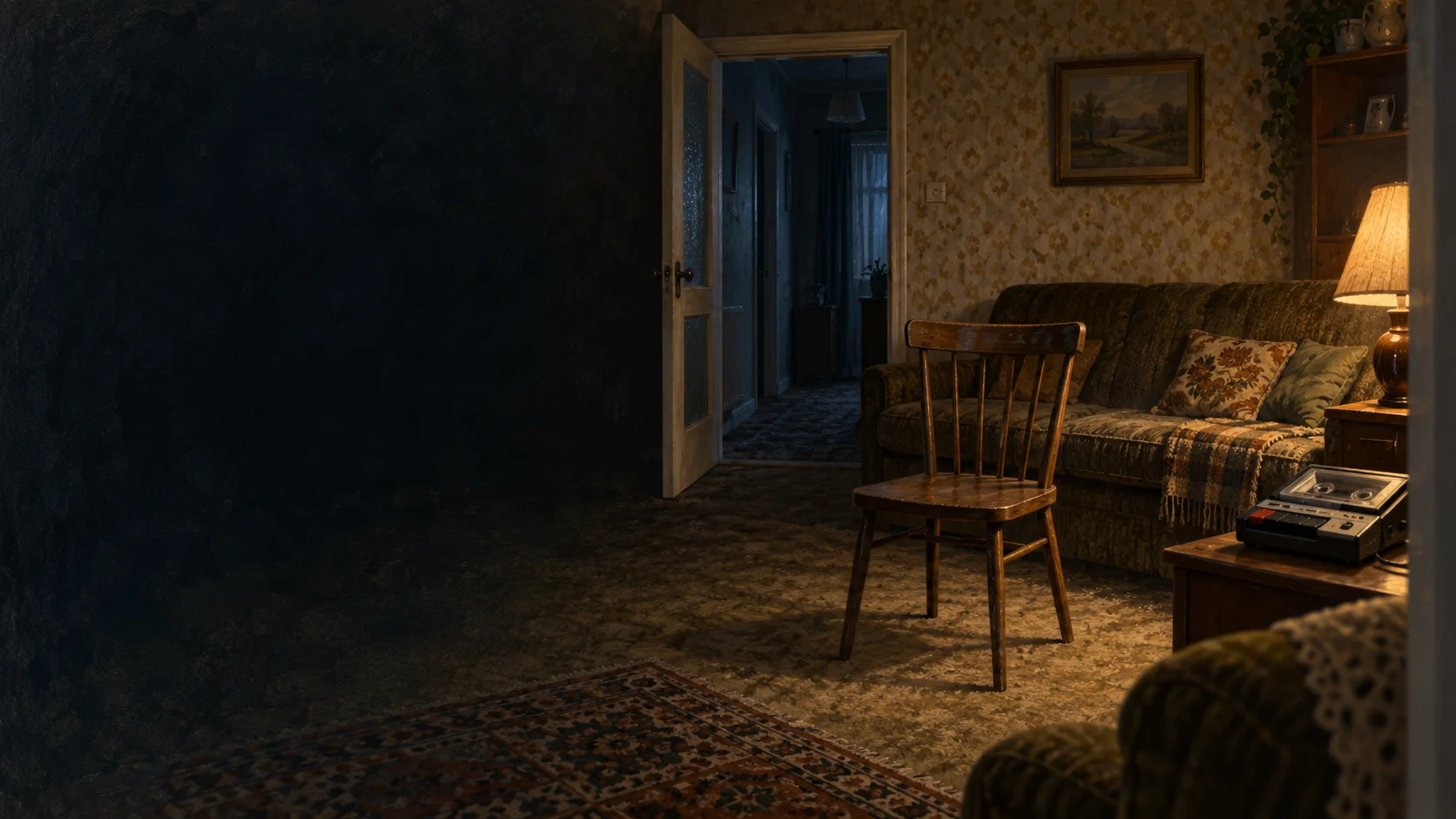
The policewoman was looking at a chair beside the sofa when it began to wobble.
It was about one in the morning on September 1, 1977, inside the Hodgson family’s house on Green Street in Enfield. Caroline Heeps had come with another officer because the family and their neighbours had heard knocking that they could not locate. In the living room, the lights were off. The officers had already checked walls, pipes and the attic with the neighbours. Now the eldest boy pointed across the room.
Heeps watched the chair slide towards the kitchen wall. In her statement to the investigators, later reproduced by the Society for Psychical Research, she put the distance at three or four feet. She checked the chair afterward and found no cause for its movement. She was equally precise about what she didn’t see: it never appeared to leave the floor.
Nothing else happened while the officers remained. But the report of that chair would stay with the house long after they left.
The neighbours come in
The Hodgsons lived at number 284, a council-owned semi-detached house. Peggy Hodgson was raising four children: Margaret, Janet, John and Billy. The disturbances began in the children’s bedroom on the evening of August 31. According to the SPR’s reconstruction from the investigation records, Janet and John reported a shuffling sound. Their mother came upstairs. They heard knocks, and a chest of drawers seemed to move across the room.
The family went next door to the Nottinghams. Vic Nottingham and his son Gary returned with them and heard knocking. Vic could not find where it came from. Peggy Nottingham called the police.
The call brought Heeps and PC Hyams into the living room. Heeps’s written account describes two sets of four taps, first on the wall adjoining the neighbours’ house, then from a different wall. The officers and neighbours searched for a physical source. Their inspection did not explain the sound to them.
The chair was a separate observation, made after some of the group had gone into the kitchen. The room was dark again. Heeps recorded that the boy drew her attention to it; she watched its slight side-to-side movement before it travelled across the floor. The officers left with a report, not an answer.
For Peggy Hodgson, the night had already moved beyond a noise in the bedroom. A neighbour, then the police, had entered the family’s ordinary rooms and encountered part of what she was describing. The house could no longer be treated as a private story told only by those living in it.
A brick in the living room
Over the next few days, the family and neighbours reported small objects travelling through the rooms. Peggy Nottingham called the Daily Mirror, hoping the paper could connect the family with someone able to help. Reporter Douglas Bence and photographer Graham Morris came to Green Street.
Morris said a toy building brick struck his forehead. In the Mirror’s September 10 account, preserved in a later transcription, he described seeing bricks cross the living room too quickly to photograph. Bence’s description was narrower: he saw a yellow brick hit a wall, but did not see the one that hit Morris. In his own much later recollection, Bence again said he saw Morris’s reaction, not the brick’s flight towards him.
Those two accounts preserve a useful difference in viewpoint. One man reported the impact; the other witnessed its aftermath. Both were in the room, but they did not see the same thing.
The paper sent more people. George Fallows, another reporter, and photographer David Thorpe joined the visits. The Mirror described four days of watching the house. On one occasion, while Bence and Thorpe watched from a bedroom doorway, a metal-framed chair fell some distance from where it had stood. Thorpe saw it move as it toppled and took a photograph, according to the newspaper’s account. A later crash led them to find it in another position.
The incidents were often like this: a sound, a changed position, and the urgent question of what anyone had actually seen between the two. A book placed back on a bedroom mantelpiece was found on the floor after another bump. In the living room, Grosse and others reported marbles moving. At the front door, hanging chimes were said to swing. With more observers present, the number of possible witnesses grew; so did the number of partial views.
A researcher arrives
Fallows contacted the Society for Psychical Research. Its secretary reached Maurice Grosse, an engineer and inventor who had recently joined the society and offered to investigate unusual reports. Grosse first visited on September 5. He encouraged Peggy Hodgson to keep notes. Within days, his visits had become a sustained watch.
Guy Lyon Playfair arrived on September 12. He and Grosse would spend many days and nights in the house over the following year, recording testimony and sounds and keeping accounts of what happened. Their work changed the shape of the case. A policewoman’s statement and a newspaper story were followed by notebooks, interviews, photographs and hours of cassette tape.
The Mirror’s first article had already captured the difficulty of watching a house in which events seemed to occur without warning. Fallows said that he had heard knocks and been present when others reported unusual happenings in a bedroom; he did not claim to have seen every movement himself. His account also described a household and neighbourhood under intense strain. Bence later acknowledged the reporters’ double role: they wanted to help, and they were there to get a story.
For the Hodgsons, the observers were no passing audience. They occupied the same rooms, waited through the quiet intervals, and were called back when a crash interrupted them. A phenomenon said to hide in everyday objects could turn a book, chair or toy into the centre of the next watch.
Sound on the tape
The investigators’ microphones gave the case another kind of witness. Grosse and Playfair recorded knocks and voices across numerous visits. The tapes could preserve a sound, its timing and the conversations around it. They could not, by themselves, show what caused it in another part of the room.
BBC reporter Rosalind Morris also went to Enfield with a tape recorder. In her later account of the assignment, she said she stayed up until five in the morning on her first visit and made a short radio report. She did not see furniture or toys flying. She did hear and record the thumps, which she said did not sound to her like taps or a heating system. Her account has the restraint of someone describing the portion of a larger story that entered her own recorder.
By the winter, the case was no longer chiefly about knocks. In December 1977, the investigators reported a rough, low voice apparently coming from Janet. It first appeared as whistles and bark-like sounds, then as speech. The voice sometimes called itself Bill Wilkins and claimed to have lived in the house. The investigators later connected that name to a former occupant, but the claim made by a voice was not proof of a speaker beyond the child in the room.
The voice was recorded and discussed at length. Visitors tried to make sense of its production. Grosse and Playfair tested it in ways they believed would make ordinary speech difficult; other observers considered whether a person could produce such a sound through an unusual vocal technique. The questions followed Janet beyond the bedroom. They made a child’s voice one of the most public and contested parts of her family’s experience.
Beyond the window
Not every reported movement took place before the investigators. Hazel Short, who worked at a nearby school crossing, later told Playfair she had been outside the house when she saw books strike an upstairs window. She also described seeing Janet rise and fall inside the room. Short spoke as someone looking in from the street; she could not see the entire bedroom. Her testimony widened the geography of the case while retaining the limits of a view through glass.
Inside, Grosse and Playfair reported other movements: doors, small objects, a sofa, a fireplace fitting. Some claims came from a single observer; others were reported by several people together. The disturbances changed from night to night, and the investigators’ watch extended into 1978.
The SPR formed a committee in May of that year to examine the investigation. Its members interviewed witnesses and reviewed the material. They found some testimony persuasive, while reserving judgment where incidents had not been clearly observed. They were especially cautious about treating the voice as paranormal. Even among people willing to investigate the case seriously, no single reading of all its episodes had emerged.
By then Green Street was a place to which police, journalists, researchers and specialists had all been drawn. The family still had to live there between their visits. The public story accumulated images and recordings, but the first event in Heeps’s statement remained modest in scale: four taps on a wall, then a chair moving across a darkened room.
What Is Known
The earliest part of the Enfield story has several contemporary strands. Heeps gave investigators a statement about the knocking and the chair, later reproduced in the SPR’s case account. The Daily Mirror’s September 10, 1977 report recorded what its reporters and photographers said they saw and heard. Grosse and Playfair then maintained a much larger investigation, generating notes, photographs and many hours of sound recordings. The SPR archive holds their correspondence and recordings, though the existence of that material does not settle what produced each recorded event.
The testimony is uneven by its nature. Heeps said the chair slid; she did not say it floated. Bence did not see the brick that struck Morris. Morris saw and felt more than Bence did. Rosalind Morris recorded thumps but did not see flying objects. These distinctions matter because a composite retelling can make separate, limited observations sound like a single unobstructed view.
The investigators themselves did not speak with one voice. Grosse and Playfair acknowledged that the children sometimes staged incidents but believed those occasions could not explain the whole case. A March 1978 Mirror report said Margaret admitted inventing the voices, then retracted that admission the next day. The SPR committee judged some witness reports strong while withholding judgment on others. Anita Gregory, an SPR member who visited the house and examined witnesses and documents, reached a much harsher conclusion. In her 1983 doctoral thesis, she called the case spurious and examined the social pressures surrounding it. Her conclusion is a firsthand investigator’s assessment, not a finding that erases the statements other witnesses made.
The core documentary fact is that people in different roles reported unusual events at the Hodgsons’ home, and their accounts generated a large, disputed archive. The main documented investigation ran from 1977 into 1978, although the case is sometimes dated through 1979. The police statement, newspaper coverage and recordings establish a history of reporting and investigation. None can make every claimed movement visible again to someone who was not there.
The Bigger Picture
Enfield became famous partly because of the collision between a private household and public scrutiny. Peggy Nottingham’s call was meant to find help. It also brought a newspaper into the family home, followed by researchers, broadcasters and other visitors. The record grew because people stayed, returned and brought equipment. The same attention changed the circumstances in which each new report was made.
This is the wider problem Gregory identified in her thesis: a case under observation is also a group of people responding to one another. The investigators hoped that more witnesses and more recording would clarify the events. Others thought the attention gave the events a life of their own. Bence’s later reflection is striking for its admission that an attempt to help was inseparable from the making of a news story.
The SPR’s archive guide describes the Grosse and Playfair papers and cassette recordings as surviving collections. They are a record of how intensely people tried to understand what was happening on Green Street. They also show why the case cannot be reduced to a single dramatic photograph or a single explanation. Its witnesses stood in different rooms, arrived at different times and reached different conclusions.
The house entered popular culture as a haunting. The documented story begins closer to the ground: neighbours called over in the night, two officers checking the walls, and a chair that one of them said she saw cross the floor. Everything that followed grew from the attempt to understand those first few feet.
Sources
- WPC Caroline Heeps, September 1977 statement, reproduced in the SPR’s Enfield account. Contemporary firsthand testimony, preserved through the investigators’ case record.
- George Fallows and Douglas Bence, Daily Mirror, September 10, 1977. Contemporary newspaper report, available here as a later transcription.
- Rosalind Morris, BBC report, reproduced by Poltergeist Archive. Reporter’s firsthand account of her visits and recordings, preserved in a later transcription.
- Douglas Bence, “Enfield Poltergeist.” Later recollection by a reporter who visited the house in September 1977.
- Anita Gregory, Problems in Investigating Psychokinesis in Special Subjects, 1983. Doctoral thesis by an investigator who visited Enfield and assessed the case critically.
- Melvyn Willin, “Enfield Poltergeist,” SPR Psi Encyclopedia. Retrospective case synthesis drawing on SPR records and published testimony.
- Melvyn Willin, “Society for Psychical Research Archives.” Institutional guide to the surviving paper and audio collections.