The October 1953 issue of Space Review offered its readers an answer and then took it away.
Under a statement of importance, the International Flying Saucer Bureau announced that the saucer mystery had been solved. The organisation knew where the objects came from. It could not explain further: the information was “being withheld by orders from a higher source.” Publication, the notice said, would be dangerous.
This was the newsletter of Albert K. Bender, a Connecticut researcher who had spent the preceding months building connections between people trying to understand the objects in the sky. His publication carried reports, arguments and letters across national borders. Now its most consequential announcement contained almost nothing its readers could investigate.
There was an answer. There was an authority above the editor. And there was a warning to anyone who might continue looking. The printed notice did not identify that authority. The story of three visitors would give it a shape.
The Bureau Upstairs
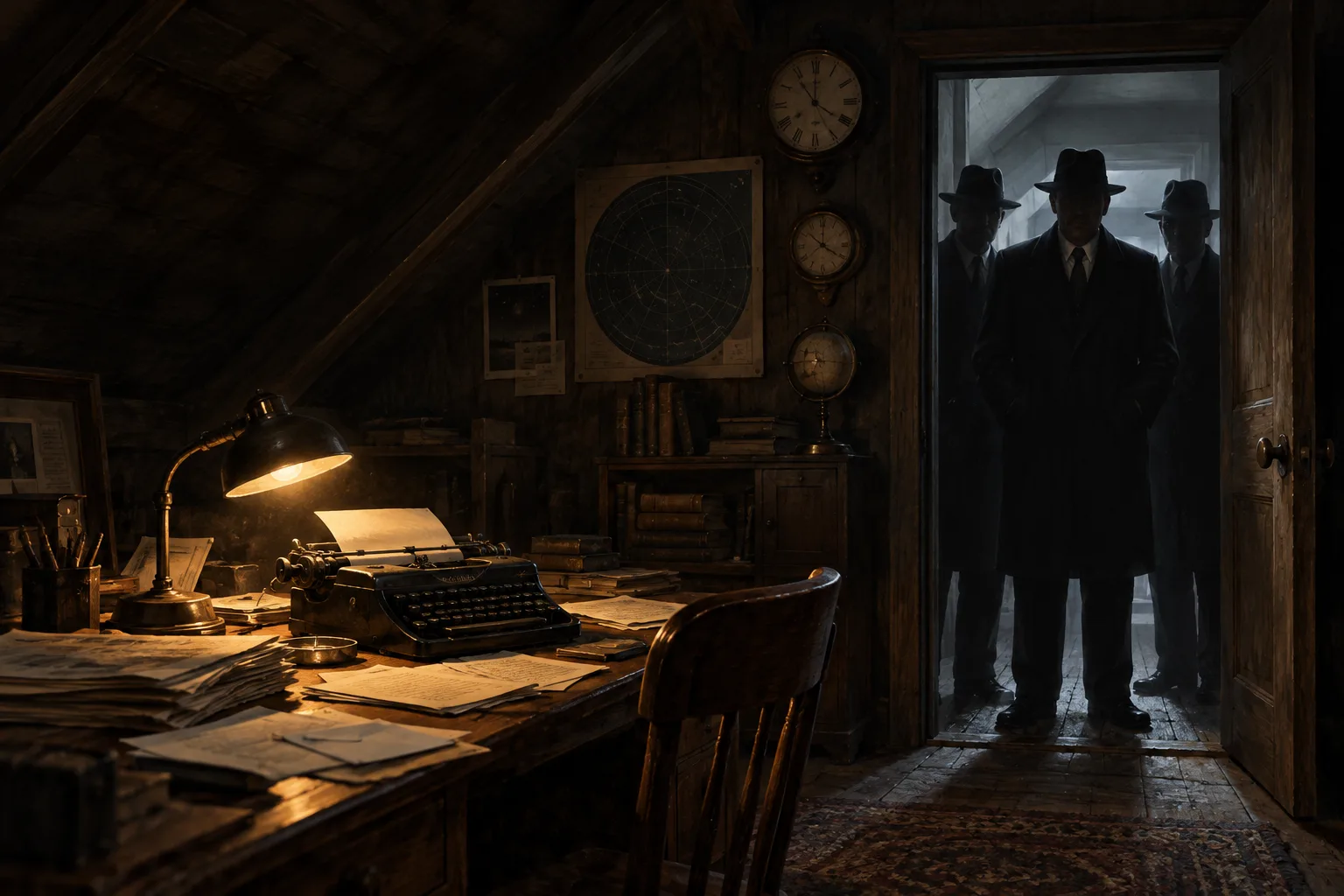
Bender lived at 784 Broad Street in Bridgeport, in a house shared with his mother and stepfather. He worked as chief timekeeper at the Acme Shear Company. Upstairs, his interests took a different form: an attic room filled with horror decorations, homemade grotesque pictures, props and numerous clocks. He called it his Chamber of Horrors.
The Bridgeport History Center’s account, drawing on local records and newspapers, describes a man who combined an industrial day job with an elaborate private world. The bureau he founded in 1952 carried an international title into that domestic setting.
By January 1953, its newsletter could point to activity well beyond Connecticut. A retired captain was organising members in Bristol, England, with meetings and proposed lectures. An Indiana branch reported thirty members in Franklin and neighbouring communities. Its participants included people from policing, civil defence, libraries, mechanics and aviation. Puerto Rico had a representative too.
The January issue also printed a reply from Albert Einstein. Bender had asked for his opinion; Einstein declined, explaining that he had no experience and only superficial knowledge of the subject. Even an unanswered question could pass through the bureau’s correspondence and become something its readers shared.
This was how the organisation grew: a local group, a distant correspondent, a letter from a famous scientist. Each issue made an investigation conducted in separate rooms look like a collective undertaking.
A Message Sent Together
On March 15, 1953, the bureau attempted something its members could do without meeting. At a designated time, participants were to concentrate on a mental message directed towards possible extraterrestrial listeners. The experiment was called C-Day.
The newsletter’s later report placed a response in England. Mrs D. M. Woodall of Bristol said that, during séances, the deceased radio pioneer Guglielmo Marconi had communicated news of the experiment’s success. According to her account, beings on Mars had received the appeal.
The July newsletter carried this extraordinary claim while acknowledging that the bureau still did not know whether its experiment had worked. Its members had sent their message; reports of an answer were beginning to travel back through the same network.
Meanwhile, the publication was preparing readers for something from its own president. An announcement in the April issue promised a startling revelation by Bender in July, alongside articles about Mars and a new approach to the saucer problem. The expectation of a breakthrough preceded the October warning.
Another kind of contact was also on his mind. In a September 9 letter to colleague August Roberts, Bender discussed Gray Barker’s report of an FBI visit. Bender said he had not himself been approached, but expected government interest in saucers and intended to be prepared. The letter survives through the Barker archive and is transcribed by researcher David Halperin.
A bureau sending messages into space was also considering who might come to its door.
Three Men, Few Answers
On October 4, according to the account Barker published in 1956, Roberts and fellow researcher Dominick Lucchesi visited Bender. They wanted to understand his withdrawal from saucer investigation.
Bender’s responses repeatedly stopped short. Asked questions about the visitors and what they represented, he said, “I can’t answer that.” He described having developed a theory about the saucers and sent it to a friend. The men who subsequently confronted him already had the story.
There had been three of them. They wore similar dark clothing and black hats. Two did the talking while the third watched. Bender said they had dealt roughly with him. But when his colleagues tried to establish whether these were government representatives, the explanation closed down again.
Barker’s book presents this conversation through Roberts’s notes, rather than as a verbatim transcript. Barker had not attended the visit. Its tension nevertheless lies in a recognisable exchange: two researchers asking direct questions, and their former organiser offering enough to suggest a threat while refusing to identify it.
By November 29, the story had reached the Bridgeport Herald. Its report described mysterious visitors, credentials and an order to stop researching. The newspaper gave readers a possible frame for the encounter: intervention by people carrying authority. Bender would later dispute the report’s accuracy and authorisation.
The Title Survives
The October newsletter contained practical instructions alongside its warning. A reorganisation had been agreed at a September 9 staff meeting. From January 1954, the bureau’s work would change, its membership would become restricted, and its interests would turn towards broader scientific subjects. Members received arrangements for refunds or back issues.
In February 1954, Space Review appeared as a limited science newsletter. Its pages discussed astronomy and humanity’s possible future beyond Earth, with the Moon as a first step towards more distant destinations. The name survived the retreat from organised saucer investigation.
Bender’s correspondence changed too. In an August 1954 letter to Roberts, he insisted on truth and proof in publication, dismissed saucer matters and said a book was far from his thoughts. He was preparing to marry.
His future wife, Betty Rose, had been an English correspondent connected with the bureau. She visited the United States in early 1954; their correspondence became a relationship, and they married that October. In Halperin’s archival account, the organisation that had brought Bender his mysterious visitors had also introduced him to the woman he would marry.
The Visitors Return in Print
The book Bender said he was not considering eventually arrived. First came Barker’s They Knew Too Much About Flying Saucers in 1956, which carried the silencing story to a wider audience. Then, in 1962, Barker’s publishing operation issued Bender’s own Flying Saucers and the Three Men.
Here the encounter acquired a different atmosphere. In passages reproduced by contemporary reviewer Riley Crabb, Bender described blue light in his room, intense cold and three figures dressed in black. Their hats obscured their faces. They appeared suspended above the floor, and communicated through thought.
The visitors now belonged to a story of extraterrestrial contact. Bender described a metal object used in establishing communication and supplied the name Kazik for one of the beings. His account of C-Day also became personal: where the 1953 newsletter had expressed uncertainty about the collective experiment, the later book described an experience involving a voice and an altered bodily sensation.
Readers who had followed the withheld answer for nine years were finally offered an explanation by the man at its centre. The three visitors had crossed from an account of threatening men into an account of beings whose appearance, movement and communication exceeded the ordinary.
What Is Known
The surviving newsletters document Bender’s organisation, its correspondence, the C-Day experiment and the October announcement that information was being withheld. They also preserve its planned reorganisation and the continued use of Space Review in 1954. Describing every activity as suddenly extinguished by the visitors loses part of that record.
The encounter itself reaches us through different layers: Barker’s 1956 presentation of colleagues’ inquiries, a local newspaper report that Bender later challenged, and Bender’s substantially more elaborate 1962 narrative. These sources establish what was published and attributed to him. They do not establish that government agents or extraterrestrials visited his home.
The September letter is particularly useful because it records Bender discussing possible official interest before the October notice. It supports a chronology of his concerns without identifying the later visitors.
Historian Gabriel McKee’s study of Barker’s publishing also places the case within a milieu that included deliberate hoaxes by Barker. That history matters when assessing his role as intermediary; it does not, by itself, prove how Bender’s account originated.
The Bigger Picture
McKee describes a publishing world in which small presses, correspondence and accounts of personal contact helped shape UFO culture. Bender’s story travelled through precisely those channels: a bureau newsletter, private letters, a book by a colleague, and finally his own account.
Its most durable feature was already present in the October issue. An investigator claimed to possess the answer, then explained why he could not share it. The visitors gave that silence an apparent cause. Later publication transformed them again, while preserving their position between the researcher and the revelation his readers expected.
The mystery began circulating in a few printed paragraphs. What made those paragraphs powerful was the space they left for someone else to fill.
Sources
- Space Review, January, April, July and October 1953, plus February 1954 — original newsletters, AFU scans.
- Gray Barker, They Knew Too Much About Flying Saucers, 1956, especially pp. 129–133 — later account of the October 1953 interview.
- Michael J. Bielawa, Bridgeport History Center — local historical reconstruction and newspaper bibliography.
- David Halperin, Barker, Bender and the summer of 1954 — archival letter transcriptions and biographical context.
- Riley Crabb, reviews of Bender’s 1962 book, part I and part II — contemporary reception and reproduced passages from the later account.
- Gabriel McKee, A Contactee Canon: Gray Barker’s Saucerian Books — independent historical study of the publishing network.