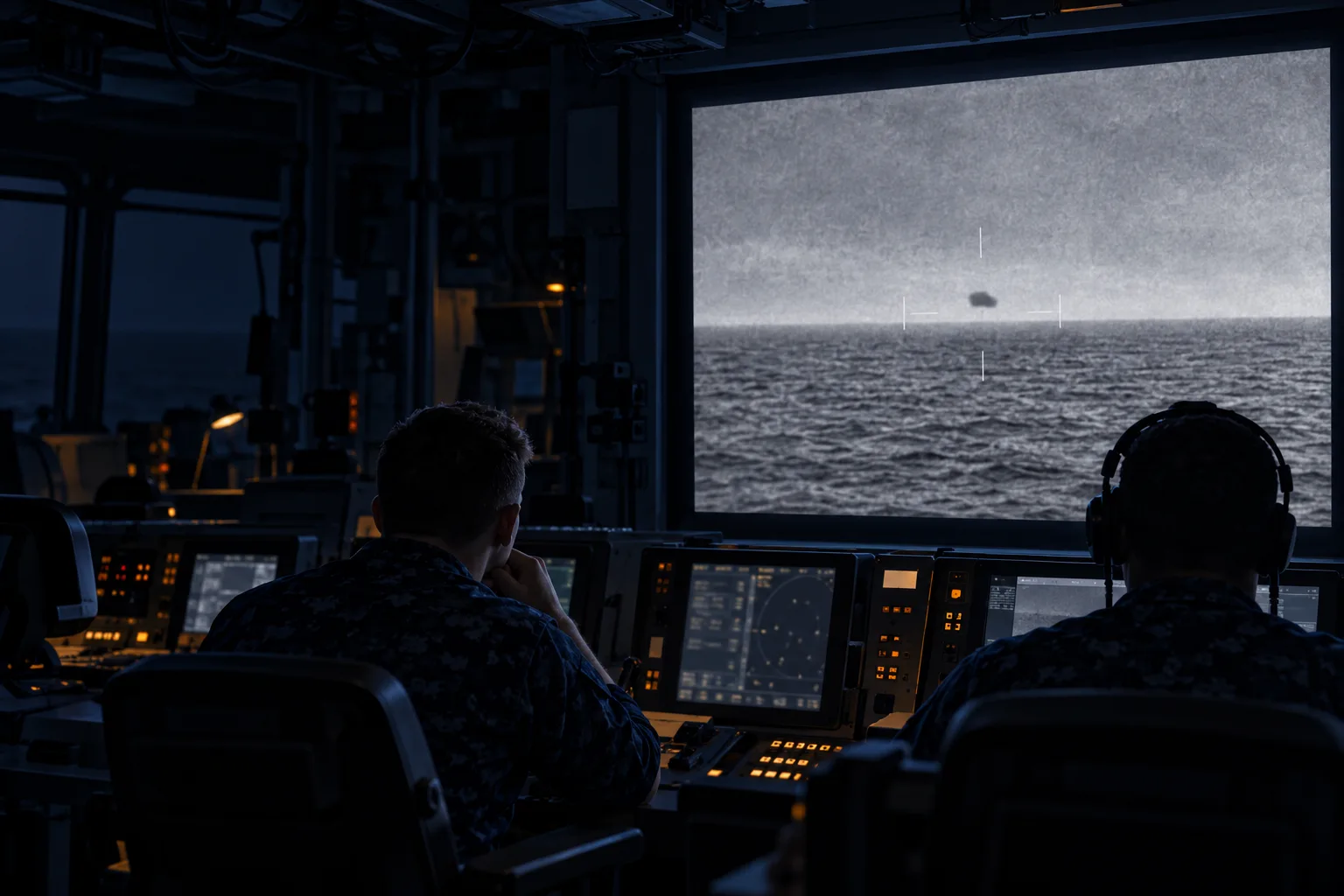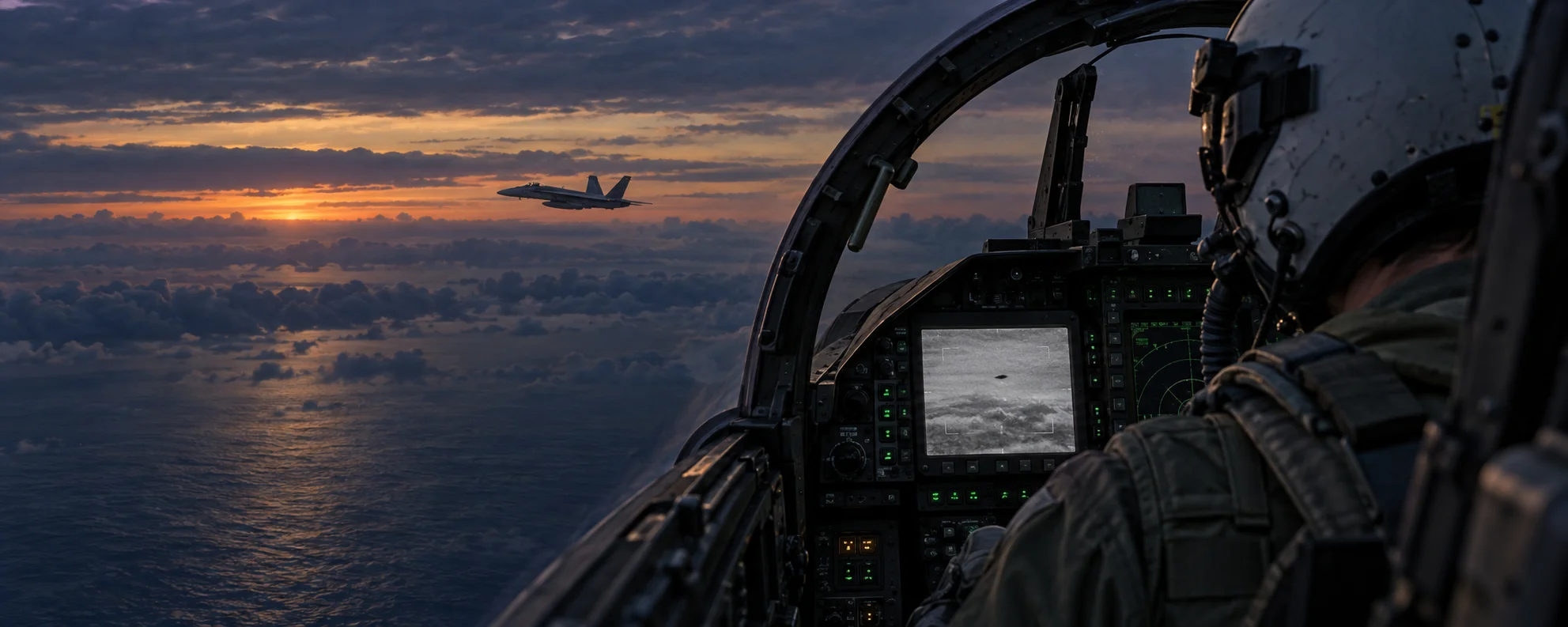
On the cockpit recording, the shape hangs beneath the targeting marks. It is dark against a pale band of cloud, with no wings or tail that a viewer can make out. Then a voice directs attention away from the image and towards another display: there is a whole fleet, the aircrew says. Look at the situational-awareness screen.
The public cannot see that other screen. It hears the crew react to it. The 34-second Navy video keeps the infrared target near the centre while the jet’s viewing angle changes. As the clip approaches its end, the dark image appears to turn. One of the voices notices. The recording stops almost immediately afterwards.
That abrupt ending helped give the January 2015 Gimbal encounter its hold on the public imagination. A camera had captured something. The aircrew were plainly attending to more than the camera alone. Yet the short released segment carried only a narrow view of the event.
The contacts before the video
The flight belonged to a period of Navy training off the American East Coast. Ryan Graves, an F/A-18F pilot with Strike Fighter Squadron 11, later wrote that his unit was preparing for deployment with the USS Theodore Roosevelt air wing. Other aircraft played opposing forces during air-to-air exercises. Fighter crews expected radar contacts and practiced distinguishing what belonged in the training picture.
Graves was airborne during the Gimbal recording, but he was not in the two-seat aircraft that filmed it. He knew the pilot and the weapons systems officer, recognized their voices when the clip became public, and said he later saw the recording briefed to the carrier group’s admiral. His account supplies the mission around the video; it is a later participant’s reconstruction, rather than another camera angle available to readers.
The squadron had already been dealing with unusual radar tracks. In his 2023 testimony to Congress, Graves said that after a radar upgrade in 2014, crews initially suspected software problems when unfamiliar returns began appearing. He said infrared checks then convinced them that at least some tracks represented things in the air. Those statements describe the wider run of encounters. They do not identify the particular target that would appear in Gimbal.
Against that background, an unexpected contact on a training sortie could look, at first, like another aircraft doing its assigned job. Graves described the Gimbal crew, call sign Ripper 11, leaving the exercise near its fuel limit and beginning the return to the carrier. They encountered radar contacts and initially considered whether the opposing-force aircraft were testing the carrier group’s airspace. They chose to approach for an identification.
Ripper 11 turns its sensor
The F/A-18F carried an infrared targeting pod. In Graves’s account, its operator directed that pod towards a radar contact. On the display, the target appeared as an unusual dark form. The crew could track it electronically, but could not settle on an ordinary visual identification from what the screen showed.
Graves later estimated that the aircraft approached within six to eight nautical miles. He wrote that the sun had set and the pod’s television mode was unhelpful for a visual inspection. Those distance and lighting details come from his later account; the published video does not provide a verified target range. What it preserves is the infrared picture and the crew’s voices during a brief portion of the approach.
The first moments in the clip already find the target on the display. Cloud layers slide beneath the tracking marks. The image remains dark in the selected infrared mode. The aircrew discuss what they think it might be, then turn to what is on the situational-awareness display. Their remarks suggest other contacts arranged nearby. No second screen, radar track file or separate image of that alleged group appears in the released footage.
Graves said he later reviewed that display after the flight. In his telling, four or five further contacts appeared near the main one, set apart by several nautical miles. He described a changing formation and a turn. These details are a compelling part of the reported encounter, but they rest on his later description of data the public has not been shown. The visible infrared image remains one tracked mark.
A wind the viewer cannot measure
The voices also discuss wind. One speaker says the contacts are going against it and gives a wind figure of 120 knots to the west. In the cockpit, that remark mattered: the crew were comparing apparent movement on their instruments with a condition they believed they knew from flying there.
For the viewer, the audio is a report, not a wind measurement embedded in the video. Nor does the excerpt reveal the other contacts’ distances, altitudes and headings. A target moving against a stiff wind might be unusual, depending on what it was and where it was. The short clip does not provide the complete flight geometry needed to calculate its ground speed or its motion relative to the air.
The image itself invites a similar caution. A dark, roughly oval signature fills only a small area of the frame. It can look like the outline of a solid object, but an infrared display shows recorded radiation processed by a sensor. Its shape need not be the boundary of the thing giving off or reflecting that energy. The aircrew did not have the luxury of stopping the aircraft and comparing a clear photograph with the instrument picture. They watched the target as the flight continued.
The turn at the end
Near the end of the recording, the mark seems to rotate. The camera keeps it within the brackets while its long axis changes angle against the background. The crew remark on the turn, and the clip ends.
That moment can be read several ways. From inside the jet, it was a change on a screen they were using to follow an unknown contact. As a released video, it is a visible rotation of an image. Without the pod’s full geometry, the original sensor data and a known range to the target, the frame alone cannot show that a physical craft rolled through the same angle. The crew’s reaction is genuine evidence of what they noticed; it is not a second measurement of the object’s body.
Graves’s 2022 account goes beyond the clip. He described the main contact making a rapid reversal on the situational-awareness display after the other contacts turned. Because that display is absent from the public release, the proposed path cannot be independently reconstructed from the 34 seconds most people have seen. The story that reached the public was already a fragment of a longer mission.
From squadron memory to public record
In December 2017, Graves saw Gimbal accompanying press coverage of the Pentagon’s UFO work. He recognized the voices. In his account, he had been present during the mission and knew that the clip represented only part of what his squadron had discussed. For viewers encountering it for the first time, its stark image and startled audio arrived without the training scenario, the other displays or the identities of the speakers.
The Navy subsequently acknowledged the circulating footage as authentic Navy material. On April 27, 2020, the Department of Defense authorized release of three unclassified videos: one from November 2004 and two from January 2015. Gimbal was among the latter. The department said the phenomena in the recordings remained classified as unidentified. It did not declare that the Gimbal image showed an exotic craft or that the apparent rotation was a measured manoeuvre.
Today the released clip still ends at the same instant. The observer can replay it, follow the dark mark, listen to the voices and see the apparent turn. The rest of Ripper 11’s instrument picture remains outside the frame.
What Is Known
The officially hosted Gimbal video contains 34 seconds of infrared imagery and cockpit audio. It shows one tracked image, cloud background and a late apparent rotation. The audio refers to additional contacts on a situational-awareness display and to wind, but those data are not visible in the public file. The host labels its date as January 1, 2015; the Defense Department’s release establishes only January 2015, so the precise recording day should not be inferred from the catalog placeholder.
Graves’s 2022 account is a later firsthand account by another pilot on the mission. He knew the recording crew and says he saw additional displays and a subsequent briefing. It adds operational context, but the public cannot independently inspect the radar tracks or the longer video he describes. His 2023 written testimony discusses wider East Coast encounters and refers to a full Gimbal video; those broader claims should not be mistaken for measurements supplied by this excerpt.
The All-domain Anomaly Resolution Office lists Gimbal among its official imagery as an unresolved case. That is a statement about the publicly assigned status, not a finding that any proposed extraordinary explanation has been demonstrated.
The Bigger Picture
The argument over Gimbal often centres on what rotated. Mick West’s independent analysis proposes that infrared glare and the targeting pod’s own movement can make a bright source’s image appear to turn while the underlying target does not. That is a technical interpretation of the video, not an official identification of the source. Graves’s interpretation of the other radar contacts and their manoeuvres addresses information beyond the visible clip. Neither account makes those absent data public.
The distinction matters beyond one Navy flight. NASA’s 2023 UAP study warned that video alone often lacks the calibrated sensor information and context needed to establish an object’s size, speed or nature. Gimbal shows why: a compelling image, a crew reacting in real time, and a much wider instrument picture that the public hears about but cannot examine.
The video is authentic. The voices are part of it. The dark mark appears to turn. What made the image turn, and what the crew were tracking beyond that frame, remain different questions. The recording preserves the instant when those questions first met on a cockpit screen.
Sources
- Naval Air Systems Command, “GIMBAL - UAP,” official video hosted by DVIDS. The 34-second primary recording; DVIDS also hosts captions, which may contain transcription errors.
- Department of Defense, statement on historical Navy videos, April 27, 2020. Official authentication, recording month and release context.
- Ryan Graves, “GIMBAL,” September 27, 2022. Later firsthand account by a pilot airborne during the mission, but not aboard the recording aircraft.
- Ryan Graves, written testimony to the House Oversight Committee, July 26, 2023. Firsthand account of the squadron’s wider East Coast encounters and the limits of the public Gimbal clip.
- All-domain Anomaly Resolution Office, official UAP imagery listing. Current government listing of the Gimbal recording.
- Mick West, “A Gimbal Glare Explainer,” January 2022. Independent, disputed sensor-analysis argument about the apparent rotation.
- NASA UAP Independent Study Team, final report, September 2023. Independent context on interpreting video without full sensor metadata.