The visitor had waited until almost midnight. Nothing had spoken.
On February 26, 1932, Captain Dennis sat with the Irvings in their farmhouse on the Isle of Man, listening to a story about an animal that lived behind the wooden panelling. They showed him the holes through which it supposedly watched them. The evening passed in conversation, without the voice he had come to hear.
At about 11:45, he decided to leave. James Irving put on his coat to guide him down the hill.
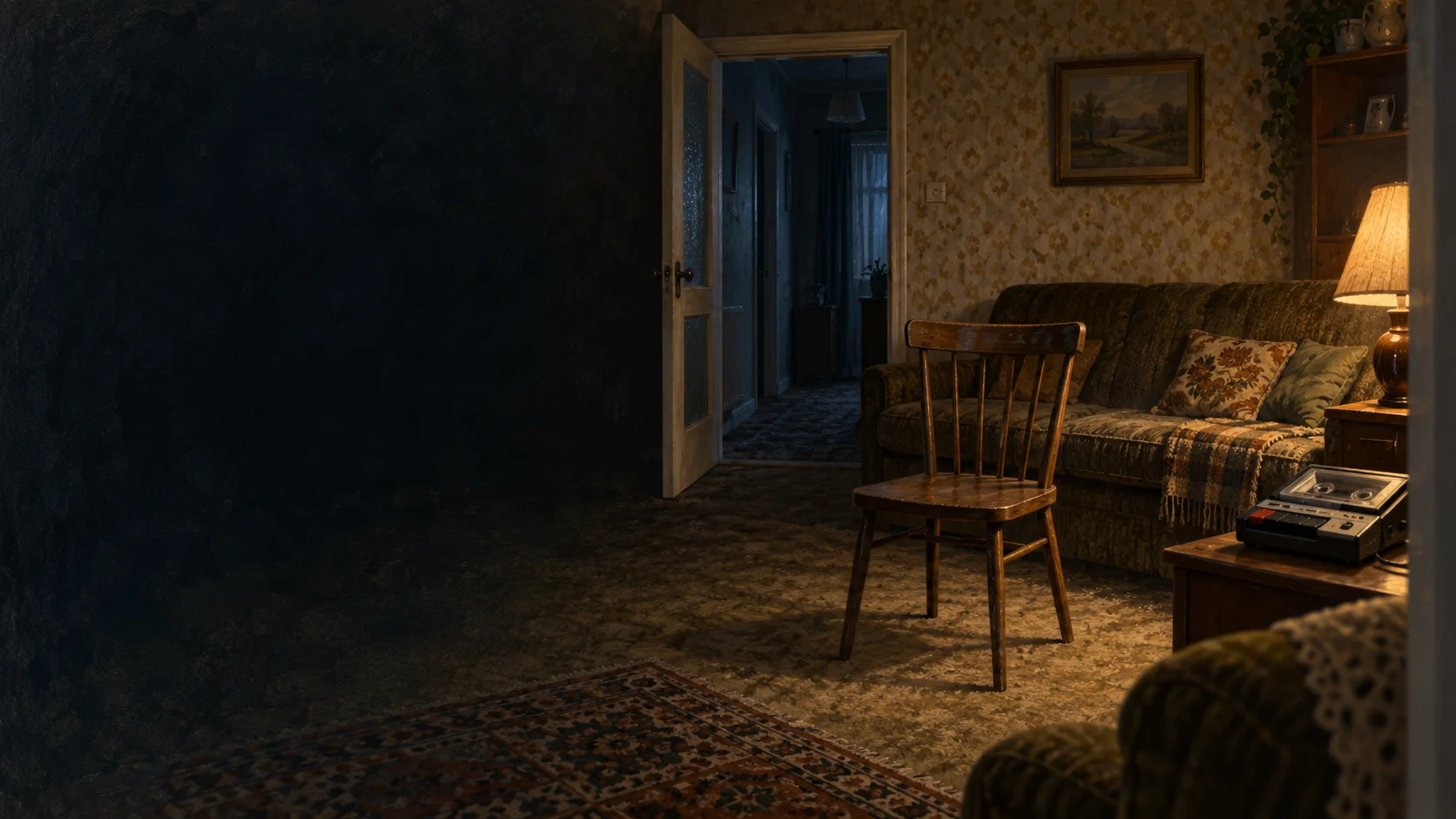
Then, according to the visitor’s report as retold in Harry Price’s 1936 account, a shrill voice sounded from inside the house, demanding to know who the departing man was. Irving gripped his arm. More words followed, too indistinct for the visitor to catch.
They went back inside.
The voice stopped.
Behind the boarding
The family’s account began in the autumn of 1931. James and Margaret Irving lived at Doarlish Cashen with their daughter Voirrey, then thirteen. Strange animal noises came from behind the stained wooden boards that lined the rooms: growls, barking, spitting and persistent blowing. The disturbance kept them awake.
James tried to deal with the intruder as an unwanted animal. Price recorded his attempts with a gun, traps and poison. None, James said, succeeded.
Then he tried something different. If the creature could make those sounds, perhaps it could copy others. He imitated the calls of birds and farm animals. The noises behind the boarding answered him. Soon, he reported, naming an animal was enough to bring back its call.
Voirrey tried nursery rhymes.
The family said these were repeated too. What had begun as an interruption to their sleep developed into something they could address. By early November, according to James’s account reproduced in The Haunting of Cashen’s Gap, the voice was speaking to them.
They described a small yellowish creature with a bushy tail, glimpsed in the house. At first it was called a weasel. Its voice had become the more remarkable part of its identity: high, clear, capable of conversation, and liable to announce itself by calling the adults’ names.
A guest with opinions
Price’s account describes a household gradually learning to live with an occupant it could neither reliably see nor control.
The Irvings called him Gef. He claimed to come from India. He could be companionable, but also rude, demanding and noisy. James became “Jim” to the voice behind the wall. Hunger brought requests for food; other nights brought enough nonsense to keep the family from sleeping.
The reported relationship changed over time. In December 1931, Gef’s threats towards Voirrey became sufficiently alarming for her bed to be moved into her parents’ room. By May 1932, she had returned to her own.
James caught occasional glimpses: something moving along a beam, or the end of a tail disappearing round a corner. Margaret and Voirrey were said to have seen more. Later, they reported being allowed to stroke the creature and feel its teeth while it sat on a beam.
Food was left for him. The list in Price’s narrative includes bacon, sausages, bananas and chocolate. In return, the family credited Gef with supplying rabbits, deposited outside where James could collect them.
The account had acquired a domestic rhythm. There was an unseen guest to feed, an uncertain presence to listen for, and an explanation for rabbits found near the house. Yet the guest’s conversation kept carrying the story beyond ordinary animal behaviour.
The man at the door
News of the farmhouse reached Harry Price in the winter of 1932. A correspondent on the island described an animal that had developed the power of speech. Price asked James for particulars, then sent a representative to investigate.
This was Captain Dennis, whose name became “Captain Macdonald” in the later book. The archive catalogue identifies the reports under both names.
After that first late-night outburst, Dennis returned the following morning. The Irvings told him Gef had been talking, had taken a look at him, and did not like him. He was asked to sit in a particular place and declare that he believed in the creature.
He waited again.
During tea, his account described a packing-case needle arriving in the room and striking the teapot. Later, he heard a shrill voice upstairs, speaking to Margaret and Voirrey. When he called for it to come down, the reply refused.
Dennis approached the stairs while the voice continued. Near the top, a loose tread slipped beneath him. He slid down noisily. The voice cried a warning about his approach, and the performance ended.
For Price, the visit produced a report to read at a distance. For the man who had climbed the hill, the encounter had been a sequence of waiting, sudden speech and silence whenever he moved towards its apparent source.
Listening from the threshold
Other visitors were finding their way to the farm.
A correspondent’s report in the Sheffield Independent of February 22, 1932, preserved in a modern transcription, described leaving without a performance, then being summoned back by Walter Graham, a neighbour’s grandson.
The reporter returned quietly to the open door. Margaret told the voice that the gentleman had gone. The voice contradicted her, saying it could hear him whispering. He was whispering to James at the time.
It then refused to talk for the visitors and referred to the reporter’s shadow.
The newspaper’s account placed the observer at the threshold, hearing a voice that appeared to know he was still there. It also recorded James’s complaint that the publicity was damaging his chance of selling the farm.
Inside the house, the family was accommodating Gef. Outside it, the story was gathering an audience whose arrival could itself become part of the conversation.
The long correspondence
Price continued receiving accounts rather than living alongside the phenomenon. James recorded Gef’s activities in letters, building a running chronicle of reported remarks and incidents.
By 1934, the creature was said to make excursions to town and return with news. He acquired opinions about the investigators too. In Price’s retelling, Gef welcomed another visit from the captain but objected to Price, whom he regarded as a doubter.
In March 1935, something more tangible arrived: hairs said to have come from Gef’s back and tail. James’s account placed them in an ornament on the mantelpiece, left there for him to find.
Price sent the material to Julian Huxley. It reached F. Martin Duncan for microscopic examination and comparison with known animal hairs.
In May, the captain visited again and reported further incidents. Price decided to go himself, accompanied by Richard Stanton Lambert, editor of The Listener.
Then the family reported that Gef had disappeared. Days became weeks. Price kept his travel arrangements.
Waiting by the lamp
On July 30, 1935, Price and Lambert reached Douglas, where James met them. After a drive and a meal, they set out for the farmhouse. The last stretch required a stiff uphill walk along a rough track, with James guiding them as darkness approached.
An animal bounded towards the party near the house. It was Mona, the Irvings’ collie.
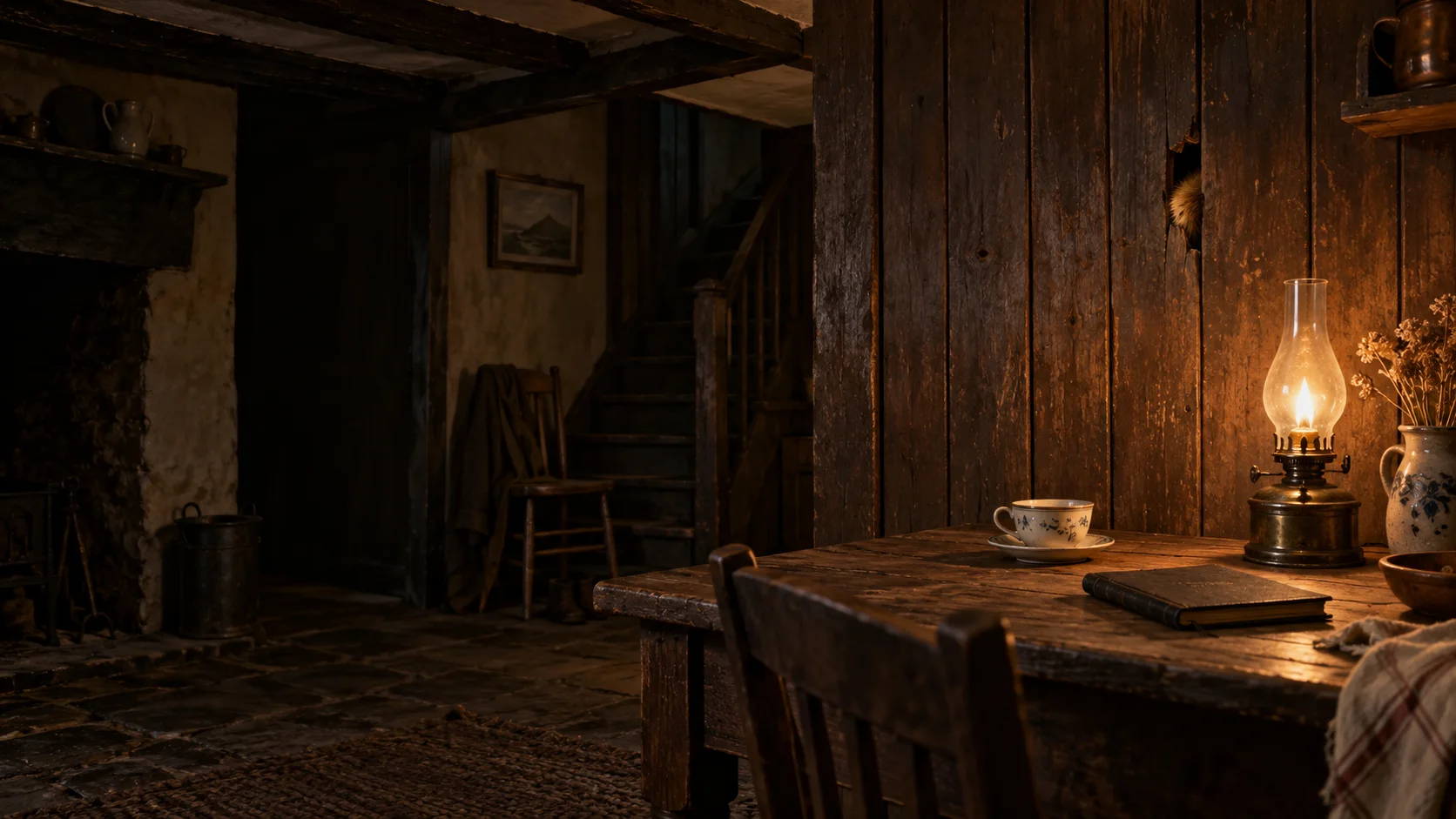
Inside, they sat around a paraffin lamp in the small, dark-panelled living-room. They questioned the family. Price wrote that the answers agreed with the accounts James had already sent him.
Margaret thought Gef might still be nearby, listening. She appealed to him. Price addressed the room too, asking for some response: a word, a sound, even an object thrown at him.
Nothing answered.
They stayed until midnight, then went down the hill with torches. The following day they returned, this time seeing the house and its surroundings in daylight.
James showed them apertures in the boarding and routes behind it through which Gef supposedly moved. Upstairs, in Voirrey’s room, they inspected the boxed partition called his sanctum. The family said he danced there to the gramophone and bounced a ball.
They walked outside, saw the places where his rabbits were reportedly left, took photographs and played with Mona. They spent another evening at the farmhouse.
Again, Gef remained silent.
After the visitors left
Price later recorded the family’s claim that Gef returned on the evening of their departure. He supposedly said he had been present during the visit and heard everything, offering excuses for keeping out of sight.
Further material followed: impressions in plasticine attributed to his paws and teeth, and a description from which a drawing was prepared.
The family also produced photographs. The archive dates alleged pictures of Gef in the field to August 18, 1935. Christopher Josiffe’s later examination of the surviving prints describes images of varying quality and an ambiguous figure on a hedge.
By the end of the period, the voice had left a trail beyond the farmhouse: typed accounts, visitors’ reports, specimens, impressions and pictures. The investigators could carry those away, even though Price and Lambert had heard no performance during their stay.
What Is Known
The surviving record documents a sustained family claim and repeated attempts to investigate it. It does not establish that a mongoose spoke.
Price’s Confessions of a Ghost-Hunter, published in 1936, distinguishes the family’s descriptions from his own visit. The joint book with Lambert, The Haunting of Cashen’s Gap, likewise belongs to the investigation’s contemporary record. Its introduction says that some witnesses’ names were changed and that the underlying correspondence and testimony were retained.
The University of London catalogue now lists James’s diary material, Dennis’s reports, and Price and Lambert’s notes from July 30 to August 1, 1935. These are archival descriptions; they establish the records’ survival rather than independently verifying the events described in them.
The hair examination produced a specific result. In Duncan’s letter reproduced by Price, he rejected a mongoose origin and considered the hairs probably canine. He also reported that they lacked root bulbs and appeared to have been cut. Josiffe’s later archival study records a subsequent comparison with Mona’s hairs, which Duncan described as identical to the alleged mongoose specimens.
The alleged paw impressions also received zoological scrutiny. The catalogue records photographs of casts rejected as mongoose prints. These conclusions concern the submitted material; they do not identify who supplied the voice heard by some visitors.
Price and Lambert’s own encounter was with the family, the house and its reported geography of movements. Gef’s claimed return after they left comes through James’s account.
The Bigger Picture
Doarlish Cashen brought two kinds of investigation together. Visitors listened in rooms where the family pointed out cracks and hiding places. Zoologists examined objects that could leave the house and be compared with familiar specimens.
That second trail has lasted unusually well. In a June 2026 account, the Zoological Society of London reports that a slide of hairs attributed to Gef survives among Duncan’s specimens. He donated boxes of slides in 1957; the Gef material was rediscovered during work on the collections following the establishment of ZSL’s Biobank in 2019.
ZSL says the hairs have not undergone genetic testing. Their appearance suggests a domestic dog. The preserved slide is a remnant of the inquiry, with an attribution attached to it, rather than a biological confirmation of the family’s extraordinary guest.
Its survival gives the case an unexpected destination. A voice reported behind farmhouse boards became a label in a scientific collection, alongside material gathered for entirely different purposes.
The story’s most intimate scene remains the one Price actually witnessed: a family and two visitors sitting by a lamp, addressing the walls and waiting for an answer.
Sources
- Harry Price, Confessions of a Ghost-Hunter (1936), chapter VI, “The Talking Mongoose,” pp. 85–97. Contemporary investigator’s account, including correspondence, his representative’s reports and his own visit. Digitized original.
- Harry Price and R. S. Lambert, The Haunting of Cashen’s Gap (1936). Contemporary investigation; introduction and early family account consulted through F. Coakley’s archival transcription. Book contents, introduction, chapter II.
- Sheffield Independent, February 22, 1932. Contemporary correspondent’s account, consulted through a modern archival transcription. Transcription.
- University of London, Harry Price archive catalogue. Institutional descriptions of diary material, reports and photographs; especially HPC/3F/1–5 and HPG/1/12/3. Catalogue.
- Christopher Josiffe, “Gef the Talking Mongoose,” Fortean Times 269. Later research in the Price and Society for Psychical Research archives. University-hosted manuscript.
- Zoological Society of London, “ZSL’s Curious Collections: Gef the Talking Mongoose,” June 1, 2026. Independent institutional account of the surviving hair slide and its collection history. ZSL article.