The plane had been gone for twenty minutes or so when the prospector heard what sounded like another one.
A Wardair Otter had set him down at Clan Lake at about six that evening, June 22, 1960. His camping gear had been piled on the shore and the plane had gone on its way. The lake lay about thirty miles north of Yellowknife, in the Northwest Territories. He had lived and worked around Yellowknife for years, cutting wood and prospecting, and knew the country well enough that the police would later say so in their report.
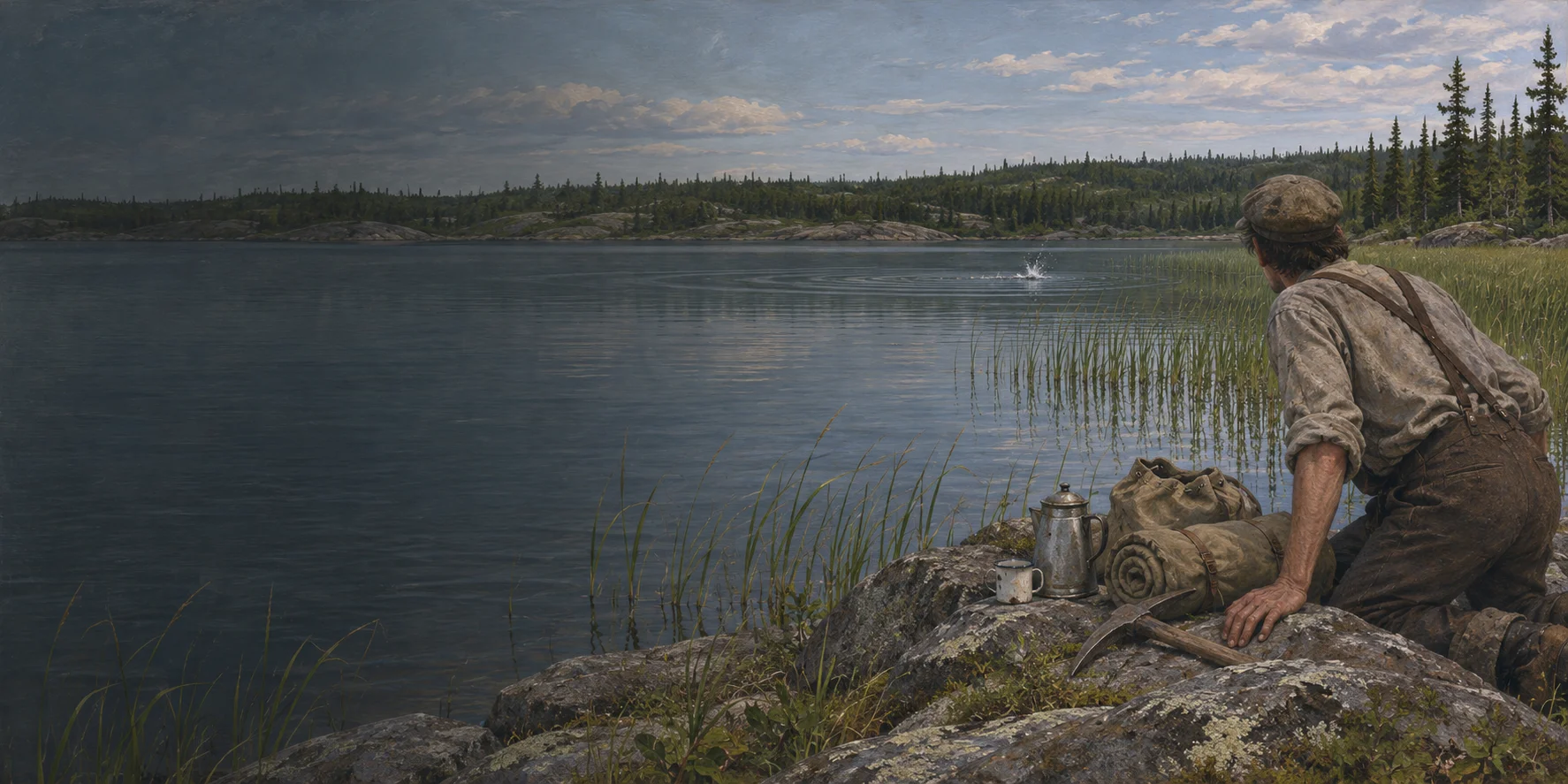
At first he paid little attention to the sound. It seemed far off. As it grew louder he looked up, then kept looking at intervals, trying to find what sounded to him like a large aircraft high overhead. He saw nothing in the sky. Then he heard something strike the water and turned around.
At the surface
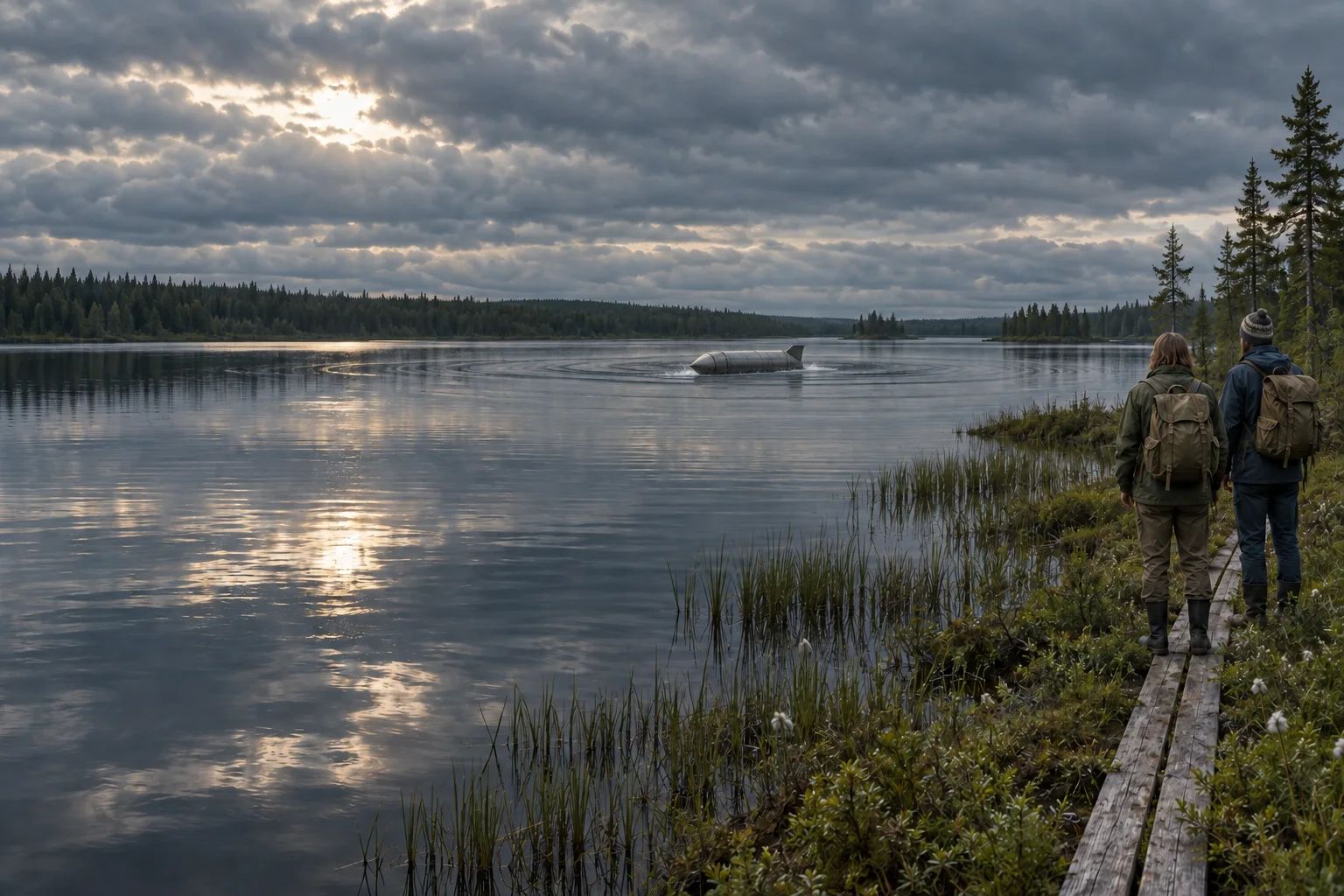
In the statement he gave the Mounties the following month, the prospector described a splash and something that appeared to have arms or spokes. It was spinning rapidly and throwing water. He guessed that it was four to six feet across. He could see enough to make out the movement, but the spray kept him from seeing its colour.
The spinning slowed and stopped. The police summary records that the object disappeared beneath the surface. The prospector remembered a wash coming towards him, all the way to where he stood on the shore. He put the distance between himself and the splash at about seventeen hundred feet.
By the time his partner arrived, there was a place to go and look. The two men took their canoe across and found grass standing in the shallows. On the east to northeast side, some of it appeared burnt to the prospector. Elsewhere, across a strip he estimated at twenty feet by sixty, the grass had been cut into small pieces.
The water was muddy. They used their paddles and a pole to feel along the bottom and found what seemed to be a channel beneath the cut grass. The prospector estimated that the channel was about a foot deeper than the surrounding bottom at one end and about three feet deeper at the other. They returned twice more to look and feel around the spot. They came away without finding the object. By the time the prospector gave his statement, he had marked the place.
From the floats
The prospector went to the Yellowknife detachment on July 18. Fred Thomas Wright, the officer who took the statement, recorded that the man had been concerned about reporting what happened and had offered to accompany a patrol. When the Yellowknifer reached Wright in 2010, he still remembered the prospector coming in and telling him about the prongs and the water. He remembered believing the man. By then, he could no longer recall his name.
In 1960 the detachment initially considered getting to the lake by canoe. Local prospectors advised against it. There were too many stretches where the patrol would have to carry the canoe and equipment overland, and the carries were long. On July 19, the day after the statement, Acting Corporal Matheson made the trip by air. A Yellowknife outfitter with his own plane and about thirty years of prospecting and mining experience went with him.
On the east side of the lake they found a cove where reeds grew a considerable way out from shore. Matheson looked from the air and then from the plane’s floats. He could see a strip roughly forty feet long and twelve feet across where the reeds were entirely gone. The water there was a little deeper than it was around the strip. The outfitter came away thinking that something had landed there, and Matheson wrote that it appeared that something had.
From the floats, Matheson judged the bottom to be soft black mud. If an object had hit it with enough force, he thought it could have gone some way in. There was no object visible in the opening between the reeds. The plan for the next visit was to bring a rod and a Geiger counter and see what the first patrol had been unable to see from the plane.
Silt and clay
In August, an inspector in Ottawa raised the possibility that the object might be a rocket nose cone or some other piece of scientific equipment. He agreed with taking a radiation reading and considered whether a diver could get to the spot. The mud might make that impractical. If the police did find anything on the bottom, he wanted them to identify it before considering how to take it out.
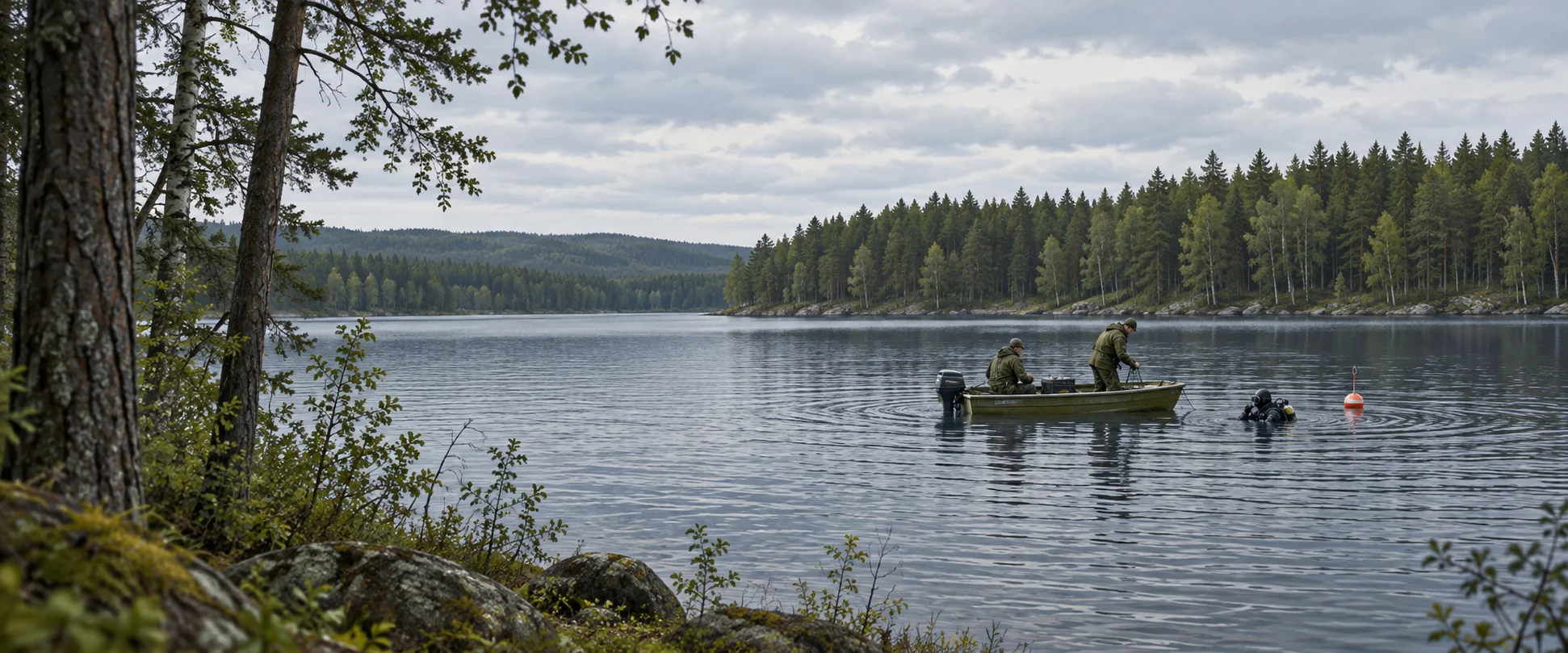
The return patrol reached Clan Lake on August 15. By then the water had dropped considerably. There was only about a foot of it at the place the officers wanted to search, and they could wade through most of the area. Under the water they found about eighteen inches of loose black silt. Below the silt was hard clay.
They pushed metal rods into the bottom. In places they could probe to about five feet, but the clay limited how far they could go. The rods turned up nothing. They went over the area with the Geiger counter and recorded a negative result. Wright recalled being on that patrol when the newspaper interviewed him fifty years later.
The officers still had one way to search below the reach of their rods. Gordon Brown, a geologist with Giant Gold Mines, offered to bring a magnetometer after freeze-up if the police could get him to the lake. He could use the instrument to look for a disturbance in the local magnetic field. Before the patrol left, the officers set trees upright in the mud. They put them in high enough to stand above the winter snow so they could find the same patch after the reeds and shallows were covered.
After freeze-up
The Royal Canadian Air Force had been sent the first two Yellowknife reports. Now it had the results of the second patrol as well. Its director of air intelligence, Group Captain L. C. Dilworth, replied on September 23. Tracking agencies in Canada and the United States had been asked about an impact in the area and had no record of one. Dilworth thought a meteorite was a better possibility. He suggested that a body breaking up could have given an impression of rotation, and that heat could account for the prospector’s description of burnt vegetation.
Dilworth also allowed that something might have gone deeper into the clay than the police had been able to probe. He doubted it mattered to national defence, but he endorsed taking Brown up on his offer if the survey could be arranged without undue expense. He wanted to hear what the instrument picked up.
In December, the Yellowknife detachment reported that Brown had volunteered to do the survey. In January it sent word that he had to go to Morocco for about seven weeks. The search was postponed. By May, Brown’s workload and travel meant that he could no longer do it. The detachment had reached the limit of what it could do with its own equipment.
On May 15, the RCMP gave astronomer Ian Halliday of the Dominion Observatory a brief account. He also thought it sounded like a meteorite and suggested his department might look into the case if someone was already in the district on other work. The RCMP’s division concluded the file the next day. Later that month headquarters sent Halliday the fuller account, from the Otter leaving the shore to the trees set in the mud, and offered to help if the observatory decided to go out.
What Is Known
The July 19 report preserves a statement taken on July 18, 1960, for an event on June 22. The Yellowknifer retrospective gives June 18 for the visit to the detachment. The dated police report places that visit in July. The signed statement begins the visible part of the encounter at the splash, and places the partner’s arrival afterward.
The two patrols documented a gap in the reeds and a search of the lake bed. Dilworth’s meteorite explanation was an assessment from the reports. His letter anticipated steam from a hot impact. The prospector had specifically said he saw none. The RCMP recovered no object, and the magnetometer survey remained a proposal.
The Bigger Picture
Canada’s Aviation Hall of Fame traces Max Ward’s flying business to the work of hauling prospectors and supplies into northern camps. Ward returned to Yellowknife in 1953 with a charter licence and an Otter, then added another Otter two years later. The kind of flight that began the Clan Lake account was part of how men and equipment reached places that took much longer to get to by canoe.
The same advantage got Matheson to the cove. From the air he could see where the reeds gave way. By August he could stand in the water there and push a rod into the bottom. The last patrol report left directions for finding the spot in a different season, marked by trees the officers had put there themselves.
Sources
- Royal Canadian Mounted Police and Royal Canadian Air Force, Clan Lake records, 1960–61. Released scans reproduced by The Black Vault. The July witness and first patrol reports are on PDF pages 57–59, the August return-patrol report starts on page 47, Dilworth’s September 23 letter is on page 42, and the May correspondence is on pages 31–35. The RCMP headquarters file reference is D 993-Q-22.
- Tim Edwards, “Something came in over the trees,” January 27, 2010. The archived Northern News Services feature includes a later interview with retired RCMP officer Fred Thomas Wright.
- Canada’s Aviation Hall of Fame, “Maxwell William Ward”. Institutional biography for the history of Wardair’s Yellowknife charter service and Otter aircraft.