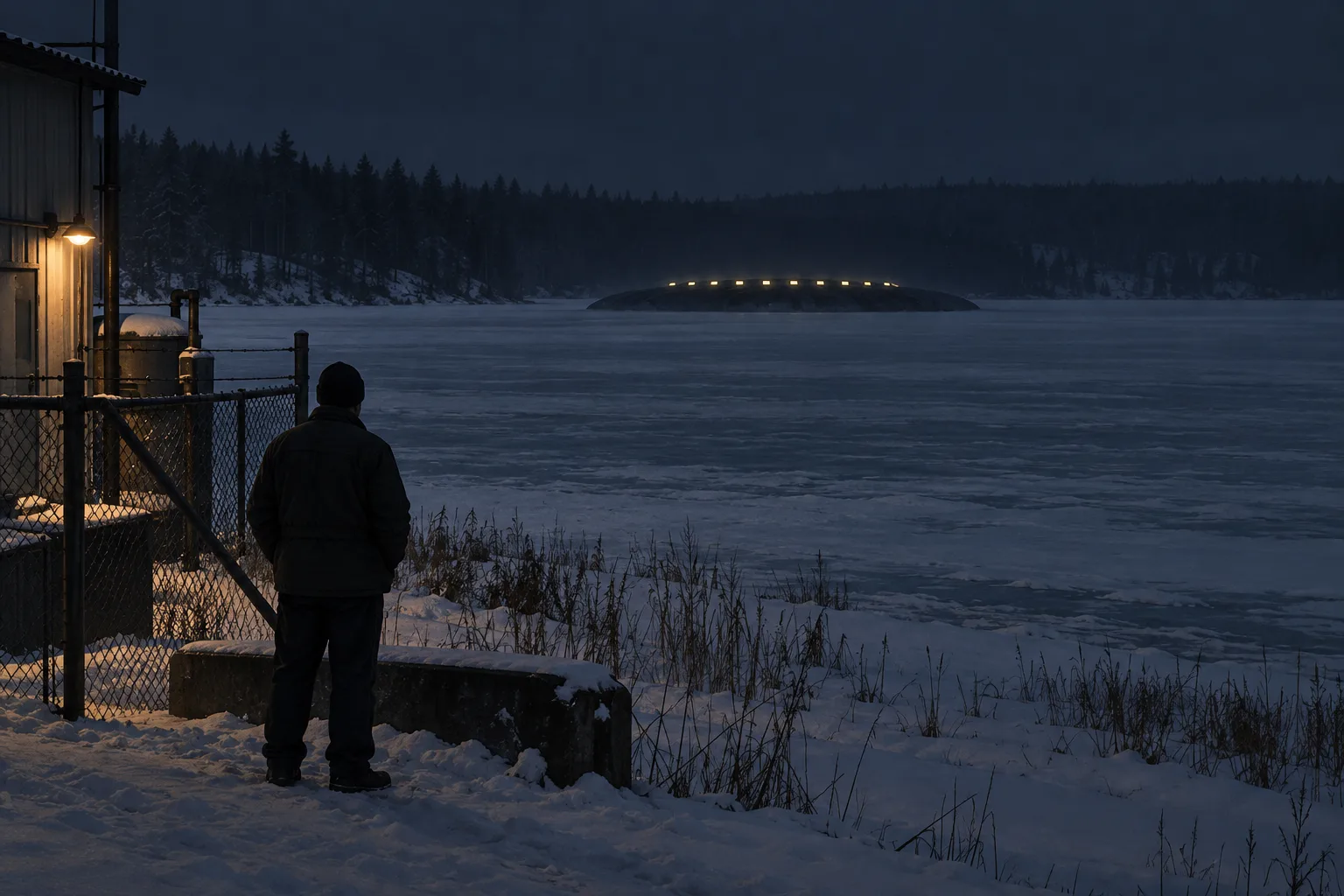
The noise brought Tor Järvid out of the summer cottage.
It was late afternoon on July 27, 1999, beside Backsjön in Värmland. Down by the water, his family and their companions were enjoying the warmth. Tor initially thought an aircraft was passing low overhead.
In the recollections later collected by investigator Clas Svahn, he stepped outside and looked up between the cottage roof and the trees. Something delta-shaped crossed above him towards the lake. Then the trees hid it.
Tor ran down to the waterfront.
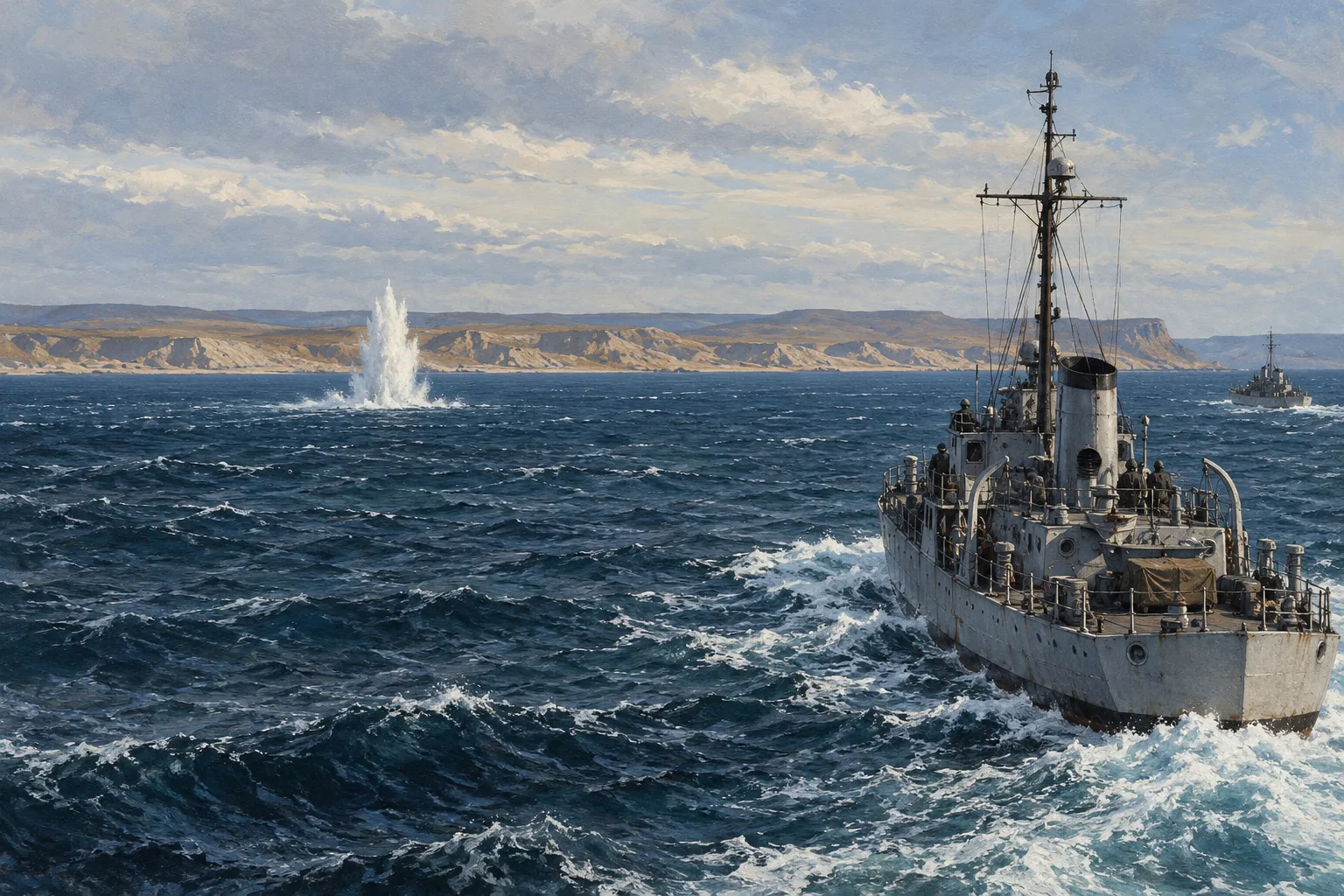
The others had a different view. Yvonne Järvid described a silver-grey object turning slightly before entering the water. Her daughter Susanna also recalled its descent and the splash. Niklas, hearing the powerful noise, had sat up and called the others’ attention to what he thought might be an aircraft about to crash.
Tor had seen the passage overhead. People below had watched its apparent ending.
The lake was now the place to look.
The water closes
The reported encounter had a sharply defined destination: an elongated object had come down into Backsjön. Whatever had crossed the trees was no longer in the sky. The witnesses’ attention followed it to the water.
That apparent ending gave the story its direction. An unfamiliar shape glimpsed overhead might have continued out of sight indefinitely. Here, the people reporting it could point towards a lake and say where it had gone.
The scene above draws on Svahn’s later reconstruction, including interviews at the site in 2002. It preserves several perspectives on a brief event: the man coming out of the cottage, the family closer to the shore, the object passing overhead and the water rising where they said it entered.
The next part of the story would unfold much more slowly. The reported descent had lasted moments. Establishing what lay beneath its apparent endpoint would occupy people through the remaining summer and into September.
Seven witnesses
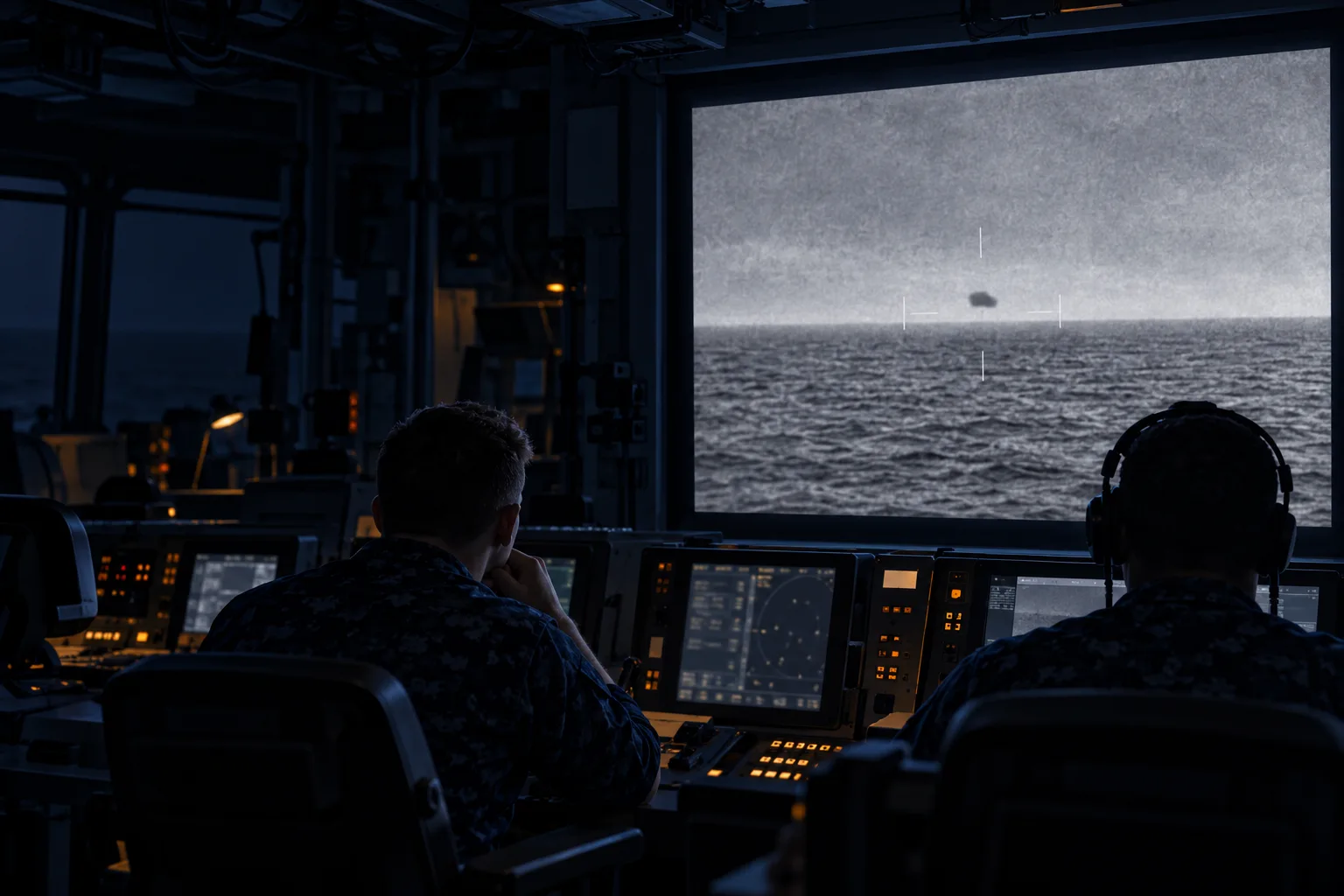
The report reached the authorities, and the military became involved. Seven witnesses were interviewed. Their account was taken seriously enough to send searchers into the lake.
The investigation moved from a description of something falling to a practical undertaking. There was a body of water to examine, an apparent entry area to work from and a possible object to retrieve. Divers could go down. Instruments could search beyond what a person could see.
The operation acquired a name: Sjöfynd, a name suggesting a find in the water.
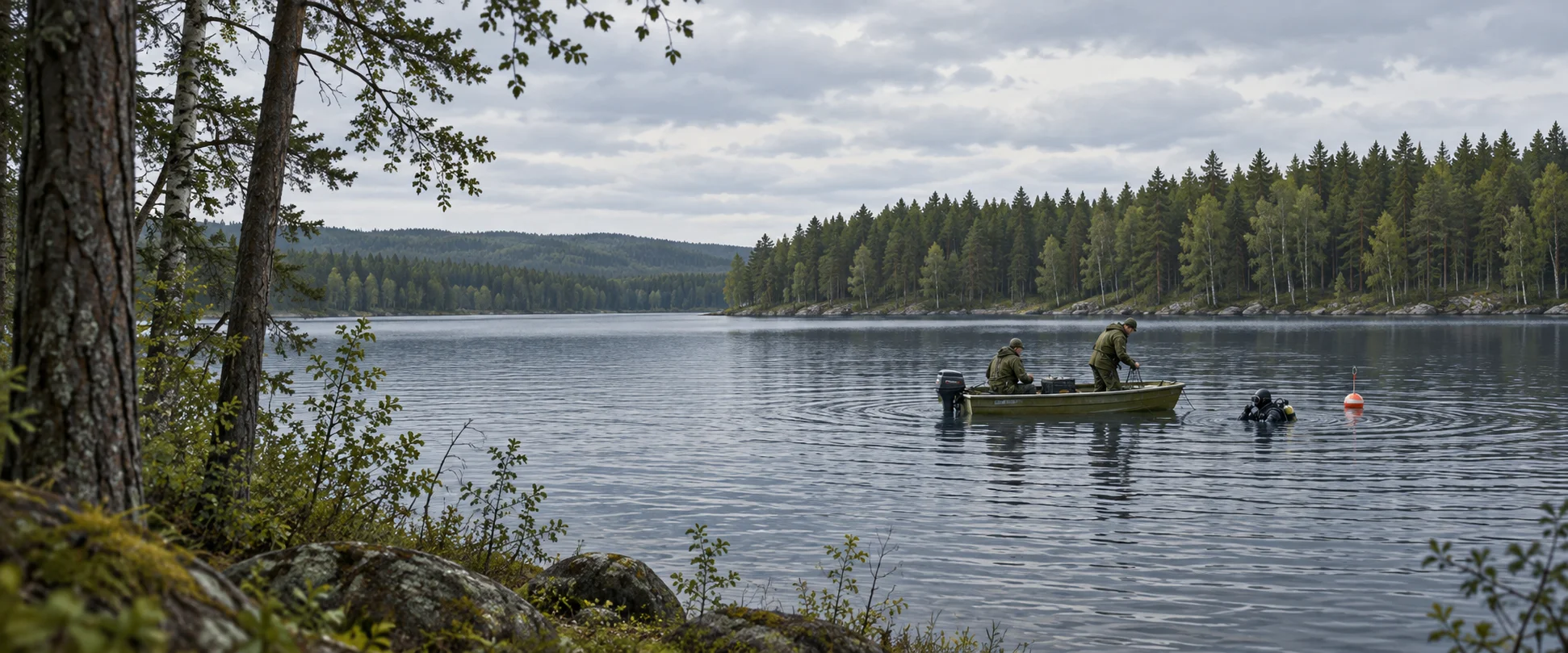
In Svahn’s early reporting, preliminary dives in August preceded a larger effort in mid-September. Eight divers were among the personnel involved. Sonar and an underwater camera joined the search.
The lake was described as roughly two kilometres long, eight hundred metres wide and thirteen metres deep. Working below its surface, however, meant confronting visibility reportedly reduced to about ten centimetres.
That figure gives the search a very different scale from the view available on shore. Above water, the investigators had a lake and its surrounding landscape. Below water, a diver’s immediate view could be smaller than a handspan.
A lake under examination
The work continued through long days. Jansson, the chief of staff responsible for the search, told Svahn that the effort had covered about three-quarters of the lake, allowing for the possibility that an object had travelled underwater beyond its entry point. The operation involved approximately ten effective days of preparation, reconnaissance and searching.
Residents could watch the activity from shore. What they were told about it varied: a Home Guard exercise, or divers practising bridge-building. Alongside the search, an attempted break-in at a nearby military store had also brought Home Guard activity to the area, Jansson explained.
For the people who had reported the descent, military personnel were now working on the question that had begun at their waterfront. Boats, divers and instruments occupied the place where the object was supposed to have disappeared.
Each method approached the same destination differently. The divers entered the water themselves. The sonar searched through sound. The camera could bring an underwater view back to the people operating it. The investigation had moved beyond asking witnesses to describe the event; it was trying to bring something out of the lake.
The search recovered a metal barrel and a plastic bag. Neither supplied an answer to the reported encounter.
On September 16, the operation stopped.
The report on the desk
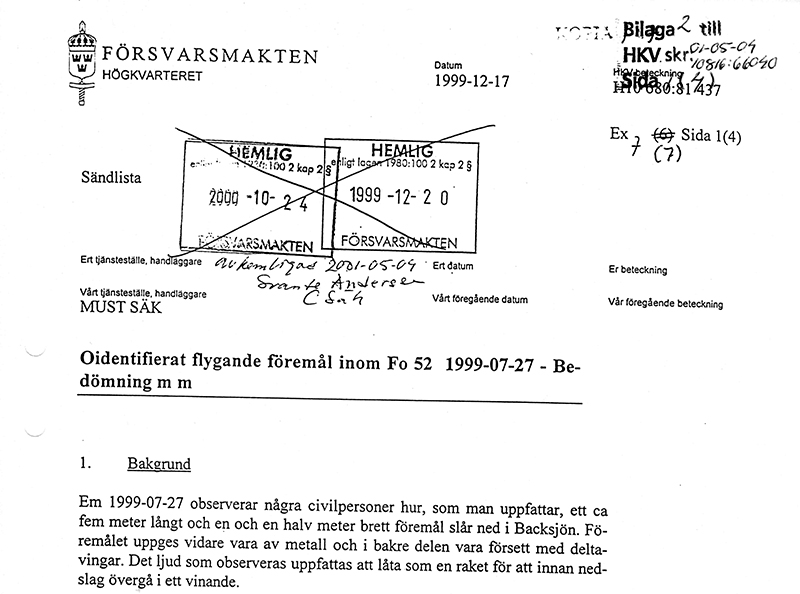
A surviving military assessment excerpt dated December 17, 1999 shows how the event entered the official paperwork. Its heading concerns an unidentified flying object within defence area Fo 52 on July 27.
The opening summarises civilians’ report of an object about five metres long and one and a half metres wide, apparently metallic, with delta wings towards the rear. It records a rocket-like noise becoming a whine before the reported impact.
The splash had become a dated incident, a set of dimensions and a description for assessment. On the page, the unidentified object had a shape. In the lake search, it had yielded no matching recovery.
Eighteen years later
When Värmlands Folkblad returned to the case in 2017, retired search commander Stellan Jansson described the assignment in practical terms. They had been ordered to dive and investigate. A projectile-shaped object with features suggesting military equipment was among the things they considered looking for.
He also explained the effort to keep spectators away: they did not want possible traces disturbed. The Home Guard had helped guard the site.
His recollection of the underwater conditions remained important. Visibility had been extremely poor, and the bottom was muddy. An object could conceivably disappear into that sediment. He would offer no absolute guarantee that the search would have discovered everything that might have entered the lake.
The newspaper interview brought the investigation back to the conditions in which it had actually been conducted: a difficult lake bottom, an uncertain target and an operation that had ended without the find its name anticipated.
Back to the shore
In July 2023, Svahn returned with a television crew working with Felix Herngren. The Järvid family was again at the centre of the visit.
His filming diary describes individual and group interviews beside the lake and on the jetty. Around twenty years had passed since his previous meeting with the family. Once again, people stood at the shore and described something crossing overhead, turning and disappearing into the water.
On the search day, a diver and a sonar specialist joined them. Heavy rain delayed the work and drove the team indoors. When it eased, the sonar boat went out, followed by the film crew.
They returned with targets worth examining. The group reviewed the sonar footage, then went out again with divers, including Herngren. Svahn and a colleague watched from the western shore.
His account of that day records another attempt to follow the witnesses’ description beneath the surface. It offers no identification of the 1999 object. Nearly twenty-four years after the reported splash, people were still returning to the same stretch of water with equipment and a reason to look down.
What Is Known
Backsjön has a documented military investigation, reporting based on interviews with its participants, a surviving assessment excerpt and later witness recollections. These establish that the report received substantial attention and prompted an underwater search. No recovered item was identified as the object described by the witnesses.
The detailed encounter narrative relies principally on Svahn’s reconstruction. The 2017 newspaper adds a later interview with the search commander, while also drawing witness material from Svahn’s work. Those are different publication dates, but overlapping source trails.
Some particulars vary. Published size estimates range from about a metre to several metres. Seven interviewed witnesses should not be confused with every person nearby who saw or heard some part of the incident. The military scan records a reported description; it is not a measurement of recovered material.
Jansson discussed possible ordinary explanations, including ice from an aircraft and a diving bird, without establishing an identification. The case remains a reported descent followed by an unsuccessful search, rather than a demonstrated crash of an extraordinary vehicle.
The Bigger Picture
The story belongs to a recognisably Swedish setting. The National Archives’ introduction to the ghost rockets describes mysterious rocket-like objects reported across the Nordic countries in the summer of 1946, including accounts of objects disappearing into lakes. Backsjön came more than half a century later, but its reported sequence carried a familiar outline: something crosses the sky, reaches water and leaves investigators searching below.
That historical resemblance helps explain the case’s lasting interest. It does not establish that the reports share a cause. What connects them most securely is the investigative problem created by an apparent ending in water.
A lake gives a sighting somewhere to go. It can turn a fleeting observation into a search area, bringing witnesses and searchers back to the same shore years apart. At Backsjön, that promise of a tangible answer survived the military operation itself.
The witnesses had pointed towards the water. The divers had followed. The empty-handed return became the part of the story that kept drawing people back.
Sources
- Clas Svahn, Backsjön – Militärer letade efter störtat föremål. Early investigator reporting, including military interviews.
- Svahn, Operation Sjöfynd. Later reconstruction drawing on witness interviews and released paperwork.
- Swedish Armed Forces, assessment, December 17, 1999. Cropped first-page scan, reproduced by Sebastian Case; the complete assessment was not examined.
- Stefan Mitander, Mysteriet i Backsjön, Värmlands Folkblad, August 19, 2017. Later reporting and interview with Stellan Jansson.
- Svahn, filming at Backsjön, July 2023. First-person production diary, July 29, 2023.
- Svahn, Dykning i Backsjön, July 2023. First-person account of renewed sonar work and diving.
- Swedish National Archives, Arkivpodden – Spökraketer. Independent historical context for Nordic lake-disappearance reports.