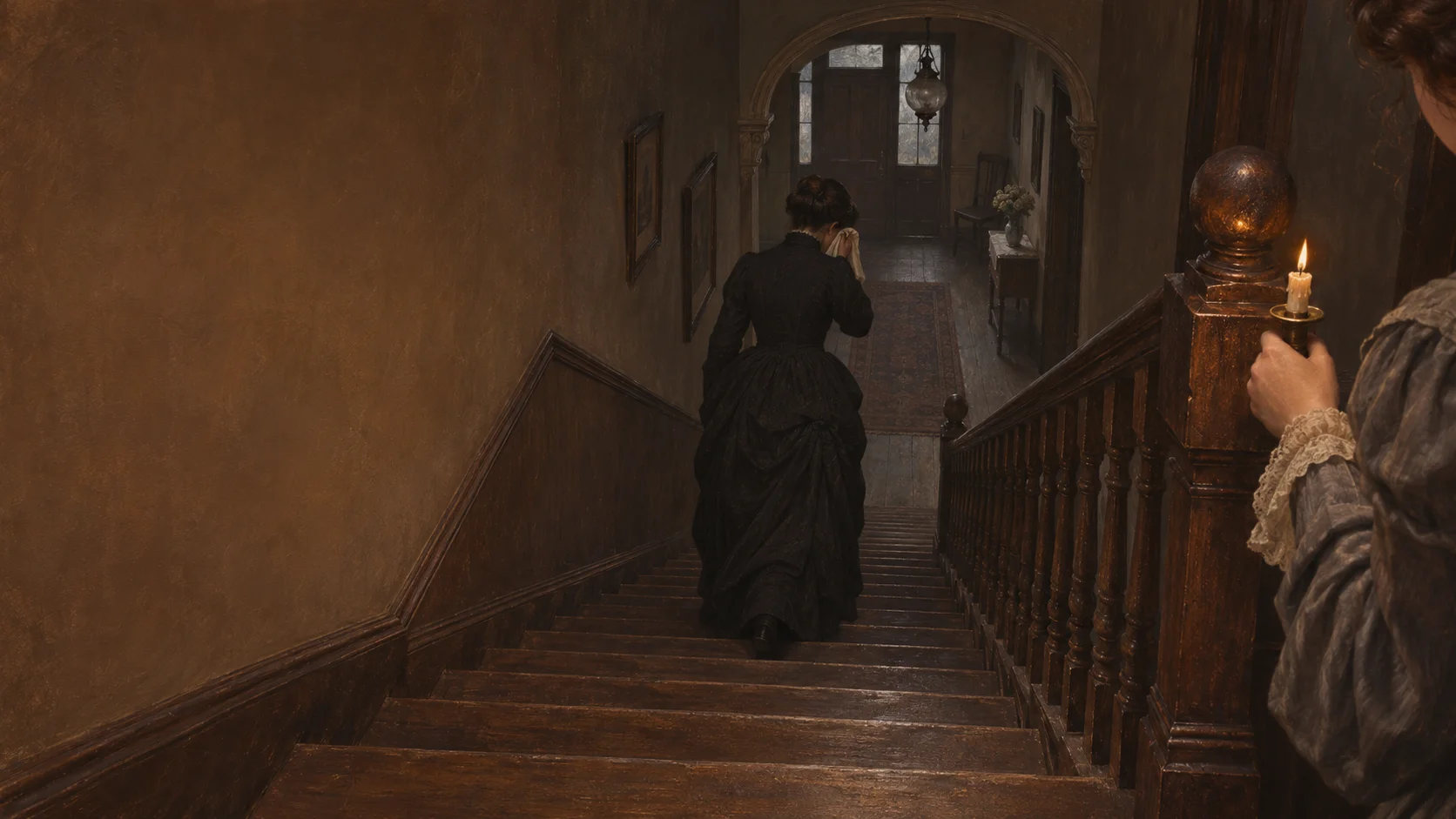
Rosina Despard had only a stub of candle left when she stepped out of her bedroom. She had heard someone at the door and thought it might be her mother. There was nobody in the doorway. A few steps along the passage, she saw a tall woman dressed in black at the head of the stairs.
The woman stood there for a moment with a handkerchief held to her face. Then she began to descend. Rosina went a short way after her before the candle burned out. Unable to see where the woman had gone, she returned to her room.
It was June 1882. Rosina was nineteen. Her family had moved into Donore, a detached house in Cheltenham’s Pittville district, towards the end of April. In the account she eventually gave, the place was an ordinary square villa with gates and a short drive in front. The small orchard screened it from the road along one side. Inside, a staircase led down to the hall and the drawing room. On later nights, when Rosina managed to follow the woman farther, that was where she went.
Someone at the window
At first, Rosina told only one friend, Catherine Campbell. Over the next two years she saw the woman about half a dozen times. As she drew closer on later occasions, she could see the edge of a cuff and a little of the hair above the handkerchief. She thought the fabric sounded like soft wool as the woman moved. The cuffs and the dark covering over the head gave her the impression of a widow.
Her married sister, visiting the house, took the figure for a visitor of a different kind. She was coming downstairs when, in her later account, a tall woman in a long black veil crossed the hall and pushed open the drawing-room door. She thought it was a Sister of Mercy. The household made inquiries, but nobody had called. Rosina put the incident in the summer of 1882. Her sister remembered it as an autumn afternoon the following year.
In December 1883, Rosina’s youngest brother Wilfred was playing outside with a schoolfriend. In his own statement, he remembered looking in through the drawing-room window in full daylight. A tall woman in black sat at the writing table, her right hand holding a handkerchief to her face. The boys ran inside. By the time they reached the room, it was empty. The parlourmaid, who remembered the boys coming in, said they went upstairs to tell Wilfred’s mother what they had seen.
Rosina came to expect a particular movement through the house. The woman would go into the drawing room and stop near the bow window. She might stay there a while before walking back through the doorway and along the passage. Rosina usually lost sight of her near the door to the garden. She compared the footfalls on the linoleum to those of someone walking softly in thin boots.
A question in the drawing room
Campbell suggested that Rosina speak to the woman the next time she saw her. On January 29, 1884, she got her chance. She opened the drawing-room door quietly and stood beside it. The woman came past her, walked to the sofa and stopped. Rosina went up to her and asked if she could help.
In a letter written two days later, Rosina said she thought at first that the woman meant to answer. She heard a slight gasp. The woman moved towards the door. Rosina spoke again as she was leaving, then followed her into the hall. In much the same place as before, she disappeared from sight.
In May and June, after the others had gone to their rooms, Rosina stretched fine cords across the stairs. She fixed the ends lightly to the wall and banister with little pellets of marine glue. Some were only inches above the steps. Others were near the height of the rail. She attached them so a slight touch would bring them down. By candlelight, she wrote, the cords were invisible from below. On at least two occasions she believed she saw the figure pass where the cords were stretched. She found them still in place.
By July the visits had grown more frequent. One evening Rosina was reading on a couch by the bow window while her father and sisters sat in the drawing room. She saw the woman enter through the open door and cross behind her couch. The figure stayed there for what Rosina reckoned was half an hour. Nobody else in the room appeared to see her. When the woman left, Rosina said she was going to fetch a book. She followed her up the passage as far as the garden door.
The door was locked
Rosina told her father on August 5. He asked the landlord, who had lived in the house briefly, whether he had noticed anything unusual. The landlord said he had seen nothing of the kind.
On another evening Rosina was coming up through the garden when she saw the woman cross the orchard, come round by the carriage drive and go in through the open side door. Rosina followed her into the drawing room, where the woman took her usual place behind the couch. When her father came in, Rosina pointed out where she was standing.
Her father went up to the spot. Rosina saw the woman move quickly round behind him and head out into the passage. This time they both followed. At the garden door they had to stop. Her father had locked it when he came in. They unlocked it and looked outside. There was nobody in view.
Her sister Edith also remembered the figure at close quarters. She was singing in the drawing room on a light summer evening when she felt a sudden chill. She saw a woman bend towards her as if to turn the page of her music. She called Rosina, who came in and said she could still see the figure in the room. By then Edith could no longer see her.
Outside the family, some of the clearest descriptions came from women who worked at the house. The former parlourmaid, Mrs. Brown, told Frederic Myers that she and a cook once stood together at the door of the servants’ hall. The basement passage was lit by gas. A dark figure passed them without a sound and disappeared round the corner. Both kept quiet while it was in view. Afterwards they turned to one another and compared what they had seen.
Candles on the landing
One night in July 1886, while Rosina and her father were away, the household heard noises above her mother’s room. Her mother and a maid went up to look. The sounds stopped, then came from below. In Rosina’s account, the two women saw a light in the hall and fetched Edith. The three checked the doors and windows and found them fastened.
Upstairs, two younger sisters and two maids opened their bedroom doors. Edith joined them on the top landing. They stood with candles while, in Edith’s recollection, the steps passed between them and then came back. Several of them described feeling a chill. The candles stayed lit. In Rosina’s telling, the sound finally went down the stairs and did not return.
On a summer evening around the same time, Mrs. Twining was waiting to be paid when a woman passed her near the top of the kitchen stairs. She thought a visitor had lost her way. In the account Myers took down in 1889, she remembered following the woman round the house and getting quite close to her. Outside the morning-room window the woman suddenly disappeared. Mrs. Twining went back inside to tell the housemaid, who signalled for her to stop. A new parlourmaid was within earshot.
That autumn Rosina began to hear stories that the house had been haunted before her family arrived. One concerned a gardener who was said to have seen a woman in black in the grounds. By the time the family traced him, he was dead. A carpenter offered something more tangible. He showed Captain Despard where a former owner had asked him to make a space beneath the floorboards to hide jewellery. The captain had him lift the boards. The recess was there and it was empty. They also lifted boards near the garden door, where Rosina usually lost the woman. Under those they found shavings and dust.
In February 1887, Edith went upstairs for some prescriptions for her father. In her recollection the woman went down ahead of her and into the unused drawing room. Edith and her father lit a candle and waited there. The room stayed empty. Rosina wrote that the figure was seldom seen over the next two years, and that by 1889 the sightings she knew about had ended. The light footsteps lasted a little longer.
What Is Known
Myers first heard about the case in December 1884 and began taking notes from the family in person in May 1886. Rosina signed her account in April 1892 under the name R. C. Morton. It includes passages from her letters to Campbell written during the period of the sightings. Campbell confirmed their dates but kept the full letters private. The published account also includes statements from Edith, Wilfred, their married sister and two women who worked at the house.
Edith dated the piano episode to July 1885. Rosina described a similar episode in August 1884, and the caption on the published floor plan gives another date. The accounts preserve what each sister remembered seeing, while the timing remains unsettled. Rosina later considered whether the woman resembled Imogen Swinhoe, a former resident. The photograph she singled out was of Imogen’s sister. Imogen had died in Clifton in 1878, before the Despards came to the house.
The Bigger Picture
The Pittville house had several names. The Swinhoes called it Garden Reach, after a district of Calcutta where the family had lived. The Despards called it Donore, a name the Cheltenham Local History Society traces to the captain’s home in Ireland. Under a later name, Inholmes, it became a boys’ school.
The 1892 account leaves the address blank. It gives readers something more intimate in its place. Across three floor plans, it marks the bedrooms, the music stool, the sofa and the route the woman usually took. The dotted line on the ground-floor plan stops where Rosina’s pursuit so often stopped, by the door to the garden.
Sources
- R. C. Morton, “Record of a Haunted House,” 1892 — Society for Psychical Research transcription of the original report in Proceedings, volume 8, pp. 311–332, including Myers’s preface, Despard’s letter extracts and the separate witness statements. The three floor plans and their captions are reproduced at the end of the PDF.
- Pittville History Works, “House names” — Local property research on the names of the house and the Swinhoe family’s connection to Garden Reach in Calcutta.
- Pittville History Works, “Haunted Pittville” — Local history identifying the Despards and the Swinhoes and tracing the house’s later use as a school. The encounter dates in this article follow the witnesses’ accounts.
- Mick Kippin, “The Ghost of Garden Reach,” 2009 — Cheltenham Local History Society Journal 25, pp. 3–4. Local archival research on the former occupants, the 1882 tenancy and the origin of the name Donore.