Betty Cash reached for the door handle and could not hold it with her bare hand.
In the account she later gave at Bergstrom Air Force Base, the metal had become so hot that she used the pocket of her leather jacket to open the door. Beyond her car, something brilliant hung above a narrow Texas road. Fire came from its underside.
Her friend Vickie Landrum and Landrum’s seven-year-old grandson, Colby, were with her. The three had been heading home on December 29, 1980. They would describe a night that began with cancelled plans and dinner, then became a roadside encounter, a succession of helicopters, and illnesses they attributed to whatever had blocked their way.
Eight months later, they would sit together in a military law library and try to explain it.
The journey home
Cash was driving her 1980 two-door Oldsmobile Cutlass. The holiday week had confused their schedule. They had gone to Cleveland to play bingo, found no game, and tried New Caney with the same result. It was Monday; they had expected a Tuesday evening’s entertainment.
They stopped at a truck-stop restaurant near the junction of Highway 59 and Farm-to-Market Road 1485. Cash placed dinner around eight or eight-thirty. Afterwards, they set off towards home.
A light caught their attention as they drove. Cash remembered watching it without imagining that the road would carry them directly towards it.
Then the object descended almost to the treetops.
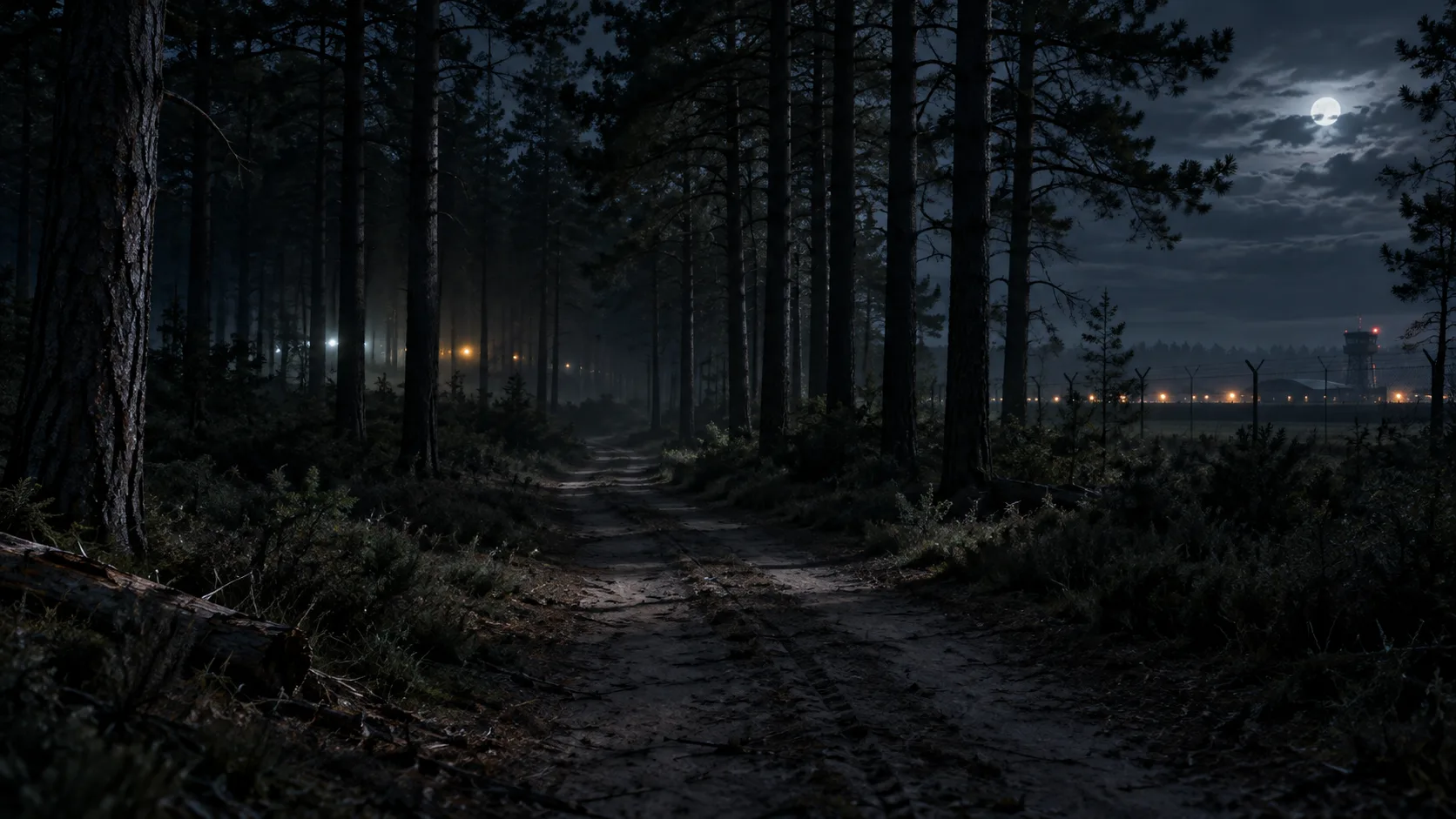
The route lay between New Caney and Huffman, northeast of Houston. Tall pines stood beside the road. Cash described an object hanging over the roadway, lighting the surroundings so brightly that she could not make out markings on its surface.
Its shape was a diamond.
Asked later to compare its size with something familiar, she chose a water tower. The comparison was hers: an attempt to give the officers an impression of something large and unfamiliar, suspended ahead of the car.
Fire was coming down from it. Cash did not believe she could drive underneath.
Outside the Cutlass
Vickie urged her to stop. Cash said that Landrum pressed her hands against the dashboard as the car braked. The interior was becoming intensely hot.
Cash put the transmission in park and got out. She walked towards the front of the car, unsure whether to remain outside, retreat into it, or run. The light and heat made the decision difficult.
Vickie was occupied with Colby. In her own account, she got out briefly, but stayed close to him. She described resting an arm on the top of the car while keeping the boy in the doorway and said that the hot surface burned her arm.
She also tried to give him a less frightening way to understand what they were seeing. Believing that the world might be ending, she told him to watch for Jesus inside the light. Her explanation belonged to the immediate fear of the scene: she was trying to quiet a crying child.
Cash remained outside longer, staring at the object and looking for a way to leave. When she returned to the door, she needed the leather jacket to protect her hand.
The flame did not remain constant.
Vickie described the object lifting when fire came from beneath it, then sinking when the fire diminished. A larger burst and a shrill sound accompanied its eventual ascent. Cash compared one sound to air brakes or a whoosh, while also remembering a piercing noise unlike anything she could readily identify.
Neither woman described seeing an occupant.
The road opens
Cash said that the car’s engine had stopped although she had left it running. When she managed to start it again, she turned on the air conditioning to cool the interior.
The object was rising. The obstruction ahead was moving away.
Looking back on the encounter, she estimated that it lasted around fifteen to seventeen minutes. It had seemed much longer. Her arrival home shortly before ten helped her put a limit on the time she believed they had spent there.
In the August interview, the officers asked about distances. Cash supplied estimates developed during the investigation: the car approximately 130 feet from the object, its height around sixty to eighty feet. Those figures became part of her recorded description of the scene.
The night was about to acquire a second, more familiar kind of aircraft.
The helicopters
Cash described helicopters surrounding the object. Some had two rotors, a configuration she found strange. After driving farther along the road, the travellers stopped again and watched.
She counted twenty-three. Vickie had counted differently, and Cash acknowledged that fear and discomfort could have affected the totals.
The helicopters appeared to remain with the object as it moved away towards the Houston area. Cash remembered them on either side, seeming to manoeuvre around it. Even later in the journey, near a bank under construction in Dayton, she said that more helicopters could still be seen coming.
The second part of the interview preserves Vickie’s distinction between the aircraft. Some had the conspicuous twin rotors; others were smaller, with a different arrangement. The double-rotor machines were the ones that had caught their attention.
For Cash, the helicopters became the reason to approach the government. When an officer asked why she had come to Bergstrom, she immediately returned to them. She believed she had seen military aircraft around the object and wanted an explanation from the people she thought might know.
The object had left the road. The question of who was flying beside it stayed with the witnesses.
After they arrived home
Cash said that she became ill within half an hour of the encounter. She described burning skin, blisters and intense thirst. By morning, she said, she could not get out of bed to fetch herself water.
She later reported swelling, headaches, nausea, diarrhoea and hair loss, and described stays at Parkway Hospital in Houston. Her mother took her back to Alabama because she needed help caring for herself.
Vickie described her own nausea, skin problems and painful eyes. She was also trying to look after Cash and Colby. The boy’s condition frightened her, and she said that much of his care took place at home.
In the military interview, Colby was invited to speak for himself. He remembered the object as yellowish-red and said that he had wondered what it was. Asked about the following morning, he described a painful stomach and diarrhoea. He also described a small patch of hair loss, while saying that some details were difficult to remember after so long.
The women believed they had been exposed to radiation. That belief became central to the help they sought. Their account was no longer only a description of a bright object; it involved symptoms, hospital visits and worry about what might happen next.
The law library
On August 17, 1981, Cash, Vickie and Colby met Captain John Camp, Captain Terry Davis and Pat Wolf at Bergstrom Air Force Base in Austin. A tape recorder preserved the conversation.
The officers asked where the encounter had happened, requested a drawing, and worked through the descriptions of the object, the helicopters and the reported illnesses. Cash drew the diamond shape; Vickie agreed with it and was asked to sign the drawing too.
They had brought photographs. Camp described one as showing substantial hair loss on Cash’s head. During Vickie’s account, he recorded visible marks, scars and blisters on her hand and lower arm for the tape. The conversation moved between what the witnesses remembered and what they could show the officers in the room.
Cash wanted to know what the object had been and why it was there. Vickie wanted help for the people she believed it had injured. Both connected the presence of helicopters with the possibility of a government operation.
Camp explained the limits of the office. The Air Force no longer had a UFO investigation programme. The visitors could submit damage claims and consult a civilian lawyer, but the meeting could not provide an agency to identify the object.
They left with claim forms. Pat Wolf explained the copies and signatures, including Vickie’s responsibility to sign for Colby.
The encounter had entered a different kind of record.
Searching the flight records
The helicopter allegation also reached the Army. An Inspector General memorandum describes requests to military commands to check whether aircraft had been flying in the reported area that night.
The inquiry contacted Army organisations and local helicopter units, including Texas National Guard Chinooks at Ellington and Army Reserve Hueys at Tomball. The reproduced memorandum says that the reports received about known helicopter flights in the area were negative.
The witnesses’ claims proceeded through rejection and litigation. In October 1986, investigator John Schuessler reported that Judge Ross Sterling had dismissed the federal case on August 21. His account summarised government statements denying ownership or operation of an aircraft matching the description.
The dismissal ended that route to compensation. It did not give the women the identification Cash had asked for in the law library.
Their search had carried the story from a country road to hospital rooms, an Air Force interview and a federal court. At its centre remained the same remembered sequence: fire ahead of the car, a door handle too hot to grasp, and helicopters disappearing with the light.
What Is Known
The Bergstrom interview is a dated firsthand account recorded nearly eight months after the reported encounter. The available text is CUFON’s later transcription of a tape supplied by Cash, reproduced by Patrick Gross. Its editorial introduction should be distinguished from the interview itself. The tape documents the witnesses’ statements, the officers’ questions and some observations of photographs and visible skin marks.
It also preserves differences. Cash said that she saw Air Force lettering; Vickie explicitly said that she had seen no names or insignia. They reported differing helicopter counts and more than one aircraft type. The transcript does not establish that twenty-three Chinooks participated in a military operation.
The Army memorandum defines its scope narrowly: whether Army, National Guard or Reserve helicopters were involved. It expressly says that the inquiry did not attempt to substantiate the object, the encounter itself or the alleged medical problems. Its flight-record findings therefore cannot be read as a medical investigation.
Radiation injury remains an interpretation, rather than an established cause. In a 2023 critical review, physician Gary Posner examines medical material reproduced by Schuessler and disputes the ionising-radiation explanation. He discusses recorded diagnoses including cellulitis and alopecia, and disagreements among consultants. The recorded symptoms, the witnesses’ attribution of them and the cause of those symptoms are separate questions.
Schuessler’s 1986 article is a contemporaneous report by the principal private investigator, not the court’s dismissal order. These records preserve a substantial case history without proving either an extraterrestrial craft or a government experimental vehicle.
The Bigger Picture
Cash–Landrum arrived after the closure of the Air Force’s main public UFO programme. The National Archives’ Project Blue Book history records its termination in December 1969. A reproduced Air Force fact sheet describes directing later callers towards private organisations or local law enforcement when safety was at issue.
That history helps explain the unusual journey of this report. At Bergstrom, the witnesses encountered a claims office rather than a continuing Blue Book investigation. The Army inquiry addressed aircraft movements. Private investigators assembled the encounter and medical accounts. Each route handled a different part of what the travellers wanted answered.
The resulting story is remembered for its blazing object and helicopters, but its most distinctive feature is what followed. The witnesses sought treatment, identification and responsibility together. Their account made the unfamiliar light personal: something they believed had changed their health and their daily lives.
In the law library, the object became a drawing and the aftermath became a set of forms. The fire above the road remained a memory for which they wanted a name.
Sources
- Bergstrom AFB interview, August 17, 1981, part I. CUFON transcription of the recorded witness interview, reproduced by Patrick Gross.
- Bergstrom interview, part II. Continuation, including Colby’s account and claims-office guidance.
- Army Inspector General memorandum, first page. Reproduced government document and scan; the page’s heading mislabels it as Air Force material.
- John Schuessler, “Cash-Landrum Case Closed?”, MUFON UFO Journal, October 1986, pp. 12 and 17. Investigator’s contemporary report on the litigation.
- Gary P. Posner, “The Legendary Cash-Landrum Case: Radiation Sickness from a Close Encounter?”, 2023. Retrospective critical chapter in The Reliability of UFO Witness Testimony.
- National Archives, Project Blue Book history. Independent institutional context, including the Air Force’s 1985 fact sheet.