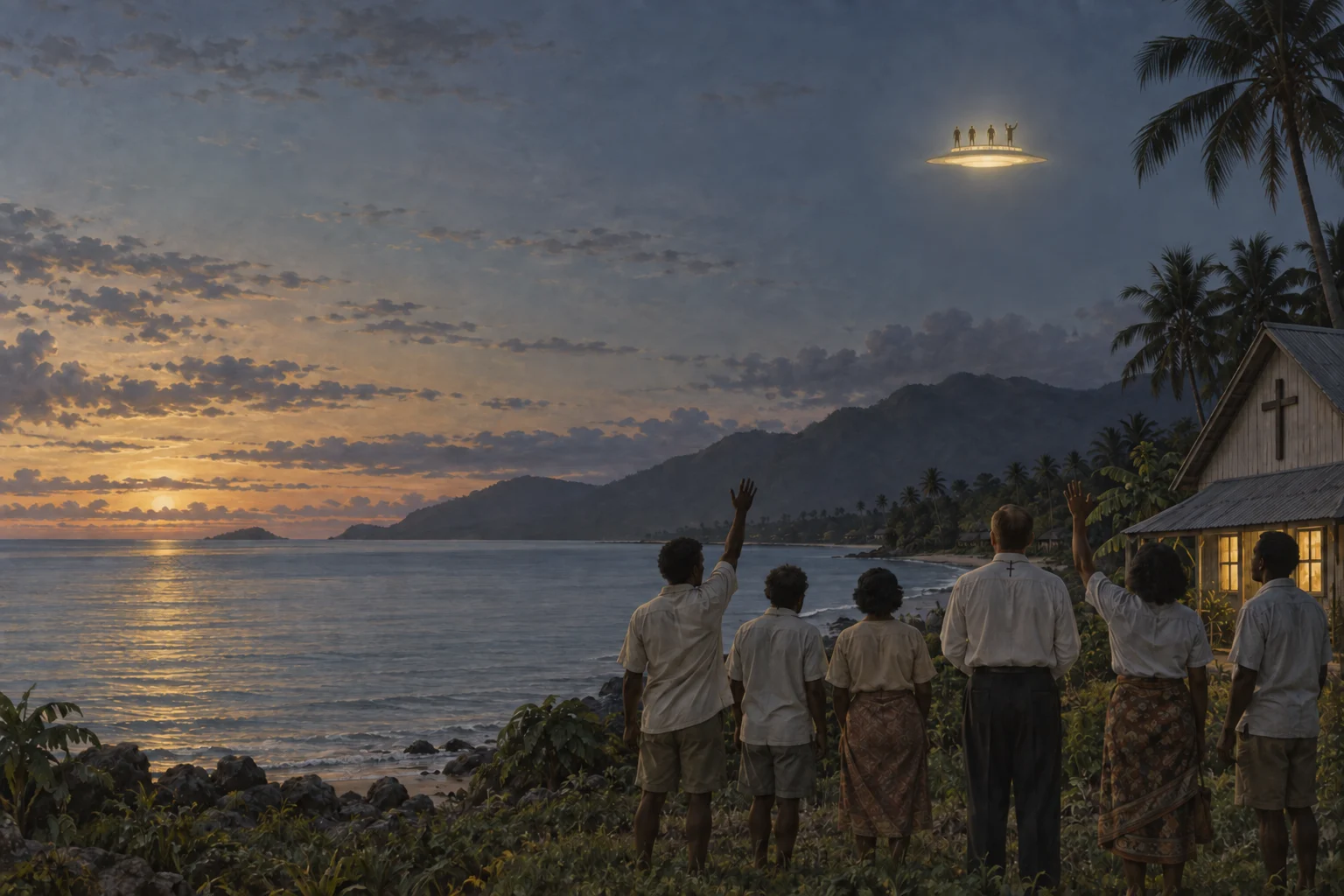
Father William Gill lifted one arm above his head and waved.
Over the coast at Boianai, a figure stood on top of a luminous object. Others were moving near the center of its upper surface. The mission community had gathered in the open, watching the light that had returned for a second evening.
According to Gill’s account, the figure answered with the same gesture.
Ananias Rarata raised both arms. Two figures at the outside of the group appeared to copy him. Gill and Ananias continued, and now all four seemed to wave back.
Around them, the mission boys gasped.
It was June 27, 1959. Darkness was approaching the bay, but there was still enough evening light to watch. For a few minutes, the distance between the people on the ground and the figures above them seemed to be crossed by something as familiar as a greeting.
The evening before, it had begun with a white light outside Gill’s front door.
Beyond the Door
Boianai stood beside Goodenough Bay, on the Papuan coast. Sea and mountains formed the setting of the mission’s observations: lights out over the water, lights above the hills, clouds passing between the observers and whatever they were watching.
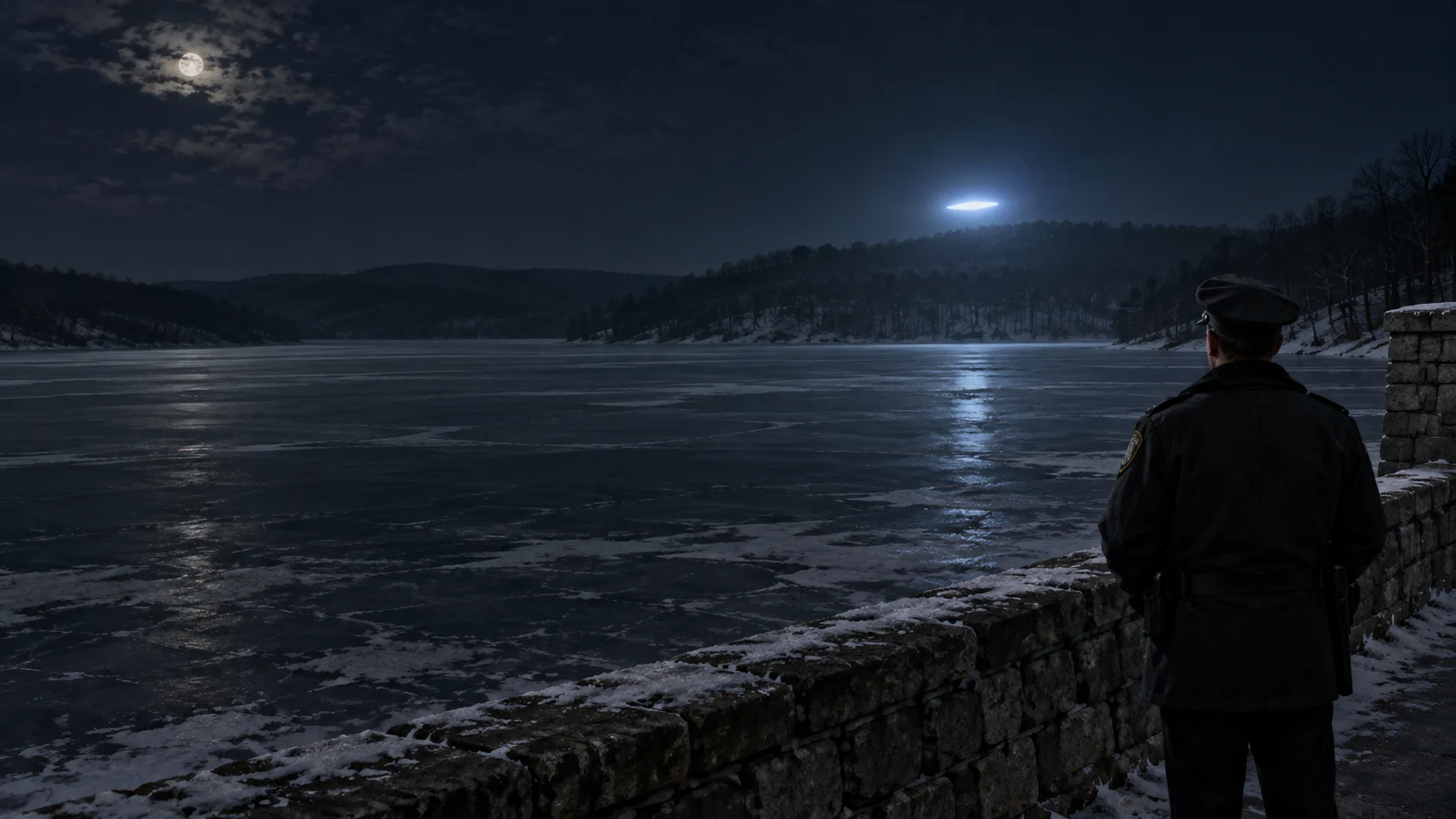
At 6:45 p.m. on Friday, June 26, Gill noticed a bright light to the northwest. His notes began with its position and the time. Five minutes later, he called Stephen and Eric Langford.
Stephen Gill Moi was a teacher at the mission. He had already described an unusual light seen earlier that month, and Gill had recorded his account. Now the two men could stand together and compare what was before them.
By 6:52, Gill thought the light was coming closer and descending. Its appearance changed as they watched. The color in his notes became tentative—orange, perhaps deep yellow—and the bright point began to suggest a shape.
He sent Eric to bring other people.
Three minutes later, Gill recorded something moving on top of the object. He reached for the word man, followed by a question mark. Then there seemed to be three figures, glowing and moving across what he called a deck.
Counting the Figures
Gill followed the figures as they appeared and disappeared.
His record did not keep a single number fixed throughout the observation. At one moment there were two; at another, none. At 7:10, he numbered four figures in the order in which they appeared. The figures were visible above the surface, their lower portions obscured by it.
A narrow blue shaft of light appeared as well. It pointed upward at an angle. For a time, the figures disappeared while the shaft remained.
The observers’ attention moved between these details. A figure would emerge, another would vanish, the blue light would remain or return. Gill’s entries tracked the changes minute by minute, giving the evening the rhythm of something watched continuously rather than glimpsed in passing.
Stephen Moi and Ananias Rarata were among the people associated with those observations. Their names recur beside Gill’s in the record of the figures and the light. Nessie Moi was also named for one of the appearances.
By 7:20, the blue shaft had gone out. The figures were no longer visible. The object passed into cloud.
Gill then brought the witnesses into a well-lit room. Three people—Gill, Stephen and Ananias—worked in different parts of it, each drawing the shape they believed they had seen. When the sketches were brought together, Gill recorded that they resembled one another.
Outside, the sight had been shared in the sky. Inside, it was being put onto separate sheets of paper.
The Sky Opens Again
At 8:28, Gill saw another light overhead and called the station people again.
It appeared to descend and grow larger. A second light was seen over the sea, hovering at times. Other lights appeared toward the village of Wadobuna and farther east.
Cloud changed the view throughout the evening. The observers would see a light, lose it, then pick it up again. Gill described the glow spreading onto cloud as an object came through it, creating a broad halo around the point they were following.
He used mother ship for the larger object. The name helped distinguish it from the smaller lights moving through the same stretch of sky.
The entries continued past nine, then ten. One object disappeared into cloud; another was seen again overhead. At 10:30, a light remained visible high in a clear patch between clouds.
Twenty minutes later, the sky was heavily overcast. At 11:04, rain brought the night’s watching to an end.
The first light had appeared more than four hours earlier. Through that interval, the mission’s evening had become a succession of gatherings, observations, drawings and returns outside to look again. The people who had been called to see a bright point were now witnesses to a much longer sequence.
Annie Laurie’s Light
The following evening, medical assistant Annie Laurie saw a large light at about six.
Gill came out at 6:02. He thought it occupied much the same position as the night before, though it looked a little smaller. He called Ananias and others, and a group of roughly a dozen stood watching.
The sun had set. In the account printed later that year, Gill emphasized that the next fifteen minutes remained light enough for observation.
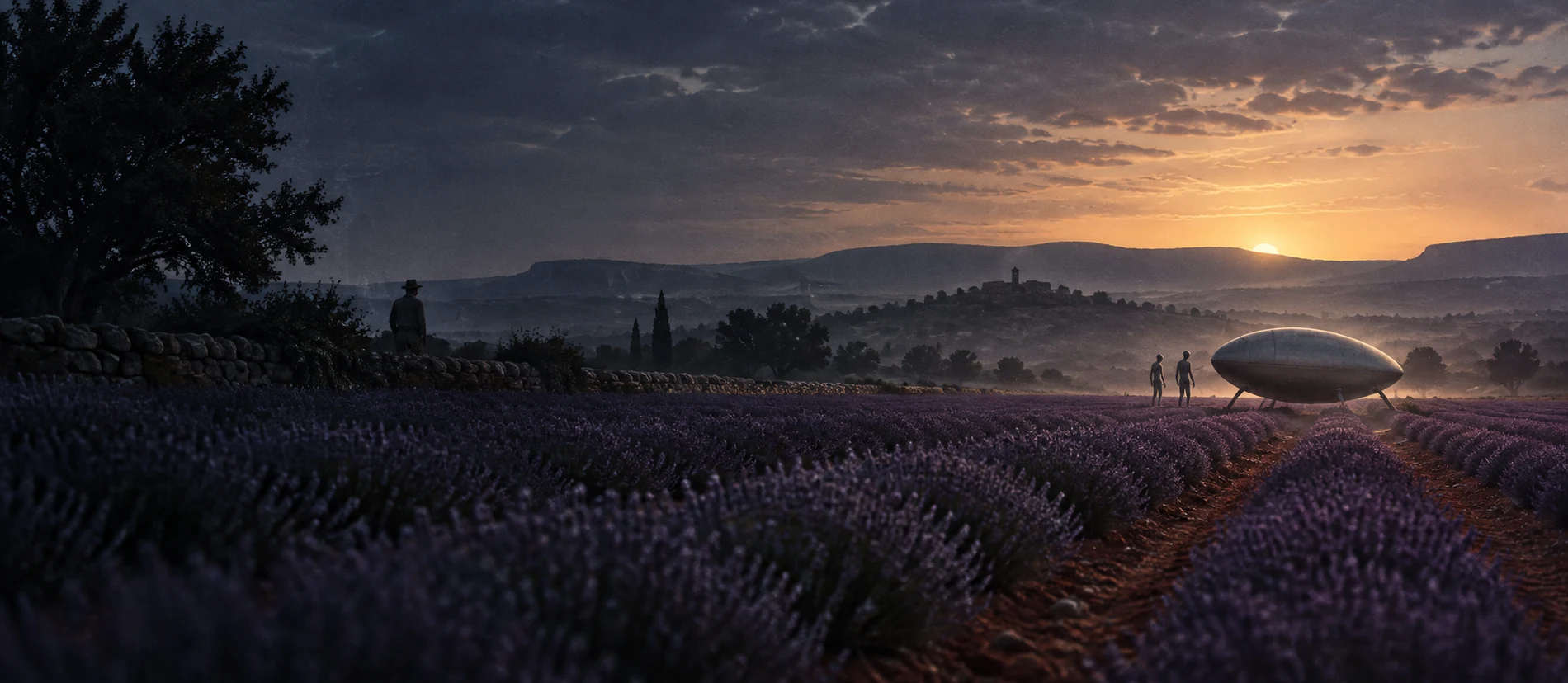
Four figures appeared above the large object’s deck. Two seemed occupied near its center, bending and raising their arms as if adjusting something. Gill could not see what that activity involved. A different figure appeared to look down toward the people below.
There were two smaller lights as well: one above the western hills, another overhead. They stayed separate from the large object and its figures.
Gill raised his arm.
A Greeting Across the Bay
The wave changed the character of the watching.
Until then, the people had followed movements that seemed directed toward something on the object itself. Now a figure’s movement appeared to correspond with Gill’s. When Ananias used both arms, two figures seemed to respond in kind.
The gestures continued. To Gill and Ananias, the exchange appeared deliberate. The boys around them reacted audibly as all four figures seemed to join in.
There were no spoken words passing between the groups. The apparent conversation consisted of visible movements, repeated across the space separating them. A raised arm could be offered without knowing who stood at the other end of it.
As the light faded, Gill sent Eric Kodawara for a torch. He directed a succession of long flashes toward the object.
After a minute or two, he reported that it moved back and forth. More waves followed, then more flashes. The object seemed to grow larger, as though approaching the people on the ground.
That apparent approach lasted about half a minute. Then it stopped.
The figures stayed visible for another two or three minutes before disappearing below the upper surface. The exchange had ended as quietly as it had begun. The people remained on the ground; the object remained above them.
The Evening Continues
At 6:25, two figures appeared again. They seemed to resume their earlier activity. The blue light came on briefly, twice in succession.
At half past six, Gill went to dinner.
That detail stayed with the story. In the later account by investigator Bill Chalker, Gill explained that he had pictured ordinary human pilots—possibly Australians or Americans—and had hoped they might land. His response to the figures had included the possibility of hospitality.
At seven, the large object was still visible, though smaller in appearance. The observers went to church for Evensong. When the service ended at 7:45, cloud covered the sky.
The mission’s ordinary evening had continued around the sighting. Dinner was eaten. A service was held. Between those familiar activities, people had stood outside and believed they were exchanging signals with figures above the coast.
Gill’s letters carried the event beyond Boianai. On June 30, he told David Durie at Dogura about the hand signals, naming Ananias and the mission boys alongside himself. The report would follow through the mission network, then into a much wider world of readers and investigators.
But the scene those papers carried was small enough to hold in a single image: people looking up, a hand raised, and a distant figure apparently raising its own.
What Is Known
Gill’s compiled report, dated July 14, 1959, survives in Australian archival file A703, 554/1/30 Part 1. It includes timed observations, sketches, letters and an account of how the drawings and signatures were gathered. The date belongs to the assembled report; the principal encounters were recorded for June 26 and 27.
The record identifies 38 witnesses during the principal sightings. Signature totals differ between versions: Gill’s compiled account records 27, while Cruttwell’s March 1960 excerpts give 25. The larger total describes the gathering, rather than 38 identical accounts of every detail.
Flying Saucer Review reproduced the June 27 account and a drawing in its November–December 1959 issue. It was a publication devoted to UFO reports, publishing testimony supplied through Cruttwell. Its contemporary text already contains the waves, torch signals and apparent approach.
Later interviews form another layer. A summary of James McDonald’s recorded interview dates their Melbourne conversation to June 28, 1967. Gill recalled the luminous outlines of the figures and the signaling. McDonald subsequently referred to Boianai in his 1968 congressional symposium statement. Chalker also describes his own later conversations with Gill.
These documents preserve a community’s reported encounter and its subsequent investigation. Descriptions such as deck, figures and mother ship belong to the observers’ account; they do not establish the object’s construction or origin.
The Bigger Picture
Boianai’s story traveled through relationships before it became a famous UFO case: a teacher telling a priest, a medical assistant calling attention to a light, colleagues watching together, letters moving between missions.
Those relationships matter to its shape. Stephen, Ananias, Annie and the mission boys have roles in the unfolding event. Remembering their names keeps the narrative connected to a place and a community, even when it is retold far from Papua.
The encounter also entered literature. Randolph Stow’s 1979 novel Visitants opens with the Boianai sighting. As Drusilla Modjeska explains in the Sydney Review of Books, the novel draws on Stow’s own 1959 experience in the Trobriand Islands and tells its story through five voices within a colonial setting. It is fiction, with its own purposes, and its use of Gill’s account belongs to the case’s cultural afterlife.
The title gives the original encounter a further resonance. A visitor arrives from outside the world someone knows. Recognition begins before explanation: a person notices a presence, attends to a movement, tries a gesture.
At Boianai, the gesture was a wave. That is the moment that continues to draw people back to the file—the possibility, recorded by people standing together on a coast, that someone unfamiliar had seen them and answered.
Sources
- William B. Gill, Report on Unidentified Flying Objects, July 14, 1959. Contemporary report, notes, drawings and letters in Australian archival file A703 554/1/30 Part 1; digitized file reproduced on Scribd.
- Norman E. G. Cruttwell, Flying Saucers Over Papua, March 1960, excerpts and Gill documents. Early compilation preserved in The Black Vault’s Philip Mantle archive.
- Flying Saucer Review, November–December 1959, volume 5, number 6, pp. 7–8. Contemporary reproduction of the June 27 testimony and a traced witness drawing; scan visually checked.
- UFO Research NSW, summaries of McDonald’s 1967 Australian witness recordings, pp. 31–33. Later transcript summary of Gill’s June 28, 1967 interview; distinct from the 1959 notes.
- James E. McDonald, statement to the US House Committee on Science and Astronautics UFO symposium, July 29, 1968. Primary record of McDonald’s discussion of group sightings and his interview with Gill. The online transcription contains a date typo in its Boianai reference.
- Bill Chalker, “Father Gill, 1959, Papua New Guinea UFO Sighting.” Later investigative account incorporating the written report and subsequent conversations with Gill.
- Drusilla Modjeska, “They Bring Their Somethings: Visitants by Randolph Stow,” Sydney Review of Books. Independent literary and historical context for the closing section.