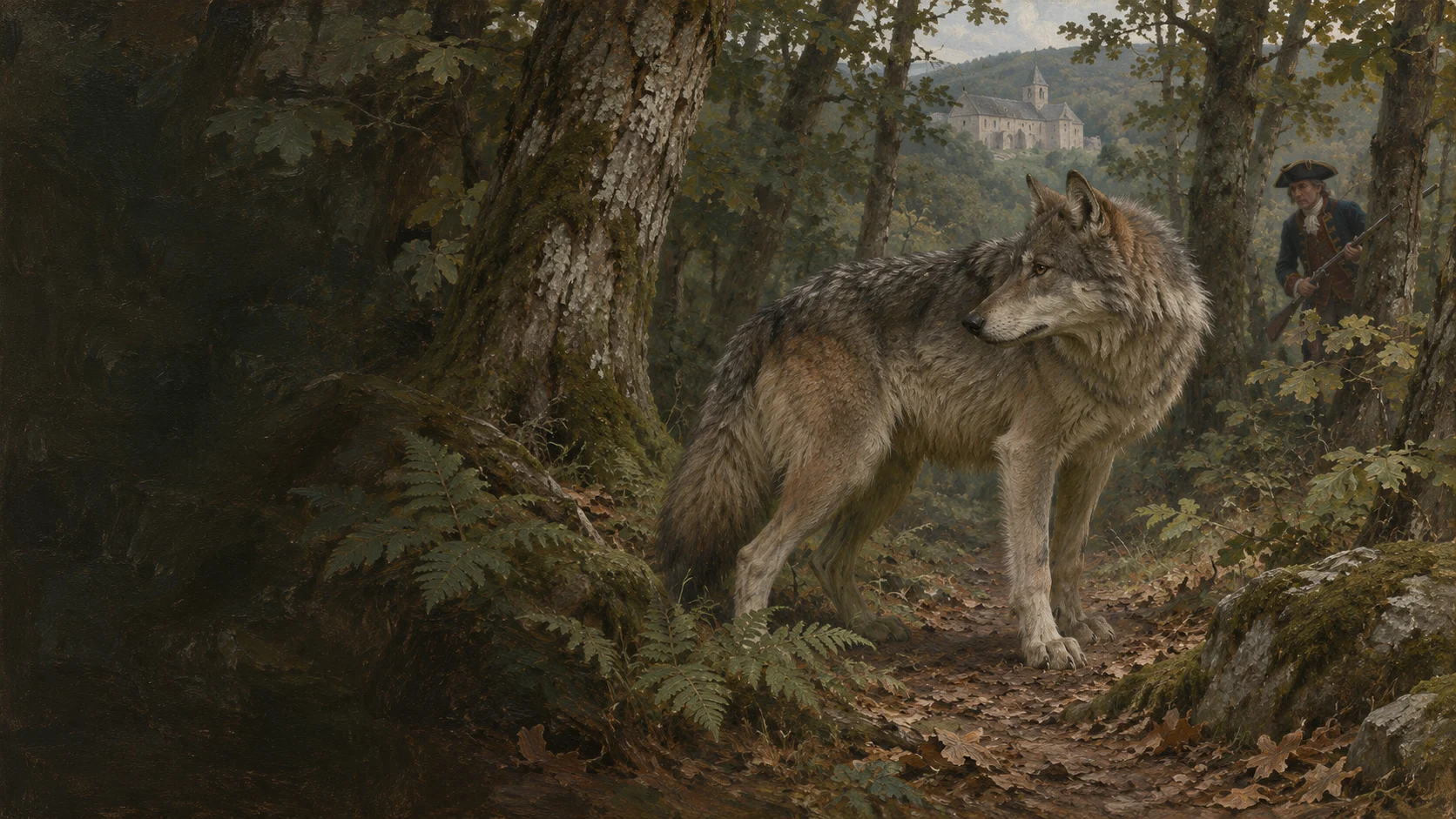
The wolf turned its head to look at François Antoine. It had come along a path in the woods of Les Chazes and was standing broadside to him, about fifty paces away by his estimate. Behind it, dogs and their handlers were working through the trees. Antoine had posted men around the wood and taken up a position in a narrow passage.
He fired. The animal fell. Antoine called out, and the wolf got up again. He said it came back towards him before he had time to reload. A gamekeeper named Rinchard was close enough to answer his call for help. At the second shot the wolf ran a little farther, out onto open ground, and dropped.
Antoine wrote that account in September 1765. Louis XV had sent him to kill the animal blamed for a succession of deaths in and around Gévaudan. He had a body to take back. Before it went to Versailles, there were people in the villages he wanted to show it to.
The name in the register
In the parish register of Saint-Étienne-de-Lugdarès, the entry for Jeanne Boulet gives the date of her burial as July 1, 1764. The priest recorded that a fierce beast had killed her. She was fourteen. The village where she lived stood near the border of Gévaudan and Vivarais, at the eastern edge of the country that would soon be hearing reports of other children and young people attacked.
By autumn, accounts were reaching the officials charged with organising the hunts. In October, Étienne Lafont, a regional administrator, passed on a description of an animal larger than a wolf, with a muzzle like a calf’s and long bristles. He wondered if it might be a hyena. Captain Duhamel of the dragoons later wrote of a wide mouth and a heavy tail. He thought of a lion when he tried to account for what he had been told. The descriptions went out in letters as the attacks spread from the country around Langogne into the Margeride and Aubrac.
The bishop of Mende had his own explanation. On the last day of 1764 he issued a pastoral letter for the parishes of his diocese. From their pulpits, priests were to tell their congregations that the Beast had been sent as punishment. Meanwhile, men on horseback and on foot went out to look for it. Duhamel’s troops failed to end the attacks. A pair of experienced wolf hunters from Normandy, the d’Ennevals, took over and spent the spring hunting. By summer the king had sent Antoine, his personal huntsman, with royal gamekeepers and hounds.
Between the bridges
On August 11 Antoine’s party was preparing to sweep the Grand Bois Noir when word came of an attack near Paulhac. Marie-Jeanne Valet, who worked for the parish priest, had been walking to a farm with her younger sister, Thérèse. The route took them across a stream that divided around a small wooded island. Marie-Jeanne told Antoine that she had been between the bridges when the animal appeared.
She said she backed away a few steps. As the animal sprang, she drove the bayonet she was carrying into its chest. She heard it cry out and saw it bring a front paw to the wound. Then it went into the stream, rolled several times and disappeared from her view.
Antoine asked her how big it had been. She compared it to a large livestock dog. She recalled a broad, flat head, a dark back and a pale band at the neck. She remembered the animal looking heavier in front than behind. Antoine questioned Thérèse separately. He recorded that her account generally agreed with her sister’s.
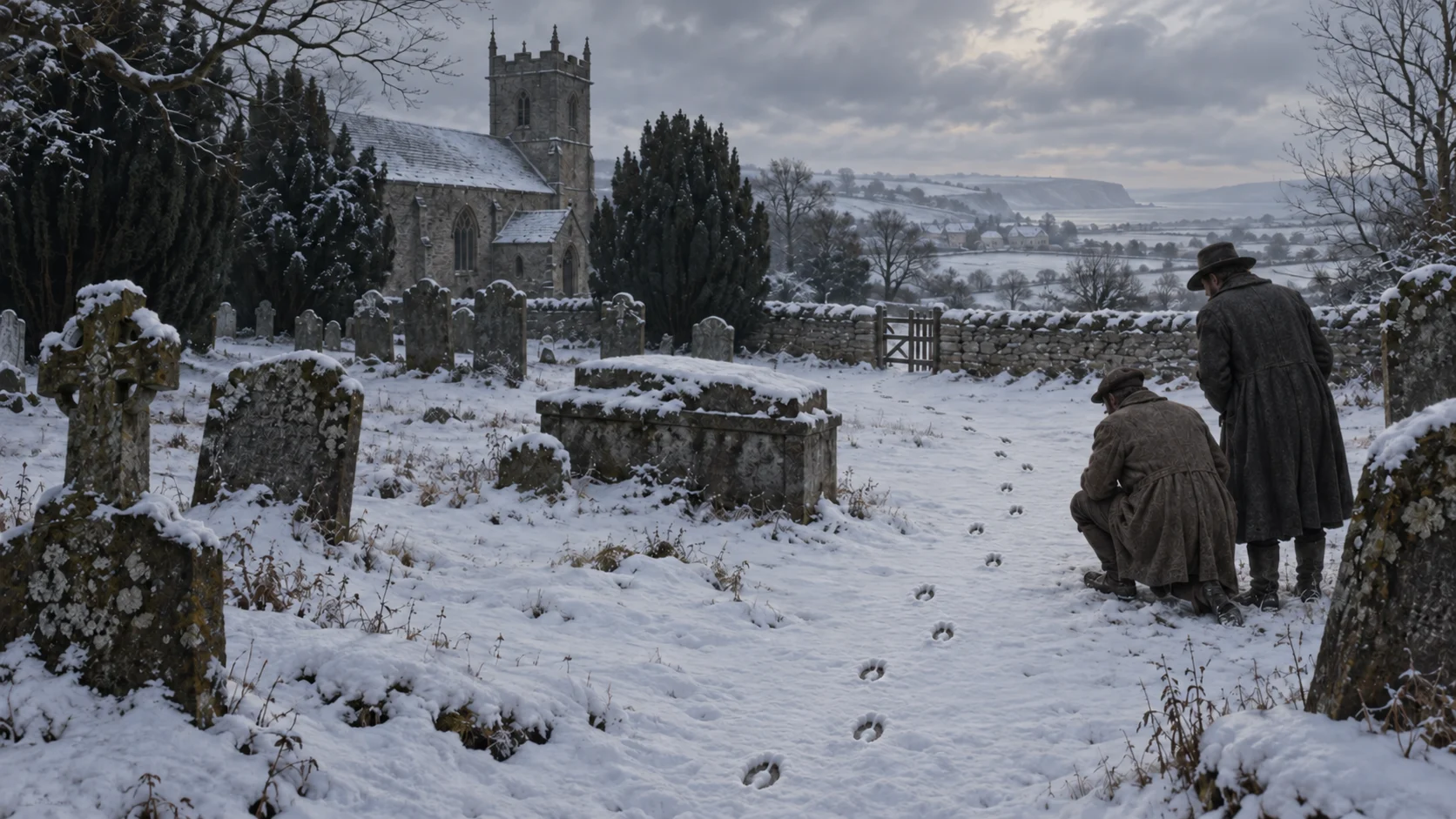
He also asked to see the bayonet and noted blood on the blade. His party followed prints along the water and saw where the animal had crossed it again. Shepherds’ dogs had already pursued it. Antoine’s own hounds lost the trail within a few hundred paces.
The body at Le Besset
In September, gamekeepers returned from the royal abbey’s woods with word of a very large wolf. They had found signs of a she-wolf and cubs as well. Antoine went to Les Chazes and brought in men from Langeac and neighbouring parishes to surround the wood. The male came out on the path where he was waiting.
At Le Besset the hunting party measured the carcass. Antoine and the others who signed his report said they had never seen a wolf comparable to it. François Boulanger, a surgeon from Saugues, opened the animal in the presence of the hunters and local men. He found pieces of flesh and bone. Some ribs he could identify as sheep. He was unable to tell what the rest of the bones were.
Then the Valet sisters came with the priest of Paulhac and a parish official to look at the wolf. Both said it was the animal that had attacked them. The men showed Marie-Jeanne a wound on the right shoulder and recorded that she recognised it. Asked where she had struck the animal, she said she could not say. Other people brought before the carcass also identified it as the animal they had seen.
By the time the preserved wolf reached Versailles, Antoine’s report had been sent ahead. A contemporary account reproduced by François Fabre places Antoine’s son there on October 1 with the carcass. It was taken first to the Count of Saint-Florentin, then to the queen, where the court could see it. The intendant of Auvergne had sent the king a message announcing that his huntsman had killed the Beast of Gévaudan.
Antoine went back to the woods for the she-wolf and her cubs. In an October 19 letter from the abbey he reported the death of the last cub, wrote that the hunting party and its dogs were exhausted, and counted twenty-nine days without news of another attack. He hoped the quiet would last.
Back into the woods
By December, the priest of Lorcières was writing that he believed the Beast was still alive. The people who came to see a different carcass later would give the notary an account of what happened after the royal hunt. In the spring of 1766, Jean-Pierre Loude said, he came upon an animal holding a girl from a neighbouring village. He struck it with a bayonet and it let her go. Anne Chabanel said she had struck at an animal that attacked her the following August.
On March 2, 1767, Antoine Plantin said, an animal carried away his daughter. He followed it for what he reckoned was five hundred paces. Then he lost sight of it in the woods. In another parish, during Lent, Marie Reboul survived an attack. When she told her story that June, she could show the men taking it down the wounds on her arm and the cut that had taken her ear. Part of the wound was still open. The notary also took accounts from people who had come to her aid.
That June the Marquis d’Apchier heard of an animal appearing near Nozeyrolles and Desges and of a child killed. He assembled a dozen men and set out around eleven at night on June 18. The next morning, at about a quarter past ten by the account that reached the notary, the animal came within sight of Jean Chastel at the edge of the wood of La Ténazeyre. Chastel fired. The animal fell where the woods ended. The marquis had it carried to his château at Besques.
The notary at Besques
Roch-Étienne Marin came to the château the next day. The animal appeared to him to be a wolf of unusual proportions. People from the surrounding country came to see it. Some hunters drew the examiners’ attention to its heavy forelegs, the colour of its paws and the size of its head. Marin recorded reddish-grey hair around the neck, interrupted by dark bands, and a white patch shaped like a heart on the chest.
The examiners measured the head and counted the teeth. They found older injuries as well as the fresh wound. People who had come to look at the body began to put names and places to it. One man remembered firing at an animal the previous spring. Another remembered an attack while he was driving a cart drawn by oxen. Plantin identified it as the animal he had followed into the woods. Reboul identified it as the animal that had wounded her.
Their names went down in Marin’s report alongside the measurements. The attacks associated with the Beast ceased after the June hunt.
What Is Known
Parish and administrative records document the attacks, and the reports of 1765 and 1767 record two separate hunts and examinations. The September report, as reproduced by Fabre, dates Antoine’s hunt to the 21st. A contemporary engraving puts it on the 20th. The sequence is clear in either case. The Valet sisters identified Antoine’s wolf in 1765. The people Marin interviewed identified Chastel’s animal in 1767, in several instances from encounters reported after the royal party left. Antoine himself allowed that more than one wolf could have been involved.
The Bigger Picture
The prints that carried the story beyond Gévaudan gave readers several beasts to picture. As research published by the Courtauld shows, some regional images gave the animal features familiar from local monster lore. Parisian prints of Antoine’s hunt tended to show a wolf the king’s men could kill. One print took the animal all the way to Versailles, where the courtiers could gather around it. In the records from Besques, the people standing around the body were the ones who had met an animal on roads, pastures and paths through the woods.
Sources
- Jeanne Boulet’s burial entry, July 1, 1764. Transcription of the Saint-Étienne-de-Lugdarès parish entry.
- Alice Motte, FranceArchives chronology. Lozère archivist’s overview of the attacks, geography and successive hunts.
- François Antoine, examination of the Valet sisters, August 11, 1765. Reproduction from Pierre Pourcher’s historical collection. The shorter version appears in François Fabre, chapter XI.
- François Antoine and François Boulanger, September 1765 reports, in Fabre, chapter XII. Transcriptions of the hunt, the examination, the identifications at Le Besset and the intendant’s message.
- François Fabre, chapter XIV. Reproduces contemporary accounts of the wolf at court, Antoine’s follow-up hunts and his October correspondence. Also dates the December letter from Lorcières.
- Roch-Étienne Marin, examination of June 20, 1767. Three manuscript images contributed by the Archives nationales, AE/II/2927. Read alongside a transcription and the local association’s extract.
- Catherine Velay-Vallantin, “Entre fiction et réalité”. Historical study with excerpts from the contemporary correspondence and an account of the bishop’s pastoral letter.
- The Courtauld, “Monstrous Ecology”. Independent study reproducing and analysing contemporary engravings, including an October 1765 print dating the hunt to September 20.