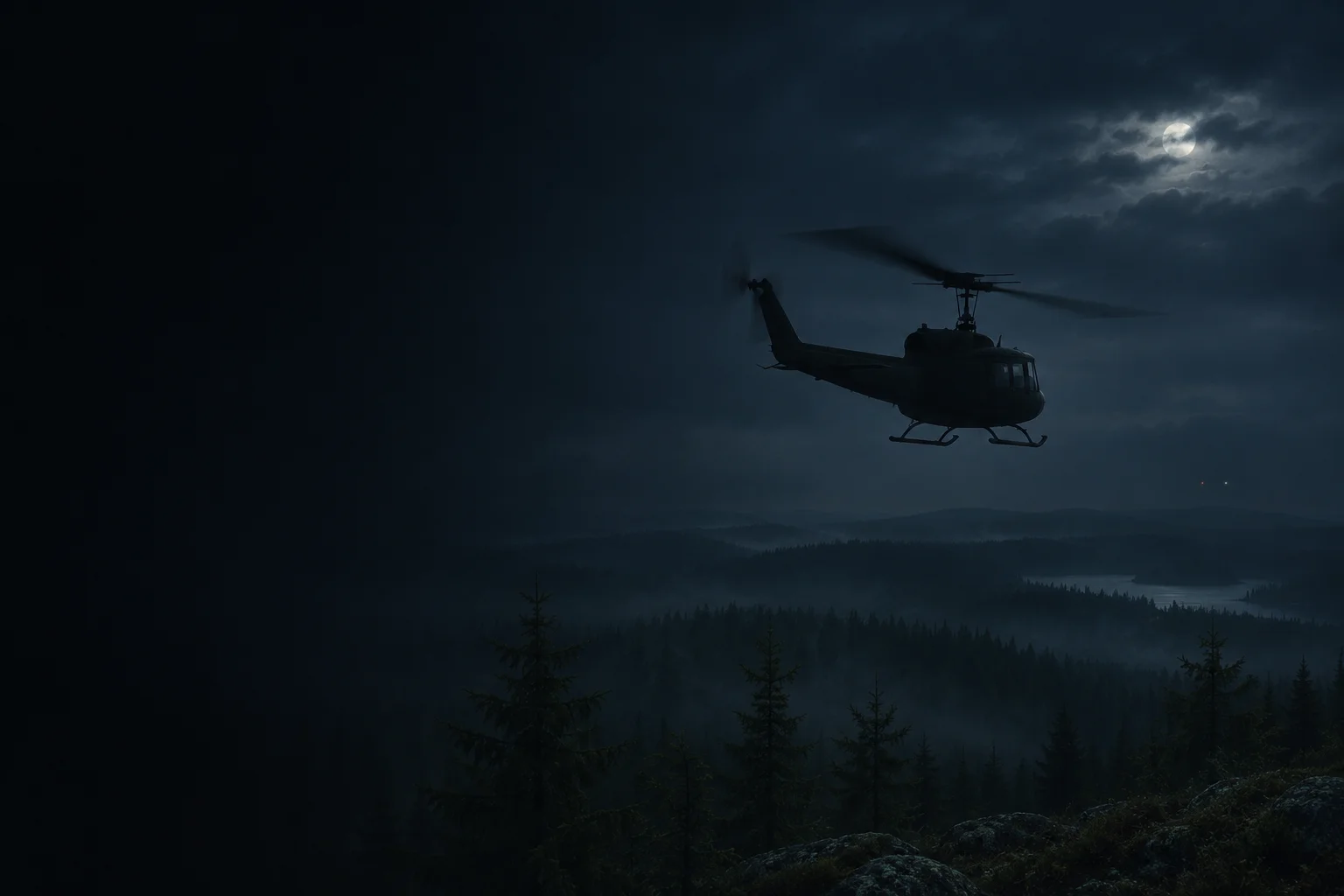
At about two in the morning, the people watching the radar guided a helicopter towards an unknown contact. When the two were close on the screen, the helicopter pilot switched on his lights. The crew were flying at about seventy-five metres. The pilot wanted the other aircraft to see them in time to avoid a collision.
Then the crew saw position lights and a flashing light below them. They were visible for ten to fifteen seconds. The crew saw enough to report that the other aircraft was flying lower than they were. The memo that recorded the approach gave it no name.
The helicopter had gone up during Operation Dacapo, the second of two searches in 1975 for aircraft reported along Sweden’s border with Norway. For the man directing the police investigation, it had begun four years earlier with a plane in daylight and a telephone call in Östmark.
The telephone box
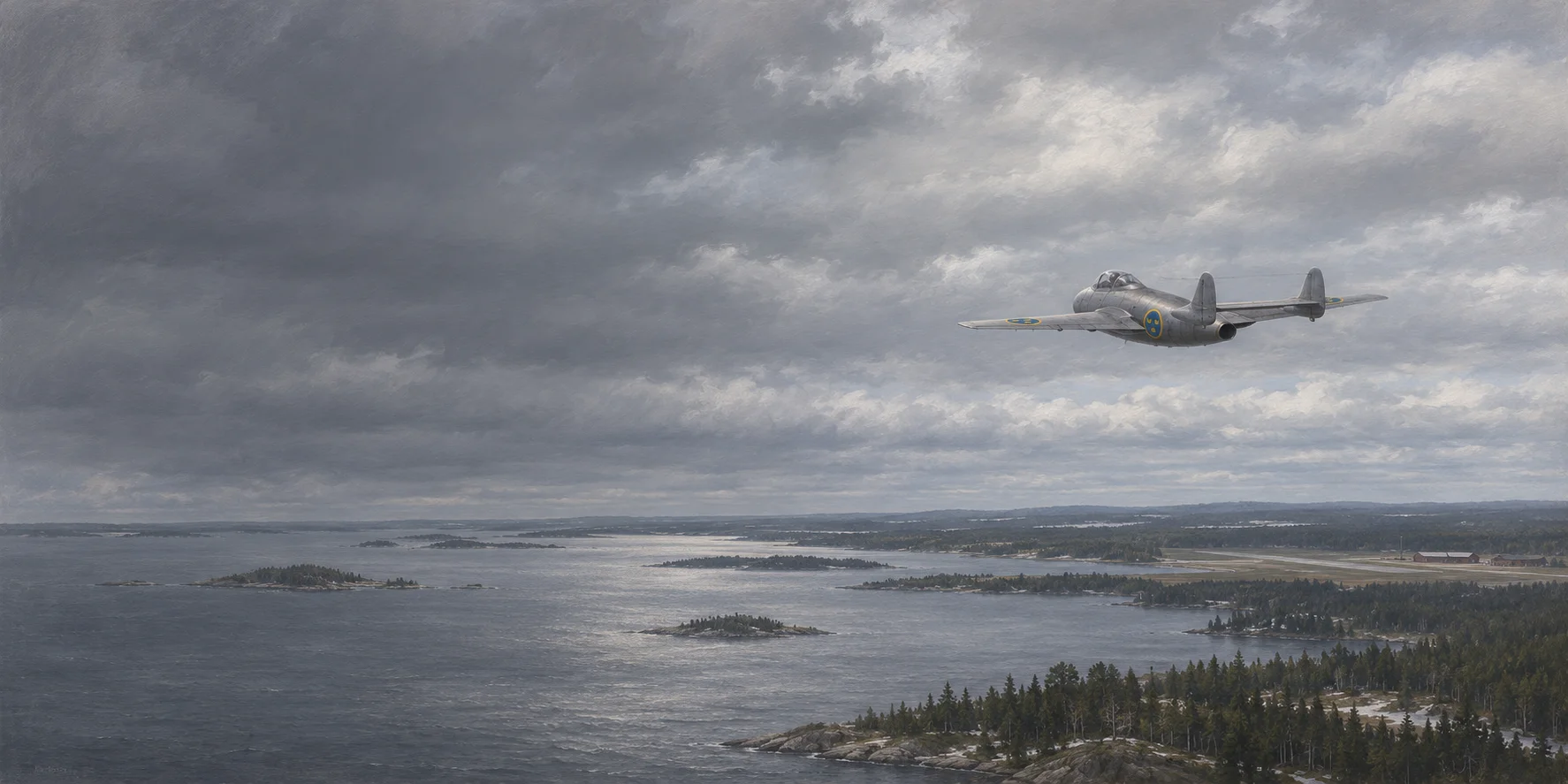
It was a November morning in 1971. As Andreas Ohlsson and Clas Svahn reconstructed it from interviews decades later, two security policemen were watching a man near a telephone box in Östmark when a single-engine plane passed low over the village. The man went into the box, made a short call and left in the direction of Norway. The police would watch him again. They learned he had made other short calls from the box, some after dark. Whether he had anything to do with the plane remained open.
Inge Stålbom, who headed the criminal police in Karlstad, was told about the incident. Two people familiar with aircraft thought they recognised a Beechcraft Bonanza. Stålbom remembered trying to account for three possible aircraft in the Nordic countries. He was told two were in for repairs and the third was abroad. That was as far as the lead took him.
More reports came in from western Värmland, many after dark and some in the kind of weather that made the alleged flights particularly difficult to understand. Stålbom began asking callers whether they had actually seen a plane or heard what they took to be one. Some of the sounds turned out to be tractors. The question still left him with people who said they had looked up and watched an aircraft pass.
Annika Asker was out skiing with her brother near Mattila one evening when, she later told Värmlands Folkblad, they heard a plane coming low from the direction of Norway. She remembered a full moon and something falling from the aircraft across Mullsjön. In her memory it looked like a sack or a box. The children ran in to tell their father. The family went looking the following day and came back empty-handed. When Asker told the newspaper in 2004, she could place the night in March, either in 1972 or in 1974.
Police had dealt with smuggling by air in the region before. The new reports brought Stålbom back to that possibility. Police and customs made contacts across the border, and people living on the Swedish side were asked to tell investigators when they saw something. If another plane came through, Stålbom wanted a track he could follow from one report to the next. He needed radar closer to the places people were calling from.
A watch at Ormhöjden
In March 1975, customs officer Bo Ohlsson joined colleagues from border posts around the region for a training day in Karlstad. At the airport they watched aircraft take off and land in the dark and learned to use battery-powered night binoculars. He remembered being told to keep the assignment within the group. By spring it had a name, Operation Argus.
Ohlsson usually worked at the Hån crossing. For Argus he and two colleagues, Karl-Erik Eriksson and Henrik Perttu, moved into a converted washhouse by the river in Gräsmark. It had two small rooms, a kitchen and no telephone. If they needed to speak to customs in Eda, they could use the radio in the car or go to a phone box. They bought food in the village and refuelled the car there. Ohlsson remembered that the man at the petrol station knew they were working in the area. Their assignment was kept from him.
The three officers drove the patrol alone, one at a time. Ohlsson described pulling up at Simonstorp, waiting half an hour and driving on to Ormhöjden. A ski hut stood near the top. From there he could see into Norway and across the Lekvattnet valley towards Östmark. The hut also had a telephone. From that post he could speak to Elof Lindow, the customs supervisor working at one of the radar stations.
One time Ohlsson was told to stay put. Radar had picked up movement at an airfield on the Norwegian side. That was all he was told. He spent six hours at the post, calling Lindow every quarter of an hour to report and ask for news. He remembered seeing Swedish Viggen aircraft in the area on several occasions during Argus. Of that long watch, what he told his interviewers years later was how little he had been given to go on.
Marks on the screen
Stålbom spent much of Argus inside a radar truck. He remembered returns they could follow for a short distance, with no altitude available from the sets they were using. Customs could keep an eye on airfields, but the police helicopter at Karlskoga could scarcely be brought in before a short-lived return was gone.
There was one approach in clear daylight. In Stålbom’s account, a plane came from Norway towards one of their stations and turned back along the border. He wondered whether the aircraft had somehow detected the radar. The Norwegian side was unable to follow it. After ten days of watching, the radar sets developed problems and the spring search ended.
Stålbom took the results to Stockholm. The short tracks were enough to persuade him that they had been watching aircraft. When he spoke with Defence Staff chief Gunnar Eklund, he was told the staff knew of no activity on the border, according to the reconstruction. The national police put money into another search. This time the people following the returns would have aircraft ready to go up.
Dacapo
In autumn the radar crews returned. There were more sets and more people, with Swedish police, customs and military personnel coordinating with counterparts in Norway. In the woods the operation tried microphones that could be switched on from a central point or set off by a sound. They were sensitive enough to trigger so often that they became a problem of their own. In the air, the crews had a chance to do what Argus could rarely arrange in time.
Stålbom remembered a night around midnight or one in the morning when a contact came in from the north. It was low, he believed, because it kept breaking up on the screen. His team was able to keep track of it as the helicopter went up. The pilot reported approaching with his own lights off. The aircraft ahead showed lights at the sides and a flashing light to the rear. In Stålbom’s telling the lights were on for about ten minutes. From the ground, he could see the contact pulling away from the helicopter.
The operation memo begins its description of the two o’clock encounter with the words “on another night.” It records the helicopter lighting up first, with the other lights visible for seconds. The memo said that there were more observations of this kind. Getting close enough to see lights had still left the crews without an identification to report.
The decision in Karlstad
Stålbom returned to Stockholm with the new county police chief, Jan Larsson. As Stålbom recalled the meeting, the national police wanted a plan to continue. Later, in Karlstad, he put his case again to a room that included police, customs and military representatives. He wanted another chance and recalled that the Norwegians were interested in continuing too. Larsson declined to put the resources behind a further operation. Stålbom was assigned other work.
Larsson told Värmlands Folkblad in 2004 that the decision in Karlstad had seemed broadly agreed at the time. The search had already taken a great deal of work and money, and what it had yielded gave him insufficient grounds to go on. He remembered Stålbom’s enthusiasm and thought he had done good work. Asked what the flights might have been, Larsson said they had considered drug smuggling. He had no facts to settle it.
Officers who had spent their shifts on the roadside and in the hills had questions of their own. In February 1976, customs personnel complained at a meeting in Karlstad that they had been told too little about what the searches found. When Ohlsson spoke about it decades later, he still wanted to know what his team’s two weeks in Gräsmark had turned up.
What Is Known
Most of the Swedish narrative comes from recollections gathered in 2002–04. The Dacapo helicopter memo survives here as an excerpt published by Ohlsson and Svahn. They also identify a February 1975 training summons in the Medskogen customs files and a December 1979 Defence Staff memo on uncontrolled flights over Värmland and the border.
In October 2025 Svahn reported speaking with a helicopter pilot who pursued an unidentified contact in western Värmland on November 7, 1975. Svahn said he had obtained the radar plot. The two o’clock memo excerpt gives no date, and the link between the two remains open.
The Bigger Picture
A Norwegian public inquiry encountered the border-flight reports while examining the 1973 killing of Ahmed Bouchikhi in Lillehammer. The inquiry read Norwegian case documents recording reports of unauthorised small-plane crossings from 1971. Customs and police had looked into them and reached no firm conclusion. The inquiry found no evidence that the people involved in the killing had used such flights to escape.
In the Norwegian files the crossings were a series of reports with no firm conclusion. On the Värmland hillside, a customs officer kept returning to the telephone, hoping for something more than movement on a screen. For a few seconds, one helicopter crew got closer than that.
Sources
- Andreas Ohlsson and Clas Svahn, Argus och Dacapo, UFO-Sverige — Reconstruction with 2002–03 interviews and an excerpt from Inge Stålbom’s undated operations memo. It cites the Karlstad customs summons of February 20, 1975 (Dnr 119P, Medskogen incoming records E:47, 1972–1976), and Defence Staff memo Fst/säk 10816:75951 of December 5, 1979. The full Swedish memos, summons and original radar logs were unavailable for this article.
- Värmlands Folkblad, July 2004 coverage reproduced on Skalman — The readers’ accounts include Annika Asker’s recollection. The July 9 interview records Jan Larsson’s reasons for ending the operation. The July 3 reconstruction shares the UFO-Sverige interview trail.
- Norwegian public inquiry, Lillehammer-saken, NOU 2000:6, §6.5.2.2 — Independent official review of Norwegian case records on reported small-aircraft crossings.
- Clas Svahn, October 6, 2025 — The investigator’s note on speaking with a helicopter pilot who took part in a November 7, 1975 pursuit.