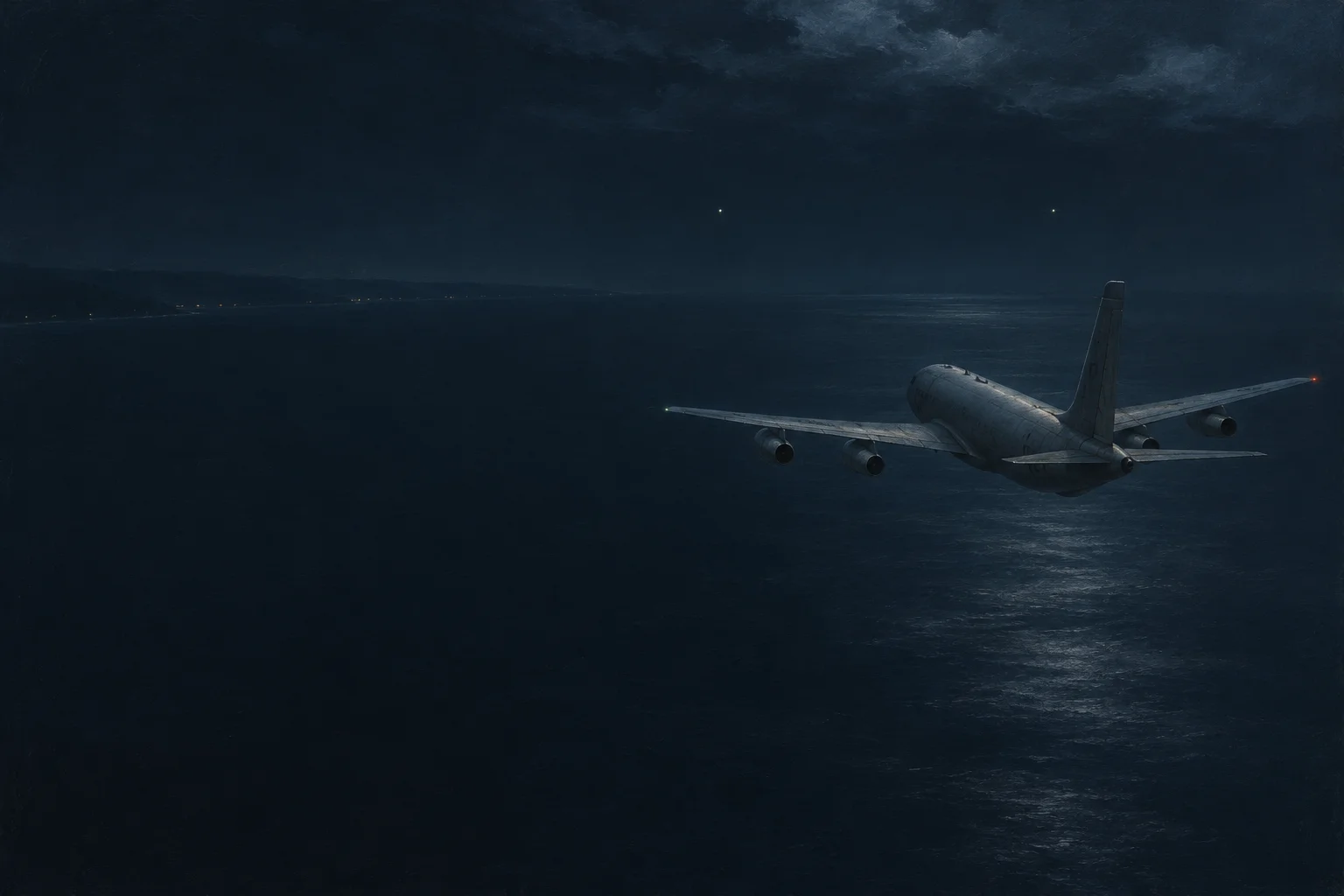
The faint glow appeared at the root of a wing. Later, the pilot reported what looked like a thin layer of white smoke around a wing. He was one of two men sent up from Kallax to identify a return on the radar. The other pilot had a different view. Twice, he reported seeing something like a shadow, without a clear outline, with a faint dark-green tint.
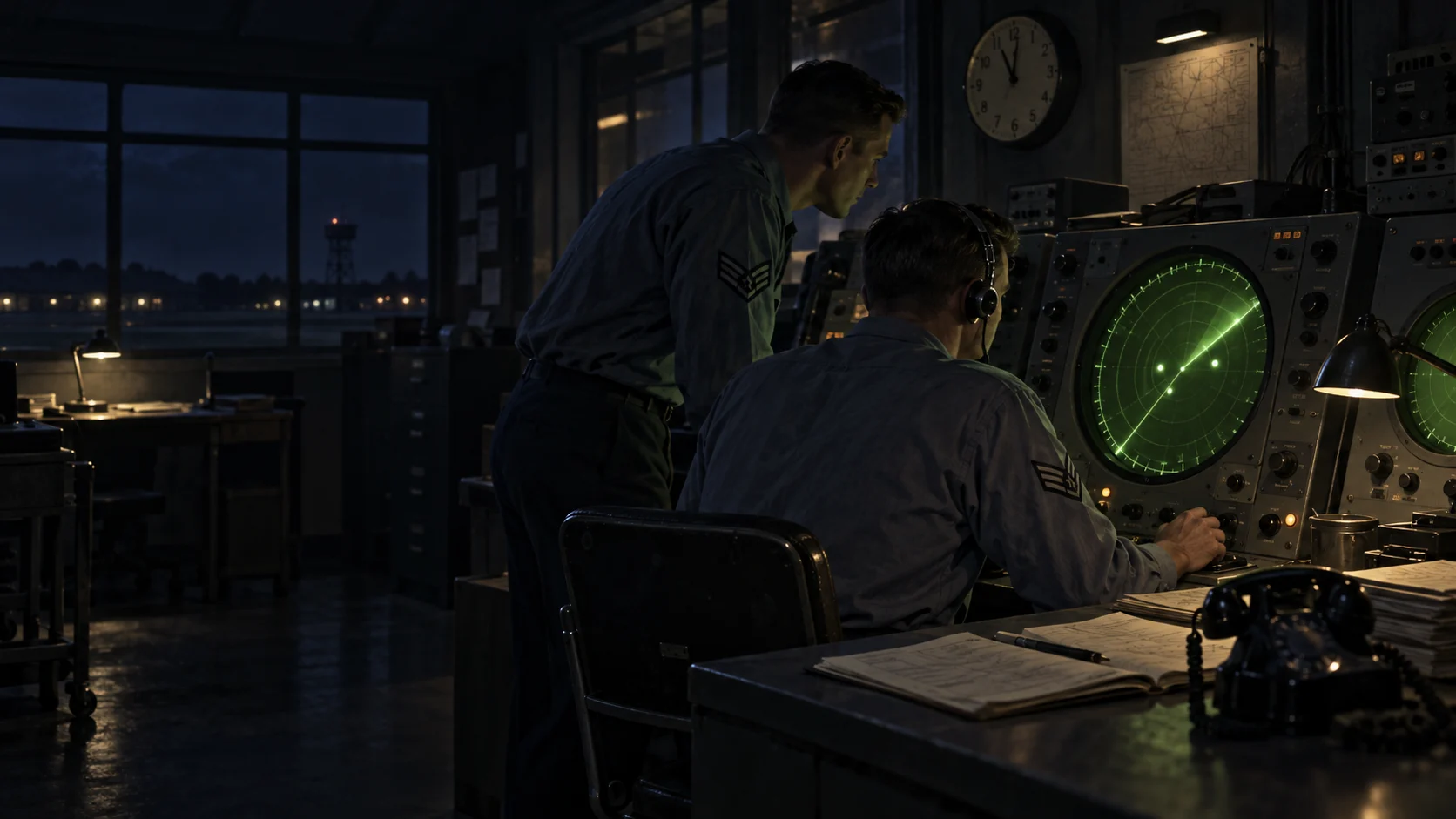
Those descriptions survive in excerpts published decades later by journalist Bength Larsson. The account begins on the morning of May 19, 1954, when the people watching the radar at F21 picked up a return southeast of Luleå. It looked about as strong as one from a single-engine aircraft. What drew their attention was how slowly it seemed to move.
Out towards Rödkallen
Larsson gives the time of the first return as 10:21. It was about thirty-five kilometres away. The operators estimated its average speed at fifty to sixty kilometres an hour, although the apparent speed varied. They followed it from east of Rödkallen, out among the islands, to the area over Niemisel inland.
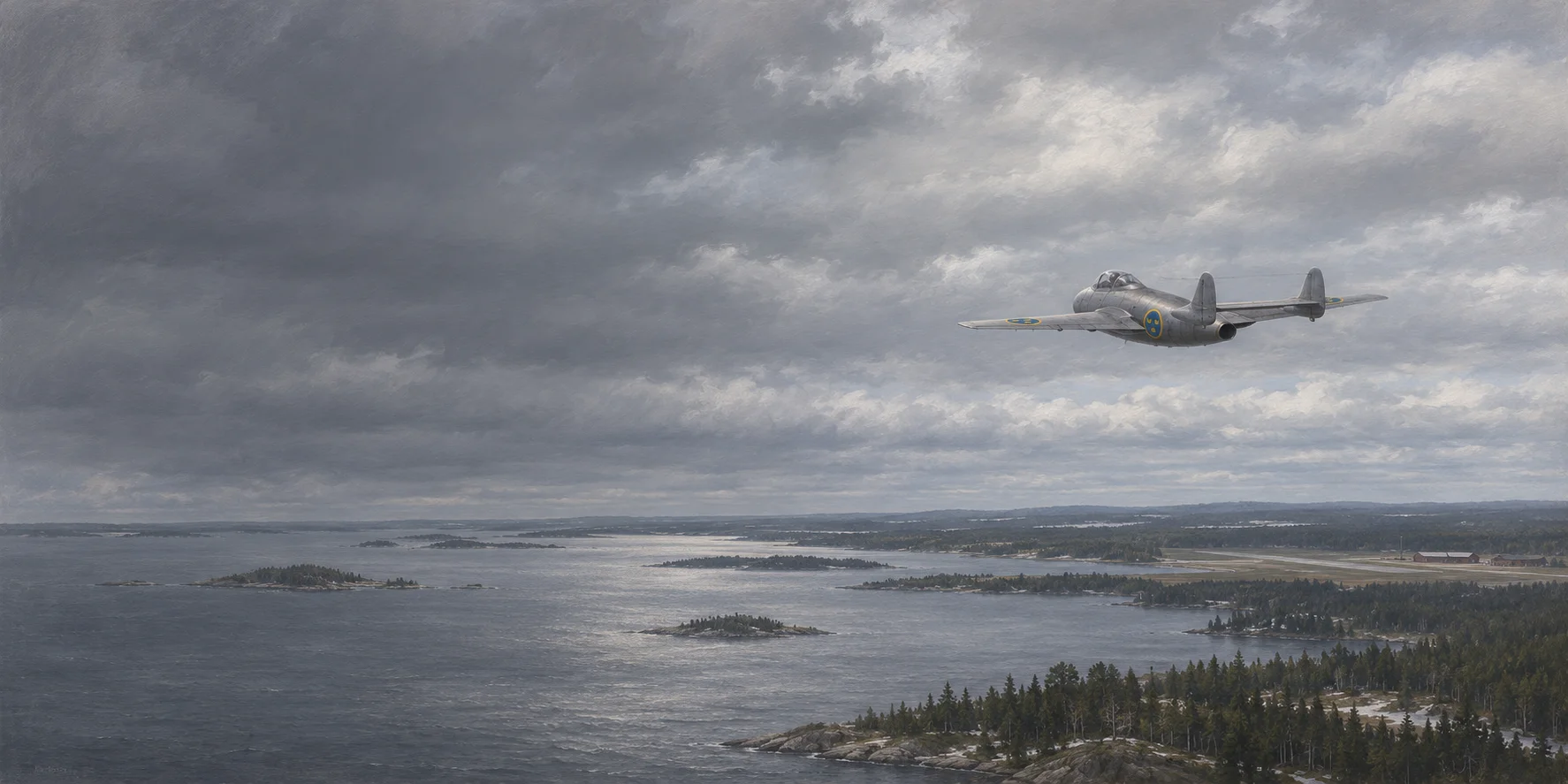
The base sent up a Mustang and a Vampire, a propeller aircraft and a jet. The radar operators guided them towards the return more than once. At one point, their estimate placed the aircraft within a hundred or two hundred metres of it. From the cockpits, neither pilot could make out an ordinary aircraft. There was cloud overhead, in layers. Larsson places the echo at about nine hundred to eleven hundred metres above sea level.
One pilot’s report, as Larsson excerpts it, describes the glow and the thin white layer around a wing. The description gives a place on the pilot’s own aircraft where the effect appeared. The other man describes the shadow on two encounters. The published excerpts leave the pilots unnamed. Back on the ground, F21 drew up a report and, according to Larsson, forwarded it to the Defence Staff.
Outside Hangar 81
Five days later, on May 24, the first unusual return came at 08:05. Larsson says the radar followed it from south of the airfield to a point north of it. At first it seemed to be moving at sixty or seventy kilometres an hour. By the operators’ estimate it later reached a hundred. Aircraft went up to look.
Around nine, aircraft technician Tyko Calla was outside Hangar 81, where the Mustangs stood. He looked out towards the archipelago and picked up a brownish shape. In the account Larsson attributes to Calla’s report that day, it had a clear edge and looked a little like a pear. After about fifteen seconds, it looked round. Calla called to Holger Lindgren and Alf Andersson, two technicians working at the base. They looked where he pointed.
Calla put the shape at about eight hundred metres up and guessed it was travelling at two hundred and fifty to three hundred kilometres an hour. Andersson described a round form with a changing gray-brown colour. Larsson’s summary of Andersson’s account gives two ways he described a change as he watched. It could have been a movement, or a pronounced shadow along the upper edge. He lost it behind what he took for a faint patch of cloud.
More than forty years later, Calla remembered a clear sky and good visibility. He said the shape had simply vanished, as though it had dissolved. In another clipping preserved in UFO-Nytt, he recalled watching it with the others for three or four minutes and put his estimate of its speed at six or seven hundred kilometres an hour. He added that distance was difficult to judge against the sky. In that interview he also remembered phoning the control tower as soon as he could and being called in to give an account.
Beyond the old terminal
At 09:25, according to the report Larsson quotes, Gunnar Wårell was near the ABA hangar, the old airline terminal. From where he stood, he saw a dark shape above the roof and placed it roughly over Kvarnträsket. Its underside looked rounder than its top. He thought it was moving faster than a Tunnan jet. He looked away briefly. When he looked back, he could no longer find it.
Wårell later recalled that at first he took it for an odd cloud. As he watched, it reminded him of two deep plates fitted rim to rim. He spoke to his superiors. In the later interview he remembered being questioned and told to keep the matter to himself. He told Larsson he had known nothing about the radar returns until he was shown the account of what had happened elsewhere at the base.
At 09:30, five minutes after the time recorded for Wårell’s observation, the radar operators picked up a return west of the airfield. They followed it for ten minutes as it moved north. Larsson lists another at 09:50, also beginning to the west. In his reconstruction, aircraft went out after all three of that morning’s returns. No pilot reported seeing what those flights had been sent to find. Out near the hangars, the technicians had their own reports to make.
A turn on the screen
On May 25 the radar followed another return on a northward course in the afternoon. The next day the operators picked up a return at 10:10 and followed it until 10:35. In the figures Larsson reproduces, its estimated altitude dropped from fifteen hundred to eight hundred metres as its apparent speed increased. The attempts to make contact again came up empty.
On May 28 another return appeared. Larsson names K. Casselgren as the radar troop commander. This time the operators watched the return and an approaching aircraft on the ground radar. In Larsson’s account of Casselgren’s report, the echo appeared to turn away while the aircraft was about two kilometres off. When the Vampire had passed, it appeared to take up its earlier course.
Wårell learned about that turn when Larsson showed him the account years later. He had been looking at the sky above Kvarnträsket on May 24. Casselgren and his crew had been looking at a screen on May 28. The two men had different views of the weeks at F21, and it took the reports coming back into circulation for Wårell to hear what the radar crew had recorded.
Larsson lists two more returns in June. The last came at eight in the morning on June 2. His chronology ends there, with the final return on the screen and no identification from the flights.
What Is Known
Larsson’s feature first appeared in Norrbottens-Kuriren in December 1995, according to the reprint. It preserves excerpts attributed to the 1954 reports alongside interviews recorded roughly four decades after the events. The complete pilot statements and radar logs would be needed to reconcile its 10:21 start time with the 11:45 time given in Clas Svahn’s account of physicist Arne Bergström’s research. The May 24 ground reports and the listed radar times also leave the relationship between the observations open.
UFO-Sverige’s short case summary says the Defence Staff did not identify the objects. Bergström later suggested a luminous phenomenon like those reported in Norway’s Hessdalen as a working hypothesis. The available published accounts leave the nature of the echoes and the pilots’ observations unresolved.
The Bigger Picture
F21 was a reconnaissance base in the middle of a change in aircraft. An Air Force history describes the camera-equipped Mustangs, the brief use of British-built Vampires and the arrival of the reconnaissance Tunnan in 1954. For the men outside Hangar 81, familiar aircraft supplied the comparisons they used when trying to put a speed or a distance on something they had seen against the sky.
Days before the first reported F21 contact, Svenska Dagbladet had carried a Luleå-datelined report on separate sightings farther north. An American intelligence digest translated it in August. That account followed civilian witnesses and the Gällivare police. The F21 story followed another route, from the hangars and the radar room into military reports, then into print decades later. By the time Wårell read what the radar crew had seen, his own glimpse above the old terminal was already a distant memory.
Sources
- Bength Larsson, “Jakten på radarekona,” reproduced in UFO och flygarna. Edited reprint of the Norrbottens-Kuriren feature dated December 2, 1995, also published in UFO-Aktuellt 4/1996. It combines excerpts attributed to military records and later interviews.
- “De såg ett UFO – men blev tystade,” clipping preserved in UFO-Nytt 4/1996. The scanned page contains later interviews with Tyko Calla and Gunnar Wårell. The original clipping’s masthead and date are absent from the scan.
- UFO-Sverige, “Elva fall”. Retrospective summary of the reported May 19 flights and Defence Staff inquiry.
- Clas Svahn, “Hessdalenfenomenen”. Later interview with Arne Bergström, including his proposed explanation and the 11:45 timing.
- Flygvapennytt 5/1971, F21 profile, printed page 5. Air Force history of the base and the change in reconnaissance aircraft.
- CIA foreign press digest OO-W-30883, August 25, 1954. Released contemporary digest. The first page translates the May 18 Svenska Dagbladet article on separate civilian sightings.