Ilya Ilyin stepped back from the garden gate. The light returned.
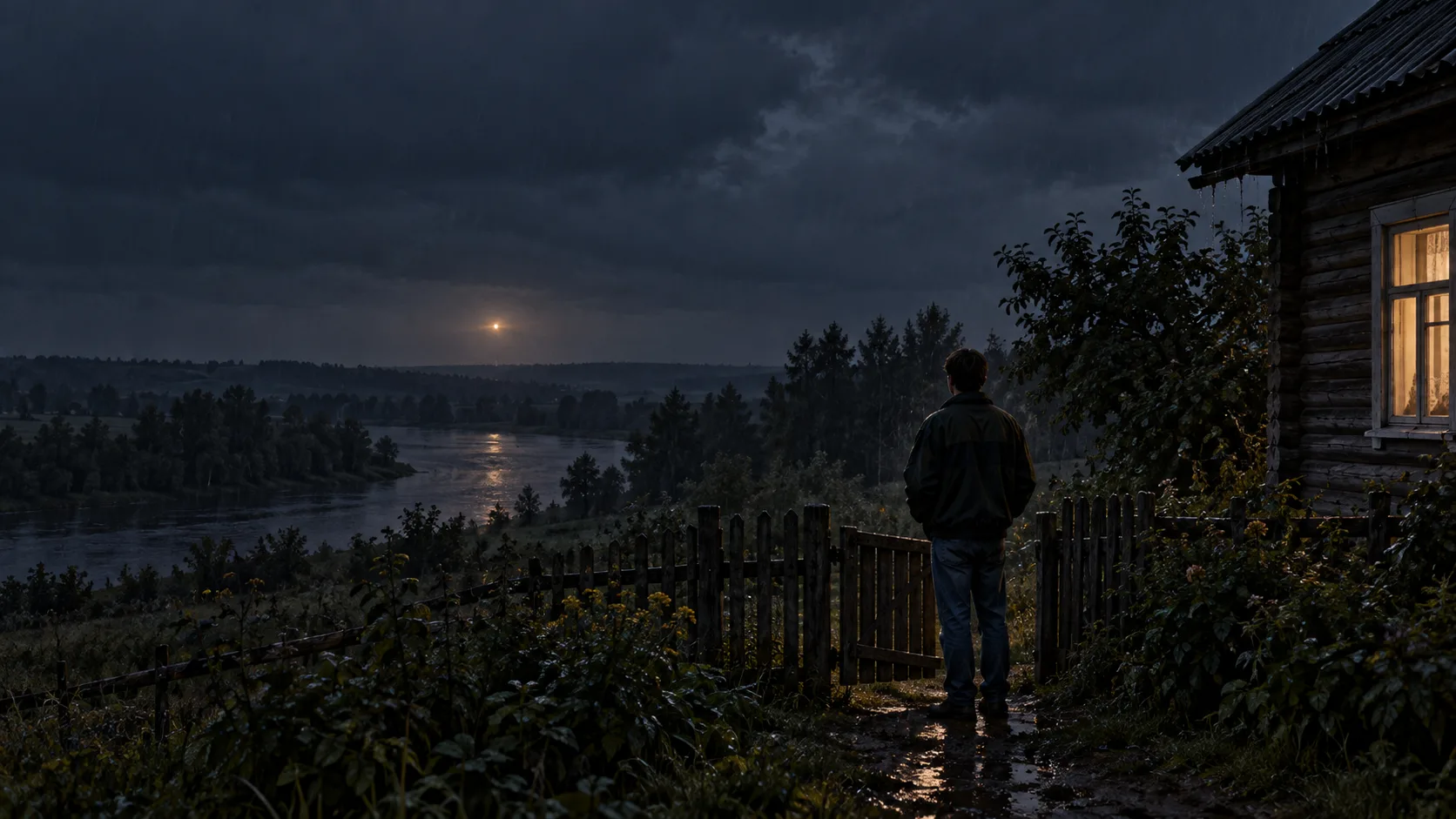
A moment earlier, he had caught a glint to his left while opening the gate. He turned towards it and saw nothing. One step backwards gave him a clear view: a brilliant point above the dark horizon, steady beneath a sky that had been clouded and rainy all day. When he moved again, it disappeared.
This is how Ilyin described the beginning of an evening in the village of Rozhdestvo, Tver Oblast, in late August 1992. His story survives in a letter dated April 9, 2001—almost nine years after he and four other physics students reportedly spent the night trying to understand what they saw.
Beside the river
The students had gone to stay with a classmate in Rozhdestvo. Ilyin placed the village near the point where the Granichnaya joins the Shlina. An independent river-route guide also places Rozhdestvo on the Granichnaya and describes its meeting with the larger Shlina downstream. The guide establishes the setting, not the sighting.
According to Ilyin, their house stood close to the water, though a low fence and gate separated the garden from it. Around ten or eleven at night he went out for water. Rain had fallen lightly but continuously. The sky was thick with cloud. He did not give a precise calendar date; in 2001 he could place the visit only around August 20–25.
The bright point seemed to be towards the south or southwest, about twenty degrees above the horizon by his first estimate. At a glance, he thought of Venus. Then he looked at the cloud cover and the falling rain. No other stars were visible. He could not make that first identification fit what he thought he was seeing.
The position at the gate troubled him more than its brightness. A light that remains in the sky should normally remain visible when an observer takes a small step. This one, he said, could vanish with that step and return when he found the previous position. The garden gate had become a reference mark for a very particular view.
Five students in the rain
Ilyin went back for his companions. In his letter he described five witnesses in all, students who had studied physics together. We have their presence through his account; none of the other four left a separate statement in the sources located for this article.
For roughly an hour and a half, he said, they tested the light from the garden. It did not appear to shift across the sky. They moved themselves instead. Ilyin reported that a sideways movement of only 25 or 30 centimetres could make the point go from Venus-like brilliance to invisibility. Returning to the narrow viewing position brought it back.
He called the visible region a beam, estimating its width at about half a metre. That was an inference from where their eyes could and could not see the light, not a diameter measured at the source. They could see a bright point along a narrow line; he did not describe a luminous shaft traced across the entire garden.
One test used cigarette smoke. If a beam crossed the rain and smoke, perhaps its outline would show from the side. Ilyin said it did not. He also found no halo of scattered light in the drizzle, though he expected one from an ordinary lamp shining through rain or mist. The point appeared startlingly bright when he looked along the right line, yet offered little visible clue to its route through the air.
The students tried changing their distance as well as their angle. Ilyin wrote that after walking three or four metres towards the direction of the light, he had to look higher—and eventually jump—to catch it again. From a fixed source, a changing position can change the angle of sight. What unsettled him was how sharply the brightness seemed to depend on where his head was.
The walk they postponed
His estimates began to pull against one another. If the low cloud base was only 300–500 metres up, he reasoned, the source might be below it. Taking a height of 500 metres and an elevation angle of fifteen degrees, he put it within roughly two kilometres. Those numbers rested on a cloud height he had only guessed and an angle he had not measured; they were attempts to make sense of the scene, not surveyed coordinates.
They considered going towards it, across the river and into the forest. Ilyin said they left that search until morning. Without a compass, in rain and darkness, they feared losing their way when the narrow light itself vanished from view. The group stayed where it could continue the position tests.
Nothing in his account describes a sudden departure. They remained wet, thinking of ways to learn more, until the observation ended. By the next morning, he wrote, there was nothing unusual to see. Years later, he still considered an unexpectedly close source possible—perhaps only 30 or 40 metres away. The distance had never been fixed.
What Is Known
The detailed record is Ilyin’s letter in the Kosmopoisk compilation, labelled as recorded on April 9, 2001. It identifies him by name and gives his remembered location, approximate date, weather, companions and improvised tests. It is a first-person account written years after the reported August 1992 evening. It does not supply a photograph, a contemporaneous diary, instrumental readings or the other students’ own statements.
Alexander Nikonov’s “Rozhdestvensky Paradox” reproduces Ilyin’s testimony with minor editorial wording. It makes the account easier to find, but does not add an independent witness. The river-route guide confirms that Rozhdestvo and the two rivers are real features of the landscape; it offers no evidence about the light.
Ilyin’s changes of position are the most distinctive part of the testimony. His conclusions about a half-metre beam, the source’s altitude and its distance depend on estimates made at night without surveying equipment. A point disappearing from one viewpoint does not, by itself, establish that a physical beam ended there or identify what produced the light.
The Bigger Picture
Many night-sky reports are built around apparent motion. This one is built around the observer’s motion. Ilyin said the point stayed in place for about ninety minutes while a step at the gate—or a small shift of the head—changed whether he could see it at all. That is why the garden, rather than the distant horizon, became the scene of the investigation.
The record preserves an honest tension in his own reasoning. He first considered Venus, then rejected it because of the overcast sky. He treated the sharp positional effect as evidence of a narrow beam, yet ended his letter wondering whether the source might have been nearby. Those possibilities are not equivalent, and the available account cannot choose among them. What it can preserve is the sequence of an observation: a glint at the gate, a step back, five students testing their positions in rain, and a light gone by morning.
Sources
- Ilya Ilyin’s letter in the Kosmopoisk archive, recorded April 9, 2001. First-person retrospective account of the reported August 1992 observation. Search the compilation for “Граничная” or “Ильи Александровича ИЛЬИНА.”
- Alexander Nikonov, “Rozhdestvensky Paradox,” in Beyond Reality. Later book reproduction of the same testimony, with minor editorial changes; not independent corroboration.
- “Granichnaya and Shlina,” river-route guide hosted by Lib.ru. Independent geographical context for the village and rivers; no sighting claim.