The officers left Charles Hickson and Calvin Parker alone in the room. The tape recorder kept running.
Parker wanted to go home, get something for his nerves, or see a doctor. Hickson tried to calm him. They talked again about being unable to move and about the opening of the thing they said had come down beside the river. Then Hickson went out. Parker remained for a moment, speaking and praying to himself.
Their conversation became the most unusual surviving record of an already extraordinary report. The sheriff’s recording captured the men within hours of the event they described, while they believed their formal questioning was over.
Earlier that evening, the two had only gone fishing.
After work
Hickson and Parker worked at F. B. Walker & Sons Shipyard on the Mississippi coast. Hickson was the older man, a foreman who had helped the younger Parker get a job. Parker had recently arrived in the area. In a 2018 interview with the Sun Herald, he remembered the fishing trip as following his first day at the shipyard.
The two later differed about their first stop. In the interview recorded at the sheriff’s office that night, Hickson said they fished below a grain elevator before moving to an old shipyard pier where he had caught fish before. Parker later remembered going directly to that pier. Both placed the reported encounter beside the Pascagoula River near the former Shaupeter yard. Both had cast their lines there when the night changed.
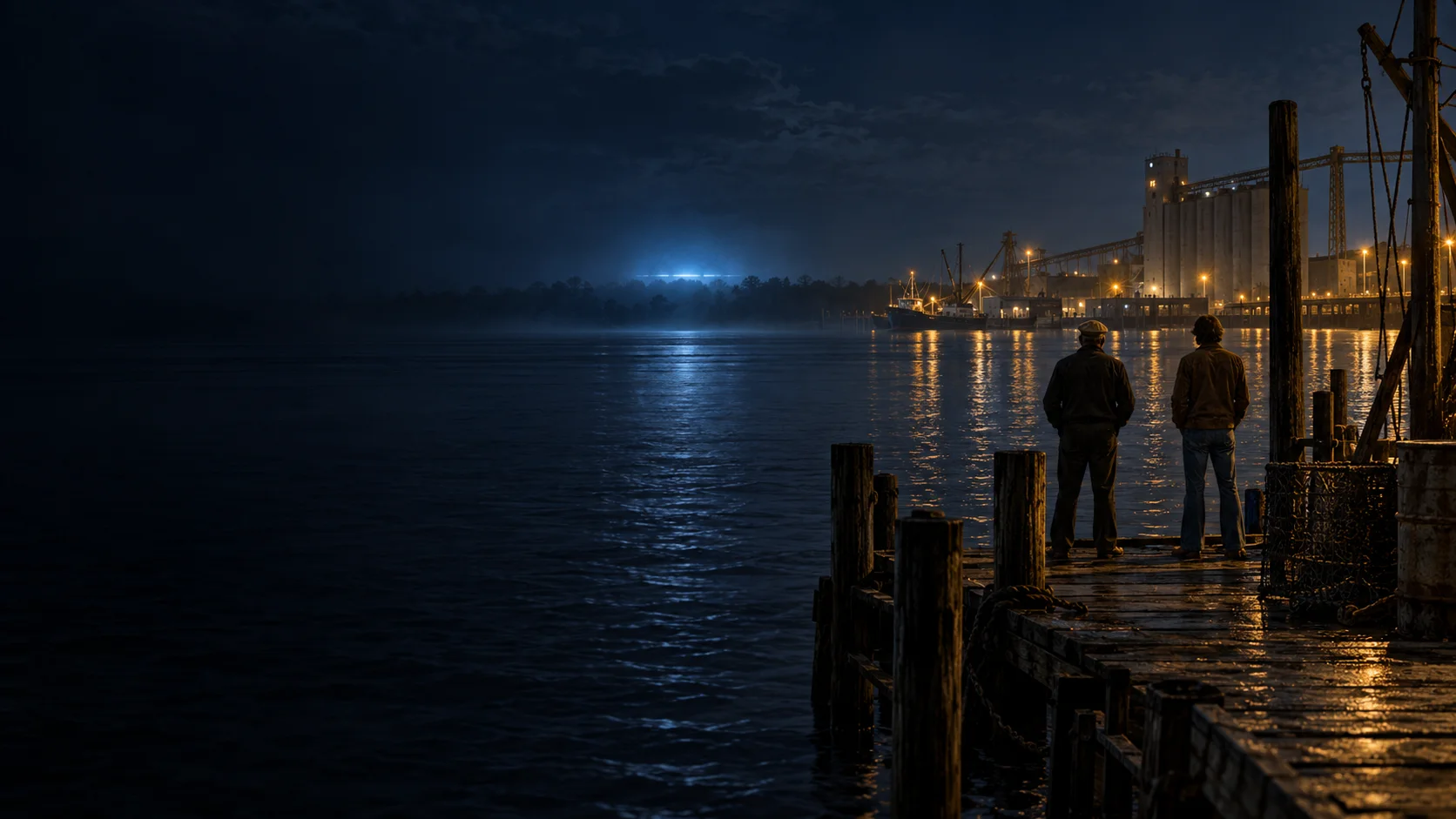
The old working waterfront was not a secluded wilderness. The river ran between industrial sites, bridges and passing traffic. But the men were on a pier, facing the water, when Hickson said they noticed a blue light. He told the sheriff it had moved in the sky and then descended close to them. He could not judge its first height precisely. As it came down, he said, it made a low buzzing sound.
Parker, recalling the moment decades later, remembered turning towards a hazy blue light and first thinking it might be police near their car. He described the light reflected across the water. Those details come from his 2021 interview, not from a separate written statement made on the pier. What belongs to the earliest record is the simple, disturbing sequence: the men reported a light, a sound, and an object hovering near where they stood.
The opening
Hickson described the object to the sheriff as oblong and roughly eight feet high. It did not land, he said. A blue light showed outside; the interior seemed brightly illuminated without visible bulbs. He remembered an opening appearing at one end and three figures coming out.
In his account, the figures moved without an ordinary walking motion. Two reached him; another went to Parker. Hickson said they had gripping appendages instead of hands and made a faint buzzing or mumbling sound. He struggled to supply familiar comparisons for their bodies and faces. When the sheriff asked about their eyes, hair and colour, Hickson repeatedly answered that he did not know. The first account contains fear and blank spaces as well as precise images.
He said the figures lifted him and carried him inside. He could not resist or move freely. A device he compared to a large eye travelled over his body while he remained suspended. He could not say how much time passed; he had no watch. He recalled trying to speak and receiving only another buzzing sound. His description of the craft’s interior gave the police almost nothing to map: light, space, the figures, and the moving instrument.
The November 1973 UFO Investigator report gave much the same early outline. Its authors wrote that Hickson believed Parker had gone limp and fainted before reaching the object. In the sheriff’s interview, Hickson said Parker had passed out. Parker himself said something similar while talking to Hickson after the officers left the room.
That does not make Parker a second detailed witness to everything Hickson described inside. Years later Parker gave a fuller account of what he believed he experienced there. The difference in when those details entered the record is part of the story, as consequential as the differences between their memories of where the fishing began.
Back on the bank
Hickson said the figures returned him to the riverbank. He remembered seeing Parker standing there, frightened and difficult to settle. Then, he told the officers, the buzzing sounded again and the object was gone. The men were left with one another and a decision about what to say.
At first, according to Hickson’s recorded account, he told Parker that nobody would believe them and they should keep it to themselves. His next actions moved in the other direction. He said he went to the Mississippi Press office looking for a reporter, but none was available until morning. He also described calling Keesler Air Force Base and being directed to the sheriff. The two men eventually reached the Jackson County Sheriff’s Office late that night.
When a deputy asked why he had waited to call, Hickson spoke openly about his fear of ridicule. The officers asked whether he had been drinking. He said he had taken alcohol only after the river encounter, while trying to steady himself.
Former sheriff’s captain Glenn Ryder, who took Hickson’s call, told the Sun Herald in 2018 that the report had come in around 11 p.m. Ryder and Sheriff Fred Diamond questioned the men. The earliest recorded interview is dominated by Hickson’s voice, his attempt to describe the object and the figures, and the officers’ efforts to pin down distances, appearances and times.
There is an ordinary procedural rhythm to those questions. How close was it? Did it make noise? What did its occupants look like? How long were you inside? Each question called for a measurement Hickson often could not give. He returned instead to what he said he had seen, how little he understood, and how unlikely he thought anyone was to believe him.
The recorder
After the questioning, Diamond and Ryder left the men together. The recorder remained on. An excerpt of that recording, published by Ralph and Judy Blum in 1974, follows their conversation from that point. It is an edited published passage rather than an official word-for-word transcript of the entire session; a copy of the audio is also available.
Parker sounded overwhelmed. He wanted medical help and said he could not sleep. Hickson promised to find something that would help him settle. They spoke about Parker’s arms becoming rigid and about his apparent loss of consciousness. Parker remembered the opening of the object. Hickson said he did not know how it opened. Again and again, the conversation returned to the difficulty of making anybody else understand.
They were still discussing the reported encounter after they thought the interview had ended. Parker remained frightened. Their words kept bringing them back to the river, even in a room far from it.
When Hickson left the room, Parker’s voice continued. He spoke briefly alone. The river story had reached a place where it could be replayed, but the person least eager to speak publicly was left with the recorder for a moment longer.
The next days
The story did not stay inside the sheriff’s office. The Sun Herald’s later reconstruction, based in part on interviews with Ryder and Parker, says the Pascagoula newspaper reported the men’s account the following morning and wire services carried it nationally. Reporters soon sought both men. The call they had made to explain a frightening experience became a public story neither could control.
Investigators came as well. J. Allen Hynek and James Harder interviewed them within days. The contemporary NICAP bulletin reported that Parker was later hospitalized for a nervous condition and that Hickson took a polygraph examination at the end of October. It framed the result narrowly: Hickson appeared to believe what he reported. The same bulletin listed several possible explanations and did not claim the test had established that a craft was present.
Their public lives then took different courses. Hickson spoke about the experience repeatedly. In a 1979 oral history held by the University of Southern Mississippi, he described both the event and the public appearances that followed. Parker withdrew from much of that attention. When a reporter interviewed him in 2018 and again in 2021, he described how the story had followed him through jobs and family life.
Parker also gave a fuller description of his own experience inside the object. In 2018 he told the Sun Herald that he and Hickson had agreed to say he passed out because he did not want to explain what he remembered. That later explanation cannot be moved back into the tape as though he had said it in 1973. It does, however, show why the same night’s account and his much later testimony need to be read alongside one another, with their dates intact.
The two men never returned to an anonymous fishing trip. For Hickson, the story became something to tell. For Parker, it was also something he spent years trying not to tell. The recorder caught them before either future had taken shape.
What Is Known
Hickson and Parker reported the encounter to the Jackson County Sheriff’s Office on October 11, 1973. The recorded interview is a near-contemporary source for what they said and how they sounded that night. The Blums’ 1974 excerpt makes much of the exchange readable, but selects and narrates portions of the tape; it is not a certified complete police transcript. The November 1973 NICAP report establishes how civilian investigators summarized the case within weeks, including the early claim that Parker fainted and the follow-up interviews and tests they reported.
Those records support a clear sequence: a fishing trip, a reported blue light and hovering object, a same-night approach to the sheriff, questioning, and a recorded private conversation. They do not independently show an object on the riverbank or identify what caused the men’s experience. In Ryder’s 2018 account, he checked the site and found nothing. The same reporting says tenders on nearby bridges did not corroborate the reported encounter. Their lack of a sighting does not establish where the men were looking or what they experienced; it limits claims of independent observation.
Later sources must be dated. The university’s 1979 Hickson oral-history record documents a later firsthand account and its aftermath, while Parker’s 2018 and 2021 interviews add details he did not give in the same-night excerpt. The tape is unusually close to the report, and the later testimony is valuable for understanding its effect on the men. Neither can turn the other into an independent observation of the claimed craft.
The Bigger Picture
The sheriff’s office was receiving a UFO claim after the Air Force had ended Project Blue Book. The National Archives’ history dates that closure to 1969. Hickson said he had tried calling an Air Force base and was sent to local authorities. The report therefore entered public life through a county interview room, then a newspaper, rather than through a continuing federal UFO investigation.
The response spread through Pascagoula almost at once. University of Southern Mississippi Special Collections preserves a locally recorded sermon from October 14, only three days after the reported encounter, using the story to address what an alien visitation might mean. That recording is evidence of how quickly the account became part of the community’s conversation. It is a different kind of record from the sheriff’s tape: one captures the men trying to describe a night; the other captures a town beginning to interpret it.
The case has endured partly because both kinds of record survive. The most intimate sound is still the one made when the officers stepped out and the recorder stayed on. What it gives us is not a picture of the river, but two people still trying to live with what they had just told the police.
Sources
- Contemporary recorded account: Jackson County Sheriff’s Office interview and subsequent conversation, October 11, 1973, audio copy in a later collection of case recordings.
- Edited transcript of contemporary recording: Ralph and Judy Blum, excerpt published in Beyond Earth: Man’s Contact with UFOs (1974), reproduced by NICAP; the authors say they listened to and recorded the sheriff’s tape.
- Contemporary civilian investigation report: National Investigations Committee on Aerial Phenomena, UFO Investigator, November 1973, p. 2, digitized by the J. Allen Hynek Center for UFO Studies.
- Later firsthand account, institutional collection note: University of Southern Mississippi Special Collections, Hickson oral history recorded in 1979; the collection note summarizes the interview rather than reproducing its full transcript.
- Independent later interviews: Karen Nelson, Biloxi Sun Herald, October 11, 2018, including interviews with Parker and former sheriff’s captain Glenn Ryder; Alexandra Kennon Shahin, Country Roads, September 21, 2021, interview with Parker.
- Independent institutional context: University of Southern Mississippi Special Collections, account of contemporary local response; U.S. National Archives, Project Blue Book reference report.