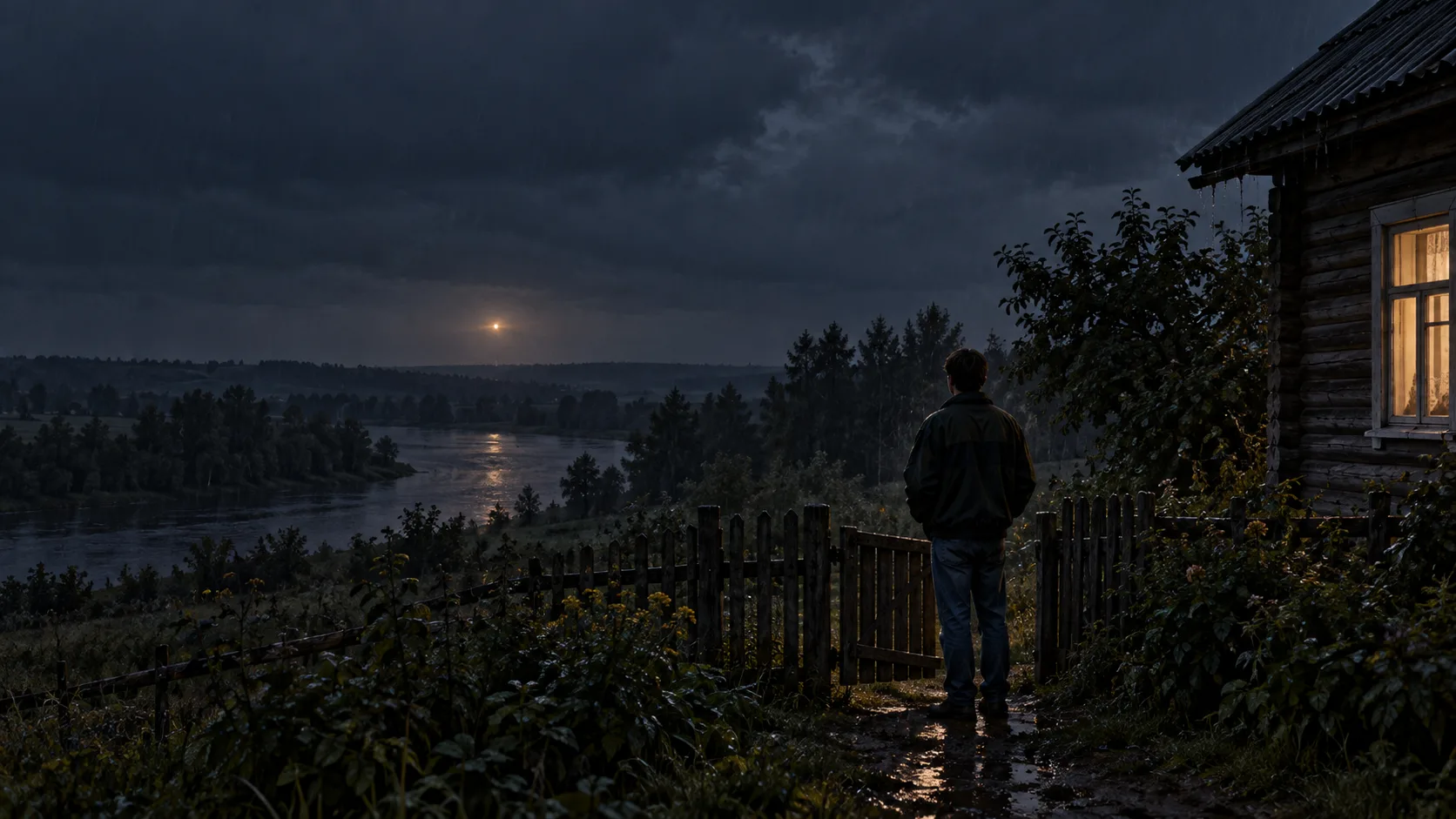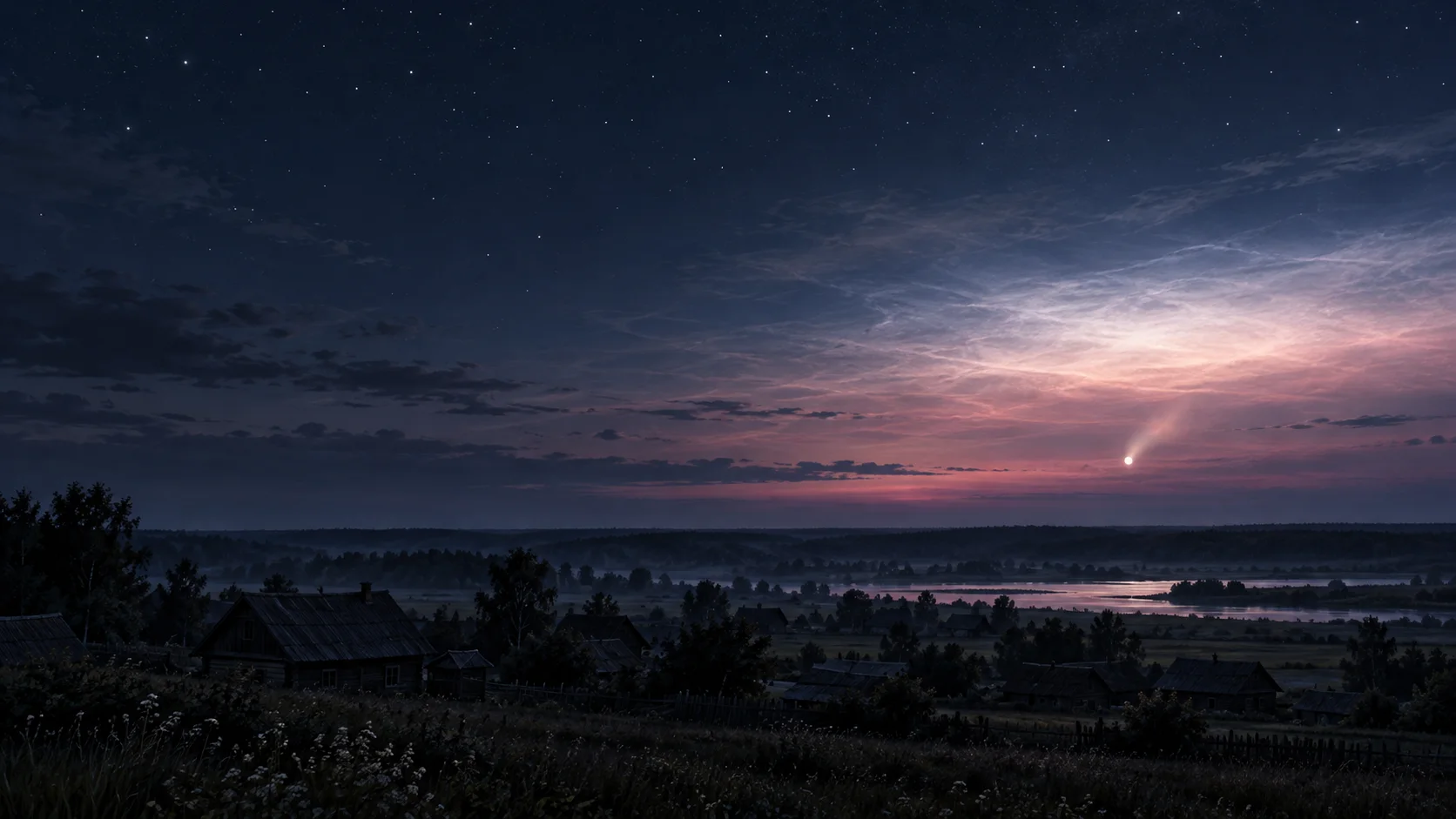
About ten minutes before midnight, a silver-pink glow spread across the northern sky above the village of Gorki.
Then a bright little shape appeared low over the horizon. It looked like mercury, the local newspaper account said: a small shining sphere against an illuminated area that seemed to fill a third of the sky. As the light travelled slowly, a cone-shaped trail followed it—or perhaps streamed out from it. The observer could not tell which.
The account places this scene on the night of August 3–4 in what was then the Vyshny Volochyok district of the Tver region. It does not give a year. The strange sequence is preserved in a 2014 reader post reproducing the words of an older newspaper clipping; the original issue has not been located.
The light above Gorki
The glow came first. The small object seemed to emerge from it, leaving the witnesses with two things to watch: a broad, coloured part of the sky and a concentrated point moving across it. From where they stood, the point looked no bigger than an apple. That was its apparent size at a distance, not a measurement of the thing itself.
The clipping compares the pale, tapering trail to the condensation left by a jet. It says the object moved slowly towards the observers. Then its appearance changed. Several bright rays spread out around it, like searchlights pointed in different directions. The account says they did not shine down onto the ground at Gorki. In Tver, the writer added, people said light reached downwards too.
For roughly three minutes, the rays moved. The small object disappeared, but the glow remained. The newspaper said it was still visible until morning. The first sight in the sky was thus also the last: after the travelling light and its rays were gone, the wide silver-pink area was what the witnesses could continue to see.
The clipping gives no named Gorki witness, exact viewing position or direct quotation from someone standing there. Its close description is compelling, but the route from observer to reporter is invisible. We know what the newspaper printed, not precisely who supplied each part of the account.
A week earlier at Bokarevo
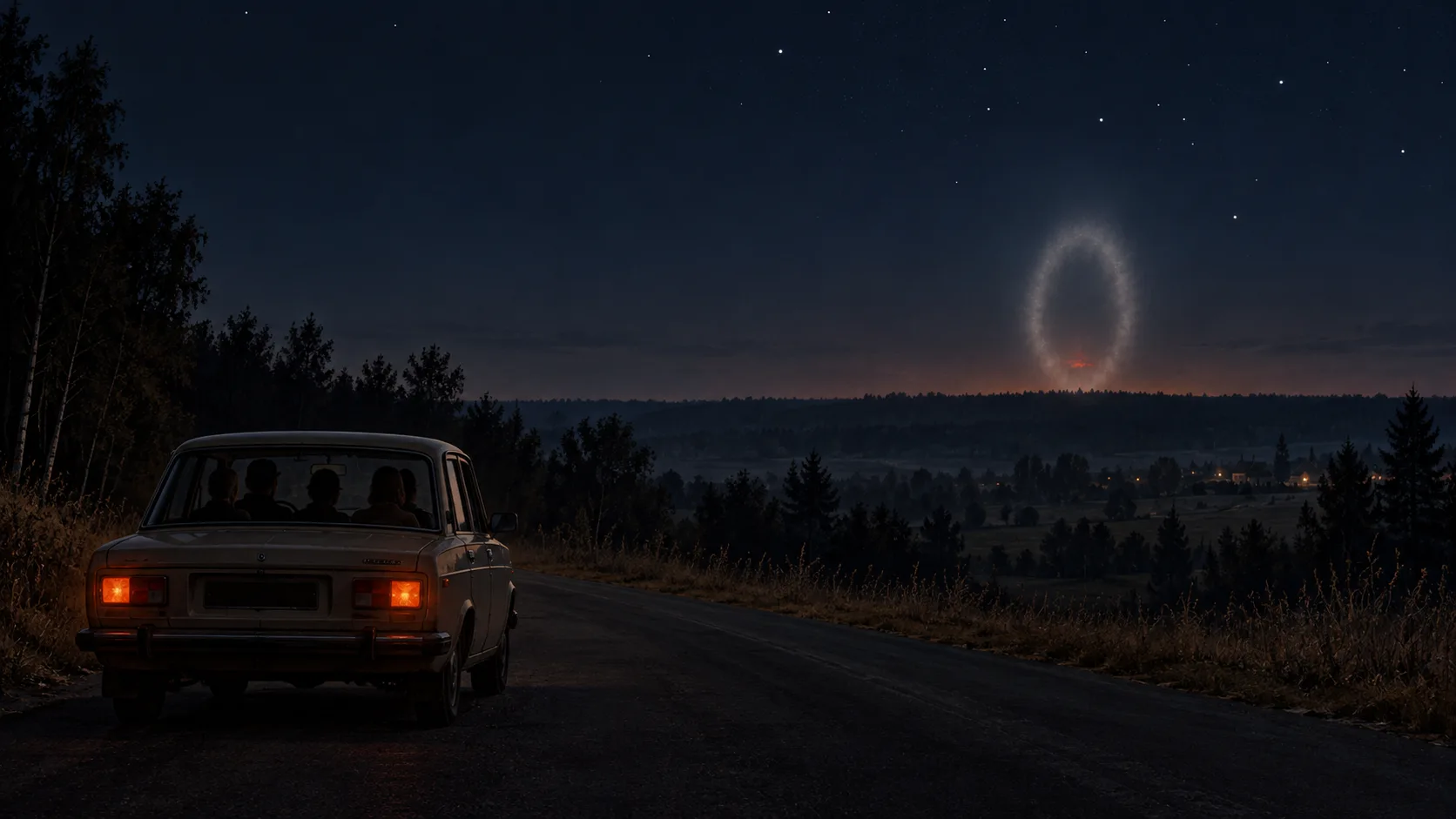
The writer turned from Gorki to a second summer night. Near Bokarevo, in the Kesova Gora district, three drillers reportedly watched a fast white sphere shortly before midnight on July 28–29. The clipping calls this “exactly a week” earlier, though July 28 to August 3 is six days.
This light behaved differently in the telling. It crossed the sky high and quickly, repeatedly seeming to stretch from a sphere into an ellipse. When it reached a point directly above the men, they said, it stopped. The newspaper described their impression of impulses coming towards them from the object. After a short interval, it looked round again and resumed its course until it disappeared over the horizon.
Unlike the Gorki report, the Bokarevo passage places a small group of witnesses beneath the light. It gives their occupation but not their names, their worksite or separate statements. The sensation of “impulses” is part of the newspaper’s report of what they felt; nothing in the accessible text tells us whether it was light, sound or another physical effect.
The same article says villagers remembered two earlier appearances near Bokarevo, one about a year before and another a month after it. The latter was said to have left dents in the ground. Those claims are even further from a dated, direct account. The three drillers’ reported sighting belongs to one night; the older village stories show how it was being linked to an existing local pattern.
Tver joins the story
The writer said the August glow and object had also been seen in Tver. A separate article in Tverskaya Zhizn supposedly described what city witnesses saw, including a broad horizontal shape with a tail and an apparent display of lights. The clipping offers its own lively summary, but the cited Tverskaya Zhizn issue has not been found. Its city account cannot yet be checked against the village account.
It also includes an interview with V. S. Yakovlev, identified as the director of a district cultural centre. His sighting was three months earlier, not one of the two midnight events. He recalled shouts from outside at about ten in the evening, windows lighting up, and an arc-shaped form against a grey twilight sky. He said it seemed to turn over without travelling, accompanied by crossing rays and bright lights, before moving towards the centre of Tver about ten minutes later.
The clipping drew these separate reports into a story of repeated visitors. The scenes remain distinct: a long-lasting glow over Gorki, a quick sphere above workers near Bokarevo, and Yakovlev’s earlier arc over the city. The connection between them belongs to the newspaper’s interpretation.
What Is Known
On November 4, 2014, a Tver News reader said they had kept a clipping from Leninskoye Znamya. The post reproduces “And They Fly Wherever They Like” without a dated scan or issue number. This single transcription is the source for all three places.
The clipping gives July 28–29 and August 3–4 without a year. It refers to Tverskaya Zhizn, which the Tver regional library says bore its former name, Kalininskaya Pravda, until July 24, 1990. If faithfully transcribed, the clipping postdates that change. The 2014 poster’s loose reference to “thirty years ago” does not resolve the conflict. The library lists Leninskoye Znamya, but not this article’s issue date. The year remains unconfirmed.
The original Leninskoye Znamya page, cited Tverskaya Zhizn report and direct witness statements were not located. The alleged ground dents have no dated inspection record here.
The Bigger Picture
The writer drew a city report from another paper together with the Gorki night, the Bokarevo drillers, older village memories and Yakovlev’s interview. Each addition widened the apparent pattern while changing whose words the reader heard.
The surviving text is most vivid at Gorki, where the broad glow outlasted the bright point that seemed to emerge from it. Yet the missing issue date is a real limit: without it, the two nights cannot be placed securely on a calendar or compared with contemporary sky, weather and flight records. For now, the enduring image is the one the clipping left behind: a northern sky still glowing after its small moving light was gone.
Sources
- Leninskoye Znamya, “А они себе летают, где хотят,” undated text reposted by a reader on Tver News, November 4, 2014. Sole accessible narrative source for the Gorki, Bokarevo and Yakovlev reports; the original issue was not recovered.
- Tver Regional Universal Scientific Library, Tverskaya Zhizn catalogue entry. Independent record of the paper’s earlier name and July 24, 1990 renaming.
- Tver Regional Universal Scientific Library, Leninskoye Znamya catalogue entry. Independent newspaper history; it does not date the UFO clipping.