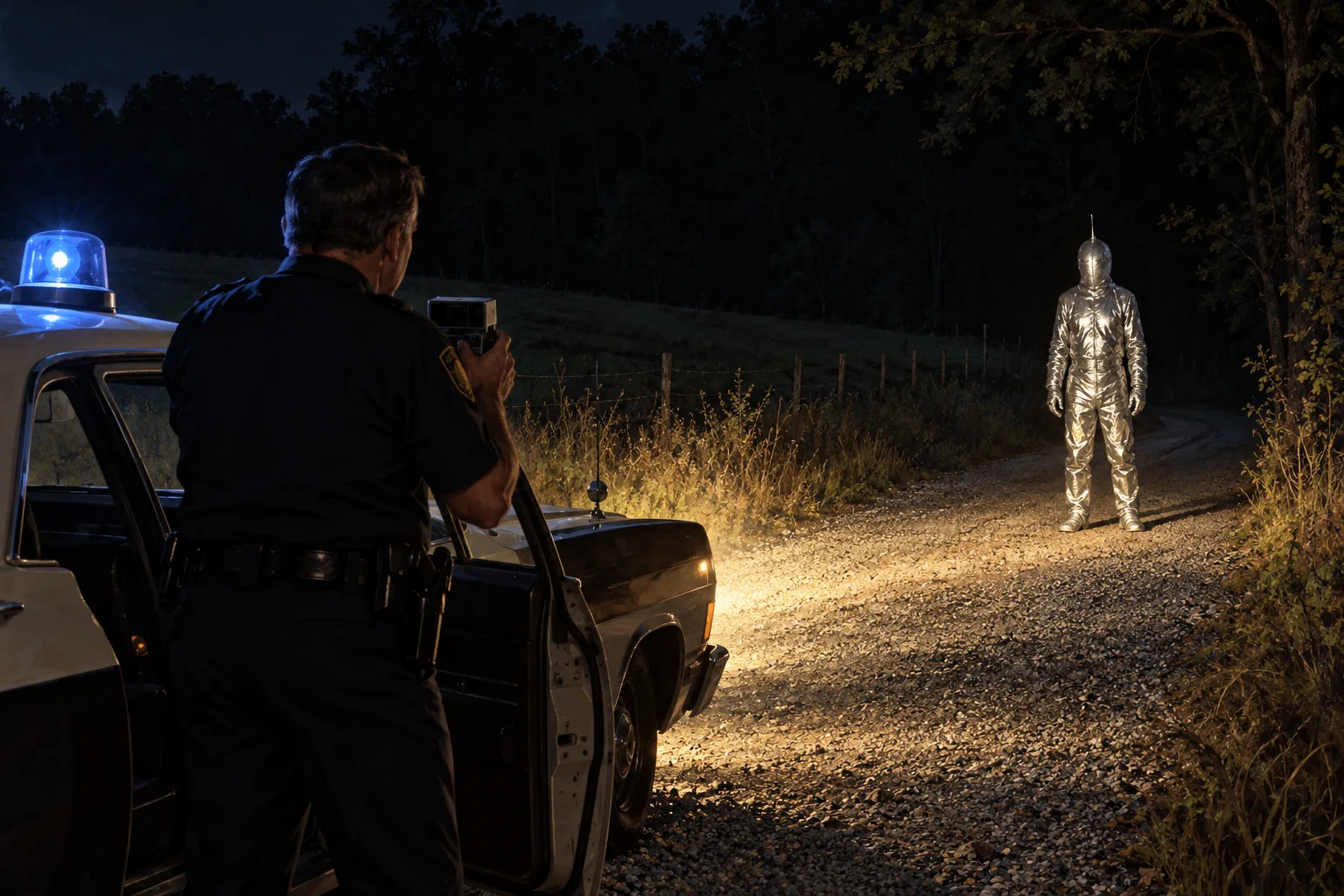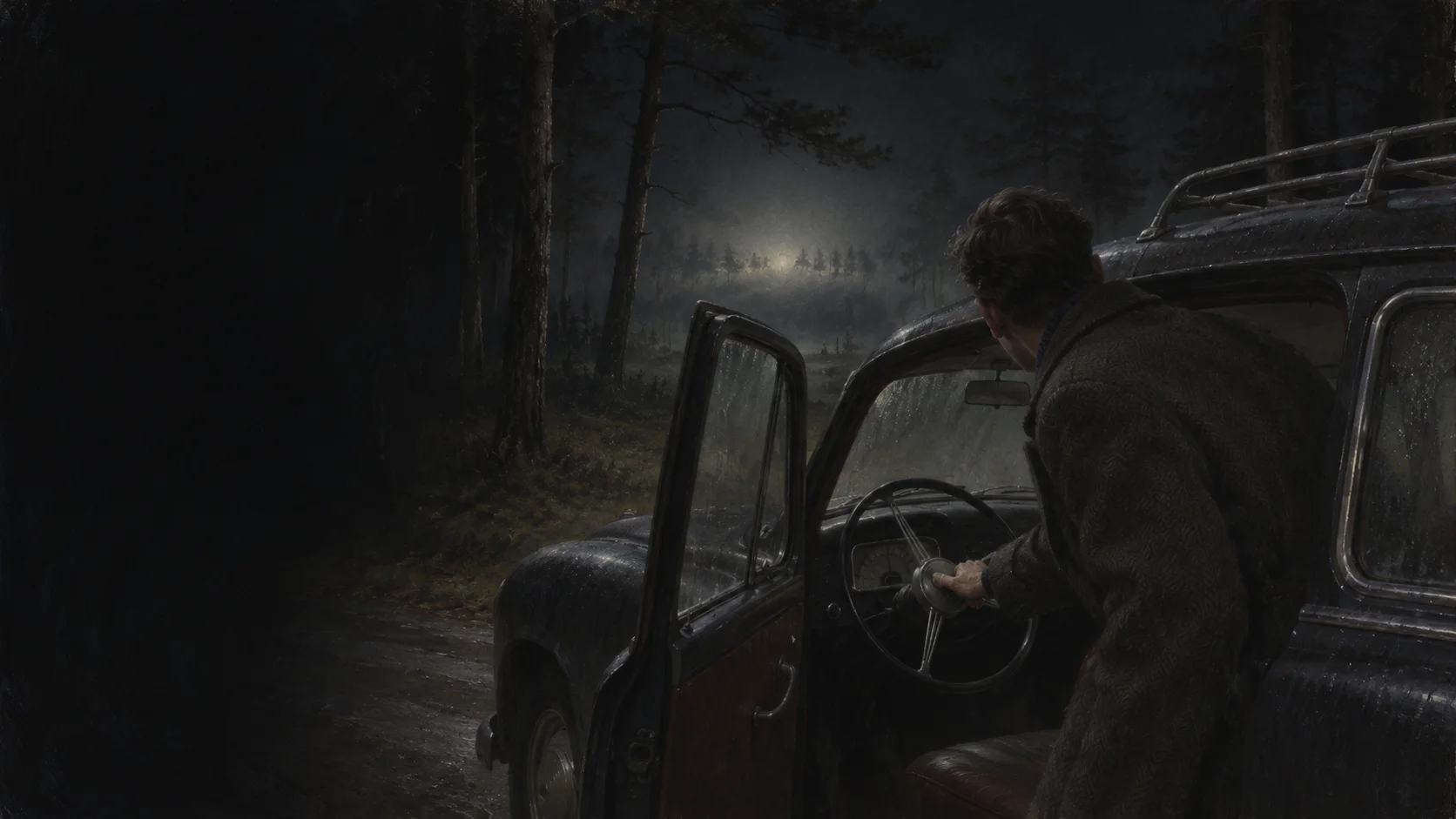
Stig Rydberg said that when he reached the car, Hans Gustafsson was still holding on to the post. He could see him through the windscreen, stretched out almost horizontally as the figures pulled at him. Rydberg put his hand on the horn and pressed.
In the version published by the American Aerial Phenomena Research Organization, the figures let go at the sound. Gustafsson dropped. Rydberg went back for him and saw the light from the clearing intensify as the object rose. He thought it went straight up. Gustafsson thought it curved away over the water.
By the time readers in the United States encountered that account, there had already been two versions in the local paper. In the first, the men had stopped beside the road and seen something in the trees. The struggle, the post and the horn came later.
A mark in the sand
The road from Höganäs to Helsingborg runs along the Swedish side of the Øresund. The two men said they had been driving back towards Helsingborg when they stopped near Domsten. They noticed a light off to the right, in an opening among the pines. In the account that travelled to America, they first took it for some activity of the fire brigade and got out to have a look.
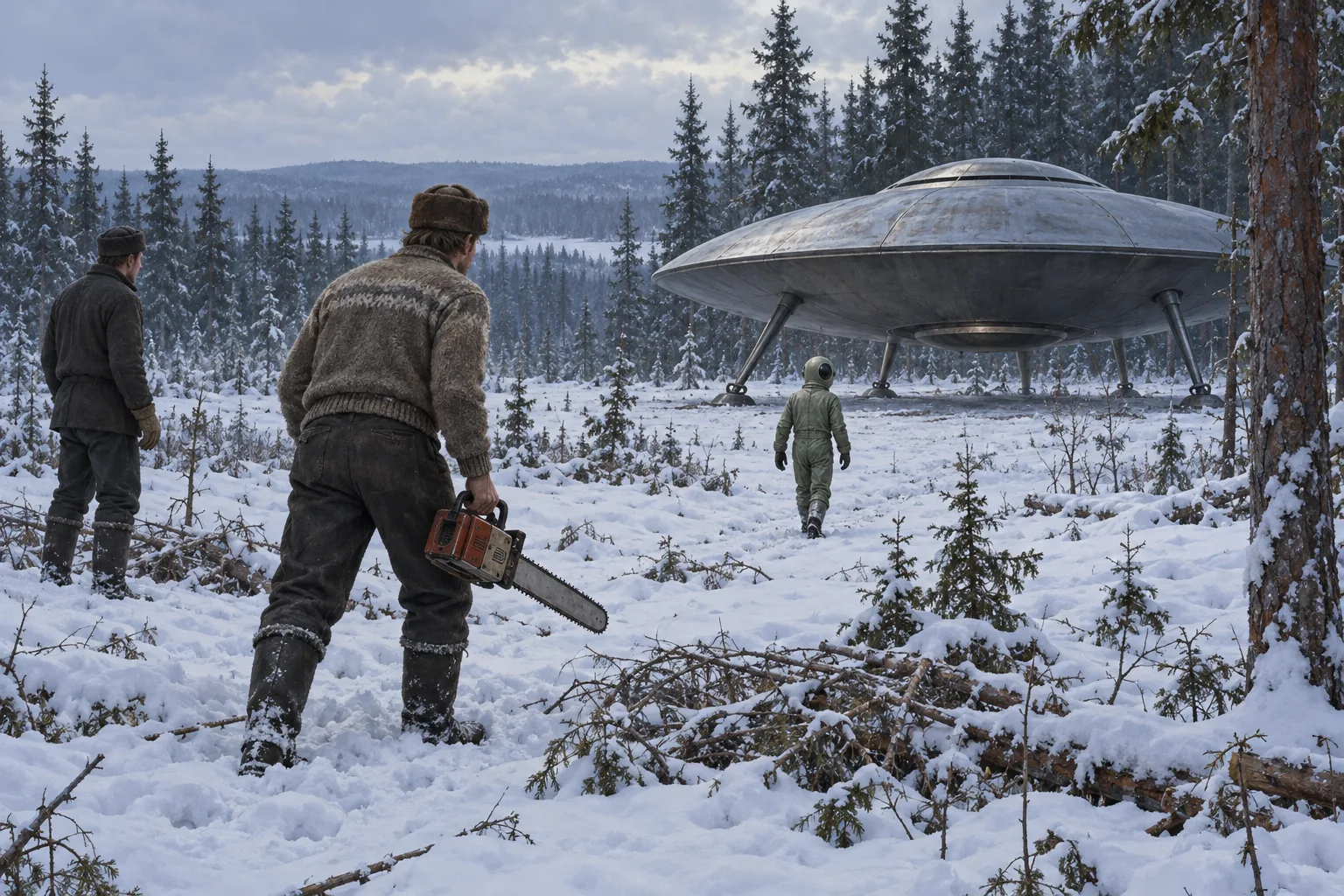
They described a disc about five metres across, standing on three supports. Small figures moved near it. Their shapes were difficult to put into ordinary terms. The men compared them to elongated loaves and spoke of their lead-grey colour. As they told it at first, the light rose and disappeared.
On December 30, the men took the story to Helsingborgs Dagblad. Reporter Kjell Lüsch went out to the clearing with a photographer. The men pointed to a faint mark in the sand where they said one of the supports had rested. The newspaper ran the story the next day, and the two men spoke on Swedish radio that evening. The case had a place that readers could go and see, and a trace they could try to find for themselves.
The first article dated the encounter loosely to about two weeks earlier, according to the later AFU reconstruction. One proposed explanation was a Polish freighter, the Morska Wola, that had run aground nearby. Lights from the ship had been visible from shore. The men later supplied December 20 as the date. By then, the freighter had already been freed.
On January 2, the paper printed the struggle. Gustafsson and Rydberg now said the figures had tried to pull them towards the disc. When Rydberg got loose and ran to the car, Gustafsson held on to a roadside signpost. The horn freed him. The account grew more specific about the noise the object made as it rose, the smell it left behind and the time the two men said they sat in the car before they could drive on.
Back to the clearing
On January 9, a team from the Defence Staff came down from Stockholm and worked with local security police. Captain Lennart Bunke, psychologist Michael Wachter and technical specialist Sture Risberg were among those looking for an explanation. In the reconstruction published by Clas Svahn and Anders Liljegren, the team went out to the clearing twice that day. One visit was late enough to try the scene in darkness.
The post gave them something to test. They questioned whether it could take the strain the men had described. Rydberg had also said the object cast little or no light on its surroundings. The investigators pressed him on how he had seen Gustafsson at the post from the car. In the published reconstruction, his account changed under questioning. The men held to the main story.
During a break, the investigators left the two men alone with a tape recorder running. The conversation on the tape gave them nothing that broke the story. The translated findings later printed in the APRO Bulletin questioned both men’s reliability and allowed for outright invention, while also considering whether one had come to believe an experience and influenced the other.
Two Helsingborg doctors, Lars-Erik Essén and Wilhelm Hellsten, tried a different approach two days later. They used a form of hypnosis to question the men. Lüsch waited outside, according to a later account by journalist Torbjörn Wester. The doctors came out willing to credit the men with an unusual experience, though the AFU investigators found that they had reservations about what the figures were supposed to be. The two inquiries had put the men through very different kinds of questioning. Both men kept telling the story.
Tickets at the door
In Landskrona, a fourteen-year-old named Christian Johansen sold tickets at the Folkets Hus for a talk by Rydberg and Gustafsson. Johansen knew Gustafsson from the village of Brödåkra, where they had lived as neighbours. By the time he took money at the door, he had heard a version of the story that the audience inside had never heard.
Many years later he told Wester about an earlier conversation. Gustafsson had approached him with a proposal to make money from a story about flying saucers. Johansen understood it to be something they would invent and turned him down. When the two men eventually pointed out a mark in the sand to the newspaper, Johansen recalled Gustafsson telling him they had already been out there disturbing the ground. For the moment, he kept what he knew to himself.
Meanwhile K. Gösta Rehn, APRO’s Swedish correspondent, collected reports from a number of Swedish publications and translated them for the American bulletin. The January issue gave the story’s readers the roadside account and the argument over the men’s credibility together. Rehn kept in touch with the pair. At a later appearance in Copenhagen, the men offered a second story about a saucer.
This time, they said a stranger had taken them out onto the Øresund in a small boat. A craft descended and took them aboard, where they encountered people very different from the figures said to have grabbed them at Domsten. When Rehn questioned the men separately in Copenhagen, the AFU investigators found, their accounts of that trip diverged. Rehn still stood by the first encounter. It went on appearing in books, including APRO editor Coral Lorenzen’s 1962 The Great Flying Saucer Hoax.
The same newspaper
By the time Svahn and Liljegren took up the story in the late 1980s, both men were dead. The investigators worked through old newspapers and correspondence and sought out people who had known them. They checked the claimed weather against records from three stations. Fog appeared on nearby dates. On the morning of December 20, the stations recorded rain and no fog, according to their comparison.
Gustafsson’s brother Artur told them about a conversation in 1960. Hans had said the story was made up. He told Artur that a bottle had been used to make marks in the ground and that he wanted to tell a newspaper. He died before giving that account publicly.
On April 15, 1989, Helsingborgs Dagblad reported on Svahn and Liljegren’s new study. Two days later the paper ran a photograph of Johansen holding that edition. He and his mother, Martha Christiansson, said they had known the story was invented and had promised to keep quiet. Johansen remembered taking money for the talks. He could now tell the same newspaper that had sent a reporter to the clearing what he had known when he stood at the door in Landskrona.
What Is Known
The December 31 article is identified in the later reporting, and the April 1989 follow-up quotes its headline. The first story’s sequence follows the AFU reconstruction and Wester’s reporting. The January 1959 APRO Bulletin preserves the more elaborate account and translated extracts from the official inquiry.
The strongest evidence of fabrication came from people who said the men had told them privately. Artur remembered a bottle. Johansen remembered being told they had gone out beforehand and disturbed the ground. Neither account is a direct observation of the mark being made. Together with Johansen’s account of the proposal and the differences in the early versions, they explain why Svahn and Liljegren concluded the encounter was a hoax.
The Bigger Picture
By late 1958, Helsingborg already had a publisher who could put a flying saucer in a reader’s hands. Edith Nicolaisen’s Parthenon had issued a Swedish edition of Desmond Leslie and George Adamski’s Flying Saucers Have Landed the year before. The Domsten investigators found another possible influence in the autumn issues of a Swedish weekly. In the Tom Trick comic, a ship stands on three legs, soft-bodied creatures seize a person, and a sharp sound later drives similar figures from the ship. The panels are reproduced in the AFU newsletter. Whether either man read those issues remains unknown.
The story also prompted other witnesses to come forward. In Roslagen, Stig Ekberg read the Domsten follow-up in Aftonbladet and wrote to Swedish UFO investigator Sven Schalin about a roadside sighting of his own, enclosing a piece of metal. Svahn later traced that letter to January 10, 1959. By then, the detail that gave the American bulletin its opening drama had prompted at least one reader to write about a sighting from years earlier.
Sources
- “A Saucer, Two Men, and ‘Little Creatures,’” APRO Bulletin, January 1959 — Early English-language compilation of Swedish coverage translated by K. Gösta Rehn, with extracts from the official inquiry, pp. 1, 7–8.
- AFU Newsletter 33, 1989 — Anders Liljegren and Clas Svahn’s account of the AFU investigation and its sources, pp. 16–20. Page 5 reproduces Ulla Stenfeldt’s April 17, 1989 Helsingborgs Dagblad interview with Johansen.
- Torbjörn Wester, interview with Christian Johansen, March 27, 2022 — Reposted local reporting with Johansen’s recollections and context from historian of religion Erik Östling.
- Sven Ove Hansson, “Kritisk UFO-rapport,” Folkvett 2/1989 — Contemporary independent review of the full AFU study, p. 14.
- Clas Svahn, “Metallbiten från Väddö” — Reconstruction citing Ekberg’s January 10, 1959 letter and the Domsten coverage that prompted him to write.
- Håkan Blomqvist, “The Parthenon Archive,” January 22, 2019 — Archival context on Nicolaisen, including the publicity sheet for the 1957 Swedish edition.